How Much Does a Clinic Website With Booking Cost?
How much does a website with online booking cost for a clinic? Real market ranges for the build, the booking software and the running costs, explained.
How much does a website with online booking cost for a clinic? For most single-location clinics, the market ranges found across published 2026 pricing guides are: roughly $3,000 to $8,000 to have a professional website built, with a combined website-and-booking setup quoted at $5,000 to $15,000 by Dojo Business, or the booking layer rented separately as software at $100 to $300 a month. Ongoing costs usually add a few hundred dollars a month. Below is where those numbers come from, why quotes for “the same thing” range from $1,500 to $25,000, what each buying route really costs in year one, and the line items most quotes quietly leave out.
The short answer, with its sources
No single page on the internet cleanly answers this exact question, which is why you are probably holding quotes that make no sense next to each other. The figures below are drawn from pricing guides published by Dojo Business, EtherealMinds Digital, Software Development Ontario, SolGuruz and MERIDIQ in 2026. They are market ranges, not one company’s price list, and we will keep them labelled that way throughout.
| What you are buying | Market range | Source |
|---|---|---|
| Template-based clinic website | $1,000–$3,000 (Dojo); $1,500–$4,000 (EtherealMinds) | Dojo Business; EtherealMinds Digital, 2026 guides |
| Professional website, small single-location clinic | $3,000–$8,000; EtherealMinds puts it at ~$4,000–$8,000 | Dojo Business; EtherealMinds Digital |
| Dentist / medical clinic website (Canada) | $4,000–$15,000 CAD | Software Development Ontario, 2026 guide |
| Website + booking system, combined setup | $5,000–$15,000, plus $200–$600/month ongoing | Dojo Business |
| Standalone online booking software, healthcare | $100–$300/month | Dojo Business |
| Booking software, small UK aesthetic clinic or salon | £0–£50/month | MERIDIQ, 2026 guide |
| Agency monthly model (site, hosting, updates, care) | ~$150–$1,200/month | EtherealMinds Digital |
| Larger custom or multi-location build | $8,000–$20,000 | EtherealMinds Digital |
| Full patient booking portal (accounts, dashboards) | $25,000–$60,000 | SolGuruz |
| Worked example: 6-page physio clinic site with booking links | $4,500 one-off, plus $35/month hosting and $100/month maintenance | Prateeksha, 2026 guide |
So the honest cluster for the clinic owner actually asking this question — one location, a handful of practitioners, a website whose job is to take bookings — is this: $3,000 to $8,000 for the website itself, booking either bundled into a $5,000 to $15,000 combined setup or rented at $100 to $300 a month, and somewhere around $150 to $600 a month in ongoing costs depending on which model you choose. The $25,000-plus figures exist in the market too. They price a different product, and a later section explains which product that is, so you can tell whether anyone is selling it to you by mistake — or on purpose.
First, know which product you are pricing: form, link or live system
Half the confusion in clinic website quotes comes from three different things all being sold under the words “online booking.”
A booking form is a page where a patient requests an appointment: name, phone, treatment, preferred time. It sends an email. Somebody at your clinic still has to call back, check the diary, and confirm. A form is cheap to build because it does not know your availability. SolGuruz’s healthcare guide prices a “basic clinic website” at $8,000 to $25,000 including an appointment booking form — a useful reminder that an expensive website can still leave the actual booking work on your front desk.
A booking link sends the patient off your website to a scheduling tool — a Calendly-style page or your practice software’s booking page. This works, and it is how the Prateeksha worked example above is built (a $4,500 site with booking links). The costs are the tool’s monthly fee and a slightly disjointed experience: your branding stops at the exact moment the patient commits.
A live booking system is connected to your real diary. The patient sees actual available slots, picks one, gets an instant confirmation, receives automatic reminders, can reschedule from the message, and can be asked for a deposit on longer or higher-value treatments. This is what Dojo Business prices at $100 to $300 a month for healthcare, and it is the only one of the three that reduces front-desk work instead of moving it around.
When you compare two quotes, ask one question first: which of these three am I being sold? A $1,500 quote with a form and a $7,000 quote with a live system are not two prices for one product. They are two products.
Route one: do it yourself with a website builder
The cheapest cash route is building the site yourself on a template builder and attaching a booking tool.
The template end of the market is well documented: Dojo Business puts a template-based clinic website at $1,000 to $3,000 if you pay someone to set it up, and EtherealMinds at $1,500 to $4,000 for basic template setups. Doing it entirely yourself can bring the cash cost below even those ranges — what it costs instead is your time, usually several weekends, and the result is only as good as your eye for design and your patience with settings.
Then add the booking layer: $100 to $300 a month for healthcare booking software per Dojo Business, or as little as £0 to £50 a month for a small UK aesthetic clinic per MERIDIQ — with MERIDIQ’s warning worth repeating: a “free” booking plan that takes a 20% marketplace commission costs you £30 the moment it books a single £150 treatment, which is more than several months of a modestly priced system. We pulled the same thread in our Vagaro alternative for salons without commission fees research: free booking is usually paid for in commission, locked features, or SMS credits.
DIY route, year one, realistically: a template setup at the low end ($0–$3,000 of cash depending on how much you do yourself), plus booking software at $100 to $300 a month ($1,200 to $3,600 a year), plus domain and hosting. Dojo Business puts domain and standard hosting at $100 to $300 a year. Total: roughly $1,300 to $6,900 in year-one cash, plus a significant amount of the owner’s evenings. This route suits a brand-new clinic testing demand. It struggles when the owner realises the reminders, the Google profile, the treatment pages and the follow-up all still need a human — her.
Route two: hire a freelancer
A freelancer sits between DIY and an agency on both price and risk. Published hourly rates explain the spread. Software Development Ontario’s 2026 Canadian guide lists mid-level freelancers at $60 to $120 CAD an hour and senior agencies at $100 to $200+ CAD. SolGuruz’s global rate table puts US and Canadian teams at $150 to $250 an hour, Western Europe at $100 to $170, Eastern Europe at $50 to $100, and India and South Asia at $30 to $80. A clinic site that takes 40 hours to build therefore costs anywhere from about $1,200 to $10,000 depending entirely on whose hours you buy — which is why freelancer quotes look random until you ask for the hours and the rate separately.
For a complete professional site, the freelancer route usually lands inside the same $3,000 to $8,000 band the guides give for a small single-location clinic, because that band is mostly freelancer and small-studio work. What you must price separately is everything after launch: the booking software subscription still applies ($100 to $300 a month), hosting still applies, and maintenance is on you to arrange. Prateeksha’s worked example is a fair picture of this route done properly: $4,500 one-off for a six-page physiotherapy clinic site with booking links, then $35 a month hosting and a $100 a month maintenance retainer.
Freelancer route, year one: $3,000 to $8,000 build, plus $1,200 to $3,600 of booking software, plus around $1,200 to $1,600 of hosting and maintenance at the Prateeksha example’s rates. Total: roughly $5,400 to $13,200, and you are the project manager.
Route three: hire an agency
An agency charges for the team and the process, not just the hours. The same published ranges apply at the top of the clinic band: about $4,000 to $8,000 for a professional small-clinic site per EtherealMinds, $4,000 to $15,000 CAD for dentist and medical clinic sites per Software Development Ontario, and $8,000 to $20,000 once the build is larger, custom or multi-location.
Dev-agency pricing goes much higher, and it is important to understand why before you let it scare you. SolGuruz prices a basic clinic website at $8,000 to $25,000, a patient booking portal at $25,000 to $60,000, and a HIPAA-compliant patient portal at $60,000 to $150,000, with a custom appointment scheduling feature alone at $5,000 to $12,000. Those are software-development products — patient accounts, records, dashboards, integrations with clinical systems. If your clinic needs patients to log in, view records and manage a care plan, that is your world and those are real prices. If you need the public to find your treatments and book a slot, you are being quoted for a hospital when you asked for a shopfront.
Agencies also sell the monthly model. EtherealMinds describes agency website plans at roughly $150 to $1,200 a month bundling hosting, security, updates and care, instead of a large one-off build. Dojo Business’s combined figure — $5,000 to $15,000 setup with $200 to $600 a month ongoing for a website plus booking system — is the agency-shaped version of the whole purchase.
Agency route, year one: using Dojo’s combined range, $5,000 to $15,000 setup plus $2,400 to $7,200 of ongoing costs. Total: roughly $7,400 to $22,200, with the project management, copy, setup and launch handled for you.
Route four: the booking software add-on (you already have a website)
If your website is fine and only the booking is missing, do not rebuild the website. Add the booking layer.
That costs the software subscription — $100 to $300 a month for healthcare booking tools per Dojo Business, or £0 to £50 a month at the small UK clinic end per MERIDIQ — plus a few hours of work to embed it properly: booking buttons on every treatment page, the link added to your Google Business Profile (our guide covers how to add a booking link to your Google Business Profile), and confirmation and reminder messages switched on and written in your clinic’s voice. A small website for a one person aesthetic clinic that takes bookings is often exactly this shape of purchase: a simple site, one live booking layer, nothing else.
Add-on route, year one: $1,200 to $3,600 of software, plus whatever the setup help costs. This is the cheapest legitimate route if the underlying website already loads fast, reads well on a phone, and ranks for your treatments. If it does not, the booking tool will politely convert a trickle.
The line items quotes hide
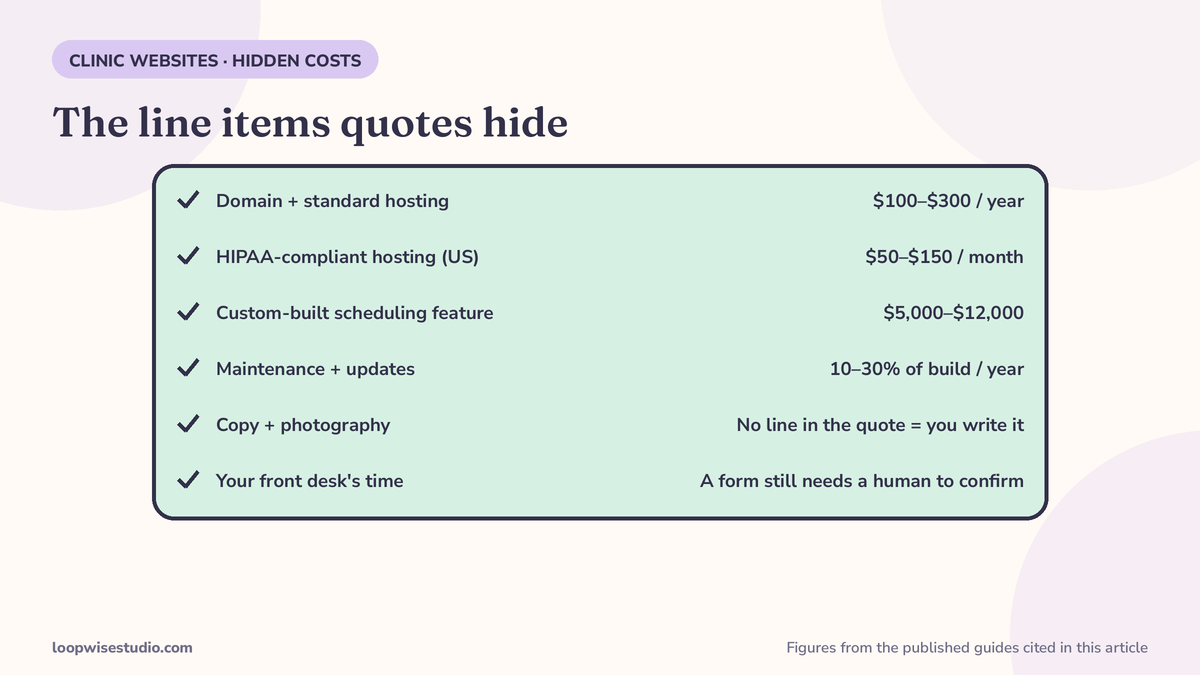
Whichever route you take, these are the costs that surface later. Every figure below is from the published guides above.
| Hidden or later cost | Market figure | Source |
|---|---|---|
| Domain and standard hosting | $100–$300/year | Dojo Business |
| HIPAA-compliant hosting (US clinics handling patient data) | $50–$150/month | Dojo Business |
| HIPAA compliance work on a web project | Adds 15–25% to the build | SolGuruz |
| Telemedicine or patient-education features | Add $2,000–$5,000 | Dojo Business |
| Custom-built scheduling feature (instead of rented software) | $5,000–$12,000 | SolGuruz |
| Maintenance and updates | Budget 10–30% of the build cost per year | Prateeksha (general rule of thumb) |
| Booking software | $100–$300/month (healthcare) | Dojo Business |
Three more that rarely carry a price tag but always carry a cost:
Copy and photography. Treatment pages written by the clinic owner at midnight read like it. The Canadian guide breaks a website budget into parts — discovery 5–10%, design 20–30%, build 20–25%, content and SEO 5–10%, launch 5–10% — which is a useful check: if a quote has no content line at all, you have just been volunteered to write your own website.
Local SEO setup. Your Google Business Profile, treatment pages structured around what patients actually search, and review flow are not decoration. They are where bookings come from. For clinics outside the US, this is also where the messaging layer matters: a WhatsApp booking system for aesthetic clinics in Dubai, for example, does work that a booking form never will, because Dubai patients already live on WhatsApp.
Your front desk’s time. A website with a form still needs a human to confirm every request. A live system with reminders removes most of that. When you compare a cheap quote with an expensive one, price the staff hours the cheap one leaves behind.
The automation layer nobody quotes
Here is the strangest gap in every pricing guide we read: they price the website and the calendar, and stop. None of them prices the follow-up — the part that decides whether the booking actually turns into a patient in the chair.
A modern clinic booking setup includes four automated pieces:
- Confirmation and reminders. Sent at booking, again 24 hours before, and a short nudge on the day, each with a one-tap way to reschedule instead of silently not showing up.
- Missed-call and missed-message follow-up. When the phone rings during a treatment and nobody can answer, the caller gets an instant text or WhatsApp message with the booking link — the system we describe in our guide to missed call text back for med spas. For a clinic, this is routinely the difference between a full diary and a quiet one, because the caller who cannot reach you calls the next clinic on Google.
- Review requests. An automatic, polite request sent after the appointment, while the experience is fresh. Reviews are the fuel of local search; asking for them by hand happens for a week and then stops.
- Rebooking nudges. A message to past patients when they are due again — Botox cycles, hygiene recalls, laser courses — sent to people who already trust you.
None of this is exotic technology. It is usually configuration inside tools you are already paying for, or a modest addition on top. But because no pricing guide itemises it, owners do not ask for it, vendors do not include it, and clinics end up paying $200 a month for a calendar while doing the follow-up manually. When you get a quote, ask directly: which of these four are included, and what do the ones that are not included cost?
Midway check: if you already have quotes in hand and they do not line up against the ranges in this article, get a free audit and we will compare them for you against these market ranges and tell you which product each quote is actually selling. That conversation costs nothing and it has saved more than one clinic from buying a portal it did not need.
One-time build or monthly plan: which suits a clinic?
Both models are legitimate; they suit different clinics.
A one-time build ($3,000–$8,000 for a professional small-clinic site, per the guides) means you own the asset outright. You then carry hosting, maintenance and software yourself — realistically a few hundred dollars a month and a small amount of attention. This suits an established clinic with someone on staff who can own the website, and it is usually cheaper across three years.
A monthly plan (EtherealMinds puts agency plans at ~$150 to $1,200 a month, and Dojo’s ongoing figure for a combined setup is $200 to $600) spreads the cost, bundles the care, and means updates and fixes are someone else’s problem. This suits a clinic that would rather pay a predictable number than manage vendors. Across three years it can cost more in total — you are paying for the service and the risk transfer, which for a busy clinic is often a fair trade.
What to avoid is the worst of both: a large one-time bill and a large monthly bill, where the monthly bill is mostly rent on your own website. Ask any monthly-plan provider two questions: if I stop paying, what happens to my site and my domain? And is my domain registered in my name? The answers tell you whether you are buying a service or renting your own shopfront back.
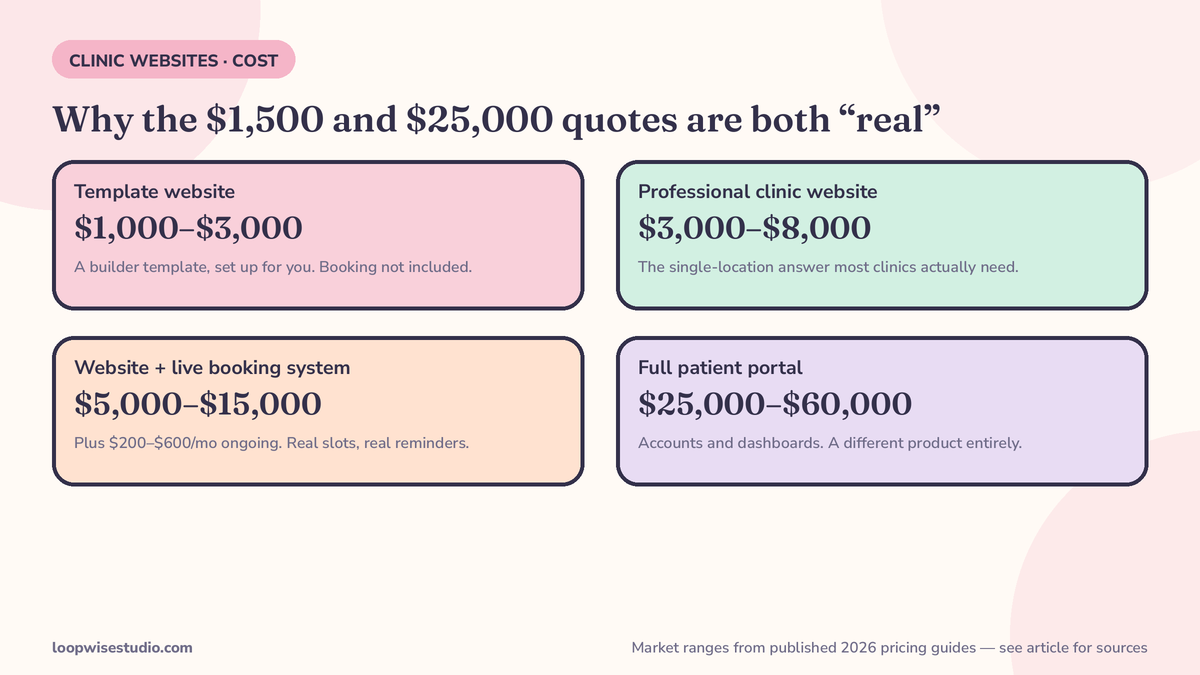
Why the $1,500 quote and the $25,000 quote are both “real”
EtherealMinds opens its guide with the same experience you have probably had: clinics asking around receive wildly different numbers for what sounds like one thing. Both extremes are real prices — for different products.
The $1,500 quote is a template site with your logo dropped in, stock text lightly edited, and a contact form labelled as booking. It will look acceptable on a laptop and underwhelming on the phone where your patients actually are. EtherealMinds makes the deeper point well: a cheap site that does not convert is the expensive option. Their guide cites a 2025 First Page Sage patient conversion report finding that most healthcare websites convert fewer than 3% of visitors into an appointment enquiry, while the best-built sites reach 21%. You do not need to accept those exact figures to accept the direction: on the same traffic, the gap between a weak site and a strong one is several times the bookings.
The $25,000 quote, in SolGuruz’s framing, buys software development: patient accounts, a booking portal, compliance architecture, integrations. For a multi-location group, that may be correct and necessary. For a single-location clinic that needs treatment pages and a diary that fills itself, it is a category error.
Your product is the one in the middle that neither extreme is selling: a professional website ($3,000–$8,000 band), a live booking system ($100–$300 a month, or bundled into a $5,000–$15,000 combined setup), and the automation layer configured on top.
What should be inside a fixed price: the checklist
Take this list to any vendor — including us — and make them answer it line by line. It is how you compare quotes apples to apples.
- Treatment or service pages for everything you want booked, written for you, not left as homework
- A live booking system (real availability, instant confirmation), not a request form wearing a booking costume
- Deposits or card-hold setup for longer or high-value appointments, if your clinic wants no-show protection
- Reminder sequence configured: at booking, 24 hours before, day-of, with rescheduling built in
- Missed-call or missed-message follow-up configured
- Review request automation after appointments
- Google Business Profile connected: booking link, services, photos, opening hours checked
- Domain registered in your name, website files and content owned by you
- Consent and intake forms appropriate to your treatments and your country’s rules
- Launch timeline in writing (a basic clinic build runs 4–8 weeks in SolGuruz’s framing; a focused booking site should be faster, and the vendor should say so)
- What ongoing costs remain after launch, itemised — hosting, software, care — with the monthly total stated
A vendor who answers all eleven happily is probably safe. A vendor who goes vague on ownership, ongoing costs or which kind of “booking” you are getting has answered the only question that matters.
A note on our own pricing
Loopwise Studio builds this exact bundle — website, live booking, reminders, missed-call and message follow-up, review requests — for clinics, med spas and salons. We are not going to print a price in an article about market pricing, for the same reason this article gives ranges instead of a single number: the honest figure depends on your clinic’s size, your current setup and how much of the stack you already have. Our prices are fixed once set — you get one number, in writing, before any work starts — and they are set after a short discovery call where we look at your actual clinic, not from a rate card. They sit against the market ranges in this article, and we are happy to have them compared line by line with any other quote you hold.
Frequently asked questions
How much is booking software on its own?
For healthcare, Dojo Business’s 2026 guide puts standalone online booking systems at $100 to $300 a month, covering confirmations, reminders and, in some cases, integration with practice systems. At the small-clinic end in the UK, MERIDIQ puts booking systems at £0 to £50 a month, with its own specialist system starting from £4 per user per month. Watch the “free” end carefully: free plans often make their money from marketplace commission, per-message charges, or locked features like deposits and intake forms that clinics actually need.
How much should a single-location clinic expect to pay in total?
Using the published ranges: a professional website in the $3,000 to $8,000 band, or a combined website-and-booking setup at $5,000 to $15,000, plus ongoing costs of roughly $200 to $600 a month for the combined model per Dojo Business. A worked real-world example from Prateeksha priced a six-page physiotherapy clinic site with booking links at $4,500, plus $35 a month hosting and $100 a month maintenance. Solo clinics can legitimately come in below these bands — see our solo clinic breakdown linked earlier in this article. If the practice is physiotherapy, our physiotherapy website cost guide for Australia prices the same build with local figures.
Do I need HIPAA-compliant hosting and forms?
If you are a US clinic and your website collects or stores patient health information — detailed intake forms, medical histories, records — then yes, and it costs money: Dojo Business puts HIPAA-compliant hosting at $50 to $150 a month, and SolGuruz estimates compliance work adds 15 to 25% to a web project. A simple booking flow that collects a name, a phone number and a treatment choice is a lighter burden. Get specific advice for your setup rather than either ignoring it or buying a $60,000 portal out of fear.
How long does a clinic website with booking take to build?
SolGuruz gives 4 to 8 weeks for a basic clinic website including a booking form, and 3 to 5 months for a full patient booking portal. A focused website-plus-booking build for one location should sit at the faster end of that — the timeline is mostly decided by how quickly treatment content, photos and diary rules come together, not by the technology. Any vendor quoting you six months for a single-location booking site is building you something bigger than you asked for. The salon version of the same build is covered in how long it takes to build a salon booking website, where the content bottleneck is a lookbook rather than treatment pages.
Is it cheaper to build the website myself?
In cash, yes, at first. A template route can start below $1,000 of your own spending, before booking software at $100 to $300 a month. The cost moves into your time: writing treatment pages, configuring reminders, connecting your Google profile, fixing the thing that breaks on a phone. Owners also give up the conversion difference — the First Page Sage figures cited by EtherealMinds suggest most healthcare sites convert under 3% of visitors into enquiries, against up to 21% for the best-built. If your clinic is new and quiet, DIY is a reasonable start. Once your diary has real value per hour, it usually is not.
What should ongoing monthly costs cover?
At minimum: hosting, security updates, backups, your booking software, and someone accountable when something breaks. EtherealMinds puts bundled agency care at roughly $150 to $1,200 a month; Dojo Business puts the ongoing cost of a combined website-and-booking setup at $200 to $600 a month. Whatever you pay, get the list in writing, and confirm the domain is registered in your name so you can leave without losing your web address.
Get a straight answer for your clinic
Ranges are useful; your clinic needs a number. Get a free audit, tell us what you have now — no website, a website with a form, a website with booking that nobody uses — and we will tell you which route fits, what it should cost against the market ranges in this article, and what we would charge to do it for you, as one fixed price. If the DIY or freelancer route is genuinely better for you at this stage, the audit will say that too.