WhatsApp Booking System for Aesthetic Clinics in Dubai
A done-for-you WhatsApp booking system for Dubai aesthetic clinics: confirmations, reminders and rebooking in English and Arabic, without an ERP project.
If you run an aesthetic clinic in Dubai, a WhatsApp booking system is a setup that turns your WhatsApp number into a proper front desk: a patient messages, gets offered real slots from your diary, books, gets a confirmation, gets reminded, and can reschedule in the chat — without your receptionist typing every message by hand. This page explains how that system works for a small aesthetic clinic, what messages it sends in English and Arabic, what it should and should not handle, and what it costs compared with the alternatives. No ERP project, no new app for patients, and no change to how your treatments run.
Most Dubai clinics already take bookings on WhatsApp. The problem is not the channel — it is that it lives in one person’s phone, in a messy inbox, next to a paper diary or a separate booking app. Enquiries that arrive at 10pm wait until morning. Some never get answered at all. A booking system fixes the system around WhatsApp, not WhatsApp itself.
What a WhatsApp booking system actually is (and what it is not)
A WhatsApp booking system has four parts working together:
- Your diary is the source of truth. Slots offered to patients come from your real availability — practitioners, rooms and treatment durations — not from a receptionist’s memory.
- The conversation runs on the WhatsApp Business Platform. That means approved message templates, automated confirmations and reminders, and a shared inbox your team can all see, instead of one phone passed around reception.
- Your website and Google profile feed it. Buttons on your site, your Google Business Profile and your Instagram profile send patients into the same flow, with the source tracked, so you can see which channel produced the booking.
- A human can step in at any point. The system handles logistics. The moment a conversation needs judgement — a worried patient, a complaint, a clinical question — it hands over to a named member of your team.
What it is not:
- Not the free WhatsApp Business app on its own. The app gives you a greeting and an away message. It cannot offer diary slots, send a timed reminder sequence, or let three receptionists work one number properly.
- Not clinic management software or an ERP. It does not replace your EMR, patient records, accounts or lab tracking. A multi-branch group needing branch-level accounts and package accounting across licences needs that bigger project — we say so honestly below.
- Not a chatbot that answers clinical questions. It never discusses suitability, results or dosage. More on that in the compliance section.
Most of what you will find for this search is either far bigger than you need (a full software stack) or far smaller (a cheap extension on a personal WhatsApp login). A 1–3 practitioner clinic usually needs neither — and if you are solo, this is the same kind of setup described in our guide to a website for a one-person aesthetic clinic that takes bookings itself: one diary, one number, built for a small clinic.
How it works: from first message to booked appointment
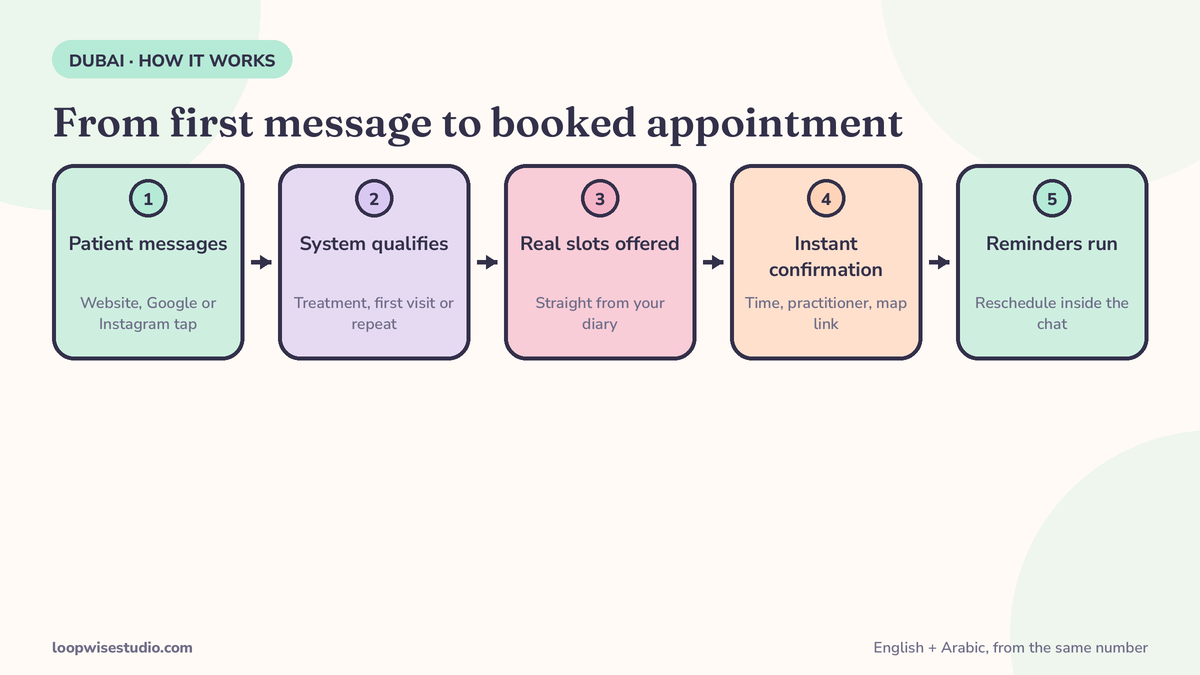
Here is the flow, step by step, exactly as a patient experiences it.
Step 1: The patient starts the conversation
The patient taps a WhatsApp button on your website, your Google profile or your Instagram bio, or simply messages the number they already have. They do not download anything and they do not create an account. The first automated reply arrives in seconds, in the language they wrote in, and acknowledges the specific thing they asked about — a treatment, a price question, a request for the next available slot.
That first reply matters more at night than at noon. An enquiry answered in seconds at 11pm is often booked before a competitor’s reception opens at 9am.
Step 2: The system qualifies the booking, briefly
The flow asks only what reception needs to book safely: which treatment, whether this is a first consultation or a repeat treatment, the preferred practitioner, and any prep requirement attached to that treatment — for example a patch test before laser. It does not take a medical history in chat. That belongs in your consultation and your clinic records. The system collects booking logistics, then stops.
Step 3: Real slots are offered and the patient picks one
The patient is offered available times from your diary, not a “we will get back to you”. They tap a slot. If a treatment needs a deposit to protect a long appointment, the deposit request goes out at this point, before the slot is confirmed, with the amount and the cancellation terms stated plainly.
Step 4: Confirmation goes out immediately
The patient receives a confirmation with the treatment, practitioner, date, time, location link and any prep instructions, and the appointment sits in your diary and the shared inbox. Nobody copies anything from a chat into a diary by hand — that copying step is where most manual WhatsApp setups lose bookings.
Step 5: Reminders, rescheduling and follow-up run on their own
After booking, the reminder sequence takes over (full templates in the next section). A patient who replies to reschedule is offered new slots in the chat and the diary updates; a patient who does not show up gets a polite rebooking message the same day; after the visit, a review request goes out. That is the whole system — not complicated, which is exactly why it should be set up properly once, rather than held together by a good receptionist’s memory every day.
To see where your own enquiry flow leaks bookings, get a free audit — we map it and show you the leaks before you decide anything.
The messages that run on autopilot
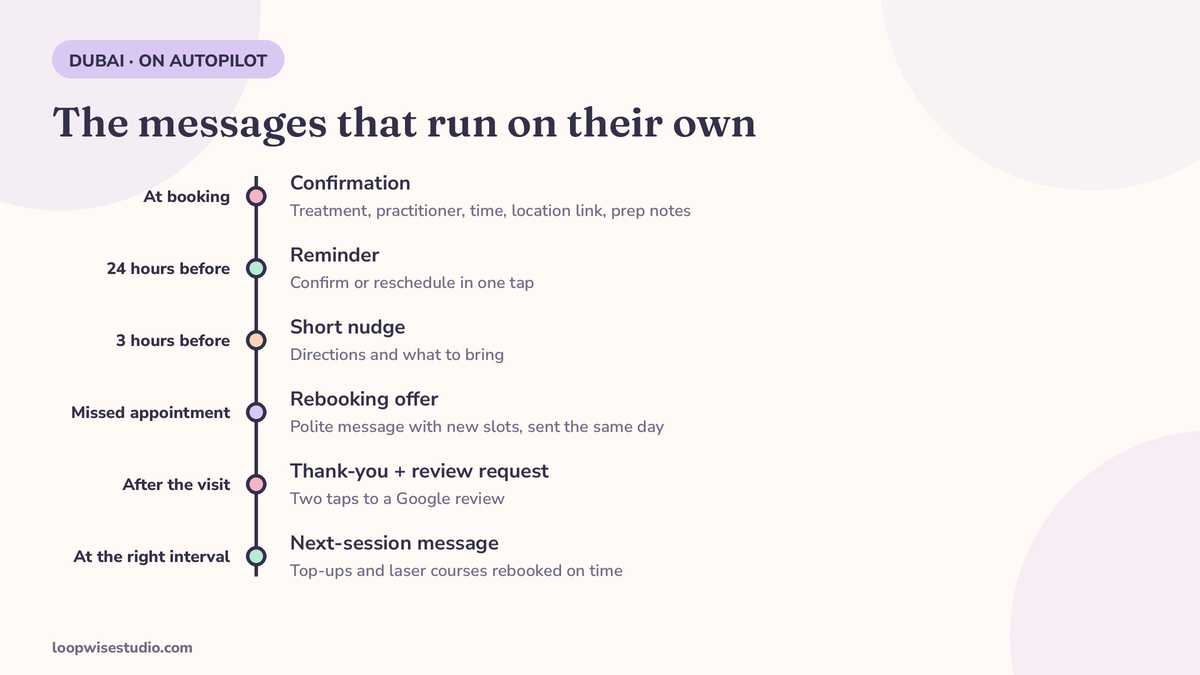
Below is the sequence we build for aesthetic clinics, with copy-ready examples in English and Arabic. Your clinic name, treatments and timings replace the brackets. The Arabic is not decoration: for a large share of Dubai patients it is the first language, and a reminder in the wrong language gets ignored like any other message.
| When | Message | Patient can |
|---|---|---|
| At booking | Confirmation with treatment, practitioner, time, location link and prep notes | Add to calendar, ask a question |
| 24 hours before | Reminder with Confirm / Reschedule buttons | Confirm in one tap, or pick a new slot |
| 3 hours before | Short nudge with directions and what to bring | Open the location link |
| After a missed appointment | Polite message offering new slots the same day | Rebook without calling |
| After the visit | Thank-you, aftercare link if you approved one, and a Google review request | Leave a review in two taps |
| At the right interval after treatment | Top-up or next-session rebooking message for Botox, filler and laser courses | Book the next session |
The timing — 24 hours and then 3 hours — follows the same logic set out in our guide to WhatsApp appointment reminders for clinics in the UK: one reminder early enough to free the slot if plans change, and one close enough to the appointment to catch the patient before they commit to something else. The markets differ, the human behaviour does not.
Booking confirmation
English:
Hi [Name], your [Treatment] appointment at [Clinic] is confirmed for [Day] at [Time] with [Practitioner]. Here is our location: [Map link]. Please arrive 10 minutes early. Reply R if you need to reschedule.
Arabic:
مرحباً [Name]، تم تأكيد موعد [Treatment] في [Clinic] يوم [Day] الساعة [Time] مع [Practitioner]. هذا هو موقعنا: [رابط الخريطة]. يرجى الحضور قبل الموعد بعشر دقائق. رد بحرف R إذا كنت بحاجة إلى إعادة الجدولة.
24-hour reminder
English:
Hi [Name], a reminder of your [Treatment] appointment tomorrow at [Time]. Tap Confirm if we will see you, or Reschedule to pick another time — no need to call.
Arabic:
مرحباً [Name]، نذكّرك بموعد [Treatment] غداً الساعة [Time]. اضغط «تأكيد» إذا كنت قادماً، أو «إعادة جدولة» لاختيار وقت آخر — لا حاجة للاتصال.
After a missed appointment
English:
Hi [Name], we missed you today for your [Treatment] appointment. Things come up — would you like to rebook? Here are the next available times: [Slots]. Tap one and we will confirm it here.
Arabic:
مرحباً [Name]، افتقدناك اليوم في موعد [Treatment]. نعلم أن الظروف تتغير — هل ترغب في حجز موعد جديد؟ هذه هي الأوقات المتاحة التالية: [الأوقات]. اختر وقتاً وسنؤكده هنا.
The same pattern covers the review request after the visit — a thank-you, one line, and your Google review link, in whichever language the patient used.
Two rules govern every template. Confirm and reschedule must be buttons or one-letter replies, never “please call us to change your appointment” — a patient who has to phone to reschedule often simply does not show up instead. And no clinical detail goes in the message: results, diagnoses and personal health information never belong in a template.
Built for aesthetic treatments, not generic appointments
A haircut and a filler appointment are not the same booking, but generic tools treat them as if they were. An aesthetic clinic’s system needs to handle at least four things a generic calendar does not.
Consultation first. Many treatments should not be bookable as a full appointment by a brand-new patient. The flow routes first-time patients to a consultation, and offers full treatment slots to returning patients or to new patients once a consultation is booked — protecting practitioners from unsuitable bookings and patients from booking the wrong thing.
Deposits for long slots. A two-hour slot left empty by a no-show is not a small loss. The system can take a deposit at booking for the treatments and slot lengths you choose, state the cancellation window in the confirmation, and release or keep it according to your own policy. The point is not to punish patients; it is to make a booked slot feel like a commitment, in writing, before the day.
Prep and patch tests. Laser needs a patch test first for many patients. Some treatments need the patient to stop certain products beforehand, or arrive with clean skin. Those instructions belong in the confirmation and the 24-hour reminder, automatically, attached to the specific treatment booked — not in a receptionist’s memory or a note on a paper diary.
Packages and top-up cycles. This is where clinics quietly lose the most repeat revenue. A patient buys a course of laser sessions, or has filler that will need a top-up in three to four months, and nothing prompts them to return. A booking system can count sessions and send a rebooking message at the interval you set for each treatment. The case for it is old and strong: work by Bain & Company, cited widely in clinic marketing, found that increasing customer retention by just 5% can increase profits by 25%–95%. And new patients are not cheap to replace: Clickworkzz, a Dubai clinic marketing firm, cites WordStream’s 2024 Healthcare Advertising Benchmarks putting the average cost per lead for healthcare ads on Google at $70–$90 (roughly AED 250–330). Every past patient you reactivate through your own WhatsApp list is a booking you did not have to buy at that price again.
Arabic and English from the same number
Patients should not need to know which number is the “Arabic number” and which is the “English number”. One number, one inbox, and the conversation continues in the language the patient started in. If they switch languages mid-conversation — very common in Dubai — a human can continue, because the whole history is in one shared place. Behind the scenes, conversations are routed to the right receptionist and given a named owner, so nobody is answered twice.
Two Dubai situations are worth planning for. Visitor and self-pay patients — tourists booking one treatment during a trip — need directions, timing clarity and a deposit option for high-value slots, handled gracefully from a number your clinic has never seen. Seasonal demand means enquiry spikes; an automated first reply stops a busy season becoming a pile of unanswered messages. Russian and Hindi templates can be added later. Do English and Arabic properly first.
Where enquiries come from: website, Google and Instagram into one flow
WhatsApp does not work on its own. Patients find you first, then they message you. In practice that means three doors into the same booking flow:
Your website. Every treatment page should carry a WhatsApp booking button and a booking page showing real availability. A website that ends with “call us” wastes the patients who found you at night. The cost side is covered in our breakdown of how much a website with online booking costs for a clinic — the site and the booking flow are one purchase, not two.
Your Google Business Profile. This is where local patients compare you with the clinic two streets away. The same Dubai research cited above draws on BrightLocal’s Local Consumer Review Survey 2024, which found that 98% of consumers read online reviews for local businesses and 87% use Google Maps to evaluate a local business. Your profile does the persuading; its message and booking actions should land the patient in the same WhatsApp flow as your website, so nothing is handled twice.
Instagram. For aesthetic clinics, Instagram is often the real shop window. The link in your bio should hand the patient into WhatsApp with the context of what they were looking at, so reception is not starting from “hi, how can I help?” with someone who just watched a specific treatment video.
When all three doors feed one inbox with source tracking, you can finally answer a question most clinics guess at: which channel produces booked appointments, and which produces conversations that go nowhere. If you run a clinic in Ireland rather than Dubai, the same WhatsApp-first model is set out in our guide to WhatsApp booking for clinics in Ireland.
Missed the call? The enquiry that never reaches WhatsApp
Not every enquiry starts as a message. Plenty of patients still phone — and when the clinic is in treatment, at lunch or closed, that call goes to voicemail, and most callers do not leave a message. They call the next clinic.
A complete setup closes this gap: when a call is missed, the caller automatically receives a WhatsApp message within seconds — sorry we missed you, here is how to book, here are the next available slots — and lands in the same flow as everyone else. This is the mechanism our whole agency is built around, and if your phone goes unanswered during treatments, it is often worth more than any other part of the system.
What stays out of the chat: a short, honest compliance section
Dubai clinics work under the Dubai Health Authority, and health data in the UAE is governed by Federal Law No. (2) of 2019 on the use of ICT in health fields. You do not need a lecture on it here. You need three working rules, which we build into every system:
- Chat is for logistics, your clinic system is for clinical records. Bookings, timings, directions, deposits and reminders live happily in WhatsApp. Assessments, treatment decisions, medical histories and clinical photographs belong in your clinic’s own governed systems, under your DHA-licensed arrangements — not in a chat thread.
- Consent must be specific. The DHA’s Health Data and Information Sharing Policy states that consent should be “specific, clear, and unambiguous”. For messaging, that means a patient who agreed to appointment reminders has not automatically agreed to marketing broadcasts. The system keeps those permissions separate, records the opt-in, and stops messaging anyone who opts out.
- Templates are approved, access is limited. Automated messages use templates approved through the WhatsApp Business Platform, and only staff who need the inbox have access, each with their own login. Patient conversations are not sitting on a personal phone that leaves with a departing employee.
Follow those three and WhatsApp booking is a normal, defensible part of a Dubai clinic’s operations. Ignore them — as some cheap tools do, running on personal accounts with no template approval and no consent record — and you carry a risk that is not worth the saving.
WhatsApp Business app vs a booking system vs a full clinic ERP
Owners often compare three very different things as if they were one decision. They are not.
| WhatsApp Business app (free) | A WhatsApp booking system (done for you) | Full clinic ERP / management software | |
|---|---|---|---|
| Best for | A solo practitioner answering a handful of messages a day | 1–3 practitioner aesthetic clinics that take bookings every day | Multi-branch groups needing accounts, labs and package accounting in one stack |
| Booking | Manual — receptionist agrees a time in chat | Patient picks a real slot from your diary, in chat | Part of a wider patient record system |
| Reminders | Greeting and away messages only | Full automated sequence: confirmation, 24h, 3h, rebook, review | Usually included, as one module among many |
| Languages | Whatever the receptionist types | English and Arabic templates from one number, routed to the right staff | Multilingual options, as part of a larger implementation |
| Team access | One device, one number | Shared inbox, named owners, handover to a human | Role-based access across branches |
| Cost shape | Free, plus your receptionist’s time | Fixed setup, then a running cost for the platform and messages | Implementation project — one consultancy on this search, Shyphan, quotes a 2–6 week timeline with software licences billed separately |
| Your effort | Everything, every day | Setup decisions once, then the system runs | Branch visits, data migration, staff training across sites |
The honest version: if you are a group with several branches and a finance team, the ERP column may be right for you. If you are a single clinic whose problem is “enquiries and bookings are chaos and patients do not show up”, the middle column is built for your problem, at a fraction of the project size. And some clinics do not need to change their diary software at all — the WhatsApp layer can sit on top of a system you like, which is the thinking behind our comparison for clinics weighing a Fresha alternative that adds WhatsApp booking instead of migrating everything at once.
What it costs and how long it takes
We will not invent a price list here — be wary of anyone who prices a clinic system without seeing your diary, treatments and enquiry volume. What we can lay out is the honest cost shape of each option, so you can compare like with like:
- Do nothing / stay manual: no software cost, and a hidden cost you already pay — receptionist hours spent typing reminders, and bookings lost after hours and during treatments. That second cost never appears on an invoice, which is why it survives.
- Hire another receptionist: covers more hours, still cannot reply in seconds at 11pm, still types reminders by hand, and adds a full salary plus visa and employment costs every month, forever.
- A DIY tool or extension: the cheapest headline price on this search is an AED 300 Chrome extension for salons. It runs on a personal WhatsApp Web session, with no official platform templates, no consent record and no clinic features. The price is real; the comparison is not.
- A done-for-you booking system: a fixed setup cost agreed in advance — flow, templates in both languages, diary connection, staff handover — then a running cost of WhatsApp platform/message charges plus our management, quoted plainly before you commit. One fixed quote, known before work starts.
- A full ERP implementation: the most expensive route, priced as a project over several weeks with licences on top, justified only when you need the wider management stack.
Timeline. A single-clinic system is a matter of weeks, not months, and most of that time is decisions and approvals rather than building: your treatment list and durations, deposit rules, cancellation wording, template approval. Once it is live, judge it on booked appointments, not message volume — enquiries received, bookings made, no-shows and rebookings. A system that sends thousands of messages and books few appointments is a broadcast tool, not a booking system.
Frequently asked questions
Can we keep our existing WhatsApp number?
In almost every case, yes. Your number is on your Google profile, your signage and your patients’ phones. The system is built around it, moved onto the WhatsApp Business Platform properly, rather than asking patients to message a new one.
Do patients need to download an app or create an account?
No. The patient experience is an ordinary WhatsApp conversation — no app, no login, no password. That is the entire reason this works in Dubai: patients are already on WhatsApp, so there is no step where they give up.
How do deposits work for long treatments?
You choose which treatments and slot lengths need a deposit. The request goes out in the booking flow before the slot is confirmed, with the amount and your cancellation terms in the message. If the patient does not pay within the window you set, the slot is released rather than held all day.
What if a patient asks a clinical question in the chat?
The system does not answer it. It acknowledges the message and hands the conversation to a named member of your team. Automated messages cover logistics only.
We already use Fresha or another booking system. Do we have to switch?
Not necessarily. In many clinics the right move is to keep the diary that works and add the WhatsApp booking and reminder layer on top of it. In others — where marketplace commission or a booking page you do not control is the real problem — moving makes more sense. That decision is exactly what the audit works through with you, and “keep what you have” is a legitimate answer.
Can it handle a second branch later?
Yes. The flow is built per location — diary, practitioners, location link and templates — so a second branch is a second diary on the same system, not a new project. What we would advise against is buying multi-branch ERP software today for a branch you have not opened yet.
Get the bookings your enquiries should already be producing
Your clinic is probably not short of enquiries. The demand is already arriving — it is leaking in the gaps: the unanswered evening message, the reminder nobody sent, the past patient nobody rebooked. That is fixable, without an ERP project or a new app for your patients. To get started, get a free audit — we will map your current enquiry flow (website, Google profile, Instagram, phone and WhatsApp), show you exactly where bookings are being lost, and tell you honestly if your current setup is already fine.