Check the inputs first
A result is only as honest as the numbers you put in — especially any rate you estimated. Pull the call count from your phone log, not from memory.

Free clinic tool · No email needed
Missed-call cost calculator for clinics answers a question clinic owners ask in plain language: calls that ring out never appear on the diary, so owners think the loss is zero. In reality the patient has usually already called the next clinic. Use your own numbers below — no email, no signup, nothing is sent anywhere. The result runs in your browser.

The call that rings out never reaches the diary. The cost does not disappear with it.
The calculator
Use a month you can actually count. The same rule every month is what makes the number useful.
Reading the number
The total is a starting point, not a verdict. Three checks turn it into something you can act on.
The number is only as useful as the call log behind it. Keep the assumptions visible and the result stays checkable.
A result is only as honest as the numbers you put in — especially any rate you estimated. Pull the call count from your phone log, not from memory.
The calculation shows where the loss actually sits: the calls you missed, the share that were new patients, and the share who would have booked.
Change one input, note the new result, and you have a plan you can defend to a partner or a manager. Changing everything at once hides what moved the number.
A useful sanity check
If the yearly figure looks too large to believe, cut the would-book share in half and run it again. If the case for fixing the phones still holds, the exact percentage is not doing the persuading — the leak is.
The maths
Every line below is visible in the result panel. Nothing is hidden inside a single impressive number.
Formula 1 · Missed calls
Missed calls = calls per month × missed-call rate
The rate is the share of calls that did not reach a person who could book: unanswered, abandoned on hold, or sent to voicemail with no booking made.
Formula 2 · Lost new patients
Lost new patients = missed calls × new-patient share × would-book share
Not every missed call is a new patient, and not every new patient would have booked. Both shares are yours to set, and both are shown in the calculation.
Formula 3 · Revenue lost
Monthly loss = lost new patients × average revenue per visit
Yearly loss = monthly loss × 12. Money is rounded to whole units in the headline; the exact calculation stays underneath.
Worked example
Round numbers, an example only — not a real clinic's data.
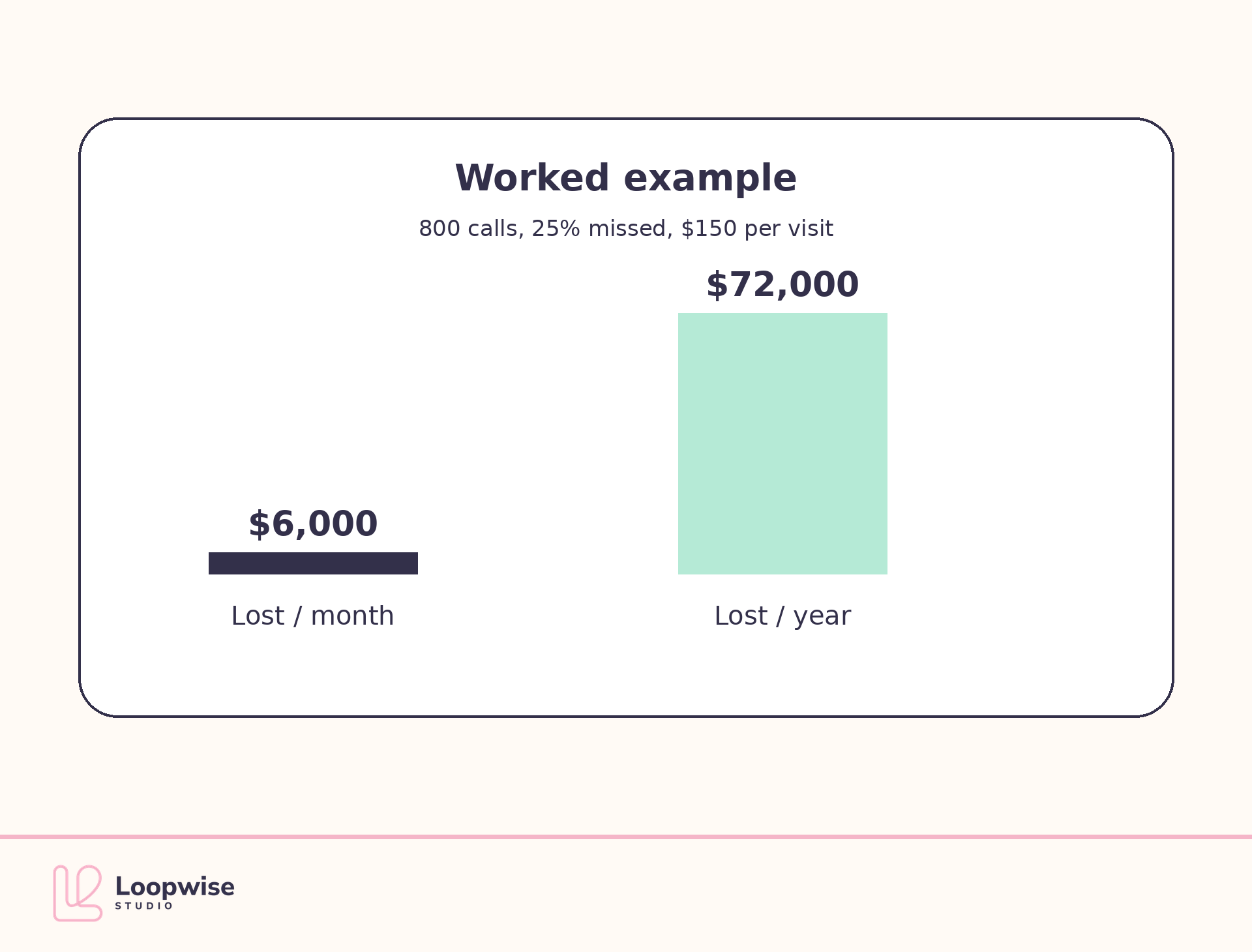
Change any input and the result changes — this example is arithmetic, not a prediction for your clinic.
Context
Published figures are context, not a target for your clinic. The calculator uses your own miss rate first.
20–23%
everyday miss rate
Published analyses of medical practices put a realistic everyday miss rate in this range.
42%
unanswered
A 7,000-call analysis across 22 practices found this share of calls unanswered.
62%
hang up at voicemail
Of callers who reach voicemail, most do not leave a message.
67%
call a competitor
Most of those callers try another provider instead of waiting for a callback.
Analyses of medical practices put a realistic everyday miss rate at roughly 20–23%, with a 7,000-call analysis across 22 practices finding 42% unanswered. Of callers who reach voicemail, 62% hang up and 67% call a competing provider instead. MGMA benchmarks put average revenue per outpatient encounter at about $150 for primary care and $233 for a specialty visit.
Note on the evidence
Ranges, not a single rate. The tool uses the owner's own miss rate first; the benchmarks are context only.
From number to next move
Three steps, in order. None of them require a new tool or a new hire on day one.
Run the tool with last month's real numbers, not a guess.
Pick the single biggest number in the breakdown and fix that first.
Re-run it after one month with the new numbers. If the number did not move, the fix did not work — change the fix, not the tool.
Questions
Plain answers, including the ones this calculator deliberately refuses to invent.
Any call that did not reach a person who could book: unanswered, abandoned on hold, or sent to voicemail with no booking made. If the caller later booked, it was not lost — count it as recovered, not missed.
Use the visit value first. Lifetime value is larger but depends on how often that patient returns, which you cannot know from one call. The tool shows visit value so the result stays checkable.
No. It sizes the leak. Whether fixing it pays depends on what the fix costs and how many of those callers you actually recover — both are your numbers to test, not a promise on this page.
From cost to fix
The demo is a working booking flow, not a slide deck. Book as a patient, then flip to the owner view and watch the confirmation, reminder and waitlist steps happen without anyone making a call.
No prices are quoted on this page — final numbers come after a discovery conversation, as Loopwise always does.
Keep reading
The booking demo, the out-of-hours version of this leak, the no-show side of it, and the full missed-call formula.
Book as a patient, then flip to the owner view and watch the confirmation, reminder and review request run automatically.
The other half of the leak: appointments that were booked and never attended, with the same browser-only approach.
The full formula, the source behind the big numbers, and how to count your own calls for a week.
The same leak outside opening hours, with the daytime figure kept separate so the two are never added together.
What to send when a call goes unanswered, and why a message is not the same as a recovered booking.
606 med spas checked website by website. Most have online booking; very few have an instant way to respond.