Website for a One Person Aesthetic Clinic That Books
A website for a one person aesthetic clinic that takes bookings: the 5 pages you need, the automation that replaces a front desk, and what you can skip.
A website for a one person aesthetic clinic that takes bookings needs to do a job no team clinic’s website has to do: it has to be your receptionist. You are the practitioner, the front desk and the marketing department in one body, and for most of your working day your hands are quite literally on a client. So your site needs five pages, a live booking system connected to your real diary, deposits that protect a diary of one, and automation that answers, reminds and asks for reviews while you treat. It does not need most of what software companies will try to sell you. This article goes through what you actually need, what a working day looks like when the site does its job, what it costs at solo scale, and what to skip without a second thought.
Why solo is different — and why nobody writes for you
Search for help with a solo clinic website and you will find something odd: there are no guides. When this article was researched in October 2026, the search results for a one-person aesthetic clinic website were a software press release, product homepages, and a 12-tool software roundup. Google had product pages to show you because nobody had written the guide. You are a real and growing part of this market — the solo practitioner renting a room or running a small studio — and the entire industry responds by trying to rent you software built for teams.
The software roundups make the problem worse. PatientNow’s 2026 roundup of the best med spa software for solo practitioners runs to 12 tools, most of them full practice systems: electronic records, clinical tracking, payments, marketing suites. Their own honest observation sits at the top of the page: a solo practice breaks when its tools are disconnected. That is true. The conclusion they draw — buy a bigger, more connected system — is where we part company. You do not have an admin problem that a bigger system solves. You have a time problem: every task the system does not do automatically lands on the only employee, in the gaps between clients, usually at 9pm.
Here is the solo reality in one paragraph. A new client finds your before-and-after photos on Instagram at 10pm and messages you. You are asleep, or with family, or simply done for the day. By the time you reply at 8am, she has messaged two other clinics, and the one that replied first has her deposit. During the day it is worse: a message arrives mid-treatment, and you face a choice between being rude to the client on your couch or losing the one in your inbox. A team clinic solves this with a receptionist. You solve it with a website that books people without you in the loop.
The five pages your site needs
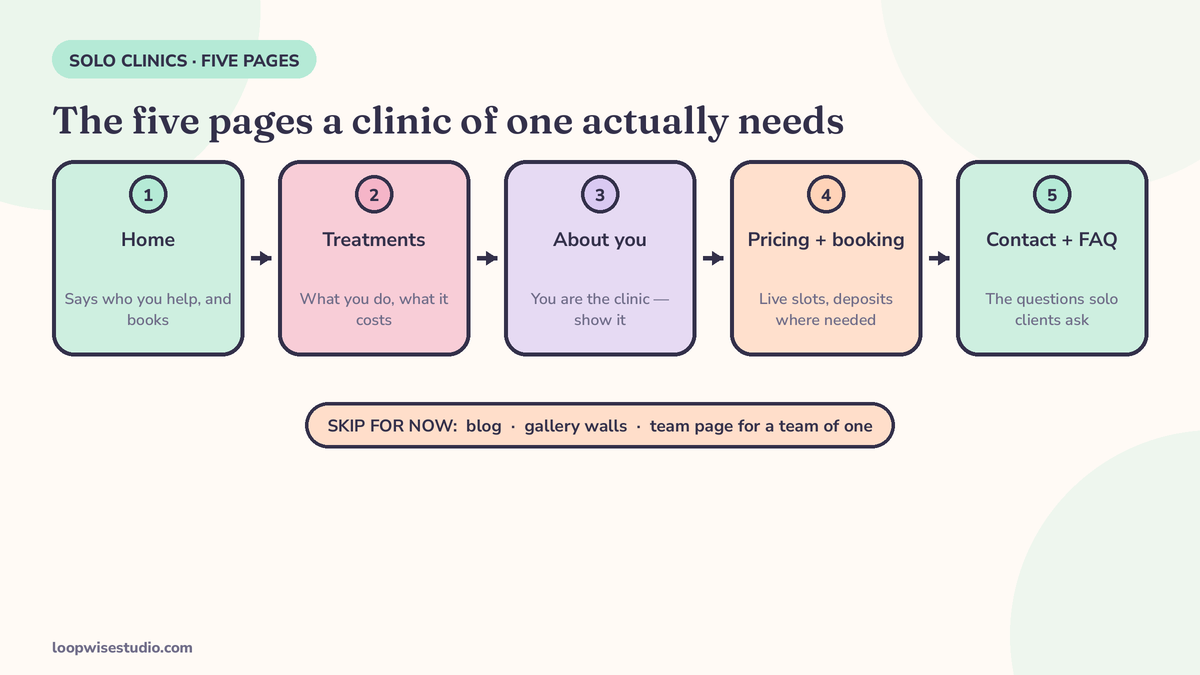
A solo clinic website is small on purpose. Five pages cover everything a client needs to trust you and book you. Everything beyond these five is either a later growth step or someone upselling you.
1. Home
Your home page has one job: reassure a nervous stranger in about ten seconds and point her at booking. What that takes: your name and face, the treatments you are known for, your location (including “find me inside…” directions if you rent a room within another business — your clients get lost, so say it plainly), a few real reviews, and a booking button that is always visible. Not a slideshow. Not a mission statement about your philosophy of beauty. A person, a place, proof, and a button.
2. Treatments
One page, or one clear section per treatment if you offer several, for each treatment you want booked: what it is, who it suits, who it does not, how long it takes, what it costs, and what happens afterwards. Price transparency matters more for you than for a chain. A solo client’s biggest fear is an awkward consultation where the price turns out to be double her budget, with you standing there and no graceful exit. Publishing prices removes that fear and removes the “how much is…?” messages that fill your evenings. Every treatment listing ends with its own booking button, for that treatment, at its real duration.
3. About you
A team clinic has a “meet the team” page. You have something stronger: a page about one named, qualified person. Your training, your certifications, how long you have practised, why you went solo, and a photo that actually looks like you. Clients booking an injectable treatment are choosing a person, not a brand, and solo is an advantage here that chains cannot copy. Chains have to build trust in a logo. Yours is your name on the door.
4. Pricing and booking
This is the working page: your live diary. A client picks a treatment, sees your real available slots, picks one, leaves her details, and — for treatments where it makes sense — pays a deposit there and then. She gets a confirmation immediately, without you touching your phone. If your booking page requires her to “request” an appointment and wait for your reply, it is not a booking page; it is a contact form with better styling, and it will lose you the 10pm clients every time.
5. Contact and FAQ
The practical page: where you are, where to park, how to find the room, your cancellation policy in plain words, and the questions every client asks — does it hurt, how long does it last, what should I avoid before and after, can I wear makeup afterwards. Answering these on the site is not just helpful; it is how your clinic shows up when someone nearby searches those questions, and it takes whole categories of messages off your phone.
The pages you can skip
No blog on day one (write one when you have an hour a month, not before). No separate gallery site — your before-and-after photos belong on the treatment pages, next to the booking button, with the client’s consent given and recorded. No “our clinic” corporate pages written as if you employ fourteen people; clients can tell, and the mismatch costs trust. No shop, unless selling products is genuinely part of your income. And no app. Nobody needs your app. They need your booking page to load fast on their phone.
A day in your diary, with the website doing its job
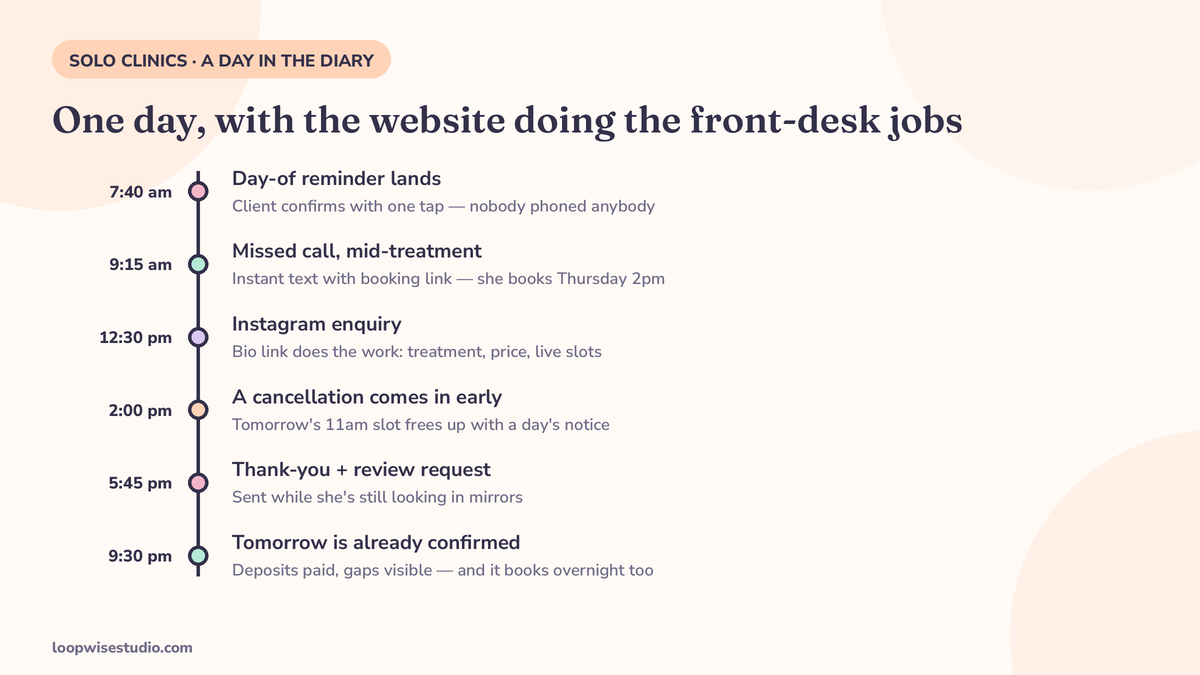
It helps to see the whole system as a day, because that is how you will feel the difference.
7:40am. A client who booked three weeks ago gets her day-of reminder automatically: time, address, the note about arriving with a clean face. She taps to confirm. You see the confirmation when you glance at your diary with coffee. Nobody phoned anybody.
9:15am. You are mid-treatment. Your phone, on silent, logs a missed call. The caller instantly gets a message: sorry I missed you, I am with a client, here is my booking link if you would like to grab a slot. She books Thursday at 2pm from that message. In the old world, she called the next clinic on Google while your phone was still ringing.
12:30pm. Between clients, an Instagram enquiry comes in about lip filler. Your bio link does the work your thumbs used to do: treatment page, price, live slots. For the messages that do need a human, our companion guide on how to reply to Instagram DM leads faster for a med spa covers the speed side — the principle is the same for a one-person clinic, only more so, because there is no colleague to catch what you miss.
2:00pm. A cancellation lands for tomorrow’s 11am — a good client, a genuine emergency. Because she cancelled through her reminder message instead of just not appearing, the slot is free with a day’s notice, and your rebooking message can offer it to the two clients who asked for earlier appointments this week.
5:45pm. Your last client leaves. An hour after her appointment, she gets a short thank-you and a link to leave a Google review, while she is still looking in mirrors. By the end of the month, that automatic request has done more for your local ranking than any amount of posting.
9:30pm. Tomorrow’s clients have all confirmed from their reminders. You can see the day laid out, deposits paid, gaps visible. You close the app. The clinic is shut; the website is not — it will take two more bookings overnight from people browsing Instagram in bed, which used to be the hours your competitors’ booking links took them instead.
That is the product, described honestly: not a prettier brochure, but a working front desk that never needs you to staff it.
If reading that day sounds like the clinic you are trying to run, get a free audit — we will look at how your bookings currently reach you and show you exactly which of those moments you are losing clients in now.
Booking that protects a diary of one
For a team clinic, a no-show wastes one chair out of several. For you, a no-show wastes the hour completely: there is no second practitioner whose diary absorbs it, and the client who would have paid for that hour was turned away yesterday. Two features matter more for a solo diary than for anyone else’s.
Deposits. Take a deposit, or a card hold, at booking for longer and higher-value treatments. The solo-focused platform AesthetiClinic, launched in the UK and Ireland in September 2026, leads its entire offer with card-protected deposits at £25 plus VAT per practitioner per month with 0% commission on patient payments, which go straight to the clinic’s own Stripe account. Whatever stack you use, copy that principle: money lands in your account, and the platform takes no cut of it. A deposit is not about the money. It is about the commitment: a client who has paid £30 towards her appointment behaves like someone with an appointment.
Buffers that respect one pair of hands. Your diary needs gaps a team diary does not: time to clean the room, write notes, eat, and run ten minutes late without the whole day sliding. Set treatment durations honestly, with changeover time built into the booking rules, so the website never promises a pace you cannot keep. The other solo-specific setting is a booking horizon: many solo practitioners open their diary four to six weeks ahead, which keeps regulars rebooking at the till and stops the diary filling with distant one-offs you cannot plan around.
And set a cancellation policy and let the system enforce it: free rescheduling up to 48 hours before, deposit kept inside that window, stated on the booking page and repeated in the reminder. You will never have to have the awkward conversation again, because the client agreed to it before she booked, and the message — not you — delivers the reminder of it.
The automation that replaces your front desk
Four automated flows do most of a receptionist’s booking work. None of them requires you to learn software; they require someone to set them up properly once.
- Confirmation and reminders. Instant confirmation at booking; a reminder 24 hours before with one-tap confirm or reschedule; a short day-of message with directions. This sequence is the single biggest reducer of no-shows at your scale, because most solo no-shows are not malice — they are forgetting, plus the friction of phoning to rearrange.
- Missed-call and missed-message follow-up. You will miss calls every day, forever, because you are treating. The follow-up has to be automatic: an instant message with your booking link, sent while the caller is still holding her phone. In Dubai and the UK, where your clients already live on WhatsApp, that message belongs on WhatsApp — the setup is the same one we describe for larger clinics in our guide to a WhatsApp booking system for aesthetic clinics in Dubai.
- Aftercare and review requests. After the appointment: aftercare instructions for her treatment, then the review request at the right moment. Aftercare messages make you look after clients the way big clinics with nursing teams do. Review requests build the Google profile that feeds everything else.
- Rebooking nudges. Your existing clients are due again on cycles you know well — toxin at three to four months, maintenance facials monthly, laser courses in blocks. An automatic nudge at the right interval, to people who already trust your hands, is the cheapest booking you will ever get. Clinics chase new clients while their own client list quietly drifts to whoever messages them first. Do not be that clinic.
From Instagram profile to booked appointment
Most solo aesthetic practitioners are found on Instagram and booked through chaos. The journey looks like this: a post or a friend’s story, a profile visit, a DM conversation spread over hours, a negotiation about times conducted by thumb between your clients, a slot agreed, no deposit, and — too often — a no-show, because a DM agreement feels less real than a booking.
The website changes the DM’s job. Your bio link goes to your treatment pages and live diary. Your replies shrink to a sentence and the link, because the page answers the price, duration and availability questions for you. Story highlights carry the same link under “Book”. The client books herself into a real slot and pays a real deposit, and your automation takes over from there. Instagram becomes what it is good at — showing your work to people who will love it — and stops being a booking system it is terrible at.
What it costs at solo scale
You do not need the multi-provider end of the clinic website market, and you should refuse to pay for it.
The published 2026 market ranges, covered in full in our guide to how much a website with online booking costs for a clinic, put a template-based clinic website at $1,000 to $3,000 (Dojo Business) or $1,500 to $4,000 (EtherealMinds Digital), and a professional small-clinic website at $3,000 to $8,000. As a solo operator you belong at the bottom of, or below, that professional band: five pages, one diary, one practitioner. Anyone quoting you multi-location money is quoting the wrong clinic.
Your realistic options, compared:
| Route | What it costs (published ranges) | What you give up |
|---|---|---|
| Rent solo-practitioner software only (e.g. AesthetiClinic, from £25 + VAT/mo, 0% commission on deposits, SMS at 7p + VAT per message) | ~£25/mo plus message costs | You still have no real website of your own — a booking page on their platform, found only if clients already know your name |
| Template site you build yourself + booking software ($100–$300/mo healthcare range per Dojo Business; £0–£50/mo small UK clinic range per MERIDIQ) | Lowest cash cost; several weekends of your time | You are the designer, copywriter, and IT support |
| Done-for-you small website + booking + automation, fixed price | Inside the $1,500–$8,000 template-to-professional bands above depending on scope; Loopwise sets its fixed price after a short discovery call — it is a quote for your clinic, not a number lifted from this article | A real one-off cost, higher than DIY cash |
One warning about the second row: general salon software’s pricing pattern applies to clinics too. Roundups of clinic tools note seat and add-on costs rising as you add users, SMS credits and premium modules — for you the danger is the starter tier that leaves out deposits, reminders in the channel your clients read, or your own domain, then charges for each. A custom domain is not a luxury extra. It is the difference between an asset you own and a page you rent.
Your launch checklist
Use this whether you build it yourself or hand it over. Tick them in order.
- Domain registered in your own name (your name or your clinic’s, short enough to say out loud)
- Home page: your face, your treatments, your location and room-finding directions, reviews, booking button always visible
- Treatment pages with honest prices, durations, who each treatment is not for, and a booking button on each
- About page built on your credentials and your photo — your name is the brand
- Live booking connected to your real diary, with buffers and a booking horizon set for one pair of hands
- Deposits or card hold switched on for longer and higher-value treatments, paid into your own account
- Cancellation policy written in plain words on the booking page
- Reminder sequence tested on your own phone: booking confirmation, 24-hour reminder, day-of message
- Missed-call follow-up message live, with your booking link
- Aftercare messages and a review request set to follow each appointment
- Google Business Profile claimed, with your booking link, treatments and photos added
- Instagram bio and highlights pointing at the booking page, not at your DMs
- Before-and-after photos only where you hold the client’s consent to publish them
What to skip — the oversell list
Software companies earn more when a clinic of one buys like a clinic of twenty. Here is what to decline, politely, every time.
An electronic medical records suite as your starting point. Your clinical notes need to be safe and compliant, and a notebook-grade system or the records tool you already use may serve you well. What you do not need is a $25,000 to $60,000 patient portal — that is SolGuruz’s published range for portals with accounts and dashboards — sold to you as “a website.” It is a different purchase, for a different stage.
A branded app. Clients will not download your clinic’s app to book a facial. The roundups list branded apps as premium features; for a solo clinic they are premium-priced shelfware.
Multi-location and multi-staff anything. Rosters, room management, payroll, team permissions: all real features, all for a business you are not yet. Pay for them when you hire, not in hope.
A marketplace as your main address. Marketplaces take their cut from your reputation — in salon software, the well-documented version of this is a 20% fee on a new client’s first booking. Discovery help is fine as a side channel. Your own site and Google profile are the main door. Build there.
An enterprise “all-in-one.” If the sales page leads with analytics dashboards, dynamic pricing engines and API access, it was not built for a woman with a treatment couch and a full Tuesday. Your system should disappear into your day, not become a second job administering it.
When you grow: the second practitioner problem
The fear underneath most solo buying decisions is: what if this works and I need to hire — do I start again? With the setup in this article, no.
A website you own grows by addition: a second practitioner gets a page, a calendar and their own treatment slots; booking rules add a second pair of hands; the same reminders, deposits and review requests keep running. Compare that with restarting inside bigger software tiers, where the roundups note pricing rising as users, message credits and modules are added — growth taxed at every step.
The reverse is also worth knowing: because your domain, your client list and your reviews were always yours, growth never means negotiating your own data back from a platform. Start small, own the foundations, and let the system scale by adding people to it — not by replacing it the first time it succeeds.
Frequently asked questions
Can I just use a booking link instead of a whole website?
You can start there, and many solo practitioners do: a good booking page linked from Instagram will take real bookings tonight. What it cannot do is be found. A booking link has no treatment pages for Google to rank, no place for your prices and credentials to build trust with a stranger, and no home for the reviews and directions that turn a searcher into a client. Think of the booking link as the till and the website as the shop. Start with the till if you must; plan for the shop.
Do I really need to take deposits? Won’t it scare clients off?
For short, low-value appointments, a deposit is optional. For anything over an hour or over your “that would hurt to lose” price, it is the difference between a protected diary and a hopeful one. In practice, deposits filter in the serious clients: someone happy to pay a small amount towards her treatment has decided she is coming. State the policy plainly at booking, apply it kindly with one free reschedule outside your cancellation window, and the clients you want will respect it — most will be relieved your time is treated as valuable.
What if I rent a room inside another clinic or salon?
Then your website matters more, not less. You cannot rely on the host business’s footfall, signage or Google listing — those carry their name, and their clients are not automatically yours. Your site and your Google Business Profile (set up as your own business, with your room clearly described and directions for finding it inside the building) are how your clients find you, book you, and follow you if you move rooms later. Owning your booking page is also what makes moving painless: the address changes, the link your clients use does not.
How much of my time will running this take each week?
Once it is set up properly: minutes, not hours. Your diary confirms and reminds without you. Missed calls answer themselves with a booking link. Reviews request themselves. Your weekly jobs shrink to checking tomorrow’s diary, glancing at any messages that genuinely need a human, and rebooking regulars at the till. The setup itself is a project — a focused small site with booking and automation is a matter of weeks, not months — but it is a project you do once, or hand to someone else entirely, instead of a nightly DM shift you do forever. The same build sequence applies to salon-style service menus, where salon booking website timelines break the phases down by week.
How quickly will I see bookings from the website?
The overnight bookings start as soon as your regular audience can reach a working booking page instead of your DMs — for most solo practitioners, existing followers and word-of-mouth clients convert first, in the first days. Bookings from Google search build more slowly, over the following months, as your treatment pages and reviews accumulate. Anyone promising you the first page of Google in a fortnight is selling you something. What you should expect quickly is the time back: the messages answered, reminders sent and slots filled while your hands were busy.
Built for a clinic of one — priced for one too
Your website should not cost what a chain pays, and it should not leave you doing a receptionist’s job at 9pm either. Get a free audit and we will look at how your bookings reach you now — DMs, calls, a marketplace, a booking link — and show you the smallest website that would take that work off your hands: five pages, live booking, deposits, reminders, review requests, all on a domain you own, for one fixed price agreed before we start. If a booking link and a rented room are genuinely all you need right now, we will tell you that in the audit, and you will have the checklist above to build from either way.