How Much Does a Physiotherapy Website Cost in Australia?
Australian physio website costs in AUD: from $999 starter builds to $8,500 agency starts, plus the booking layer and running costs quotes leave out.

A physiotherapy website in Australia typically costs $2,500–$8,500 for a professionally built clinic site. Published starts run from $999 for a small starter build (WebXpert) to $8,500 at general agencies (WebApex’s medical starting price), plus booking software and roughly $500–$2,000 a year in running costs.
All figures are AUD, from Australian sources, checked October 2026 — and that already puts this page ahead of most of what ranks for the question. The biggest “physio website cost” guide on the internet quotes a global $2,000–$10,000 and spends its compliance section on HIPAA and GDPR — American and European rules that mean nothing to a clinic in Brisbane. Australian physio sites answer to Ahpra, Medicare and Cliniko or Nookal. This article prices the Australian purchase: build, booking layer, and the first year of running it.
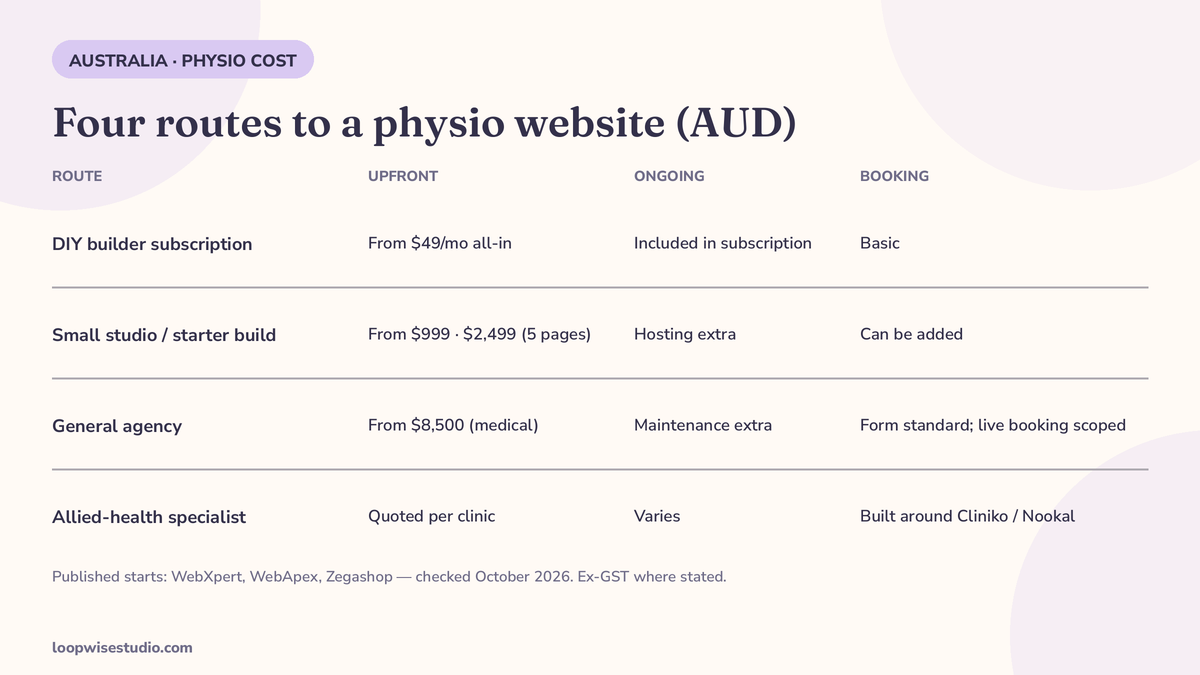
The four routes — and what each one costs
| Route | Upfront (AUD) | Monthly/ongoing | Booking included? | The catch |
|---|---|---|---|---|
| DIY builder subscription | From $49/mo all-in (Zegashop) | Included in the subscription | Basic | Your time; template look; limited physio-specific structure |
| Small studio / starter build | From $999 (1–4 pages); from $2,499 (5 pages) — WebXpert | Hosting extra | Can be added | Page count is tight; multi-location clinics outgrow it fast |
| General agency | From $8,500 for medical & dental (WebApex) | Maintenance extra | Enquiry form standard; live booking is scoped work | Physio is one line in a general price list — check allied-health experience |
| Allied-health specialist | Quoted per clinic (WebXpert quotes multi-page clinic sites after consultation) | Varies | Designed around Cliniko/Nookal | Premium for regulatory and systems knowledge |
WebApex’s published packages give the general-agency shape: One Page $2,500, Standard $6,500, Business $9,500, eCommerce $12,500 — with medical and dental clinics, physiotherapy explicitly included, starting at $8,500. WebXpert, an allied-health-focused studio, starts far lower for small builds — $999 for a typical 1–4 page site, $2,499 for five pages — and quotes larger clinic sites individually. Both are the studios’ own published prices, ex-GST where WebApex states it.
Where does your clinic land? Mostly on one number: how many pages you actually need. That maths is next, and it is where physio quotes surprise people.
Why physio sites cost what they do — the page-count maths
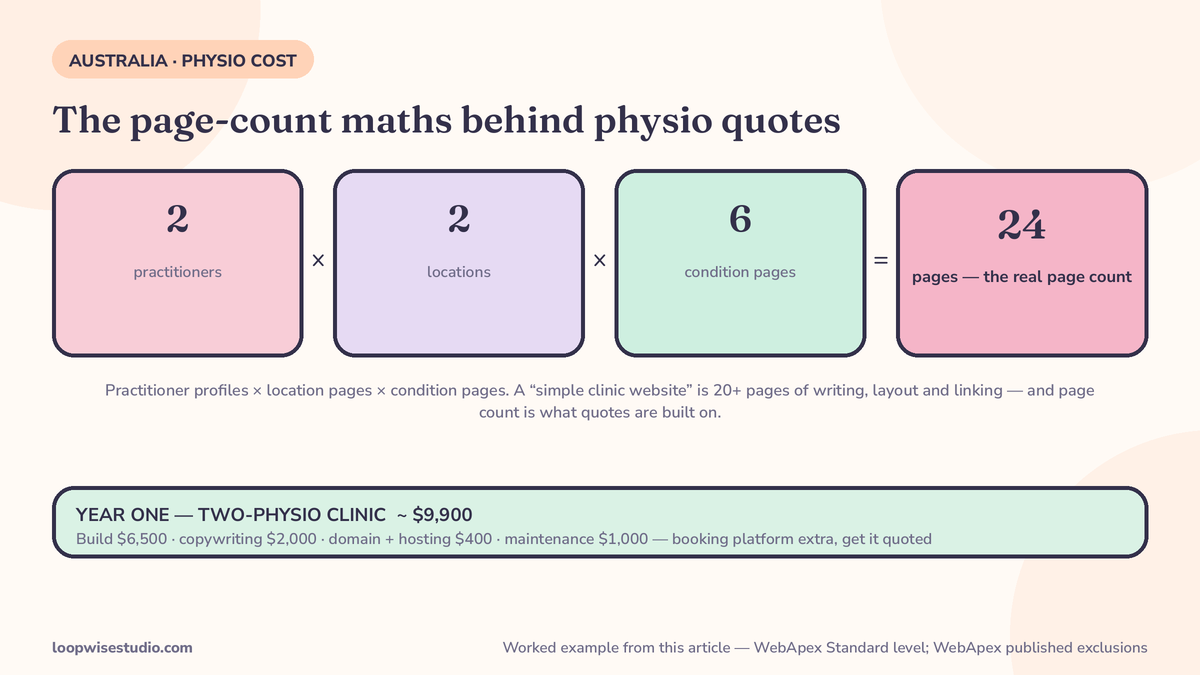
A physio website is not one brochure page. Patients search by condition and by practitioner, so a findable clinic site is a multiplication problem:
2 practitioners × 2 locations × 6 conditions = the real page count.
Practitioner profiles, a page per location, and condition pages (lower back pain, ACL rehab, running injuries, post-op physio…) each need to exist as proper pages if you want them found. That is how a “simple clinic website” becomes 20+ pages of writing, layout and internal linking — and why a quote built on page count (WebXpert’s model) climbs quickly from the $999 start, while a quote that ignores it (a $49/mo template) produces a site that cannot be found for the searches that fill diaries.
This is also the honest way to compare quotes: count the pages each one actually includes. A $3,000 quote for 5 pages and a $7,000 quote for 24 pages are not the same product at different prices.
The general benchmark behind this — what any clinic pays for a site with booking built in — is totalled in our pillar guide to how much a website with online booking costs for a clinic. Physio adds two Australia-specific layers on top of it: the booking system below, and Ahpra further down.
The booking layer — the cost every cost guide forgets
Here is the strangest gap in every Australian physio cost page: none of them prices the booking system. Yet the booking system is the part of the website patients actually use, and it is a subscription your clinic pays every month for as long as it takes bookings.
The mechanics matter to the price. WebXpert’s physio guide — the most systems-literate page ranking for this query — explains the real choice: embedding Cliniko’s booking directly in your site versus linking out to a Nookal booking page. Embedded booking keeps the patient on your site through the whole booking; a link sends them to the practice software’s page. Both work. They differ in setup effort, in how much of the flow you control, and in what happens to the patients who drop off halfway.
What should you budget? Every source in this space leaves the subscription itself unpriced in its cost guide — the booking platforms publish their own pricing and change it — so this article won’t invent a figure. Treat it as a mandatory line in any quote you request: the worked-example checklist below forces it onto the page. The same applies to reminder messaging: text reminders that cut no-shows ride on top of the booking system, and their cost belongs in the same conversation — our Cliniko alternative comparison covers what the platform layer includes and what it charges for, if you’re weighing a switch at the same time. Across the Tasman, the equivalent booking setup is priced and explained in our guide to an online booking system for NZ physio clinics.
Solo practitioner or multi-site clinic — two different budgets
The ranges above frustrate owners because they span an order of magnitude. They do so honestly, because “a physio clinic” describes two different businesses:
The solo practitioner or single-room clinic needs five things done well: a home page that says who you treat, two or three condition pages for your highest-value work, a practitioner profile, a contact/location page, and booking that works on a phone. That is the $999–$2,499 starter-build territory (WebXpert’s published starts), and spending $8,500 here buys polish, not patients.
The multi-practitioner, multi-location clinic is a different purchase entirely. WebXpert’s guide makes the operational point most cost pages miss: each location needs to appear correctly on Google in its own right, with its own pages and profile details, or the locations cannibalise each other’s visibility. Add a practitioner roster, the full condition set, and booking rules per location, and you are buying the $6,500–$8,500+ general-agency or specialist build — because the page count and the systems work genuinely are four times the solo site.
Before you collect quotes, decide which business you are. Clinics that brief agencies as the first business and price-shop as the second end up with a five-page site trying to do a twenty-page job — and then pay twice.
One more briefing point from WebXpert’s guide worth stealing: brief the studio on how patients actually arrive. Physio bookings come from condition searches (“physio for ACL rehab near me”), practitioner names, and referrers checking you out — three different visitors landing on three different page types. A quote that prices “a website” without asking which of those matters most to your clinic is pricing a guess.
Running costs — and the exclusions every quote hides
WebApex publishes the most honest exclusions list in this market. Budget for these on top of any build quote (their figures, AUD):
| Excluded item | Their published range |
|---|---|
| Domain name | $15–$360+ per year |
| Hosting | $150–$500+ per year |
| Copywriting | $75–$500+ per page |
| Support & maintenance | $500–$2,000+ per year |
One more reading note on every figure in this section: WebApex states its prices ex-GST, and most Australian studios quote the same way. Add 10% when you compare an ex-GST quote against a subscription (like the $49/mo builder) that presents its price GST-inclusive — clinics regularly misjudge a build by exactly that margin.
Copywriting is the sleeper cost. At $75–$500 a page, the 20-page site from the page-count maths above carries $1,500–$10,000 of writing if you buy it — or weeks of a physio’s evenings if you don’t. Ask every bidder whether copy is included, and if it is, whether the writer knows what Ahpra allows you to say (next section).
Year one, totalled — a two-physio clinic, worked example
Assumptions, stated: one location, two physios, a mid-range build, copy bought in for the core pages, booking system connected. This is arithmetic from the sourced ranges above, not a quote.
| Item | Year-one cost (AUD, ex-GST) |
|---|---|
| Website build | $6,500 (WebApex Standard package level) |
| Copywriting — 8 core pages at ~$250 | $2,000 |
| Domain + hosting | $400 |
| Maintenance | $1,000 |
| Booking platform + reminders | Get it quoted — see the checklist below |
| Year one total (before booking platform) | ≈ $9,900 |
A smaller start is genuinely possible — a solo physio on a $999–$2,499 starter build with five pages lands year one nearer $3,000–$4,500 on the same arithmetic. A multi-location clinic with the full condition-page set lands well above $10,000. The range is wide because the page count is the price.
If you’d like this table built with your clinic’s real page count and your current booking setup, get a free audit and we’ll price the gaps before anyone quotes you a rebuild.
The Ahpra rules that change what you pay for
Australian physio websites operate under Ahpra’s advertising rules, and those rules change the work — which changes the price:
- Testimonials about clinical care cannot be used in advertising. A template site with a five-star review carousel is not a shortcut; for a registered health service it is a compliance problem. The copy has to be built testimonial-free from the start.
- Claims need care. What you say about conditions and outcomes is regulated advertising, not marketing flair. Budget for copy to be written or reviewed by someone who knows where the line is.
- Medicare wording must be current. WebXpert’s guide, citing MBS Online, notes the GP chronic condition management plan replaced the old GPMP/TCA naming from 1 July 2025, with a maximum of five allied-health services per calendar year shared across service types (MBS item 10960). A site still using the retired terms is telling referrers it’s out of date.
Compare that with the top-ranking global guide for this query, which covers HIPAA and GDPR compliance in depth and never mentions Ahpra at all. If your website supplier’s physio experience is offshore and generic, this section is where it shows.
For the sister problem — what the whole booking website costs a small Australian clinic once the booking layer is included — see our guide to how much a booking website costs for a small clinic in Australia. If you are setting up a physical therapy clinic rather than an Australian physio practice, the booking layer is built out in our guide to a booking website for physical therapy clinics.
There is a competitive point buried in all this: most physio clinics in your area are running the same five-page template with the same stock language. The clinics that invest in the condition pages and the booking flow are not buying a prettier website — they are buying the searches their competitors’ sites cannot answer. That is the return the cost has to be judged against.
A quote checklist you can copy
Send this with every quote request. It forces the exclusions and the booking layer into the open, so quotes become comparable:
PHYSIO WEBSITE QUOTE REQUEST
Clinic: [name], [locations], [number of practitioners]
Pages included in your price: practitioner profiles [n],
  location pages [n], condition pages [n] — list them
Copywriting: included? Written Ahpra-compliant (no clinical
  testimonials, claims checked)? Cost per extra page?
Booking: Cliniko embed or Nookal link — set up in the price?
  Platform subscription: state it as a separate monthly line
Reminders: text/email appointment reminders configured? Cost?
Running costs year one: domain, hosting, maintenance — itemised
Ownership: we own the domain, site and content; export on exit: confirm
Total: year-one figure, ex-GST and inc-GST
Any quote that won’t separate the booking platform’s monthly subscription from the build price is hiding the cost you’ll pay longest.
If quotes are already on your desk and you want them compared line by line — or your current site is live but the diary isn’t filling — get a free audit and we’ll go through the numbers with you first.
The short version
A physiotherapy website in Australia costs from $999 for a small starter build (WebXpert) through $8,500+ at general agencies (WebApex’s medical start), driven mostly by page count — practitioners × locations × conditions. Add $500–$2,000+ a year in running costs, copywriting at $75–$500 a page if you buy it in, and a booking-platform subscription no cost guide bothers to price. Total year one for a typical two-physio clinic: around $10,000 before the booking platform. Get every quote to itemise all of it.
FAQs
How much does a physiotherapy website cost in Australia in 2026?
Professionally built physio sites run roughly $2,500–$8,500. WebXpert publishes starts of $999 (1–4 pages) and $2,499 (five pages); WebApex starts medical and dental clinic sites — physiotherapy included — at $8,500. DIY builders start from $49 a month. All AUD, checked October 2026; confirm current pricing with each studio.
Why do physio website quotes vary so much?
Page count. A findable clinic site needs practitioner profiles, location pages and a page per condition treated — easily 20+ pages. Quotes built on page counts climb accordingly; cheap quotes usually include far fewer pages and exclude copywriting.
Does the price include online booking?
Often not the full layer. Sites may include an enquiry form or a link to your Nookal booking page, while an embedded Cliniko booking flow and reminder setup are separate scope — and the booking platform’s own monthly subscription is always separate. Ask for it as an itemised line.
What are the ongoing costs of a physio website?
WebApex’s published exclusions put domains at $15–$360+ a year, hosting at $150–$500+ a year, and support and maintenance at $500–$2,000+ a year, plus your booking platform subscription and any reminder messaging costs.
What can’t a physiotherapy website say under Ahpra rules?
Ahpra advertising rules prohibit using testimonials about clinical care, and treatment claims must not be misleading or create unreasonable expectations. Medicare wording also needs to be current — the GP chronic condition management plan replaced GPMP/TCA naming from 1 July 2025. Copy written for US or European clinics (HIPAA/GDPR framing) is a warning sign.
Is a $49-a-month website builder enough for a physio clinic?
For a solo practitioner who needs a basic web presence quickly, it can be a start. It won’t give you the condition-page depth that wins local searches, an embedded booking flow you control, or Ahpra-checked copy — and you’ll spend your own hours building it. Most growing clinics outgrow it within the first year.