Missed Call Text Back for Med Spas: How It Works
Missed call text back for med spas sends a text within seconds of a missed call, with a booking link. No AI receptionist, no new software to learn.
Missed call text back for med spas is simple: when a call to your spa goes unanswered, the caller gets a text from your business number within seconds, with a link to book. They reply or tap the link instead of calling the next spa on Google. No robot answers your phone. No new front-desk software to learn.
That is the whole idea. The rest of this page is the detail most pages skip: why med spas miss calls in the first place, what the texts should actually say, what happens after the reply, and what the booking page behind the link has to do for the recovered call to turn into money.
Why med spas miss calls in the first place
Most missed calls at a med spa are not a staff problem. They are a timing problem.
You are mid-treatment with a client on the table. Your one front-desk person is checking someone out, answering a question about aftercare, and watching the phone ring at the same time. It is 6:40 pm, you closed at 6, and someone who just got paid is finally ready to book the Botox appointment they have been thinking about for a month.
Calls bunch up at exactly the moments nobody can answer them: during treatments, at lunch, in the last hour of the day, and after you close. HealthcareCallCenter, an answering service that tracks call patterns across healthcare practices, says 46% of patient calls arrive after hours or during busy windows. You do not need to agree with that exact figure to recognise the shape of it. Look at your own call log for last week and check the times.
AmSpa’s 2024 Medical Spa State of the Industry Report, cited by NetPartners in its GoHighLevel guide for med spas, found that 81% of medical spas in the US are single-location businesses. Most of those run with a small team. There is no spare receptionist waiting for a quiet moment. The phone rings during the work, not between the work.
So the fix is not “try harder to answer”. The fix is what happens in the first thirty seconds after you cannot.
What missed call text back is, and what it is not
Missed call text back is an automatic text message sent to a caller whose call was not answered. It goes out within seconds, from your spa’s number, and it opens a normal text conversation. The caller can reply like any other text. Your team can pick that conversation up from a phone or inbox when their hands are free.
It is not an AI receptionist. Nobody’s call is answered by a voice robot. The caller hears your normal ring and voicemail, same as now. The difference is that instead of the conversation ending at the voicemail beep, they also get a text while they are still holding their phone.
It is not a call centre. No stranger is quoting your prices or giving treatment advice.
It is not a new CRM you have to migrate to. A good setup works alongside the booking system you already use. The text carries a link to that booking system. The conversation lives in texting, where your clients already are.
And it is not a blast message to a list. It only goes to a person who just called you, seconds after they called. That timing is the whole point, and it is also why it needs to be set up with proper opt-out handling, which we will cover below.
How it works, step by step
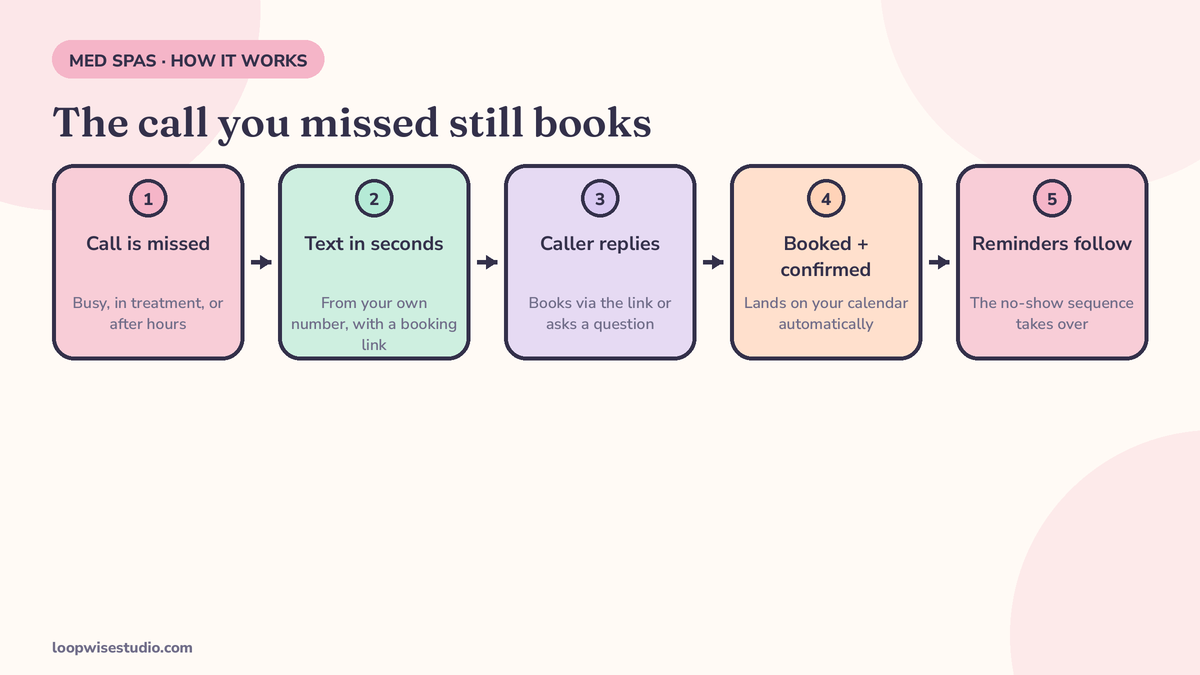
Here is the flow a caller actually goes through.
Step 1: The call rings out. A client calls at 1:15 pm. You are in a laser session. The call goes unanswered and lands in voicemail, as it does today.
Step 2: A text goes out within seconds. Not ten minutes later, not when someone remembers to check voicemail. Within seconds, while the caller is still deciding what to do next. Speed matters here more than clever wording. A text that arrives twenty minutes later arrives after the caller has already rung two other spas.
Step 3: The text names the problem and offers a way forward. It says sorry we missed you, it says who you are, and it offers two easy replies: tell us what you were after, or tap the link and book it yourself.
Step 4: The caller replies or books. Many people would rather text than talk. A price question, a “do you have anything Saturday?” question, a “how much is lip filler?” question — all of those are easier by text, and your team can answer them between clients instead of in a rushed call.
Step 5: The booking link does the heavy work. If they tap the link, they land on a booking page, pick a treatment and a time, and get a confirmation. No phone tag. No “I’ll call you back” that never happens.
Step 6: The booking triggers confirmation and reminders. A recovered call that books and then does not show up is only half a win. The confirmation and reminder flow that follows a booking is covered in our guide to how to reduce no shows at a med spa, because the two problems are two halves of the same leak.
Step 7: You see the numbers. Each week you should be able to see how many calls were missed, how many texts went out, how many conversations started, and how many bookings came from them. If you cannot see that, you cannot tell whether the system is earning its keep.
What the text should actually say
Most pages about text back describe the idea and give you no words. Here are scripts you can use or adapt. Keep each one short. Keep it in your spa’s voice. Send every one from your business number, not a random short code people do not recognise.
1. The standard daytime miss
Hi, this is [Spa Name] — sorry we missed your call, we’re with a client. Reply here and we’ll help, or book anytime: [booking link]
This works because it explains the miss without making an excuse of it, and it gives two routes: reply, or book alone.
2. After hours
Thanks for calling [Spa Name] — we’re closed for the day. You can book online here: [booking link]. Or reply and we’ll pick this up first thing in the morning.
After-hours callers are often your best callers. They have decided. They are not browsing. A booking link at 8 pm catches a person that a voicemail greeting never will.
3. The Botox or filler price question
A lot of med spa calls are one question: how much? If that caller gets a text, this is the reply your team can send once they respond:
Happy to help. Botox starts at [price] per unit, and most first visits begin with a consult so we can dose it right. You can grab a consult here: [booking link] — or tell me what you’re looking at and I’ll point you to the right appointment.
The numbers in brackets are yours to fill in. A 2026 Gracero buying guide for med spa owners, citing ScaleHaven’s 2026 industry statistics, put average Botox appointments at $350 to $550. Your prices are your prices. The script matters because it answers the question and moves to a booking in the same message, instead of answering and letting the chat die.
If you are wondering what those missed calls add up to before you fix anything, run your own numbers with our breakdown of how much revenue med spas lose from missed calls. It shows the full formula, including the parts the headline figures leave out. The same mechanism scales down to smaller treatment rooms: our guide to missed call text back for massage therapists covers the solo-practitioner version, where the phone is across the room and every missed call is a session you cannot interrupt.
4. The consult booking
Sounds good — a consult is the right first step. Pick a time that suits you here: [booking link]. It takes about two minutes and you’ll get a text confirmation straight away.
Consults are where new clients start. AmSpa’s 2024 report put average spend at $527 per visit, and said 73% of med spa patients are repeat patients. That means the first visit is rarely the whole value of a client. Getting the consult booked matters more than its ticket price suggests.
5. The existing client
Hi [Name], sorry we missed you! Want me to move your appointment, or were you looking to book your next one? I can sort it here, or use this link: [booking link]
Existing clients calling mid-treatment-cycle often just need a small thing fixed. If they hit voicemail and hear nothing back for hours, a small thing starts to feel like poor service. A fast text protects the relationship you already paid to win.
6. The no-reply nudge
If someone got the first text and did not reply, one short follow-up the next morning is reasonable. One. Not three.
Morning — just closing the loop on your call yesterday. If you still want to book, here’s the link: [booking link]. If you got sorted elsewhere, no worries at all.
After that, stop. Chasing further turns a helpful system into a pest, and it risks the opt-outs and complaints that get numbers flagged.
The part everyone skips: the booking page
Here is the gap in almost every text-back page on the internet: they assume the page the text links to does its job.
It often does not.
A caller who taps your link and lands on a slow page, a generic services list, a “call to book” notice, or a booking widget that asks for an account before showing a single time slot will leave. You recovered the call and then lost the same person again, thirty seconds later, on a page you control.
A booking page that converts a recovered caller has a short list of things on it:
- The treatments, named the way clients name them, not the way the machine supplier names them.
- A price or a clear starting price, so the person who called to ask the price finds the answer without asking again.
- Real available times, visible before any long form.
- A booking flow that takes two or three taps on a phone, because almost every one of these clicks happens on a phone.
- A deposit or card-on-file step for the appointments that need one, explained in plain words on the page.
- An instant confirmation by text, so the client knows it worked.
This is why we build the website and the text back together. A text that sends people to a weak page is half a system. If your current booking software cannot give you a page like that, that is a separate decision worth making with open eyes — we compared one of the big names in our piece on a Boulevard alternative for med spas that need text back, including where Boulevard itself does the job well.
Not sure what a caller hears and sees at your spa right now? get a free audit — we’ll call your spa after hours, follow the journey a real caller takes, and send you what we find.
Text back vs an AI receptionist vs calling back later
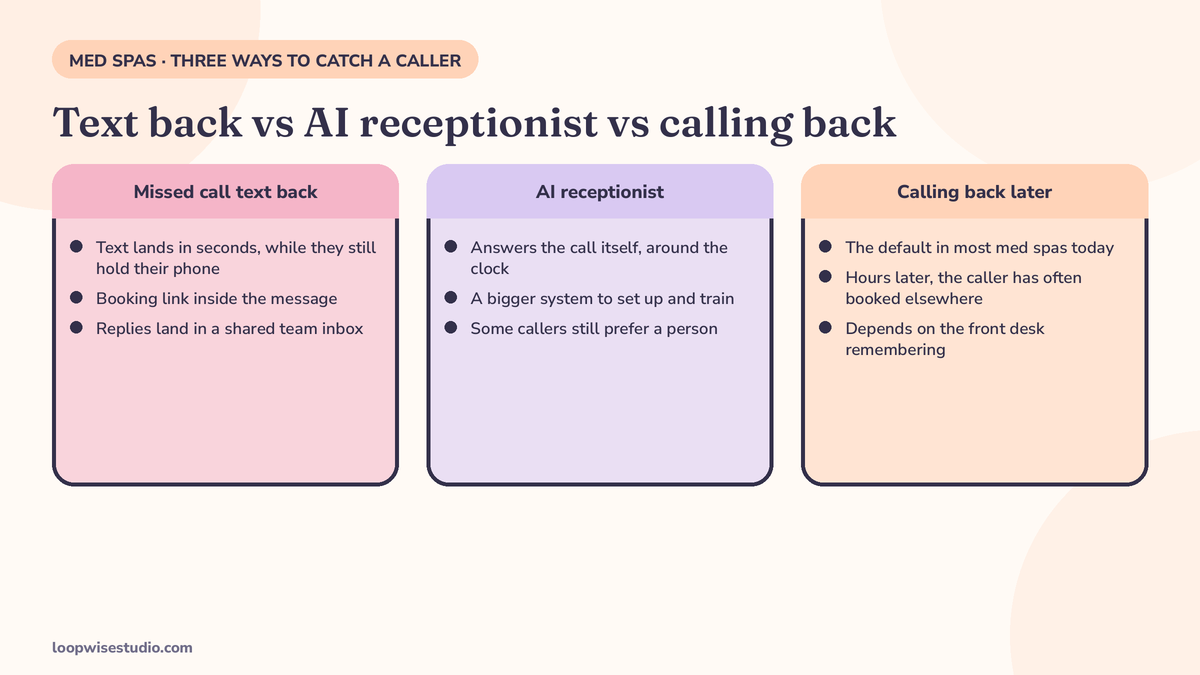
These are the three real options. They suit different spas.
| Option | What the caller gets | Typical cost found in our research | Who it suits |
|---|---|---|---|
| Do nothing / call back from voicemail | A beep, then a callback hours later, if it happens | $0, plus whatever the missed bookings were worth | Almost nobody, once they have counted their missed calls |
| Missed call text back | A text within seconds, with a booking link and a human reply when you are free | Done-for-you services in this market run around $449–$499 a month (FrontDesk Assist’s published pricing) | Small and single-location spas that want the leak fixed without changing how the phone is answered |
| Human answering service | A person answers, takes a message or books | $300 to $900 a month, per HealthcareCallCenter’s published range | Spas that want a human voice on every call and are happy to pay per month for cover |
| AI voice receptionist | A robot answers, talks to the caller, and books | VoixDesk lists $297 to $997 a month, plus setup and per-minute charges | Spas comfortable with clients talking to an AI, and willing to train it on their treatments and prices |
| DIY platform build (e.g. GoHighLevel) | Whatever you configure it to do | $97 to $297 a month for the software, per NetPartners’ cost breakdown, plus your setup time | Owners who enjoy building systems and have a week to set it up properly |
Two honest notes on that table.
First, the DIY route is real work. NetPartners’ own guide lays out seven setup steps, including carrier registration for business texting (A2P 10DLC), which on its own can take days to clear. ClinicEcho, an AI capture service, tells its own customers text back switches on during the trial “once carrier registration clears (about 2–3 weeks)”. Set your expectations by that, whoever builds it for you. Anyone who promises texting from your number tomorrow, with no registration step, is skipping a step that will bite later.
Second, an AI receptionist and text back are not the same product wearing different clothes. Some owners like a voice that always picks up. Many small spas do not want their regulars greeted by a robot. Both views are fair. Text back keeps your phone exactly as it is, and only steps in when a call has already been missed.
Compliance basics that actually matter
This is not legal advice, and US texting rules change. But the basics are not optional if you want the system to keep working:
- Only text people in the flow of their call to you. Text back replies to a person who just called your business. That is a different thing from buying a list and blasting it, and it should stay that way.
- Honour STOP every time. If someone replies STOP, they are out. Your setup must handle that automatically, including at 11 pm when nobody is watching.
- Respect quiet hours. An automatic reply to a 9 pm call is expected. A marketing nudge at 6 am is not. Keep follow-ups inside reasonable hours.
- Keep clinical detail out of texts. Prices, times, booking links and aftercare reminders are fine. Anything about a person’s treatment or results belongs in your proper records system, not in a text thread.
- Tell people who is texting. Your spa’s name goes in the first message, every time.
How you will know it is working
Forget dashboards full of charts nobody opens. Four numbers, once a week, tell you the truth:
- Missed calls. How many calls were not answered, and at what times. The times usually point at a fixable pattern, like the lunch hour or one busy afternoon.
- Conversations started. How many of those callers replied to the text.
- Bookings from text back. How many appointments exist this week that would have sat in voicemail.
- Show rate on those bookings. A booking that no-shows is recovered revenue that leaked again. If this number is weak, the problem has moved, not gone — the reminder side of the system needs attention.
If a provider cannot show you the first three, you are paying for a feature, not a result.
Frequently asked questions
Will this work with my existing phone number?
In most cases, yes. A proper setup connects to the number your clients already call and already have saved. You should not have to print new cards or change your Google listing to a new number. Ask any provider to confirm this in writing before you start, because a number change would cost you more than the system saves.
What happens if the caller is on a landline?
A landline cannot receive a text. That caller gets your normal voicemail, exactly as today, and you lose nothing compared with now. Most med spa enquiries come from mobile phones, so this is a small share of calls, but it is a real limit and any honest provider will name it rather than promise 100% coverage.
Does it work with the booking system I already use?
It should. The text carries a link, and that link can point at Boulevard, Mangomint, Vagaro, Jane, or a booking page on your own website. The more important question is whether that page converts on a phone. If it asks for an account before showing times, the text back is doing its job and the page is undoing it.
How fast can this be live?
The messages and booking link can be built in days. The part you cannot rush is carrier registration for business texting, which can take days and, per one provider’s own wording, up to two to three weeks. Plan on the honest timeline, not the sales timeline. Everything else — scripts, booking page checks, testing with your own phone — should happen while that registration clears.
What should the first text say if I’m open but busy?
Keep it to one line of apology, one line of options. “Sorry we missed your call, we’re with a client. Reply here or book here: [link].” That is enough. The caller does not need your schedule, your story, or three paragraphs. They need to know a human business noticed them and that there is a way forward that does not involve redialling.
Is texting a caller who didn’t leave a message allowed?
Rules differ by situation, and this page is not legal advice. The general principle providers work to is that the text is a direct reply to a call that person just made to your business, from your business number, with a clear opt-out. Use a provider who builds STOP handling, quiet hours and registration in from the start, and check the current TCPA position for your state before you switch anything on.
The short version
Your spa misses calls because your team is doing treatments, not because anyone is careless. Those callers do not wait. A text within seconds, with a link that actually books, gives them a reason to stay with you instead of ringing the next name on the list.
It is a small system. That is the point. It does not ask you to learn a platform, retrain your front desk, or let a robot answer for you.
If you want to see what your callers get today before you change anything, get a free audit. We will call your spa the way a new client would, at a time your team is busy, and show you the exact gap — the ring-out, the voicemail, and the silence after it. Then you can decide if it is worth fixing.