Vagaro Alternative for Salons: No Commission Fees
Looking for a Vagaro alternative for salons without commission fees? Compare real Vagaro costs, add-ons and a done-for-you option you own outright today.
If you are looking for a Vagaro alternative for salons without commission fees, start with an honest correction: on regular bookings in the US, Vagaro does not actually take a marketplace commission. That is the finding across the pricing breakdowns published in October 2026 by Trafft, Koalendar and GlossGenius. So if commission is your only worry, you may not need to switch at all. Where Vagaro does take its money is somewhere else: a subscription that grows with every staff member, a stack of paid add-ons, and card processing on every booking. This article separates those three costs, shows you what salons of different sizes actually pay, compares the real alternatives fairly, and covers the option no software roundup lists — keeping your bookings on a website you own, set up for you.
The short answer: does Vagaro charge commission?
Mostly, no — with two exceptions you should know about.
Trafft’s October 2026 comparison, which cites Vagaro’s own support pages, states that Vagaro charges no commission on regular US marketplace bookings. Koalendar says the same thing in different words: online booking carries $0 commission and the marketplace listing itself is free. If a client finds you on the Vagaro marketplace, books, and pays, Vagaro’s cut of that booking is zero.
The exceptions are promotions. When you opt into Vagaro’s Fill My Books or Daily Deals promotions, Trafft reports a fee of 20% on a new customer’s first booking and 5% on a repeat customer’s booking through those deals. That is not a mistake — you are paying for extra visibility, the same way you would pay for an advert. It only becomes a problem if you turned the promotions on, forgot about them, and never worked out what they cost you. The second exception is geography: Trafft reports that in the UK, Vagaro applies a flat 20% new-customer fee. So a UK salon reading US-focused advice that says “Vagaro has no commission” is getting an incomplete picture.
One source, a Top Salon Software FAQ, claims a Vagaro marketplace fee of 2.5% plus $0.15 per transaction. That figure appears nowhere else — not in Trafft’s sourced comparison, not in Koalendar’s pricing breakdown, not in GlossGenius’s roundup. We are flagging it rather than repeating it as fact, because this is exactly how salon owners end up switching software for a problem they do not have.
The platform where commission is real, large and central to the model is Fresha. Multiple sources agree: Fresha charges a one-time fee of 20% of a new client’s first booking, with a $6 minimum, when that client comes through its marketplace. On a $60 first appointment that is $12. On a $150 treatment it is $30. On a $300 booking it is $60. If you are comparing a Fresha alternative for clinics that want WhatsApp booking, that 20% is the number to focus on. With Vagaro, focus on the bill instead.
The three cuts: where your booking money actually goes
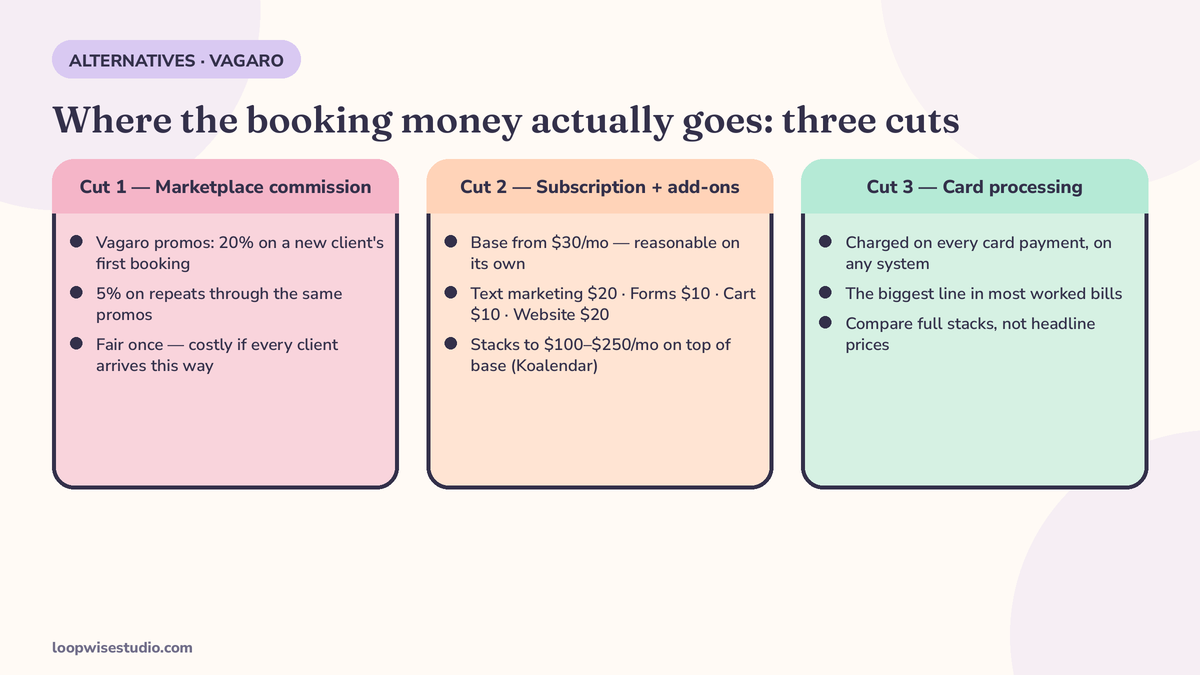
Every booking platform takes money in up to three different ways. Comparison articles mix them together, which makes honest comparison almost impossible. Keep them separate and the whole market gets clearer.
Cut one: marketplace commission
This is a percentage of a booking, taken because the platform found the client for you. Fresha’s 20% new-client fee is the clearest example in this market. Vagaro’s promotional fees — 20% on a new customer’s first booking through Fill My Books or Daily Deals, 5% on repeats, and the flat 20% new-customer fee reported for the UK — belong in this category too.
Commission is not automatically bad. Paying 20% once for a client who then rebooks with you directly five times can be cheap marketing. It becomes a bad deal when a large share of your “new” clients keep arriving through the marketplace instead of through your own Google profile, your Instagram and your returning client list — because then you are renting your own growth, month after month, and the shelf your salon sits on also displays every competitor near you.
Cut two: the subscription and add-on stack
This is where Vagaro actually makes its money from most salons, and it is the least visible cut because no single charge looks unreasonable.
As of October 2026, Vagaro’s base price is $30 per month for one bookable calendar, with a promotional rate of $23.99 per month reported by Trafft and GlossGenius. Each additional calendar — in practice, each additional bookable staff member — adds $10 per month, capped after seven calendars, so the base subscription tops out at $83.99 on the promotional rate or $90 at the standard rate. A three-person salon pays roughly $50 a month before anything else. A seven-person salon pays $90. That part, on its own, is reasonable for what the software does.
Then the add-ons start. Koalendar published the fullest list in October 2026:
| Vagaro add-on | Monthly cost |
|---|---|
| Text marketing | $20 |
| Forms | $10 |
| Online shopping cart (needed to take deposits online) | $10 |
| MySite website builder | $20 |
| Check-in app | $10 |
| Vagaro Drive storage | $10 |
| Live stream | $10 |
| QuickBooks integration | $10 |
| Xero integration | $10–$30 |
| Data Lake reporting | $40 |
| Payroll | $34 plus $5 per employee |
| Branded app | $100, plus a $100 setup fee reported by Trafft |
None of these is a rip-off on its own. Together, Koalendar notes that seven to ten add-ons “can easily reach $100–$250 per month on top of the base subscription.” A salon that adds text marketing, forms, the shopping cart so it can take deposits, and the website builder is paying $60 a month in add-ons before payroll or anything fancy enters the picture. That is the real Vagaro cost story — not commission, but stacking.
Cut three: card processing
This cut, nobody escapes — not on Vagaro, not on any alternative in this article, and not on your own website.
Vagaro’s processing rates vary by source and merchant size, so treat this as a dated range: card-present rates of roughly 2.2% to 2.6% are reported across Koalendar, Trafft and GlossGenius, with keyed-in transactions at 3.5%, plus small fixed fees and, for larger merchants, a $10 monthly fee in some accounts. On $10,000 of monthly bookings, Koalendar works that out at $220 to $350 a month in processing alone — $2,640 to $4,200 a year.
Be suspicious of any page, including any page selling our kind of service, that says “no commission” and lets you believe your bookings become fee-free. Zero percent platform or marketplace commission means the platform takes no cut of the booking. It does not mean the card networks and your payment processor work for free. On a system you own, you would still pay standard card processing, typically in the same 2.2% to 3.5% range depending on how the payment is taken. Any provider who hides that distinction is hoping you will not ask.
What a salon actually pays Vagaro: three worked bills
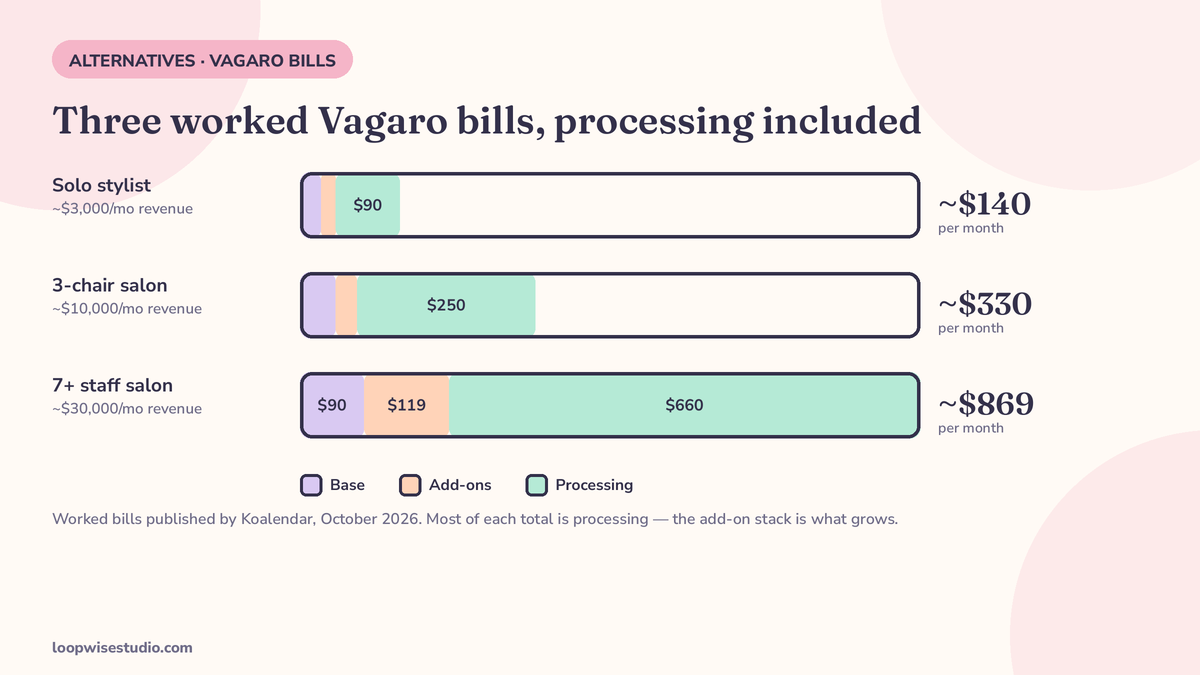
Koalendar did salon owners a favour by building worked monthly totals for different salon sizes, including processing. Trafft published similar scenario maths. Here are Koalendar’s figures, published October 2026:
| Salon size | Base subscription | Add-ons | Processing | Realistic total per month |
|---|---|---|---|---|
| Solo stylist, ~$3,000/mo revenue | $30 | $20 (text marketing) | ~$90 | ~$140 |
| 3-chair salon, ~$10,000/mo revenue | $50 | $30 | ~$250 | ~$330 |
| 7+ staff salon, ~$30,000/mo revenue | $90 | $119 (incl. payroll for 7) | ~$660 | ~$869 |
Trafft’s scenarios land in the same neighbourhood: $115.99 a month all-in for a solo operator taking $3,000, for example. Koalendar also adds one-time hardware of roughly $100 to $300 for point-of-sale equipment, which rarely appears in headline pricing.
Read the table the right way. Most of the solo stylist’s $140 is processing, which she would pay on any system. The honest Vagaro-specific cost is the $50 of subscription and add-ons. But look at how the add-on line grows with the team: $20, then $30, then $119. The stack, not the base price and not commission, is what owners are actually complaining about when they search for alternatives. When you compare alternatives, compare this full stack — not the $30 headline.
If the maths above makes you want a proper breakdown for your own salon before you decide anything, that is exactly what an audit is for: get a free audit and we will go through your current bill and your booking flow with you, line by line, whichever platform you end up on.
The real alternatives, compared fairly
Vagaro is good software. It holds a 4.7 rating on Capterra across more than 3,600 reviews, according to figures cited by Trafft, and plenty of salons run their whole business on it happily. The question is never “is it bad?” — it is “does its pricing model fit your salon, and who has to do the work of running it?” Here are the main alternatives, with their own catches stated plainly.
| Option | What you pay (Oct 2026 sources) | Marketplace commission | Card processing | Who sets it up and runs it |
|---|---|---|---|---|
| Stay on Vagaro | $30/mo base, +$10 per extra calendar (cap $90); add-ons $10–$100 each | None on regular US bookings; 20%/5% on Fill My Books and Daily Deals promos; 20% new-client fee reported in UK | ~2.2–2.6% card-present, 3.5% keyed-in | You |
| GlossGenius | $24/mo Standard, $48 Gold, $148 Platinum | None — no marketplace | 2.4% + $0.15 on Standard, per GlossGenius | You |
| Fresha | $19.95/mo independent; $14.95 per team member/mo | 20% of a new marketplace client’s first booking, $6 minimum | 2.29% + $0.20 in-person (US) | You |
| Square Appointments | Free for solo operators; team plans from $29/mo per Koalendar | None | 2.6% + $0.10 per Koalendar | You |
| Boulevard | From about $158–$175/mo (sources disagree) | None reported | Varies | You, with vendor onboarding |
| Your own website with booking, built for you | One fixed build price plus your booking/payment tools; no platform cut | None — there is no marketplace | Standard processor rates still apply (~2.2–3.5%) | Done for you |
A few fair notes on each:
GlossGenius is the cleanest like-for-like swap for solo operators and small teams who like an all-in-one. Its whole pitch is transparent pricing and no marketplace fees, and its published rates back that up. Its own claims about its customers — a 75%+ rebooking rate and an average 26%+ revenue increase in a customer’s first year, as stated on glossgenius.com — are vendor claims about its own platform, so read them the way you would read any supplier’s brochure. The tiers still step up steeply: the features many salons want sit at Gold or Platinum, so do the same stack maths you did for Vagaro.
Fresha is genuinely strong software with a huge marketplace — Fresha’s own 2026 figures, cited by Trafft, put it at more than 130,000 businesses and 25 million marketplace customers. If discovery is your main problem and you are happy to pay 20% once per new marketplace client for that reach, Fresha is a rational choice. If your clients already find you through Google and Instagram, that 20% buys you clients you would likely have won anyway — and note the detail Trafft flags: the fee can trigger even if the client only viewed your marketplace profile first and then booked through your own link.
Square Appointments suits salons already using Square for payments, and the free solo tier is real. The trade-off is depth: it is a capable scheduler attached to a payments company, not a salon system built around rebooking, reminders and client retention.
Timely is the other name UK and New Zealand salons ask about. It handles deposits and reminders well, but its reminder stack is the thing most switchers are trying to improve — our Timely alternative with text reminders works through the New Zealand case in detail.
Boulevard is a polished, premium option aimed at higher-end salons and med spas — closer in spirit to what we compare in our Boulevard alternative for med spas that need text back guide. At $158 to $175 a month before processing, it prices itself for established businesses, and sources disagree on the exact starting figure, so confirm it directly before budgeting.
And the last row is the one no roundup includes, because roundups only compare software. It is covered in its own section below.
The option no comparison table lists: own the booking page
Every alternative above is a swap: export your clients from one rented system, import them into another rented system, retrain your staff, and start paying a different monthly stack. There is a third path that owners rarely get shown, because there is no affiliate commission in recommending it.
You keep your client relationships on property you own: your own website, on your own domain, with a booking page that sends clients into your calendar, takes deposits through your own payment account, and follows up automatically. There is no marketplace, so there is no marketplace commission — not 20%, not 5%, not on promos. There is no shelf of competing salons beside your listing. Your reviews sit on your Google profile, which you also own.
What changes in practice:
- A client who finds you on Google lands on your site, not a marketplace. She books there. Nobody takes a cut for introducing you to your own search traffic.
- The follow-up runs without you. Confirmation and reminder messages go out automatically, a missed call or unanswered message gets an instant reply with your booking link, and clients are asked for a Google review after their appointment. This is the layer software charges add-on after add-on for — and it is also the layer that protects a diary, as we explain in the no-show research linked from our med spa guides.
- You are not locked in. Your domain, your client list and your content are yours. If you change tools later, the website and the audience stay with you.
- It is done for you. The honest weakness of every software swap is the work: migration, setup, templates, staff training. A done-for-you build hands that work to someone else.
What it does not do, stated plainly: it does not remove card processing fees (nothing does), it does not run your till or your payroll the way a full salon platform tries to, and if you love Vagaro’s back-office, you do not have to rip it out on day one. Several salons keep their existing system for the till and records, and put an owned booking page and follow-up layer in front of it. “Keep Vagaro, fix the leaks around it” is a legitimate answer, and it is strange that no comparison page ever offers it.
Price-wise, an owned website is a different shape of cost — a one-off build plus modest running tools, instead of a per-staff, per-add-on stack that grows every time you hire. We break down what that build typically costs across the whole market in our guide to how much a website with online booking costs for a clinic, and if you are a one-person operation, our page on a website for a one person aesthetic clinic that takes bookings covers the smaller, cheaper version of the same setup. Loopwise builds are priced as a fixed quote after a short discovery call, so you know the full number before anything starts — no per-calendar creep afterwards.
What switching (or layering) actually involves, week by week
Whether you swap platforms or put your own booking page in front of the one you have, owners underestimate the same thing: the move itself. GlossGenius’s guide is one of the few to treat it as a project, suggesting one to two weeks. A realistic version looks like this:
Days 1–2: Export and clean your data. Client names, contact details, service history and future appointments come out of your current system. This is the moment to delete duplicates and dead contacts — importing a messy list just moves the mess.
Days 3–5: Rebuild the essentials. Services, prices, durations, staff calendars and opening hours are set up in the new system or on your new booking page. Deposits and cancellation rules get decided now, not later: how much, for which services, and how a client reschedules instead of vanishing.
Days 6–8: Connect the follow-up. Reminder timing (most systems work well with a confirmation at booking, a reminder 24 hours before, and a short nudge on the day), the missed-call or missed-message reply, and the after-appointment review request. Test each one on your own phone.
Days 9–11: Point your traffic at it. Update the booking link on your Google Business Profile, Instagram bio, Facebook page and any directory listings — including your old marketplace profile, so existing clients find the new door. Put a sign at reception with the new booking link or a QR code.
Days 12–14: Run both, watch, then close the old door. Keep the old system readable for its remaining appointments, check the new one daily for double bookings or missed reminders, and only cancel the old subscription once every future appointment is safely across.
The two mistakes that cause nearly all switching pain are skipping the parallel-run week, and forgetting how many places the old booking link lives. Both are boring, both are avoidable, and both are the kind of work a done-for-you service exists to absorb.
Which path fits your salon?
| Your situation | The sensible path |
|---|---|
| Solo, under ~$3,000/mo in bookings, clients mostly come from Instagram | Your real Vagaro bill is small; switch only if the add-ons annoy you. A flat tool like GlossGenius Standard or an owned one-page booking site both work — the owned site wins if most clients already know your name. |
| 2–5 staff, paying for 4+ add-ons | Do the stack maths first. Your alternative must beat your total Vagaro bill, not its $30 headline. This is where an owned booking layer in front, or a flat-fee platform, usually wins. |
| You rely on marketplace discovery for new clients | Stay where the marketplace is — Vagaro (no regular US commission) or Fresha (20% once per new client) — but build your own site alongside it, so repeat clients stop arriving through a cut-taking door. |
| UK salon | Recheck the commission assumption: the reported 20% Vagaro new-customer fee in the UK changes the comparison completely, and WhatsApp-based booking and reminders matter far more than in the US. |
| You love Vagaro’s till and reports, hate everything around them | Keep it. Fix the front door: your own website, your own booking page, automated reminders and review requests on top. |
Frequently asked questions
Does Vagaro really charge no commission?
On regular US bookings, yes — multiple October 2026 breakdowns (Trafft, Koalendar, GlossGenius) report no marketplace commission and a free marketplace listing. The exceptions are optional promotions: Fill My Books and Daily Deals reportedly cost 20% of a new customer’s first booking and 5% on repeats, and Trafft reports a flat 20% new-customer fee in the UK. One affiliate FAQ claims 2.5% plus $0.15 per marketplace transaction, but no sourced breakdown supports it.
If Vagaro has no commission, why is my bill so high?
Because commission was never the main cost. Your bill is the base subscription ($30, plus $10 per extra calendar up to $90), the add-ons you have stacked up (text marketing $20, forms $10, website $20, the shopping cart you need for deposits $10, payroll $34 plus $5 per employee, and more), and card processing at roughly 2.2% to 2.6% on every transaction. Koalendar’s worked examples put a solo stylist at about $140 a month all-in, a 3-chair salon at about $330, and a 7+ staff salon at about $869.
What does “no commission” not cover?
Card processing. Every system in this article, including your own website, pays the card networks and a payment processor — typically somewhere around 2.2% to 3.5% depending on the method. “No commission” means no platform or marketplace cut on top of that. Any provider who blurs that line is not being straight with you.
Is Fresha actually free?
No. Fresha’s subscription starts at $19.95 a month for an independent operator, or $14.95 per team member, per its published pricing as reported in October 2026 — and its real cost is the 20% fee (minimum $6) taken from a new client’s first booking when that client comes through the Fresha marketplace. For salons that need discovery, that can be money well spent. For salons whose clients already find them on Google and Instagram, it is a recurring tax on their own reputation.
Can I keep Vagaro and still take bookings on my own website?
Yes, and for many salons it is the smartest move. Your own website can carry your booking page, your service information and your automated follow-up — confirmations, reminders, replies to missed calls and review requests — while Vagaro continues to run the till and the back office if you like it there. You stop depending on a marketplace profile for new bookings without betting the business on a full migration.
How long does switching to an alternative take?
Plan on about two weeks done carefully: a couple of days to export and clean your client data, a few days to rebuild services and calendars, a few days to connect and test reminders and follow-up, then a week where old and new run side by side while you update your Google profile, Instagram and directory links. Rushing it into a weekend is how double bookings and lost appointments happen.
Find out what your current setup is really costing you
Most salon owners who read this far are not sure of their own total — the subscription line they remember is not the bill they pay. So start there, before you switch anything or buy anything: get a free audit, and we will add up your current platform, add-on and processing costs, look at where bookings leak (marketplace cuts, missed calls, no reminders, no review requests), and tell you honestly whether the best move is staying, swapping, or putting your own booking page in front of what you already have. No commission on that advice, either.