Skip to content
Loopwise Studio
Menu

Free clinic tool · No email needed

No-Show Cost Calculator for Clinics

No-show cost calculator for clinics: put in your own month and see what missed appointments cost in money, not just percentages. An empty chair still uses staff time, a treatment room and a slot another patient could have taken. Enter your appointments, your no-shows and your average visit value to get the monthly and yearly loss — no email, no signup, nothing sent to us.

Calculated in your browserRate and money in one placePrint or save your result

The calculator

Run your own month

Use a month you can actually count. The same rule every month is what makes the number useful.

01 · Appointments

Booked slots on a normal day.

Days the diary is open.

Cancelled with enough notice to refill. These come out of the scheduled total and are not counted as a loss.

02 · Missed appointments

Patients who did not arrive.

Fill one; the other updates.

Cancelled inside the refill window. Counted with no-shows, because the slot was usually too late to fill.

03 · Money

What one kept appointment is worth, before costs.

Display only.

%

Slots given to a waiting-list patient still earn. Put 0 if you never refill.

04 · What if reminders help?
0%
0%50%100%

Your assumption, not a Loopwise promise. Move it to see the value of a reduction you think is realistic.

Calculated in your browser. Nothing is sent to us.

Your result

Updates as you type

No email

Your numbers go here.

Fill in appointments per day, working days and average visit value to see the result. We do not guess defaults — an empty field stays empty.

  • No-show rate, with the maths shown
  • Gross loss and net loss after refills
  • Monthly and yearly value at your own reduction

Reading the number

How to read your result

The percentage tells you how often the diary breaks. The money tells you whether it is worth changing anything. Keep both in view.

Four things move the number more than any benchmark: refills, the time frame, your own baseline, and the gap between gross and net.

01 · The two numbers

Gross is the ceiling. Net is the estimate.

Gross treats every missed appointment as a full-price sale that disappeared — the worst case. Net subtracts the slots you usually refill, because a waiting-list patient who takes the hour still pays. Decide what to fix with the net figure; get attention with the gross one.

Gross · worst caseNet · after refills
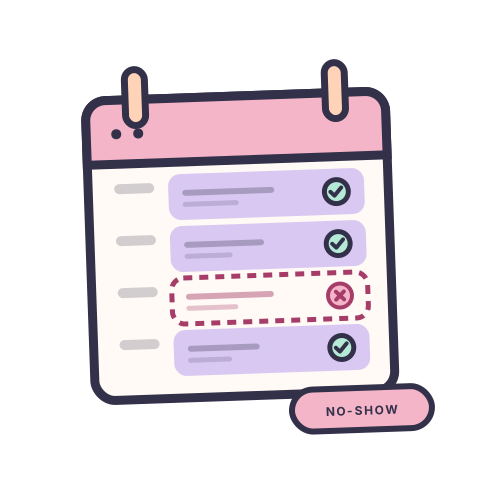
Diary of four appointments with one slot marked as a no-show
02 · Refills

A live waitlist changes the answer.

The same clinic loses less when a freed slot goes to the next patient. If your refill share is a guess, keep it low — the honest number is more useful than a dramatic one.

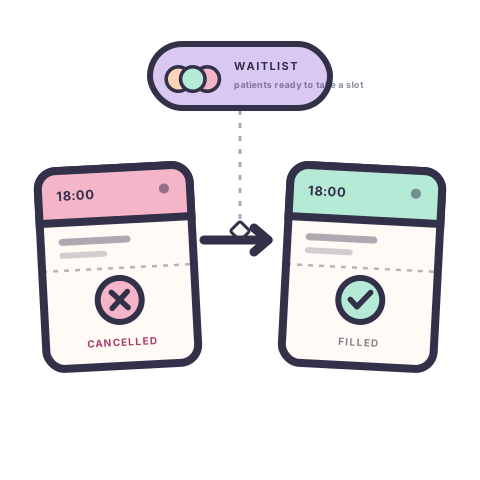
A cancelled 18:00 appointment being offered to the waitlist and filled by another patient
03 · Time frame

One month is noisy. Three is steadier.

Holidays, a new practitioner and one bad week can all move a monthly figure. If your clinic runs fewer than about 250 appointments a month, recalculate on a rolling 90 days and divide by three before comparing months.

90days

The rate is a trend, not a verdict. Compare the same length of window every time.

04 · Your baseline

Your own number beats a borrowed benchmark.

There is no universal target to chase. These are the things that make another clinic's rate useless as a target for yours:

  • Specialty and treatment mix
  • How far ahead patients book
  • New vs returning patients
  • Reminder and deposit policy

Compare your clinic with its own last three months, then with its own next three.

The maths

How we calculate it

Every line below is visible in the result panel. Nothing is hidden inside a single impressive number.

Formula 1 · No-show rate

No-show rate (%) = (missed appointments ÷ scheduled appointments) × 100

Missed appointments are no-shows plus late cancellations. Timely cancellations, made with enough notice to refill the slot, come out of both the top and the bottom. In this tool, the scheduled total is appointments per day × working days, minus those timely cancellations.

Formula 2 · Monthly loss

Gross monthly loss = (no-shows + late cancels) × average revenue per visit

Then, as separate lines so you can check them:

  • Net monthly loss = gross monthly loss × (1 − refilled % ÷ 100)
  • Net yearly loss = net monthly loss × 12
  • Recovered at X% reduction = net monthly loss × (X ÷ 100)
  • One fewer a week = average visit × (1 − refilled % ÷ 100) × 52 ÷ 12

Worked example

Every assumption, in the open

Round numbers, an example only — not a real clinic's data.

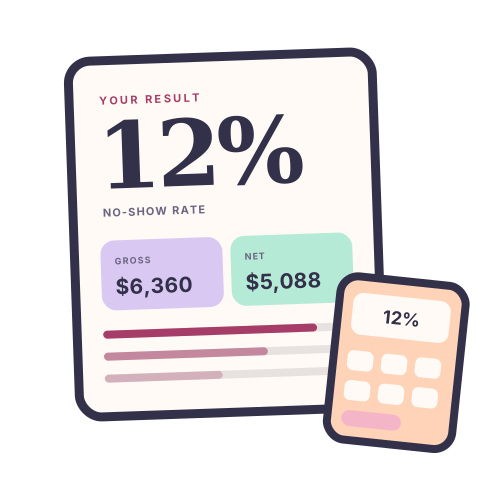
Result card showing a 12% no-show rate, $6,360 gross loss and $5,088 net loss
  1. 20 appointments a day × 22 working days = 440 scheduled appointments a month. No timely cancellations in this example.
  2. 12% no-show rate = 53 missed appointments (440 × 0.12 = 52.8, rounded to 53).
  3. 53 × $120 average visit = $6,360 gross loss a month.
  4. 20% of those slots refilled = $6,360 × 0.80 = $5,088 net loss a month, or $61,056 a year.
  5. A 25% reduction (the reader's assumption, not a promise) = $5,088 × 0.25 = $1,272 recovered a month.

Change any one assumption and the answer changes. That is why the calculator asks for your numbers instead of filling in its own.

Segments

Where no-shows hide

One overall rate hides the useful part. Split the same data a few ways and the worst segment usually points at the fix: a reminder time, a confirmation message, a deposit rule or a waitlist that never gets used.

Split byWhat to compareWhat a high number usually means
PractitionerCompare each practitioner's missed appointments against their own scheduled total.A diary with longer gaps, a practitioner who is hard to rebook, or a patient list that needs a different reminder time.
ServiceSplit by treatment or appointment length. A 15-minute consult and a 90-minute procedure do not carry the same cost.A treatment with a long wait for a first appointment, or one where the price makes patients hesitate after booking.
WeekdayCount missed appointments for each day you open, using the same rule every month.Mondays and early mornings often collect bookings made weeks earlier. That is a reminder-timing question before it is a demand question.
Booking lead timeGroup appointments booked same-week, 2–4 weeks ahead and more than a month ahead.Long-lead bookings are the usual home of no-shows. They are also the easiest group to confirm twice.
New vs returningCompare first visits with patients who have been in before.A high first-visit figure points to the confirmation message, the deposit wording, or expectations set at booking.

Break it down

Which row loses the most?

Split by service or practitioner. It uses your average visit value and refill rate from the calculator above. Leave a row blank if it does not apply.

Manual table, same counting rule.

Service or practitionerMissed this monthAverage visit valueNet loss / monthShare
—
—
—

Add missed appointments for each row to compare them.

What to do next

The reminder sequence

Six moments, each with one job. You do not need all six on day one. Start with the confirmation and the 24-hour reminder, then add the rest as the diary allows.

  1. 1

    At the moment of booking

    Send the confirmation

    Repeat the treatment, day, time and location. Ask for a reply so the appointment is confirmed by the patient, not assumed by the clinic.

  2. 2

    24 hours before

    Remind, then make replying easy

    One message with two choices: confirm, or move it. A patient who can reschedule in the same thread is far less likely to go quiet.

  3. 3

    2–3 hours before

    Send the short nudge

    This catches the patient whose day has already changed. Keep it to one line and one question. No essay, no guilt.

  4. 4

    In every reminder

    Offer a one-tap reschedule

    Reply-to-confirm and a live reschedule link remove the effort that turns a cancellation into a no-show. The slot comes back while there is still time to refill it.

  5. 5

    Same day, after a miss

    Follow up without a lecture

    A short, friendly message asking whether they want to rebook keeps the relationship and often recovers the appointment. Two options, no shame.

  6. 6

    Within minutes of a cancellation

    Offer the slot to the waitlist

    A cancellation is only a loss if nobody hears about it. Offer the freed slot to the next patient on the list before the day is out.

Phone showing a WhatsApp appointment reminder with confirm and reschedule buttons

The rule behind the wording

Every message should make one of two replies easy: confirm, or move it. A reminder that only says “see you tomorrow” gives the patient no graceful way out, so the easy option becomes silence.

Copy-ready messages

Loopwise's own WhatsApp templates

Replace the placeholders with your clinic's details. English first, Arabic second.

Confirmation at booking

Hi {name}, your {treatment} at {clinic} is booked for {day} at {time}. Reply C to confirm, or R and we'll send you other times. — {clinic}

24 hours before

Hi {name}, a reminder about your {treatment} tomorrow at {time}. Reply C to confirm, or R and we'll find you another slot.

2–3 hours before

Hi {name}, see you at {time} today for your {treatment}. If something has changed, reply R and we'll move it. Reply C if you're still coming.

Reply to confirm

Thanks {name} — you're confirmed for {day} at {time}. If you need a different time, tap {reschedule link} and pick what works.

Same-day follow-up after a miss

Hi {name}, we missed you at {time} today. No lecture — would you like to rebook? Reply 1 for the next open times, or 2 to leave it for now.

Waitlist offer

Hi {name}, a {treatment} slot has opened at {clinic} on {day} at {time}. First reply gets it. Reply YES and we'll confirm it for you.

Questions

Frequently asked questions

Plain answers, including the ones this calculator deliberately refuses to invent.

What is a typical no-show rate for a clinic?

There is no single typical rate. It varies by specialty, by how far ahead patients book, and by whether the clinic reminds them. Use your own figure from last month, counted the same way every month, instead of borrowing a benchmark from another clinic.

What is the formula for no-show rate?

No-show rate (%) = (missed appointments ÷ total scheduled appointments) × 100. Missed appointments are no-shows plus late cancellations. Timely cancellations, made with enough notice to refill the slot, come out of both the top and the bottom of the fraction.

Should cancellations count as no-shows?

Usually not. A cancellation made with enough notice gives the clinic time to offer the slot to someone else, so it is excluded from both the numerator and the denominator. A late cancellation inside the refill window is different: it is counted with no-shows. Whatever rule you choose, write it down and apply it every month.

How often should a clinic measure its no-show rate?

Monthly is practical for most clinics. Larger practices can review weekly. A smaller clinic with fewer appointments is better off using a rolling 90-day figure, because one unusual week can move a small monthly rate a long way.

How much can reminders reduce no-shows?

It depends on the clinic, the patient group and the reminder sequence, so this calculator does not promise a percentage. Set your own reduction in the slider and see what that assumption would be worth. Then test it on your own diary.

Why does the calculator ask about refilled slots?

Because a refilled slot is not lost revenue. If a waiting-list patient takes the empty appointment, the clinic still earns from that hour. The refill figure keeps the net loss honest instead of making the gross number look worse than it is.

Is my clinic's data sent anywhere?

No. The calculator runs entirely in your browser. No numbers are sent to Loopwise, stored on a server or added to a database. If you print the result, the file stays with you.

From cost to fix

See it working on a real booking page

The demo is a working booking flow, not a slide deck. Book as a patient, then flip to the owner view and watch the confirmation, reminder and waitlist steps happen without anyone making a call.

Open the clinic demo

No prices on this page. If you want a build, the scope and one fixed quote come after a short conversation.

Keep reading

The booking demo, the reminder playbook, the missed-call side, and the research behind our clinic work.

Book your free audit

A few questions so the audit starts with your business, not a template. Takes about 2 minutes.

What kind of business do you run? (required)
Do you have a website? (required)
How do most of your bookings happen right now? (required)
What's your biggest problem right now? (required)
Roughly how many appointments do you handle in a week? (required)

Where should we send it?

The audit is delivered on WhatsApp. Email is optional — if you add one, we can reply there too.

Include your country code — this is where the audit gets delivered.

Only used if we need to reply by email.

No pitch, no obligation. We use your answers only to prepare the audit.