How Much Does a Website Cost for a Hair Salon in 2026?
What a hair salon website really costs in 2026: DIY, freelancer, fixed-price and agency routes compared, plus the booking-system cost quotes hide.
A hair salon website costs about $250–$700 for the first year if you build it yourself on a website builder ($16–$60/month plus a domain), $499–$2,000 one-time for a fixed-price done-for-you salon site, $1,500–$5,000 from a freelancer, and $5,000 and up from an agency. Every route also needs a booking system on top — roughly $0–$110/month depending on team size, based on vendor prices read in October 2026. Verify current pricing on each vendor’s site before you budget.
One warning before the numbers: every price in this article was published by someone selling that route. The DIY builder prices DIY, the done-for-you studio prices done-for-you, and the agency prices the agency. Nobody in this market publishes an independent comparison — so this page lays all four routes side by side, totals the first year honestly, and names what each price leaves out.
The routes genuinely differ by a factor of twenty. That spread isn’t a scam in either direction; it’s four different products wearing the same name. Here’s how to tell them apart.
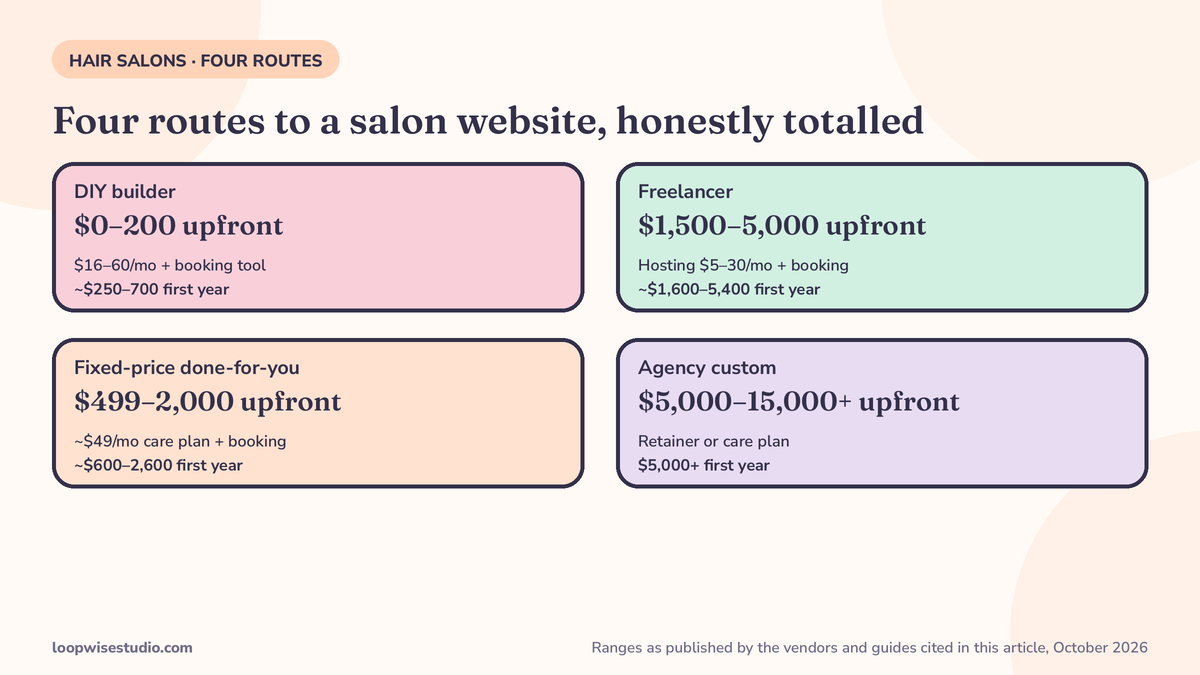
The 4 routes, side by side
| Route | Upfront | Monthly | Rough first-year total | Best for |
|---|---|---|---|---|
| DIY builder | $0–200 (template) | $16–60 + booking tool | ~$250–700, plus your time | Solo stylist, tight budget, simple menu |
| Freelancer | $1,500–5,000 | Hosting $5–30 + booking tool | ~$1,600–5,400 | A custom look without agency process |
| Fixed-price done-for-you | $499–2,000 | ~$49 care plan (optional) + booking tool | ~$600–2,600 | Owners who want it handled, at a known price |
| Agency custom | $5,000–15,000+ | Retainer or care plan + booking tool | $5,000+ | Multi-location or brand-led salons |
First-year totals are built from the vendor-published prices detailed below — DIY and freelancer ranges are the commonly cited ones from MuffinGroup’s salon-website guide, and every route still needs the booking layer priced in its own section further down. Keep that layer in mind as you read each route: it’s the cost nobody puts in the headline.
Route 1 — DIY builder: cheap in money, priced in hours
The builder route is genuinely inexpensive. Appy Pie, a no-code builder, publishes its salon plans at $36/month (Starter) and $60/month (Grow). MuffinGroup’s guide puts DIY platforms generally at $16–49/month — Squarespace $16–49, Wix $17–35, WordPress hosting $5–30 — plus $12–20/year for a domain and $50–200 one-time for a premium template, totalling roughly $250–700 for the first year.
What that total hides is your time: MuffinGroup puts the DIY build at 20–40 hours of owner time. Price your own hours honestly. A salon owner spending 30 hours building a site during the weeks they could be doing hair is not saving $1,500 — they’re spending it differently.
And know the limits before you start. Appy Pie’s own page is unusually honest about this: its website builder has no booking calendar of its own, and can’t take deposits, charge no-show fees, or send text reminders. Those come from the separate booking tool — which is fine, as long as you budget for both from the start.
Route 2 — Freelancer: the wide middle
MuffinGroup’s guide puts freelance salon websites at $1,500–5,000. Treat that as a commonly cited range rather than surveyed data — freelancer pricing is the least standardised corner of this market, and two quotes for the “same” site can differ by thousands for legitimate reasons.
What moves a freelance quote:
- Pages and design originality. A template adjusted to your brand sits at the low end; original design work climbs fast.
- Who writes the words. If the freelancer expects finished copy and photos from you, the quote is smaller and your homework is bigger.
- What happens after launch. Many freelance quotes end at handover. Edits, updates, and “the booking button stopped working” are then your problem or a new invoice.
The questions that protect you here are in the checklist at the end of this article. Get the booking-system connection in writing — a beautiful site whose Book button links to a generic tool page is a brochure, not a booking system.
Route 3 — Fixed-price done-for-you: the published-price route
This route barely existed in salon web design a few years ago: a specialist studio publishes fixed prices, builds the site for you, and charges a flat care plan after launch.
The clearest published example is Cider for Salons: a website launch at $499 one-time (up to 5 pages), Pro at $999 (up to 15 pages), and Signature at $2,000 (up to 30 pages plus logo design), with an optional care plan at $49/month covering hosting, domain, and four small edits a month. They offer a free first draft in 5–7 business days and charge the launch fee only when the site goes live. Another salon designer, 5280 Design, publishes a simpler offer: $500 flat, site done within a week, hosting at $240/year including maintenance.
What this route buys you is certainty: the price before you commit, and edits handled. What it doesn’t automatically include — read the fine print anywhere you buy — is the booking system itself. Cider’s model links your site out to the booking tool you already run (they list Vagaro, Fresha, Boulevard, GlossGenius, Square, and Booksy), which is honest and common. It means the booking subscription in the next section is still yours to pay.
If a fixed quote with the booking page and reminders built as one system is the version you want priced, get a free audit and we’ll scope it against your current setup first.
Route 4 — Agency custom: when $5,000+ is actually worth it
MuffinGroup places agency-built salon sites at $5,000–15,000 and up. At that level you’re paying for strategy, original brand design, copywriting, and a team — and for the right salon, it’s money well spent: multiple locations, a rebrand, a retail storefront, or a concept where the website is the brand launch.
For a single-location salon that mainly needs to be found on Google and take bookings cleanly, agency scope is usually more than the problem requires. The honest test: if the quote’s line items are mostly things your clients will never see, you’re buying the agency’s portfolio piece, not your booking system.
The cost nobody puts in the quote: your booking system
Website and booking system are two separate purchases, and most quotes only cover the first. Without the second, your shiny new site has a Book button that leads to a phone number — or to a tool that can’t take a deposit or send a reminder, which is how no-shows move back in.
Here is the booking layer, priced. These figures were compiled by Appy Pie from each vendor’s own pricing page, read on 21 October 2026 (Square’s read a week earlier) — second-hand, so verify on the vendor’s page before you budget a cent:
| Booking tool | Published monthly price | Notes |
|---|---|---|
| Square Appointments | Free; Plus $49 per location | Online card fee 3.3% + 30¢ on Plus |
| Fresha | $19.95 solo; $14.95 per member (Team) | Plus a 20% one-time fee on marketplace new clients, min $6 |
| GlossGenius | Standard $28 | Includes its own booking website |
| Booksy | $29.99 + $20 per extra staff member | Costs climb with team size |
| Vagaro | $30 + $10 per extra bookable calendar | Same pattern |
Note for the careful reader: MuffinGroup’s guide lists Vagaro at $25–85/month, which doesn’t match Appy Pie’s dated read of $30 + $10 per calendar. When two compilations disagree, trust the one with a read date — and confirm on the vendor’s pricing page, because all of these change. Premium all-in-one platforms sit above this table entirely: Mangomint’s real monthly cost for a small salon shows why a $165+ tier rarely belongs in a first website budget, and why that rent only makes sense once the diary is already full.
Appy Pie’s worked totals show what the stack looks like once you add both layers: a solo stylist runs $36/month all-in (their Starter plan plus free Square Appointments); a three-chair salon, $86/month (Starter plus Vagaro at $50 for three calendars); a five-chair salon with retail, $169.99/month (Grow plus Booksy at $109.99). The website was the smaller half of two of those bills.
What moves the price: the salon-specific scope
Two salons can both be quoted for “a website” and be buying different products. These are the scope items that change the number — Cider’s salon pages are a good reference, because their standard build quietly includes most of them:
- Per-stylist pages and booking links. One generic Book button for the whole salon forces clients to hunt for their stylist. A page and a booking link per stylist — essential with chair renters — adds pages and setup.
- Stylist-level pricing. Level-based menus (junior vs master pricing) need the price list structured properly, not photographed from the salon wall.
- A lookbook that stays current. Your work, not stock photos — and a way to update it without a developer.
- Walk-ins and policies, visible. Hours, walk-in availability, and the cancellation/deposit policy stated before the booking screen. Cider names this as a classic mistake: policies sprung on clients at the deposit step, where they abandon the booking.
- Gift cards and add-ons sold from the site, not just services booked on it.
The mistakes side of the ledger is short and worth taping to the quote: “call for prices” instead of a readable price list, one booking link for the whole salon, and photos that aren’t your work. A cheap site with all three mistakes costs more in lost bookings than a mid-range site without them. What belongs on the page is half the battle — the clinic version of that question is covered in the clinic website cost guide, and the mechanics differ less than you’d expect.
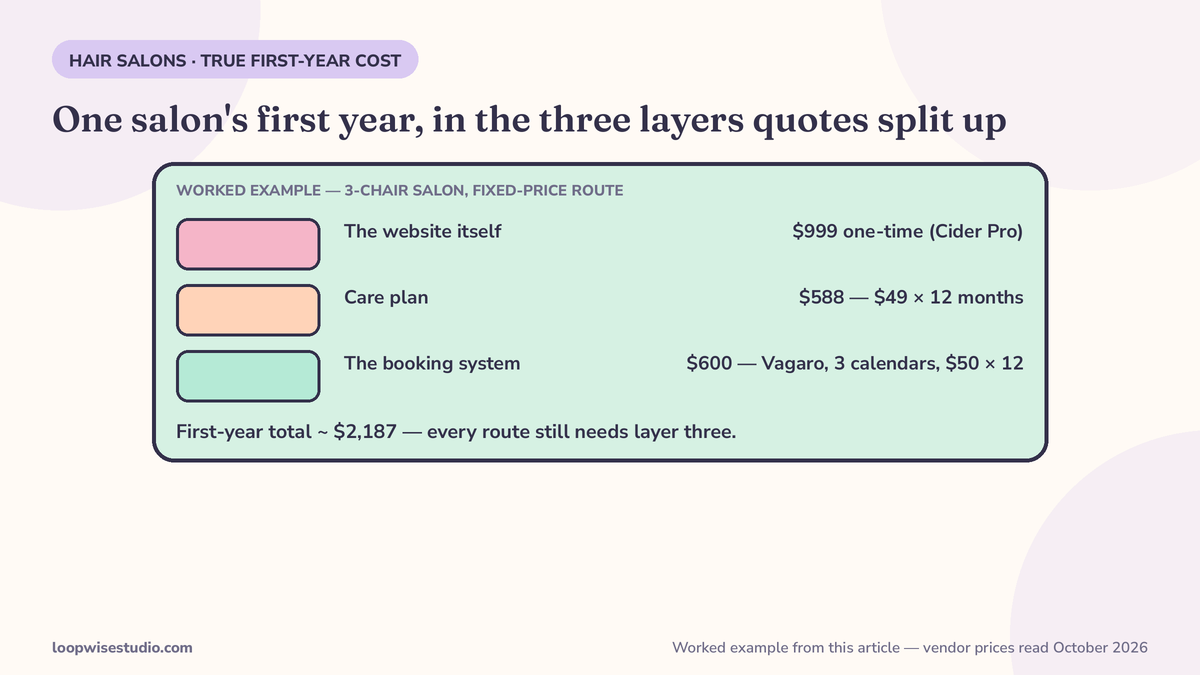
Year one, totalled: three salon sizes
Putting the layers together, using only the published prices above:
| Salon | Route | Website | Care / hosting | Booking system | Year one |
|---|---|---|---|---|---|
| Solo stylist | DIY | $36/mo (Appy Pie Starter) | included | Square free | ~$432 |
| 3-chair | Fixed-price DFY | $999 (Cider Pro) | $588 ($49 × 12) | Vagaro 3 calendars, $600 ($50 × 12) | ~$2,187 |
| 5-chair + retail | DIY | $60/mo (Appy Pie Grow) | included | Booksy 5 staff, ~$110/mo | ~$2,040 |
Read the middle row twice — it’s the row most owners get wrong. The done-for-you site’s launch fee is less than half its first-year cost once care and booking are counted. That’s not an argument against the route; it’s an argument for totalling every quote the same way before comparing. Compare year one to year one, never launch fee to monthly plan.
Timelines matter to the total too: the booking-website build timeline for salons shows where weeks go, and a site that launches a month late costs a month of bookings no invoice shows you.
The bottom of the market: $30 gigs and $9.99 pages
Below the DIY route sits a floor worth naming, because it ranks for this search too. Marketplace listings for salon websites start at $30, $90, and $170 tiers on Upwork — those are gig-floor prices for a template with your name swapped in, not a market rate for a working salon site. At the product end, one-page site offers like Menubly’s pitch a site plus booking link at $9.99/month under the slogan “skip the $4,000 website quote.”
Neither is automatically a bad buy for a brand-new stylist with no clients yet. But know what the floor leaves out, because it’s the same list every time: no readable price list structured per stylist, no deposit or reminder setup behind the Book button, no lookbook you control, and no one to call when the page breaks during your busiest month. The floor sells you a page. Everything in this article above the floor is, in one way or another, paying for the page to also be a booking system — and the gap between those two things is where salons lose the money they thought they saved.
When a booking page alone is enough
Honesty section, borrowed from Appy Pie’s own framing: if you’re a solo stylist whose clients all arrive through Instagram and word of mouth, a good booking-tool page may genuinely be all you need for now. Add a website when you need Google to find you, when chair renters need their own pages, when your menu outgrows a single list — or when the booking page’s limits (no deposits, no reminders, no your-brand-anywhere) start costing appointments.
The website is also what makes the rest of the machine possible: it’s the page your Google review requests link back to, and the thing that fills quiet hours when your weekday recall system sends clients somewhere worth landing.
How to compare two quotes: the checklist
Copy this and run every quote through it:
- Is the price a launch fee, a monthly plan, or both? What’s the first-year total?
- What does the booking system cost on top — and who pays it?
- Are per-stylist pages and per-stylist booking links included, or extra?
- Are deposits and text reminders set up, or just “supported”?
- Who makes edits after launch, and what does a small edit cost?
- Do I own the domain and the site if I leave?
- Are prices and policies published on the site — or “call us”?
- What does month 13 cost?
A quote that can’t answer these isn’t cheap. It’s unfinished.
The short version: budget $250–700 for a DIY first year (plus 20–40 hours of your time), $499–2,000 plus a care plan for fixed-price done-for-you, $1,500–5,000 for a freelancer, or $5,000+ for an agency — and add $0–110/month for the booking system every route needs, because that’s the layer that actually protects your appointments.
Want your current setup costed against what it should be doing? get a free audit — we’ll total your real year-one number and tell you plainly if a booking page is all you need.
FAQs
How much should a small hair salon website cost?
For a single location, most owners land in one of two sensible bands: roughly $250–700 for the first year doing it yourself on a builder, or $499–2,000 one-time plus about $49/month for a fixed-price done-for-you build. Add the booking system either way — $0–110/month depending on team size, per the October 2026 vendor prices above.
Is a $499 salon website legit, or too cheap to be real?
It’s a real, published model — Cider for Salons charges $499 for up to 5 pages with a free draft before you pay, and 5280 Design publishes $500 flat. Fixed-price studios make it work with tight scope. What to check is what the price excludes: booking system, edits after launch, and per-stylist pages are the usual extras.
Do I still pay for booking software if someone builds my website?
Almost always, yes. Most website builders — including done-for-you studios — link out to a booking tool you subscribe to separately. That’s fine, but total it: the booking layer runs $0–110/month and is the part that takes deposits and sends reminders, so it should be in your budget from day one, not discovered in month two.
How long does a salon website take to build?
The fixed-price route advertises days to a couple of weeks — Cider promises a free first draft in 5–7 business days. DIY takes as long as your 20–40 hours take to happen around a full book, which is why owner-built sites so often stall half-finished.
Can I update prices and staff myself afterwards?
On builders and most done-for-you care plans, yes — price changes are exactly the “small edits” a care plan covers (Cider includes four a month in its $49 plan). Ask before you sign: if a price change needs a developer and a ticket, you’ll stop making them, and a stale price list quietly costs bookings.
What’s the difference between a website and a booking page?
A booking page is one screen: services, calendar, checkout. A website is the whole front door — your stylists, prices, lookbook, policies, gift cards, and the Google presence that gets new clients to the booking page in the first place. Many salons start with the page and add the site when discovery becomes the bottleneck.