Automatic Google Review Requests for Hair Salons by Text
Send one automatic review text 2 hours after checkout to every hair salon client — no gating, no incentives. Templates, timing by service, re-ask rules.
An automatic Google review request for a hair salon is a text sent about 2 hours after checkout to every client, carrying a one-tap link to your Google profile. Every client gets the same message: sending the link only to happy clients is review gating, which Google prohibits. Send one reminder the next day, then stop.
That is the whole system. The rest of this page is the details that make it work in a salon specifically — when to send it for a cut versus a colour, what the texts should say word for word, how often you can ask a regular without annoying her, and which popular tools quietly break Google’s rules on your behalf.
Most salon owners know they need more reviews. What they usually have is a verbal ask at the till that depends on who is working, how busy the desk is, and whether anyone remembers. An automatic text takes the remembering out of it: the appointment completes in your diary, the text fires, the reviews come in steadily instead of in bursts.
Fresh reviews beat a high rating — Google searchers read the recent ones
A 4.8 rating built two years ago does less work than a 4.6 with three reviews from this month. Clients deciding between two salons on Google look at what was said lately, because a salon is only as good as its current team.
BrightLocal’s Local Consumer Review Survey found that 74% of consumers only pay attention to reviews written in the last three months. Read that the other way round: three quarters of the people checking you out will ignore anything older. A salon that asks every client, every visit, keeps a constant flow of recent reviews. A salon that ran one review push last spring is, to a new client, a salon with no reviews at all.
This is also why review count matters less than review flow. You do not need a campaign. You need a small, automatic ask attached to every single checkout, running all year. The salons that win local search are rarely the best salons in town — they are the ones whose reviews never go stale.
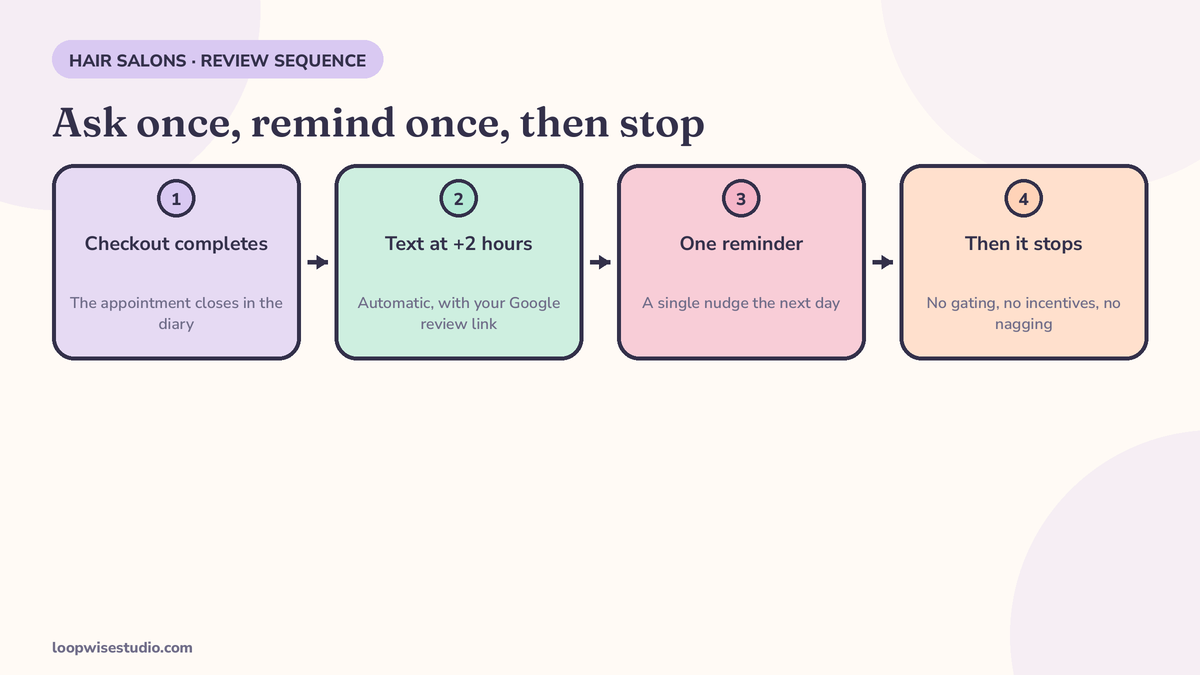
The exact sequence — ask in the chair, text at +2 hours, remind once, stop
The sequence has four parts. Three of them are automatic, and the whole thing takes less than a day from start to finish.
Step 1 — the verbal ask at the mirror. When the client sees the finished result, your stylist says one sentence: “If you love it, you’ll get a text from us in a bit — a Google review really helps me.” Ten seconds. This primes the text so it does not arrive cold, and it ties the review to the stylist, not just the salon.
Step 2 — the automated text, about 2 hours after checkout. Not at the till — the client is paying, holding a bag, finding her keys. Two hours later she has seen her hair in daylight, in the car mirror, and probably in a selfie. That is the emotional peak, and it is when the ask lands best. Review platforms built for salons use this same timing; Spokk, for example, sends its request text 2 hours after the appointment ends.
Step 3 — one reminder, the next day. A single short nudge for anyone who did not tap the link. Not a second ask with new wording — just a bump.
Step 4 — stop. No third text. A client who ignored two asks has answered. Chasing her costs you goodwill you will need at her next appointment.
| When | What happens | Who does it |
|---|---|---|
| At the mirror | One-sentence verbal ask from the stylist | Your stylist |
| ~2 hours after checkout | Text with your Google review link | Automatic |
| Next day | One short reminder text, only if no review yet | Automatic |
| After that | Nothing — the client is asked again after a future visit, on the cooldown rules below | Automatic |
One more mechanical point: send inside waking hours. Spokk’s salon setup sends between 8am and 9pm local time, and that window is worth copying — a review text buzzing at 11:40pm reads as spam, however good the haircut was.
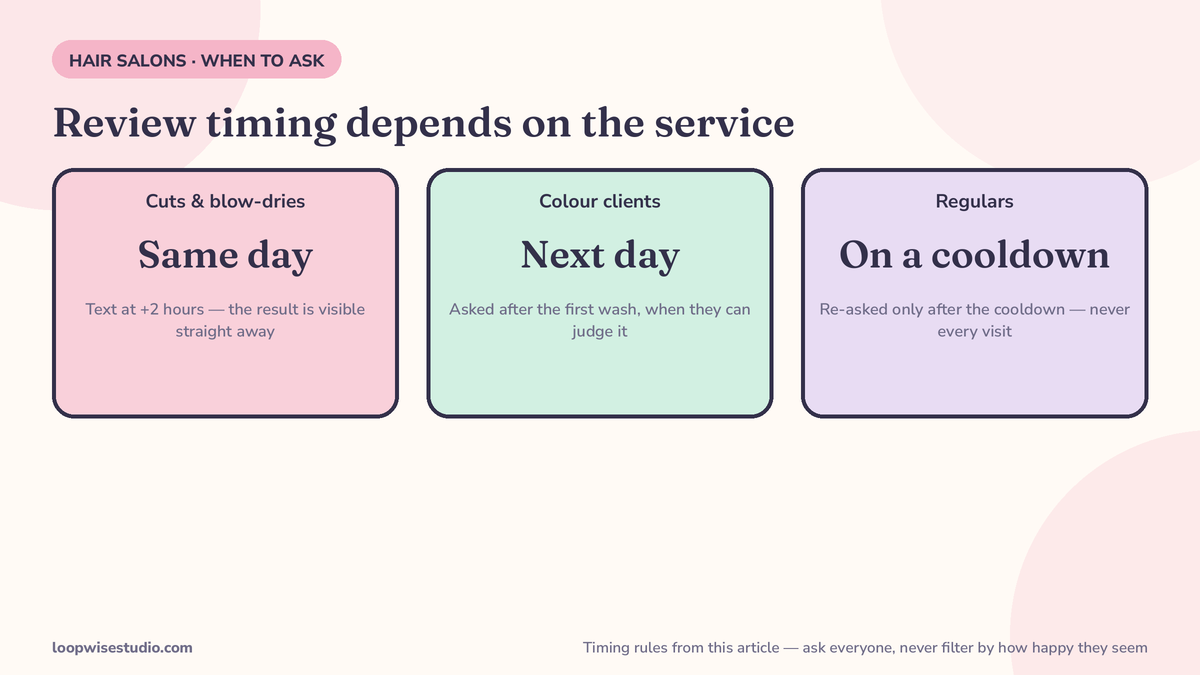
Timing by service — colour clients can’t judge their hair until the first wash
The 2-hour rule is right for most services. Colour is the exception, and getting it wrong costs you stars.
A balayage or a global colour looks different at home, in bathroom light, after the first wash. A client asked at +2 hours is reviewing the blow-dry and the salon experience, not the colour she paid for. If the tone settles slightly differently than she expected on day two, your review request is sitting in her messages at exactly the moment she forms her real opinion — and she may use it to say so publicly before she ever calls you.
Push the colour ask to the next day, after the first wash. She has lived with the colour, styled it herself, and knows whether she loves it. Spokk’s salon guidance makes the same call — delay the request for colour clients until the day after — and it is the one timing detail almost every generic review tool misses, because generic tools do not know what a first wash is.
| Service | Send the ask | Why |
|---|---|---|
| Cut, blow-dry, styling | Same day, ~2 hours after checkout | Result is final the moment she leaves; peak reaction is immediate |
| Colour, balayage, bleach | Next day | She judges the colour after the first wash, in her own light |
| Treatments (keratin, glosses) | Next day | The result is how the hair feels and behaves, not how it looked in the chair |
| First-ever visit, any service | Follow the service rule above | New clients are your most valuable reviewers — do not rush or delay them off-pattern |
If your booking system records the service (it should), the timing rule is just a setting per service type. Set it once; the system picks the right delay for every client.
Copy-paste texts — the four messages your salon actually needs
Nobody in the salon software world publishes the actual words. Here they are. Swap in your salon name, stylist name and review link.
1. The standard ask (+2 hours, cuts and styling):
Hi [First name], thanks for coming in today! If you’re happy with your hair, a Google review would mean a lot to us: [review link] — [Salon name]
2. The colour ask (next day):
Hi [First name], hope you’re loving the colour after the first wash. If you are, a quick Google review helps other clients find us: [review link] — [Salon name]
3. The one reminder (next day, only if no review yet):
Hi [First name], just bumping this up — if you have 30 seconds, a Google review really helps a small salon like ours: [review link]
4. The stylist-named ask (use when a stylist is building her own book):
Hi [First name], it’s [Salon name] — [Stylist] loved doing your hair today. Reviews that mention her by name help her fill her column: [review link]
Notice what none of these do. None of them ask for five stars. None of them offer anything in exchange. None of them check how the visit went before deciding whether to show the link. That is deliberate, and the next two sections explain why it matters.
The same ask-everyone principle is what we built into our med spa work — the automatic Google review requests med spas use by text run on the identical rule, because Google’s policy does not change by industry. And if your salon would rather reach clients on WhatsApp, the guide to getting Google reviews on WhatsApp covers the same sequence on that channel.
If you would rather not wire any of this up yourself, Loopwise builds the review text into the booking system we set up for you — checkout completes, the text fires, the timing rules are already set. get a free audit and we will map the sequence onto your current diary.
Asking regulars without nagging — the re-ask cooldown
Hair clients are repeat clients. TrueReview’s salon guide puts the return cycle at every 6–8 weeks, which means a loyal regular gives you six to eight chances a year to ask her for a review. Ask all six times and you are not marketing, you are pestering — and a client who has already reviewed you cannot leave a second one that counts the same way anyway.
Build in a cooldown:
- A client who left a review is not asked again for at least 6 months. She has done her part.
- A client who was asked but did not review can be asked again at a later visit — but not the very next one. Salon software SalonIQ, for reference, defaults its review requests to every second visit, which works out to roughly twice a year for a typical regular. That cadence is a sensible floor.
- Weekly clients (blow-dry regulars) need the longest cooldown of all. Spokk’s salon setup gives frequent regulars an extended gap between asks for exactly this reason. A standing Friday appointment should not generate a standing Friday text.
The rule of thumb: a regular should be asked at most two or three times a year, and only ever after a visit, never as a standalone blast. Review requests are a checkout habit, not a campaign.
The rules — no incentives, no gating, and the “feedback gate” trap
This section matters more than the templates, because some of the most popular advice on this exact topic will get your Google profile in trouble.
Rule 1: never offer anything for a review. No discounts, no free treatments, no entries into a draw. Incentivised reviews breach Google’s policies, full stop. Every honest source in this space says the same.
Rule 2: never decide who gets the link based on how happy they seem. This is review gating, and it is where the salon industry is currently being led astray — politely, and by software.
One top-ranking salon guide builds its whole system around what it calls a “feedback gate”: clients privately rate the visit, those who give 4–5 stars are sent to the public review platform, and those who give 3 or less are routed to a private form. The guide insists this is not review gating. It is. The moment the public ask depends on a private score, you are selectively soliciting reviews — which is the definition of gating used by Google and stated plainly in the FAQ of another automation guide on the same results page: policies prohibit “review gating (selectively soliciting only happy customers for public reviews).”
It gets blunter. One AI review tool aimed at salons describes its request feature, in its own FAQ, as a text “sent only to customers with 4–5 star service ratings” — and elsewhere on the same page, “only happy customers see the review link.” That is not a grey area. That is gating sold as a feature, running on your salon’s Google profile, under your salon’s name. If Google acts on it, the profile that loses its reviews is yours, not the tool’s.
The honest version is simple: every client gets the same invitation, whatever their visit was like. You can absolutely offer a private feedback route — a “tell us directly” option helps you catch problems early — but it must sit alongside the public link, offered to everyone, never instead of it for the clients you are worried about. Unhappy clients have the same right to the Google link as delighted ones. Most will not use it. The ones who do were going to find it anyway, and a fair response from you under a 3-star review does your profile more good than a wall of filtered 5-stars that Google may strip later.
If your reviews have stalled because clients never get asked at all, that is a systems problem, not a reputation problem — the same missing follow-through that makes a salon lose callers it never answers. Our breakdown of missed call text-back for salons and barbershops covers the other half of that front-desk gap.
What you need in place before you automate the ask
Three things, in order:
- Your Google review link. The short link from your Google Business Profile that lands clients directly on the review form — not your profile page, not your homepage. One tap from text to stars-and-words, or most clients will not finish.
- A trigger you can trust. The text must fire from a completed appointment in your booking system, not from a list someone exports. If your diary does not mark appointments complete, fix that first — it is also what your reminders and rebooking messages will run on.
- The timing and cooldown rules from this page, set per service and per client, so nobody has to think about them again.
You can assemble this from review software — Spokk, the most policy-honest product we found in this space, publishes pricing from $149/mo (check its site for current pricing) — or inside a general CRM if you have the hours to build and maintain the workflows. Or it can simply be one of the automations inside the booking system on your own website, which is how we set it up: the same system that takes the booking sends the reminder, the rebooking nudge and, after checkout, the review text. One client record, every message, no extra subscription.
While you are tightening follow-up, the diary itself usually has the same leak in the other direction — gaps nobody fills. The system in how to fill empty weekday appointments at a hair salon uses the same client list and the same texting habit to put bums in Tuesday chairs.
The short version
Ask every client, by text, about 2 hours after checkout — next day for colour. One reminder, then stop. Never pay for reviews, never filter who gets the link, and do not let any tool do either on your behalf. Set the cooldown so regulars hear it two or three times a year at most. Do that and your review flow never goes stale again.
If you want the sequence built into your booking system rather than bolted on, get a free audit — we will show you exactly where your current setup leaks reviews, calls and rebookings.
FAQs
Is it legal and allowed to ask for Google reviews by text?
Yes. Asking clients for a review by text is allowed, as long as you ask everyone the same way, offer nothing in exchange, and honour opt-outs. What Google prohibits is incentivised reviews and gating — only inviting clients you expect to rate you highly. Automation itself is fine; several guides and Google’s own policy language draw the line at who gets asked, not how.
When is the best time to text a salon client for a review?
About 2 hours after checkout for cuts, blow-dries and styling — the client has seen the result in daylight and is still feeling it. For colour, wait until the next day, after the first wash, because that is when she actually judges the result. Send inside waking hours (roughly 8am–9pm), and send one reminder the next day at most.
What is review gating, and why do some salon tools do it?
Gating means filtering who receives the public review link — for example, privately asking “how was your visit?” and only sending the Google link to clients who answer positively. Some tools market this as a “feedback gate” or a smart feature because it inflates ratings in the short term. Google prohibits selectively soliciting reviews, and the risk lands on the salon’s profile, not the software company.
How often should I ask a regular client for a review?
At most two or three times a year. A regular returns every 6–8 weeks, so ask on a cooldown: skip her if she has already reviewed you in the last 6 months, and skip at least one visit between asks if she has not. SalonIQ’s default of asking every second visit is a reasonable pattern to copy.
Can I offer a discount or a free treatment for a review?
No. Any incentive — discount, freebie, prize draw — makes the review incentivised, which breaches Google’s policies and can get reviews removed. The only “reward” a client should get for reviewing is being thanked.
What should I do when a bad review comes in anyway?
Reply, briefly and without arguing: thank them, acknowledge the specific issue, and invite them to contact the salon directly so you can put it right. Because you ask everyone, the occasional low review sits inside a flow of genuine recent ones — which is exactly what a client reading your profile expects a real salon to look like. Never respond by tightening who gets asked; that is the gating trap again.