Is Mangomint Worth It for a Small Salon?
Is Mangomint worth it for a small salon? The real 2026 monthly cost with add-ons, the pricing conflict explained, and a break-even test to run first.
Mangomint is worth it for a salon with roughly six or more staff, or a front desk that cannot keep up with the diary. For a solo or two-to-three-person salon, its current plan — $120 a month per location plus $10 per user, per its published pricing — plus add-ons usually costs more than the admin it removes. The older $165/$245/$375 tier prices still shown online were replaced in August 2026.
That last point matters more than it sounds. Search “is Mangomint worth it” today and you mostly get directory listings and rival vendors arguing with each other’s price lists. The verdicts are all over the place partly because half the internet is quoting a price Mangomint no longer charges. This page sorts out what it actually costs now, what the real monthly bill looks like once the add-ons land, and how to run the break-even maths for your own salon before you sign anything.
What Mangomint costs now — and why half the internet quotes a different price
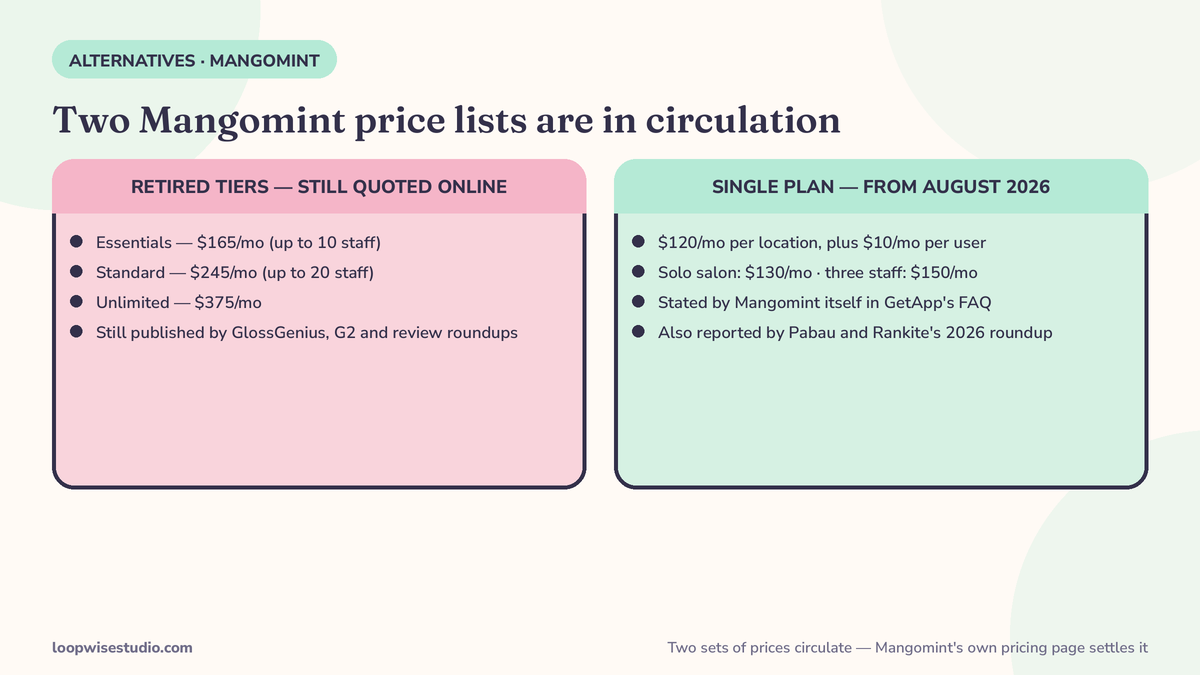
Mangomint used to sell three tiers. Several widely read pages still publish them as current:
| The old tiers (still published as current by some) | Price |
|---|---|
| Essentials (up to 10 staff) | $165/mo |
| Standard (up to 20 staff) | $245/mo |
| Unlimited | $375/mo |
Those figures appear on GlossGenius’s comparison page, on G2, and in several review roundups. But Pabau’s pricing breakdown states that Mangomint “has retired its three tiers” and now sells one plan: $120/month per location plus $10/month per user, with a headline starting price of $130 a month for a single user. GetApp’s FAQ carries Mangomint’s own statement saying the same thing — “All customers pay $120/month per location + $10/month per staff member. No contracts or hidden fees” — and Rankite’s 2026 roundup describes the single plan as “effective Aug 2026.”
So there is a live conflict in the sources, and this page won’t pretend otherwise. Two sets of prices are in circulation. The single-plan account is supported by Mangomint’s own statement on GetApp and three independent write-ups; the tier account is older and still being copied from page to page. The document that settles it for you is Mangomint’s current pricing page and, if you’re already a customer, your own invoice. Everything below uses the single-plan figures, dated August 2026, because those are the ones Mangomint itself states.
The real monthly bill: subscription is only the first line
A one-user salon starts at $130 a month. A three-person team is $150. Five staff, $170. That part is genuinely simple — reviewers praise Mangomint for dropping the tier maze. The bill grows in the add-on column:
| Add-on | Price as published | Source |
|---|---|---|
| Integrated forms | $50/mo (+$25 per extra location) | GlossGenius, DINGG |
| Two-way texting (Connect) | $75/mo (+$25 per location) | GlossGenius, DINGG |
| Phone line | $70/mo per line | Pabau, GetApp |
| Payroll | $50/mo + $8 per worker | All sources agree |
| Marketing | From $30/mo credit plans (Pabau/GetApp), or pay-as-you-go at 1¢ per email credit (GlossGenius) | Conflict — check current pricing |
| Card processing | 2.45% + 15¢ in person, 2.90% + 30¢ virtual | Pabau, citing Mangomint’s website — single source, verify before relying on it |
DINGG’s hands-on review — a 90-day test across three spa environments, and a rival vendor, so read it as an informed competitor rather than a neutral lab — warns that the add-ons “can double your monthly bill,” and that a two-location, full-feature setup “can easily exceed $500/month.”
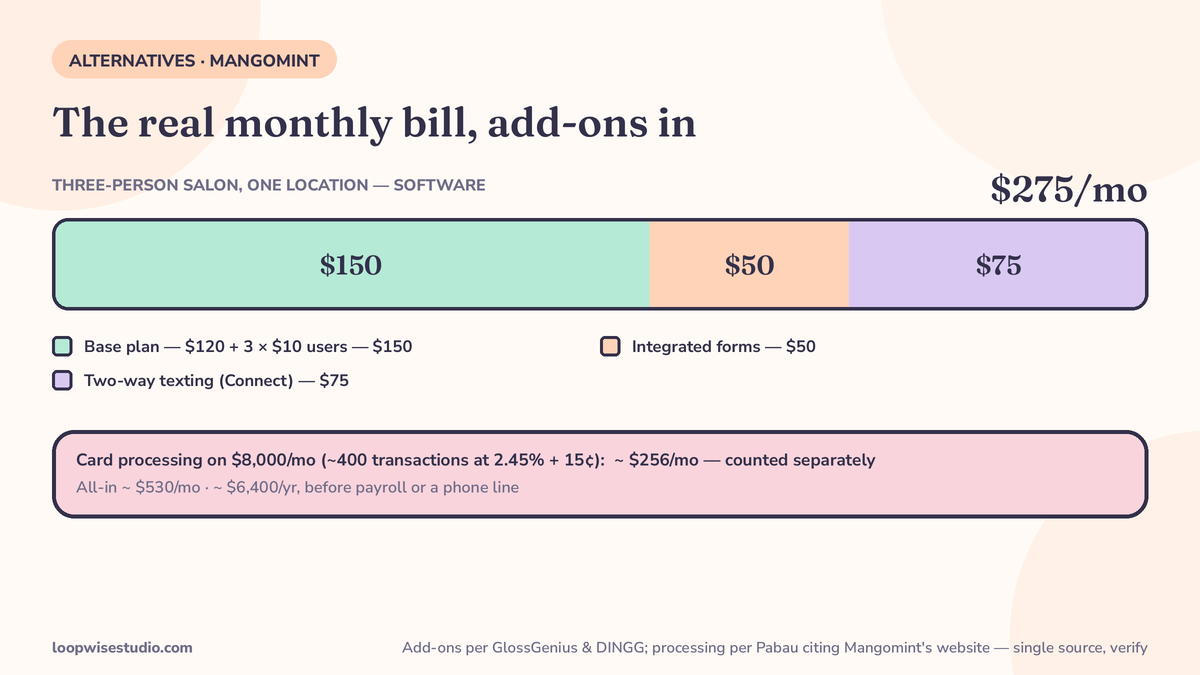
Here is the worked version for a small salon. Assumptions, stated plainly: three staff, one location, forms and two-way texting switched on, $8,000 a month in card sales across roughly 400 transactions.
- Base plan: $150
- Forms: $50
- Two-way texting: $75
- Software total: $275/mo
- Processing on $8,000 at 2.45% + 15¢: about $196 + $60 = ~$256/mo
That’s roughly $530 a month, about $6,400 a year, before payroll or a phone line. None of this makes Mangomint a bad product. It makes the “$130/month” headline the wrong number to judge it by. One more trap, flagged by ProjectManagers.net’s review: if you run cards through an outside processor instead of Mangomint’s, you lose features such as deposits and cards on file — so the processing line isn’t really optional.
What owners actually love, and what they complain about
The review pattern across Capterra, GetApp and G2 is unusually consistent, and it’s not “the software is buggy.” Pabau, citing Capterra, puts Mangomint at 5.0 out of 5 from 350+ verified reviews — a second-hand figure, but the directory pages themselves tell the same story: customer support is the most praised thing about the company, again and again.
The complaints cluster in one place: price at the small end. G2’s pricing Q&A notes that solo practitioners and independent stylists flag Mangomint’s pricing as a stretch, with several wishing for a lower-cost solo tier that doesn’t exist. DINGG’s verdict lands in the same spot from the other direction: solo practitioners find it “probably too expensive,” while a single-location business that values automation over cost savings is “a great fit.” Rankite positions it for “growing salons with 2 to 20+ staff where the front desk is the bottleneck” — a team tool, in other words, described as one by everyone including its fans.
The break-even test: three numbers to run before you pay
Don’t decide from reviews. Decide from these three numbers, which take about twenty minutes with your diary and your card statements.
Copy-paste worksheet:
- Front-desk hours. For one week, tally the time spent on booking admin only: answering booking calls and messages, sending reminders by hand, rebooking at the chair, chasing no-shows. Hours × what that time costs you (your rate, or a receptionist’s wage) = your current monthly admin cost. Mangomint has to beat this number, not just exist alongside it.
- No-show cost. Count last month’s no-shows and late cancellations that stayed empty. Multiply by your average ticket. If reminders and cards on file recover even a third of those slots, what’s that worth monthly? Be honest — use your diary, not a vendor’s percentage.
- True Mangomint total. Base plan for your headcount + the add-ons you will actually switch on + processing on your real card volume (use the worked example above as the template). Compare against numbers 1 + 2 combined.
If 1 + 2 comfortably exceeds 3, Mangomint pays for itself and the support reviews suggest you’ll be looked after. If the numbers are close, you’re buying polish, not profit — and polish is a weaker reason at three chairs than at ten.
The worksheet, run once. A three-chair salon, owner plus two stylists. The owner tallies a week of booking admin — calls, DM bookings, hand-sent reminders, rebooking at the chair — at roughly 5 hours, so about 21 hours a month. At a modest $25 an hour for that time, that’s ~$525 a month of admin. The diary shows five no-shows or dead late-cancels last month at an $85 average ticket: $425 lost, of which recoverable reminders and cards on file might plausibly save a third — call it $140. Problem total: ~$665 a month. Against Mangomint’s realistic ~$530 all-in from the worked example above, it clears — barely, and only because the admin hours are real. Now run the same worksheet for a solo renter: admin closer to 6 hours a month ($150), two no-shows ($170, a third recovered is $55) — a ~$205 problem against a $275-plus software bill before processing. Same product, opposite answer. That’s why “small” needed defining, and why no review roundup can answer this question for you.
Three myths the search results will sell you
Myth: “The entry price is $165 a month.” That was the retired Essentials tier. The current model, per Mangomint’s own statement on GetApp and three dated write-ups, is $120 per location plus $10 per user. Any comparison page still leading with $165/$245/$375 is quoting a price list replaced in August 2026 — which also means its verdict was written about a different offer.
Myth: “The add-ons are extras you can skip.” Look at what the add-ons are: forms, two-way texting, the phone line, marketing messages. For most salons those aren’t garnish — they’re the follow-up and no-show machinery that justifies the platform in the first place. DINGG’s review found add-ons can double the monthly bill. Budget for the version you’ll actually run, not the bare subscription.
Myth: “Five stars means it’s right for my salon.” The 5.0/5 Capterra score Pabau cites comes from a reviewer base heavy on exactly the team salons Mangomint suits — and the same review ecosystems carry solo practitioners saying the opposite about price. Averages hide the segment split. Read the one- and two-star reviews from salons your size, not the headline score.
If you’d rather someone else ran this audit on your current setup, that’s exactly what our free audit does — get a free audit and we’ll go through your booking costs and leaks with you.
When it’s the right call, and when it’s overkill
| Your salon | Verdict |
|---|---|
| Solo / booth renter | Overkill. There’s no cheaper solo tier, and the per-user model gives you nothing to grow into yet. |
| 2–5 staff, owner still runs the desk | The break-even zone. Run the worksheet. It wins if your admin hours and no-shows are genuinely costing you more than ~$300–500/mo. |
| 6+ staff, or you’re about to hire front-desk help | Worth it. The comparison isn’t software vs nothing — it’s software vs a wage. Mangomint usually wins that one, and this is the salon it was built for. |
| Multi-location | Worth pricing seriously, but model the per-location add-on surcharges (+$25 here, +$25 there) — DINGG’s $500+/mo warning is about exactly this shape. |
One more scenario worth naming, because the per-location maths cuts both ways: if you’re planning a second location within the year, price Mangomint as the two-location business you’re becoming, not the one-location salon you are. The base doubles to $240 plus users at both sites, and the +$25 per-location surcharges on forms and texting start to stack — exactly the shape behind DINGG’s warning that two-location, full-feature setups can pass $500 a month. Growth is a good reason to choose a platform; it’s a bad reason to be surprised by its bill.
And if you do decide to move — to Mangomint or away from it — the mechanics matter more than the platform: our guide to switching booking software without losing clients covers the export-first order that keeps your regulars safe.
The other shape of answer: your own booking page, no per-user fees
Every comparison in this space quietly assumes your booking system must be a subscription platform you rent by the head. There’s a second shape: a booking system on your own website, with text or WhatsApp reminders and follow-up built in, priced as a build rather than a per-user rent. No tier, no per-staff creep as you hire, and your client list lives on your domain.
That’s the model Loopwise builds — see how it stacks up against the platform route in the owner-operator booking software roundup, and specifically what it does about the follow-up work in our Mangomint alternative with automated follow-up and rebooking. It isn’t for everyone: if you want a big platform’s payroll, inventory and reporting suite, Mangomint is the more complete tool, and it’s only fair to say so — much as we said in our Boulevard alternative for med spas, good software isn’t the enemy. The enemy is paying team prices to solve a two-chair problem.
A note on where these prices came from
Because this page exists partly because the pricing information in this market is a mess, here’s the sourcing, plainly. The single-plan figures ($120 per location + $10 per user) are stated by Mangomint itself in GetApp’s FAQ, and independently reported by Pabau’s pricing breakdown and Rankite’s 2026 roundup, which dates the change to August 2026. The retired tiers ($165/$245/$375) are still published by GlossGenius, G2 and several review sites. Add-on prices are cross-checked where sources agree (forms $50, payroll $50 + $8 per worker) and labelled where they conflict (marketing) or rest on one source (card processing, via Pabau citing Mangomint’s website). Review patterns are drawn from the Capterra/GetApp/G2 corpus as characterised by those platforms and by Pabau and DINGG — both of which sell competing software, a bias we’ve flagged where their verdicts appear. Prices change; the invoice test stands. If Mangomint’s pricing page disagrees with anything here on the day you read it, the pricing page wins, and the break-even method still works with the new numbers dropped in.
The short version
Mangomint is a well-liked, well-supported platform whose current price — $120/mo per location plus $10 per user since August 2026, whatever older pages still say — only makes sense once your salon is big enough for the admin it removes to cost more than the bill. Run the three numbers first.
If the worksheet says you’re leaking more in missed bookings and manual follow-up than any subscription costs, get a free audit and we’ll map the cheapest fix for your salon — platform, own-website system, or a mix.
FAQs
Is Mangomint worth it for a solo stylist or booth renter?
Usually not. There is no solo tier: you pay the same $120/mo location base plus $10 as a team does per head, and the add-ons (forms $50, two-way texting $75) are flat regardless of size. G2 reviewers who work solo flag the pricing as a stretch and wish for a cheaper tier. A solo operator’s booking admin rarely costs $275+/mo, which is what a realistic Mangomint setup runs.
Why do some websites say Mangomint costs $165, $245 or $375 a month?
Those were the old three tiers (Essentials, Standard, Unlimited), and many pages — including GlossGenius and G2 — still publish them. Pabau, GetApp (quoting Mangomint itself) and Rankite report that Mangomint replaced them with a single plan in August 2026: $120/mo per location plus $10/mo per user. Check Mangomint’s own pricing page before relying on either set.
What does Mangomint really cost a month for a small salon?
For a three-person, single-location salon with forms and two-way texting on: $150 base + $50 forms + $75 texting = $275/mo in software, plus card processing (2.45% + 15¢ in person, per Pabau citing Mangomint’s website — verify current rates). On $8,000/mo of card sales that’s roughly another $256, so budget around $530/mo all-in.
Does Mangomint charge per staff member?
Yes, under the current model: $10/mo per user on top of the $120/mo per-location base, per Mangomint’s own statement on GetApp. Add-ons also scale in places — forms and texting each add $25/mo per extra location.
Can I use my own card processor with Mangomint?
You can, but ProjectManagers.net’s review warns that using an outside processor removes features such as deposits and cards on file — the tools that protect you from no-shows. For most salons the integrated processing is effectively part of the product, so include it in your cost comparison.
What should a small salon use instead of Mangomint?
It depends on the problem. If the problem is front-desk overload at 6+ staff, Mangomint is a strong answer. If the problem is missed calls, manual reminders and no follow-up at 1–5 staff, a booking system on your own website with text/WhatsApp reminders does that job without per-user fees. Run the break-even worksheet above before choosing either way.