How to Fill Empty Weekday Appointments at a Hair Salon
Fill empty weekday appointments at your hair salon with recall timed to service intervals, off-peak slot offers and a same-day gap-fill text list.
Fill empty weekday appointments by routing the clients you already have into the quiet hours: audit the last four weeks of your diary to find the exact dead windows, send rebooking prompts timed to each service’s natural interval — about six weeks for colour, four for waxing, three for gel infills — and text a small opted-in gap list the moment a weekday slot opens. You rarely need new clients; you need existing clients at a different time.
That last line is the whole argument, and it comes from Nuzzel’s “Quiet Tuesday” essay for TimeTailor, the sharpest piece written on this problem: Saturday is rammed, Thursday evening and Friday are full — and Tuesday at 11am, Wednesday at 2pm, and the post-lunch hour sit empty. The clients exist. They’re just all booked into the same ten hours.
So this is a system, not a tips list. Five steps: count the holes, recall by interval, make the quiet slot worth taking, run a gap-fill list for the holes that open anyway, and steer at checkout so next month’s diary is shaped better than this month’s.
Step 1 — Count the holes before you fix them
Nuzzel’s advice is to audit the last four weeks of unsold slots before running anything, because the pattern is always more specific than “Tuesdays are quiet.” SupaDay’s salon guide makes the same point with a longer window — 60 to 90 days of bookings by day and hour — and one warning worth repeating: a “slow Tuesday” is often busy 5–7pm and dead 10am–2pm. You’re not filling a day. You’re filling specific hours.
Do this once, on paper:
- Export or scroll the last 4 weeks of your diary.
- Mark every unsold chair-hour by day and start time.
- Circle the windows that repeat — same day, same hours, two weeks running or more.
Those circled windows are your targets. Everything below is aimed at them, not at “weekdays” in general.
What those empty hours are costing you
Worked example — assumptions stated, use your own numbers. Say your average ticket is $75 and you have two dead chair-hours a day, Tuesday to Thursday, that typically hold one appointment each. That’s 6 lost appointments a week: roughly $450 a week, or about $23,000 a year, per chair, in hours your rent and staff costs are already covering.
For scale, the published version of this maths from UK consultant Lilach Bullock uses a £65 average colour-and-cut and four empty hours a week, arriving at about £6,760 a year per chair — and over £20,000 a year across three stylists. Different currency, different assumptions, same shape of problem: the money isn’t lost in a dramatic way. It leaks out two quiet hours at a time.
Step 2 — Recall by service interval, not by newsletter
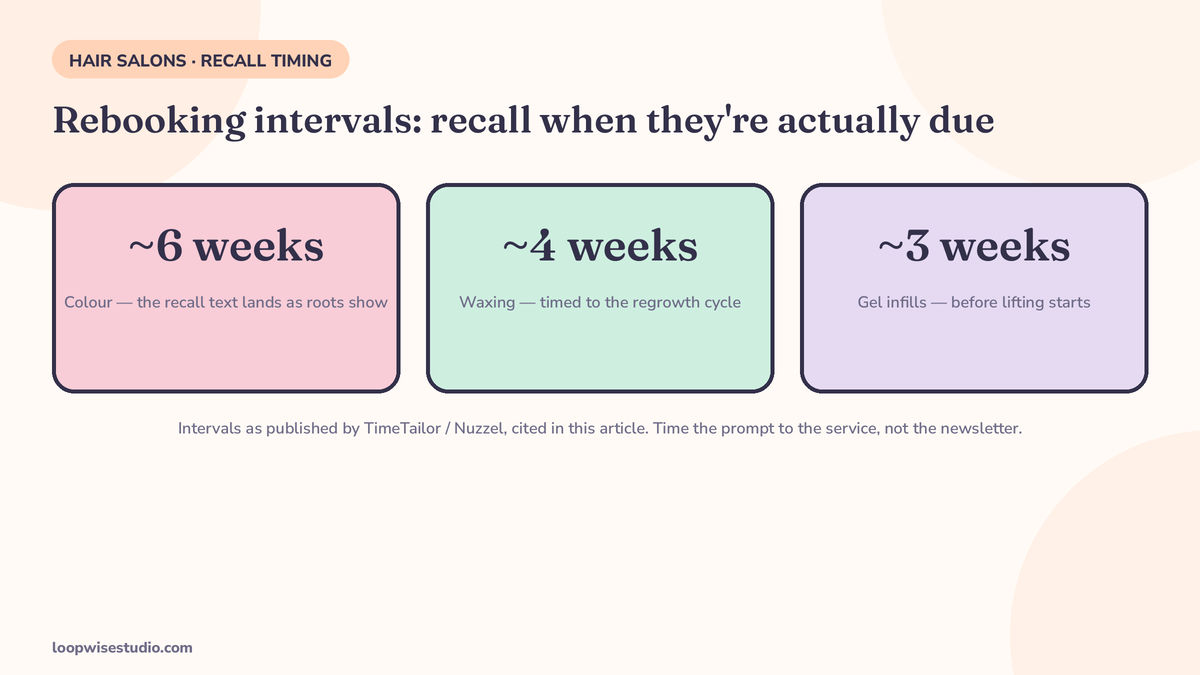
A monthly “we miss you!” blast goes to everyone, including the client who was in last week. A recall system messages only the clients whose service is coming due — and hair services run on cycles your diary already knows:
| Service | Typical rebooking interval | Source |
|---|---|---|
| Colour | ~6 weeks | TimeTailor / Nuzzel |
| Waxing | ~4 weeks | TimeTailor / Nuzzel |
| Gel infills | ~3 weeks | TimeTailor / Nuzzel |
| Everything else | Read it from your own booking history | Your diary |
Nuzzel calls this the service-specific rebooking nudge, and it’s the highest-value message a salon sends, because it arrives exactly when the client can feel the reason: roots showing, infills lifting. Set the interval per service in your booking system, and the message writes itself:
Recall text (colour, week 6): “Hi Jess, it’s been about 6 weeks since your colour — your usual slot with Mia is open this Thursday at 11am if you want it held: [booking link]. No pressure if the timing’s off.”
Notice the slot in that message: a quiet one. Recall isn’t just “come back” — it’s “come back into the window I’m trying to fill.” This is the same engine as a structured WhatsApp rebooking campaign, aimed at weekday hours instead of lapsed clients generally.
One step further out sits the client who is past her interval and still hasn’t booked. She’s not a recall anymore — she’s a win-back, and the timing matters. SupaDay’s guide puts the response sweet spot at 60–90 days since the last visit: long enough that the service genuinely needs redoing, recent enough that she still thinks of your salon as hers. Their own automated win-back defaults to clients inactive 90+ days, which tells you where the vendor sets the bar when its own product has to perform.
The message is short and carries a small, dated reason to act now. SupaDay’s published example runs along these lines:
“Hi [Name], it’s been a while since your last visit — book this week and get $10 off: [booking link]”
Aim that message at a weekday window and it does two jobs at once: a lapsed client returns, and she returns into a Tuesday. What you should not do is send it on a Friday for Saturday. Win-backs routed into quiet hours are the cheapest demand a salon ever buys, because the chair was earning zero.
Step 3 — Make the quiet slot worth taking, without a blanket sale
The instinct is a weekday discount across the board. Nuzzel argues against it directly: blanket discounts discount bookings that would have happened anyway, train clients to wait for offers, and cheapen the salon’s positioning. Discount the slot, never the service.
Two ways to price a dead window honestly:
- Off-peak slot pricing. A small, specific reduction on the window only — Nuzzel’s example is 10% off weekday mornings; SupaDay’s guide suggests $5–10 or 10–15% off dead hours, or bundling two services into the slow window.
- Value instead of a cut. SupaDay’s alternative: a free 15-minute add-on — a treatment, a finish — available only in the slow window. The ticket stays whole; the quiet hour becomes the smart hour to book.
Either way, the offer expires with the slot. A Tuesday 11am price that also applies on Saturday is not an off-peak strategy; it’s a pay cut.
If your diary, recall intervals, and offers currently live in three different tools, get a free audit — we’ll show you what the joined-up version looks like on your own booking page.
Step 4 — The same-day gap-fill list, for the holes that open anyway
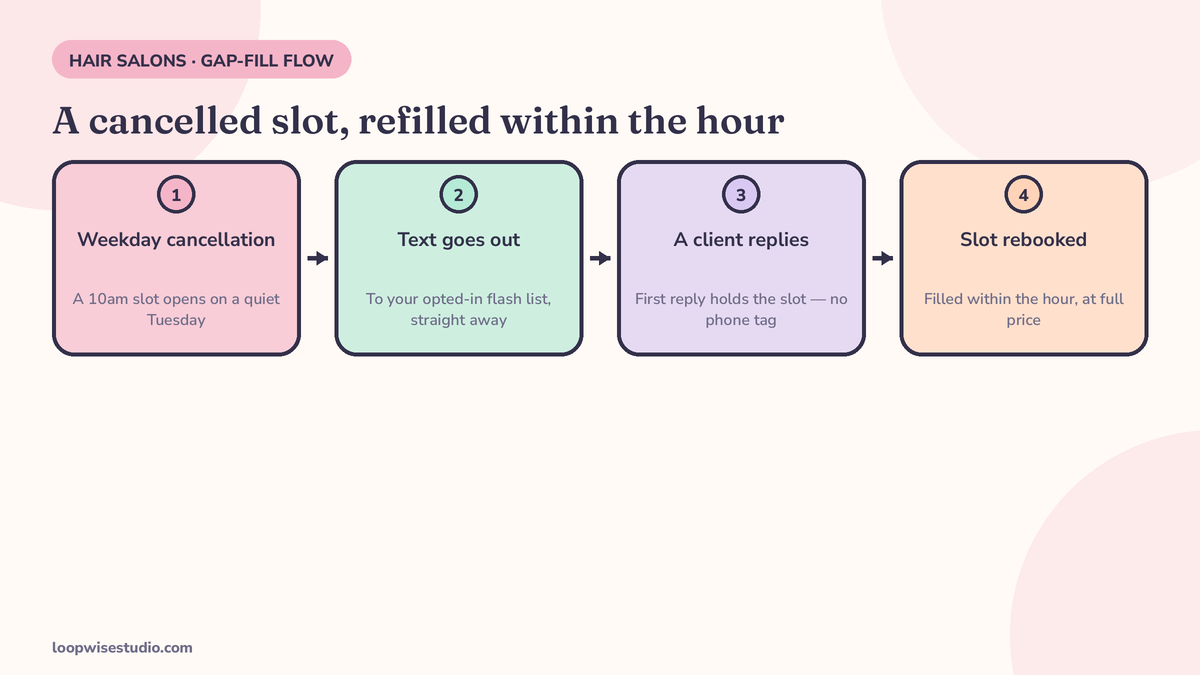
Some weekday gaps aren’t predictable: they open at 9:40am when a client cancels their 2pm. Filling those is a speed game, and it’s the piece with actual field data behind it.
Bullock documents setting this up for a salon as a 10-day build: assemble a “flash list” of roughly 60 clients who’ve opted in to last-minute offers, then set the trigger — when a cancellation lands more than 3 hours before the slot, the list gets a text, and the first to book wins. Her example message:
“Gap just opened, 2pm today with Sarah, colour and cut, £15 off if booked in the next hour. Reply YES.”
In the case she reports, the first week’s three gaps all filled within 40 minutes, and ten weeks in the salon was filling around 70% of same-day cancellations. Treat those as one salon’s reported results, not a benchmark — but her FAQ range for automated waitlist fills, 60–75% of same-day cancellations within an hour, is the most honest expectation-setting on the subject.
The template set — copy these:
Gap-fill (SMS): “Quick one, [Name] — a slot just opened today at [time] with [stylist] for [service]. [Offer if any.] First reply gets it: [booking link]”
Gap-fill (WhatsApp): “Hi [Name] 👋 [Salon] here — [stylist] has a gap today at [time] (usually gone fast). Want it? Book here: [link]”
Off-peak regular offer (weekday window): “We’re holding a few quiet-hour slots this [day] at [times] for regulars — [offer]. They’re not on the public booking page: [link]”
Solo or two chairs? Bullock’s stripped-down version needs no software at all: a WhatsApp broadcast list of about 20 flexible regulars and the same 10-second template, sent by hand. The system scales down fine. What doesn’t work is the alternative most salons still use — a “gap tomorrow!” Instagram post. In her case it drew roughly 1 reply from 4,000 followers. A post hopes the right person is scrolling; a text goes to the 60 people who already said yes.
Note the difference from a cancellation-refill system: that fills slots a client gave back. This step is your rescue net — the automatic refill of cancelled appointments covers how the waitlist side of it runs. Weekday shaping, steps 2, 3, and 5, is what stops the holes forming in the first place.
Step 5 — Steer at checkout: book the next visit into a quiet day
The cheapest gap to fill is the one that never opens. When a client rebooks at checkout — SupaDay’s guide pushes recurring appointments at the natural interval, every 4 or 6 weeks — the stylist chooses which day the standing booking lands on.
That choice is the whole trick: a colour client on a 6-week cycle can be a Saturday regular or a Tuesday regular forever, at the same price, with the same loyalty. Ask at the desk: “Same again in six weeks? That’s the Tuesday — quieter, and I can take more time on the finish.” Many clients prefer the quiet day once it’s offered as the better experience rather than the leftover.
And the genuinely new client: aim her at the quiet hours too
Everything so far routes existing clients. New clients belong in this system as well — with one discipline from Nuzzel’s essay: a new-client offer should be aimed only at new clients, never sprayed at the whole list, or your regulars end up subsidised for no reason.
The weekday twist is simple. When a new client finds you — through Google, Instagram, a referral — the booking page decides which hours she sees first. Put the quiet windows at the top of the offer: a first-visit colour consultation on a Tuesday morning, an intro cut in the post-lunch gap. She has no habits with you yet, so there’s nothing to retrain; her first appointment sets her default day, and a client acquired into a Tuesday tends to stay a Tuesday client. Growth that lands in dead hours costs you nothing in peak capacity — which makes weekday-shaped acquisition worth more than the same client won for Saturday.
Protect what you fill: deposits on hard-to-refill slots
A filled quiet slot that no-shows is worse than an honestly empty one — you turned other clients away for it. SupaDay’s seventh rule is the guard: protect the slots you fill with a deposit or cancellation fee, especially on slow-window bookings that came in on an offer. The deposit doesn’t need to be heavy. It needs to exist, be stated before booking, and be the same rule for everyone.
The 3 numbers to check every week
Bullock’s measurement set is the one to steal:
| Number | What it tells you | Healthy sign |
|---|---|---|
| Fill rate | Share of gaps that get rebooked | Rising month over month |
| Time to fill | How fast a gap goes after the text | Under 1 hour good; under 30 minutes excellent |
| Flash-booker repeat rate | Do gap-fill clients come back at full rhythm? | Under ~25% repeat suggests the wrong list — deal-hunters, not regulars |
Check them on the same day each week, next to the hole count from step 1. If holes shrink and fill times drop, the system is working and the numbers — not a streak of busy Saturdays — prove it. And once the diary is fuller, the follow-up that compounds it is asking those happy regulars for reviews at the right moment, which is exactly what automatic Google review requests by text handles.
Doing it yourself vs having the system set up
Every step here can be DIY’d: an audit on paper, recall messages from most booking tools, a broadcast list on your phone. Bullock’s solo-salon version runs on exactly that.
Where owners stall is the joins — recall intervals configured per service, the gap-fill trigger watching the diary, the booking page steering new bookings toward quiet windows, deposits wired into the same flow. That’s a setup job, done once. It’s what Loopwise Studio builds for salons: your booking page and messaging working as one system instead of five logins. The audit comes first either way — knowing your real dead windows costs nothing and changes what you’d build.
The short version: audit four weeks to find your real dead hours, recall clients by service interval into those hours, price the slot (not the service) when you need a nudge, and keep a 60-name gap list for the cancellations that land anyway. Steer every checkout rebooking toward a quiet day and next month mostly fills itself.
Want the system built on your diary instead of your to-do list? get a free audit and we’ll start with your hole audit — the four-week picture, in plain numbers.
FAQs
Do I need new software to fill weekday gaps?
Not to start. The audit, the recall timing, and a WhatsApp broadcast list for a small salon all run on what you have. Software earns its keep when you want the trigger automated — cancellation lands, list gets texted, first reply books — and when recall intervals need to fire per service without you remembering.
How big a discount should a last-minute gap offer carry?
Bullock’s practice guidance is 15–25% for true last-minute fills, and Nuzzel’s off-peak example is smaller — around 10% on weekday mornings — because that offer is planned, not desperate. Keep the discount attached to the slot and the hour, never to the service everywhere.
Won’t texting clients offers annoy them?
The flash list is opt-in — clients join because they want first refusal on gaps. Frequency is self-limiting: the list only hears from you when a real gap opens. That’s a different message from a weekly blast, and clients read it differently.
What’s a realistic fill rate for same-day cancellations?
In the one documented case on this, around 60–75% of same-day cancellations filled within an hour once the list and trigger were set up (Bullock, 2026 — single consultant’s case data, so treat it as indicative). Your mileage depends mostly on list size and how flexible your regulars’ schedules are.
Does this work for a solo stylist?
Yes — it’s arguably easier. One chair means a shorter list (about 20 flexible regulars on a WhatsApp broadcast, per Bullock’s method), one diary to audit, and gaps you can often fill with a single text. Solo operators also gain the most per filled hour.
How is this different from just running weekday promotions?
A promotion announces a price to everyone and hopes. This system routes specific clients — due for a service, opted into gaps, or rebooking at the desk — into specific hours you’ve already identified as dead. The promotion is one small tool inside step 3, pointed at a slot, with an expiry.