How Much Does WhatsApp Automation Cost in the UK?
What WhatsApp automation actually costs a UK small business in 2026: Meta's current per-message rates, platform fees, setup, and a worked example for a salon or clinic.
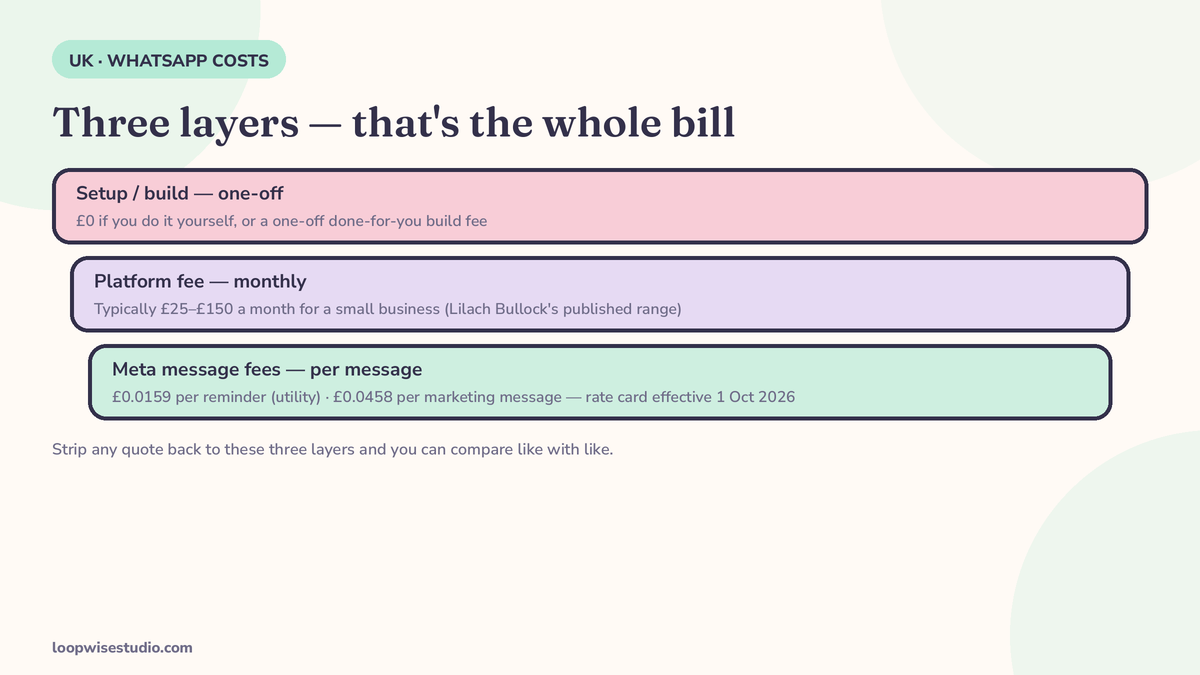
For a UK small business, WhatsApp automation costs three things: Meta’s per-message fees (£0.0159 per appointment reminder and £0.0458 per marketing message on the rate card effective 1 October 2026), a platform fee (typically £25–£150 a month, per consultant Lilach Bullock’s published range), and setup — free if you do it yourself, or a one-off build fee if it’s done for you.
That surprises most owners. They expect the messages to be the expensive part. They aren’t. For an appointment business, Meta’s share of the bill is usually the smallest line on it — often under £15 a month. The rest of this page breaks down each layer, works a real example for a salon or clinic, and flags the traps that quietly triple costs.
The three layers you actually pay for
Every WhatsApp automation bill, whatever the vendor, is made of the same three layers:
| Layer | What it is | Typical cost |
|---|---|---|
| Meta message fees | What Meta charges per delivered message on the WhatsApp Business Platform | £0.0159 utility / £0.0458 marketing per message (rate card effective 1 Oct 2026) |
| Platform fee | The software that connects you to WhatsApp — templates, automations, inbox | Typically £25–£150/month for a small business (Lilach Bullock’s published range) |
| Setup / build | Getting it built: DIY with your own time, or a one-off done-for-you fee | £0 DIY, or a one-off build fee, sometimes plus a care plan |
Vendors bundle these differently, which is why quotes look incomparable. One quotes £95 a month “plus Meta fees”. Another quotes a one-off build and passes Meta’s fees through at cost. Strip any quote back to these three layers and you can compare like with like.
This is the same discipline that applies to any booking-system purchase: the headline price is never the whole price. If you’re costing the website side too, our breakdown of how much a website with online booking costs a clinic uses the same layers approach.
Meta’s UK rates right now — and the model change most pages missed
Meta changed how it charges on 1 July 2025. Before that, businesses paid per conversation — a 24-hour window. Since then, Meta charges per delivered message, and replies your customers send you are not charged.
The current UK rates, on Meta’s GBP rate card effective 1 October 2026 (as published by Logica HQ and Flowcall, two independent rate trackers who agree on the figures):
- Utility messages: £0.0159 each — booking confirmations, appointment reminders, reschedule notices. The everyday traffic of an appointment business.
- Marketing messages: £0.0458 each — offers, rebooking campaigns, anything promotional.
- Service replies are free inside the 24-hour customer-service window, and each phone number gets 1,000 free service messages a month.
Two warnings from the research behind this page:
Most pricing pages online are out of date. Two of the top five pages ranking for this query still teach the retired per-conversation model, quoting prices “per conversation” that Meta abolished in July 2025. If a vendor’s pricing page talks about conversation windows, their numbers are at least a year stale.
Rates move. The marketing rate was £0.0382 in July 2025 and is £0.0458 now. Meta revises the card roughly twice a year, so treat any figure — including these — as “check the live rate card before you budget”.
What a clinic or salon actually sends in a month — the worked example
Here is the calculation no vendor page does: the real message mix of an appointment business.
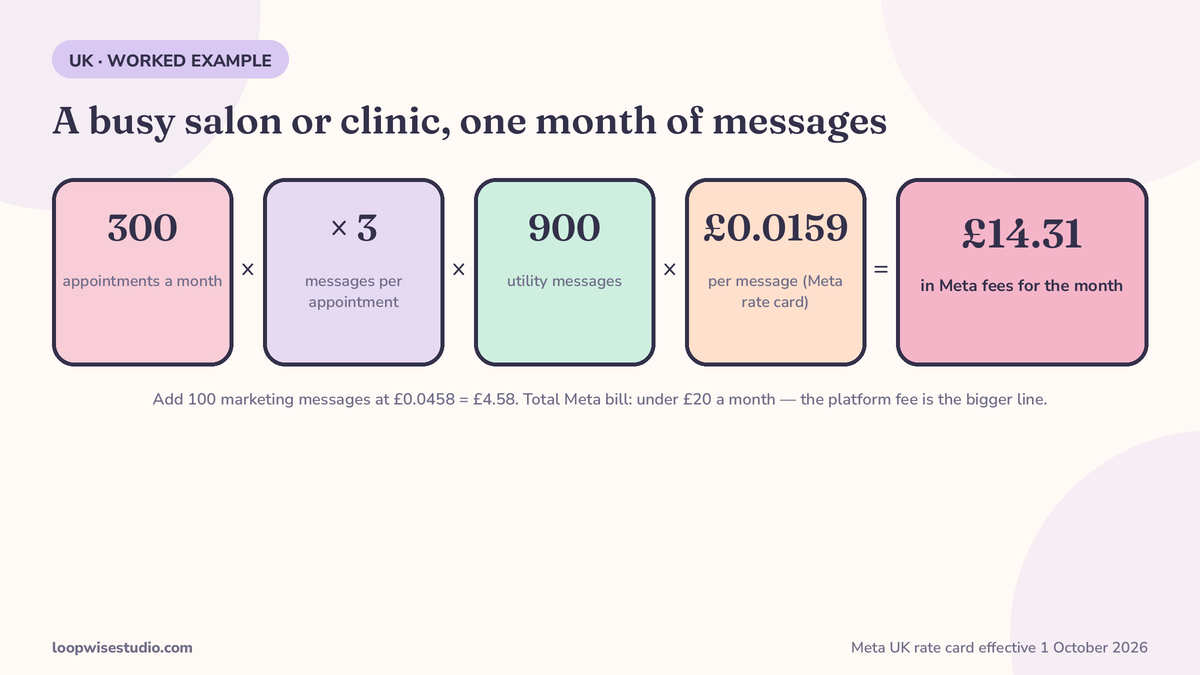
Say your salon or clinic handles 300 appointments a month. For each one, the system typically sends:
- A booking confirmation — utility
- A reminder 48 hours before — utility
- A reminder 2 hours before — utility
That’s 900 utility messages. At £0.0159 each: £14.31 in Meta fees for the month.
Add the marketing side: a rebooking nudge or review request to, say, 100 clients. Even if all 100 are billed as marketing at £0.0458, that’s £4.58. Replies from clients land inside the free service window.
Total Meta bill: under £20 a month for a busy appointment business. The platform fee (£25–£150) is the bigger line, and the setup is a one-off. When a vendor quote looks large, it’s almost never Meta’s messages driving it — it’s the platform and the labour, which is exactly what you should be comparing. If you are in Ireland, the same message maths applies on the euro card — our guide to WhatsApp booking in Ireland covers rates and clinic setup together.
Want to run your own numbers? Take your monthly appointments, multiply by 3 messages, multiply by £0.0159. That’s your Meta floor.
How the billing actually works, in plain terms
A few mechanics explain most of the confusion around WhatsApp pricing:
- You pay per delivered message, not per chat. A confirmation, a reminder and a review request are three separate messages. A back-and-forth conversation doesn’t rack up charges the way the old per-conversation model did — your customers’ replies inside the 24-hour service window are free.
- Every automated message uses an approved template, and Meta classifies it: utility (about a specific booking or transaction) or marketing (promotional). Classification is where the price difference lives — £0.0159 versus £0.0458 — and it’s why a reminder should never smuggle in an offer.
- The free tier is real but small. Each phone number gets 1,000 free service messages a month. A quiet business may live inside it; a busy salon sending 900 reminders won’t — but at £0.0159 each, exceeding it is a rounding error, not a budget line.
- Volume discounts exist and don’t apply to you. Meta’s card includes tier discounts (around 5–25%) that only start to bite at roughly 100,000+ messages a month. Ignore them in any quote aimed at a small business.
Your copy-paste cost worksheet
Four lines give you your real monthly Meta bill:
- Appointments per month: ______
- Utility messages per appointment (confirmation + 2 reminders = 3): × 3
- Line 1 × line 2 × £0.0159 = £______ (your Meta utility bill)
- Marketing messages per month × £0.0458 = £______
Add your platform fee (or £0 on the free app) and you have the whole running cost. Everything else in a quote is setup.
Three ways to buy it — like-for-like totals
1. The free WhatsApp Business app — £0, plus your evenings. The app is genuinely free and fine for manual messaging. Nothing is automated: no booking confirmations at midnight, no reminder sequence, no review asks. The cost is your time, every day, forever.
2. A DIY platform — typically £25–£150/month plus Meta fees plus your setup time. You rent software (a “BSP” — business solution provider), connect your number, build the templates and flows yourself. Published UK plans illustrate the spread: ChatDaddy’s UK pricing (as published March 2026) runs from a free tier to roughly £95, £240 and £640 a month by team size, with Meta fees on top. One real-world anchor: consultant Lilach Bullock describes a Kent clothing shop paying £50 a month platform plus about 1,200 utility messages a month, landing at roughly £180 a month all-in — one business’s actual bill, not an average.
3. Done-for-you — a one-off build fee, a small care fee if you want one, Meta fees at cost. Someone builds the booking and messaging system around your business. As a market reference point, UK agency Augustova publishes a WhatsApp AI Assistant build at £795 one-off plus an optional £79/month care plan (their prices, updated October 2026) — that’s a generic AI assistant, not an appointment system, but it shows the shape of fixed-price done-for-you pricing. Your Meta fees then run at the worked-example level above: typically under £20 a month.
Comparing a phone-based service instead? The same layering applies — see what a plumbing answering service costs once per-minute billing and after-hours premiums are added up.
The four cost traps
1. The misclassified template. A reminder is utility at £0.0159. Add one promotional line — “…and 20% off your next facial this week!” — and the whole message bills as marketing at £0.0458, roughly three times the price. Keep reminders purely about the appointment.
2. Platform markups on Meta fees. Some platforms pass Meta’s fees through at cost; others add a margin on every message. Ask one question before signing: “Do you mark up Meta’s per-message rates, and by how much?” If they can’t answer in pence, that’s your answer.
3. Ex-VAT quotes. Most B2B prices in this market are quoted excluding VAT. A £95 plan is £114 on the invoice. Compare totals including VAT.
4. Volume tiers you’ll never reach. Meta offers tier discounts of around 5–25% — starting at volumes like 100,000 messages a month. A small business sending 1,000 will never see them. Any pitch built on “volume savings” isn’t built for you.
The same trap-spotting applies to marketplace fees, by the way — the true cost of Treatwell’s charges for UK salons is another bill that looks small per transaction and isn’t.
How to read any WhatsApp automation quote in 60 seconds
Take the quote apart with five questions:
- Which Meta rate card is this priced on? If it says “per conversation”, it’s pre-July-2025 pricing — walk away or make them re-quote.
- Are Meta’s fees included, passed through at cost, or marked up? Get the answer in pence per message.
- Is the platform fee the whole subscription? Some platforms price per user or per location, so a “£25” quote becomes £75 with three staff.
- Is setup one-off or hidden in the monthly? A higher monthly with “free setup” usually costs more by month six.
- Is VAT on top? Assume yes until told otherwise, and compare all quotes VAT-inclusive.
Augustova’s published model passes this test cleanly, which is worth copying whoever you buy from: every price listed, dated (“updated October 2026”), ex-VAT stated openly, and even their running-cost expectation published — “about £10 to £40 a month for a typical automation” (their own estimate). Demand the same four things from anyone else.
The wider platform market, for orientation
If you shop the DIY route, you’ll meet prices all over the map. One comparison table (TopTenAIAgents, a vendor roundup — treat its figures as indicative, not gospel) lists entry points like 360dialog from ~£50 a month, Tidio from ~£19 a month and Intercom’s Fin from ~£74 a month. The spread tells you less about value than about what each product thinks it’s selling: a bare connection to WhatsApp, a chat widget with AI bolted on, or a support platform. For an appointment business, the question is never “what’s the cheapest platform?” — it’s “does it run my booking confirmations, my reminder sequence and my review asks without me touching it?” A £19 tool you have to operate daily costs more than a £50 one you don’t.
Does consent and GDPR add cost?
Not in money — in setup care. Marketing messages on WhatsApp need a proper opt-in from the client, captured and recorded; appointment reminders to existing clients about their own booking are service messages and sit in a different category. Either way, your message templates need Meta’s approval before they send, which is a one-off setup step, not a recurring fee. Where owners get caught is blurring the categories — using the cheap utility route for what is really a promotion. Keep service messages about the appointment and marketing messages opted-in and honest, and the compliance cost of WhatsApp automation is effectively zero.
When free is genuinely enough — and when it stops being enough
Stay on the free app if you take a handful of bookings a week and you personally answer every message. It costs nothing and it works.
It stops being enough at a specific moment: when bookings arrive while you’re with a client, asleep, or closed — and sit unanswered. A confirmation that goes out instantly, a reminder that sends itself at 48 hours, a review request you’d never remember to send — that’s what the paid layers buy. Not the messages. The messages cost £14.31.
If you’re at that point and want the whole thing — website booking, WhatsApp confirmations, reminders, review asks — built around your diary rather than rented as generic software, get a free audit and we’ll map what your message mix and costs would actually look like before you spend anything.
What it comes down to
WhatsApp automation for a UK small business = Meta fees (pennies per message, £0.0159 utility / £0.0458 marketing on the 1 October 2026 card) + a platform fee (£25–£150/month typical) + setup (£0 DIY or a one-off build). For a 300-appointment month, Meta’s share is about £14. Judge every quote by its three layers, not its headline.
FAQs
Is the WhatsApp Business app free?
Yes. The WhatsApp Business app costs nothing and includes basic features like a catalogue and quick replies. What’s not free is the WhatsApp Business Platform (the API) used for automation: Meta charges per delivered message, and you’ll usually pay a platform fee on top.
How much does Meta charge per WhatsApp message in the UK?
On the rate card effective 1 October 2026: £0.0159 per utility message (confirmations, reminders) and £0.0458 per marketing message, per delivered message. Replies from customers inside the 24-hour service window are free, and each number gets 1,000 free service messages a month. Rates change — Meta revised the card in July 2025 and October 2026 — so check the live rate card.
Why do some websites quote WhatsApp prices “per conversation”?
Because that was Meta’s old model, abolished on 1 July 2025 in favour of per-message pricing. Pages still quoting per-conversation prices (or “first 1,000 conversations free”) are out of date — treat their other numbers with the same suspicion.
What’s the difference between a platform fee and Meta’s fees?
Meta’s fees pay for the messages themselves and go to Meta. The platform fee pays the software company that connects your business to WhatsApp and provides templates, automations and an inbox. Some providers mark up Meta’s fees as well as charging their platform fee — ask before you sign.
How much would a salon or clinic pay in total?
Using the worked example on this page: 300 appointments a month generates about 900 utility messages, roughly £14.31 in Meta fees. Add a platform at £25–£150 a month if you DIY, or a one-off build fee if it’s done for you. For comparison, a small salon website itself is a separate purchase — see what a website costs for a hair salon.
Do I need clients’ permission to send WhatsApp reminders?
Appointment confirmations and reminders to existing clients about their own booking are service messages; marketing messages (offers, campaigns) need proper opt-in under UK GDPR/PECR rules. Keep the two separate — it also keeps reminders at the cheaper utility rate instead of the marketing rate.
If you’d rather not assemble this yourself, get a free audit — we’ll price your exact setup, message mix included, with no obligation.