How Much Does a Website Cost for a Massage Therapist?
Massage-only figures: DIY $200–$500 in year one, templates $500–$1,500, agency builds $3,000–$15,000 — plus booking software at $10–$350/mo most quotes leave out.
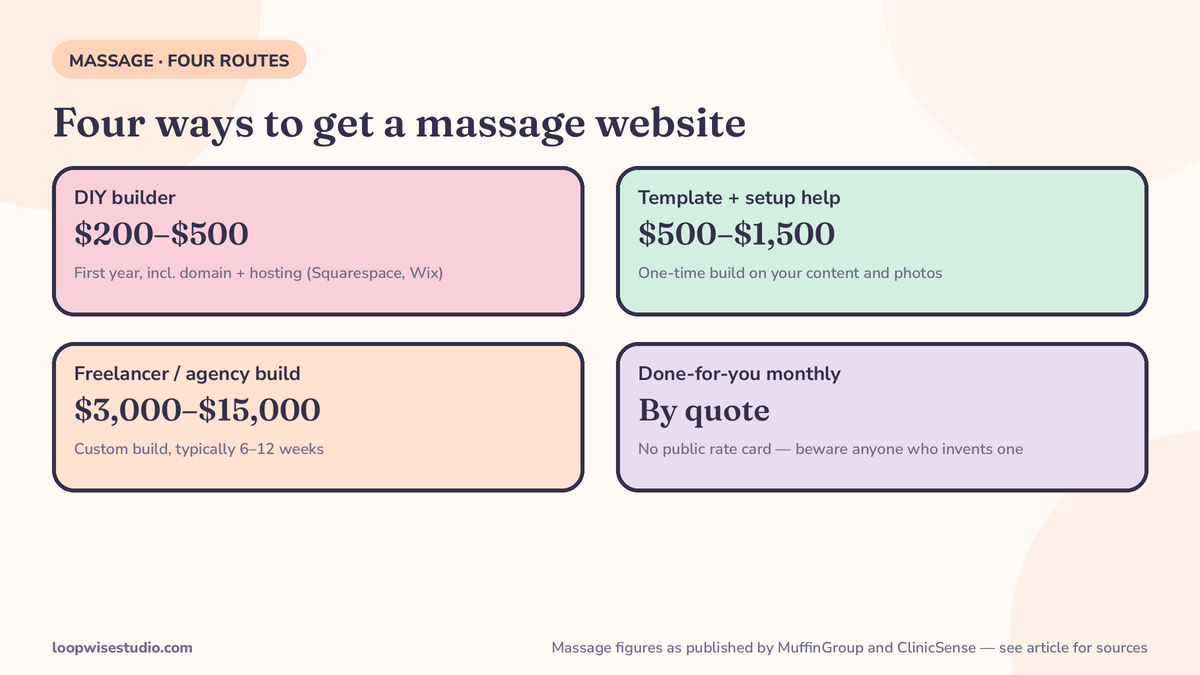
A massage therapist’s website costs $200–$500 in the first year DIY on Squarespace or Wix, $500–$1,500 from a template, or $3,000–$15,000 custom-built by an agency. Add your booking software on top: massage practice software runs about $10–$350 a month.
Those are massage numbers. That needs saying up front, because if you have already searched this question, half the pages you found were pricing websites for a different profession entirely — and their numbers will quietly wreck your budget if you plan around them. Below: the four routes priced for massage, the booking-software cost almost every quote leaves out, what actually moves the price for a massage practice, and a checklist for comparing two quotes without getting caught.
First, a warning: half the “therapist website” prices online are not for massage
Search “therapist website cost” and the top results are mostly about counselling and psychotherapy practices. Their cost pages are well made — and useless for you. They price things a massage therapist never buys: therapist-directory profiles, intake built around caseloads and mental-health compliance. Their DIY bands and done-for-you monthly figures describe that market, not yours.
It also explains a confusion you may already have hit: two “therapist website” pages quoting wildly different numbers are often both telling the truth — about different professions. A counsellor’s website is largely a trust document with a contact form. A massage website is a working booking desk. Same search term, different machine, different price.
Why this matters: if a counselling-therapist page says a professional website runs a certain monthly figure, that figure includes services built for talk therapy. A massage website has a different job — real-time booking by duration and therapist, intake with physical contraindications, memberships, gift certificates. Price the job you actually need done. Everything below is massage-priced, from sources writing for massage businesses.
The four routes, priced for a massage practice
Figures as published by MuffinGroup’s massage website guide and ClinicSense, a massage practice software vendor — check current pricing before committing, as vendors adjust rates.
| Route | What it costs (massage figures) | What you get | What you do yourself |
|---|---|---|---|
| DIY builder (Squarespace, Wix) | $200–$500 in the first year, including domain and hosting | A real website you build from a template, with the builder’s booking add-ons | Everything: pages, photos, booking setup, upkeep |
| AI builder (e.g. Grigora) | $15/mo Starter ($144/yr) or $25/mo Pro, per the vendor’s own pricing | A faster start than a classic builder; same DIY reality afterwards | Content, booking setup, upkeep |
| Template + setup help | $500–$1,500 one-time for the template build; premium ThemeForest themes alone run $60–$80 | A designed site on your content, without agency pricing | Content and photos; booking software still separate |
| Freelancer / agency custom build | $3,000–$15,000, typically 6–12 weeks | A site designed around your practice, booking wired in, done for you | Approvals and content decisions |
| Done-for-you monthly | Priced by quote, not a public rate card | Build, hosting, edits, and the booking layer run as a service while you are in session | Nothing day-to-day |
For the widest honest band, ClinicSense puts a massage business website anywhere from $0 (a free Facebook page) to $5,000 — which is true and also useless for comparing quotes, because the $0 end cannot take a booking with a deposit and the $5,000 end does several jobs at once. The table above is the band with the jobs separated.
A note on the last row: there is no standard published monthly price for a done-for-you massage website, which is why you will not find one invented here. That route is quoted per practice — what it should always include, though, is the booking layer in the same bill, which brings us to the cost everyone forgets.
The cost nobody puts in the quote: your booking system
A massage website without online booking is a brochure with your phone number on it — and your phone is off six hours a day while you are in session. The booking layer is not an optional extra; it is the point of the site. Yet almost every website quote you will receive prices the site and leaves the booking software as a separate line you discover later. A missed call text back while your hands are busy handles the calls that arrive mid-session, sending the caller a booking link before they try the next therapist on the list.
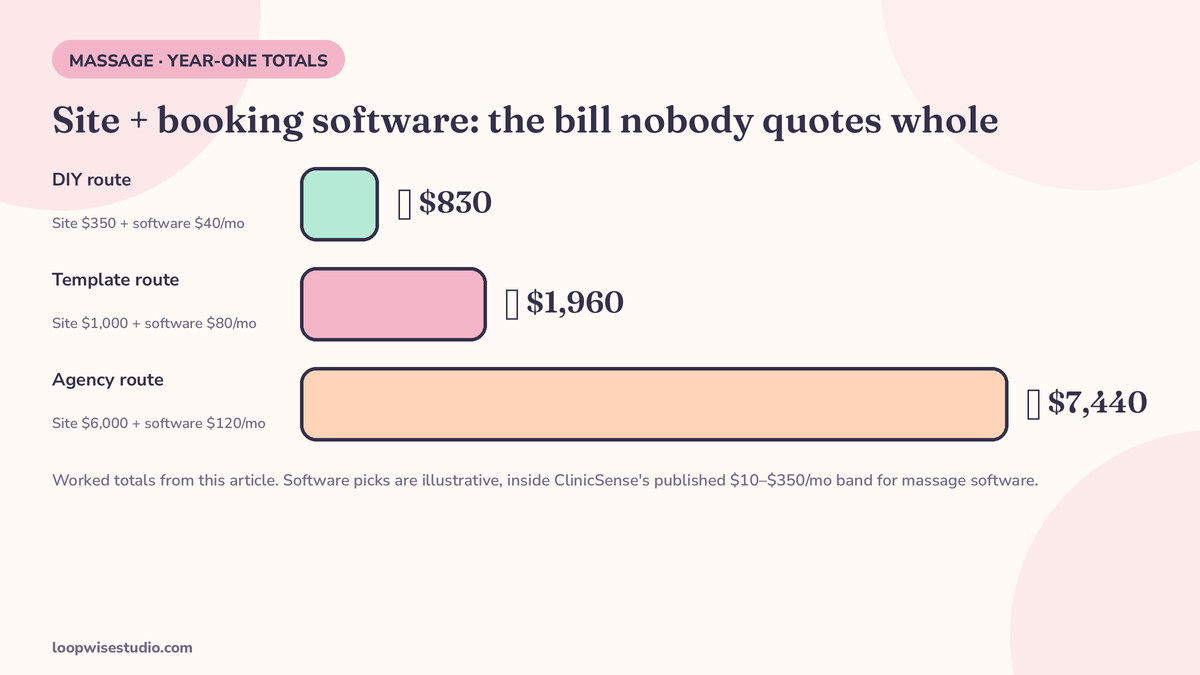
ClinicSense prices massage therapy software at $10–$350 a month. That range covers everything from a basic scheduler to full practice software with intake, reminders, and memberships. Price the two together, as one year-one total:
| Example (assumptions stated) | Site | Booking software | Year-one total |
|---|---|---|---|
| DIY route | $350 (mid-band builder year) | $40/mo × 12 = $480 | ≈ $830 |
| Template route | $1,000 one-time | $80/mo × 12 = $960 | ≈ $1,960 |
| Agency route | $6,000 one-time (low-mid band) | $120/mo × 12 = $1,440 | ≈ $7,440 |
The software figures are illustrative picks inside ClinicSense’s published $10–$350/mo band — swap in the quote you are actually holding. The lesson survives any swap: on the DIY and template routes, the booking system costs more over the year than the website does. Anyone comparing two site quotes without the software line is comparing the smaller half of the bill.
This is also where the booking layer starts paying for itself. Software at these prices carries the reminders, deposits, and card-on-file capture that decide whether your diary holds — the system in our guide to reducing no-shows in a massage therapy practice runs on exactly this layer. And if you are comparing against what a clinic pays for the same combination, our breakdown of how much a website with online booking costs a clinic prices the same site-plus-booking question for a bigger practice.
Comparing quotes is much easier once the booking layer is in both columns — get a free audit and we will take the quotes you are holding (ours included) and rebuild them as year-one totals, so you can see what each one actually costs.
What moves the price for a massage practice
Five things push a massage website quote up or down. Knowing them tells you whether a high quote is padded or honest:
- Intake forms with contraindications. A booking form that captures health history, injuries, medications, and pregnancy status — and routes it to the right therapist before the session — is real build work, not a contact form. It is also non-negotiable for a clinical practice.
- Memberships and packages. Selling a monthly membership or a 5-session package, tracking balances, and letting members book against them adds a commerce layer a plain site does not have. MuffinGroup names memberships and gift certificates as genuine cost drivers for massage sites, and they are right.
- Gift certificates. Online purchase, delivery, and redemption against bookings — a small shop inside your website.
- More therapists, rooms, or locations. Every therapist needs her own bookable calendar; every room is a resource that cannot be double-booked. Multi-therapist scheduling logic is where cheap builds fall apart.
- Mobile service areas. If you travel to clients, service-area pages and travel-aware booking rules cost more than a single address page.
And one budget line owners forget entirely: photography. MuffinGroup suggests allowing $500–$1,500 for professional photos of the space. Stock photos of someone else’s serene spa do your conversion no favours — clients book the room they can picture themselves in.
The yearly stack: what you keep paying after launch
Launch price is the loud number. The quiet numbers are the recurring ones. For a massage practice, the stack looks like this:
| Recurring cost | Massage figure | Source / note |
|---|---|---|
| Website builder plan (DIY route) | Inside the $200–$500 first-year band; AI builder $15–$25/mo | MuffinGroup; Grigora’s own pricing |
| Booking / practice software | $10–$350/mo | ClinicSense — the widest swing in your whole stack |
| Template (one-time, not recurring) | $500–$1,500; ThemeForest themes $60–$80 | MuffinGroup |
| Agency build (one-time, not recurring) | $3,000–$15,000 over 6–12 weeks | MuffinGroup |
| Professional photography (one-time) | $500–$1,500 | MuffinGroup’s suggested budget |
Two habits protect you here. First, price the second year, not launch day: a “cheap” route whose software sits at the top of the $10–$350 band can cost more by month eighteen than the agency build did. Second, ask every quote the same question — “what will I be paying, to whom, in month thirteen?” Any vendor who cannot answer in one sentence is hoping you will not ask. Salon owners face the identical trap with a different price tag; our hair salon website cost guide runs the same year-two test on salon figures.
What the cheap site cannot do (and the expensive one can)
Bands tell you what things cost. They do not tell you what you are not getting at the bottom of the band. When you are holding a $500 quote and a $5,000 quote, the difference is rarely the pages — it is the machinery behind them:
| Job | At the cheap end | At the agency end |
|---|---|---|
| Booking | A contact form or a “call to book” button — you are still the booking system | Real-time booking by therapist, duration, and room, with deposits taken in the flow |
| Reminders | None, or you texting clients yourself between sessions | Confirmation, 48-hour, and 2-hour reminders running on their own |
| Intake | A PDF, or questions asked on the day | Contraindication intake captured at booking and in the therapist’s hands before the session |
| Repeat business | Memberships and gift certificates handled by hand, in a notebook | Sold online, balances tracked, members booking against them |
| Changes | You, in the builder, at midnight | Included or handled for you, depending on the route |
Neither column is a scam. The cheap site is an honest brochure; the expensive one is a front desk. The mistake is buying the brochure at front-desk expectations — or the reverse, paying for machinery your one-room practice will never use. The checklist below exists to pin down which one a given quote actually is.
Price the second year, not launch day
Launch day is the most expensive-looking day of the DIY and template routes and the cheapest-looking day of the agency route. By month thirteen the picture flips: the one-time build is paid and gone, and what remains is the recurring stack — which is mostly software. Run the same routes forward one more year, assumptions stated:
| Route | Year one (from the earlier table) | Year two (recurring only) | Two-year total |
|---|---|---|---|
| DIY | ≈ $830 | ≈ $830 (builder year + software at the same picks) | ≈ $1,660 |
| Template | ≈ $1,960 | ≈ $960 (software only; the build is paid off) | ≈ $2,920 |
| Agency | ≈ $7,440 | ≈ $1,440 (software only) | ≈ $8,880 |
The numbers are illustrative — they reuse the picks inside ClinicSense’s published bands, so swap in your own quotes. Two lessons survive any swap. First, the gap between routes narrows every year, because software is the cost that never leaves. Second, the real long-term decision is not the website at all — it is which software band you live in. A practice that picks $40/mo software over $150/mo software saves more across three years than most build negotiations ever will.
There is one more variable the table cannot show: your hours. The DIY route’s true price includes the evenings you spend building pages and fighting a booking widget — hours that bill at your session rate when a client is in them. The agency and done-for-you routes are, in part, buying those evenings back. Neither choice is wrong. But a quote comparison that counts only dollars is missing the largest line on the DIY side.
Comparing two quotes? Run this checklist before you decide
Copy this into your notes and score each quote honestly:
- ☐ Does the price include online booking, or is booking software a separate monthly bill? How much?
- ☐ Are deposits and card-on-file included at this price, or gated behind a higher software tier?
- ☐ Are reminders (text and email) set up as part of the build, with the timings configured?
- ☐ Does the intake form capture contraindications, and does it reach the therapist before the session?
- ☐ Memberships and gift certificates: supported, priced as extras, or absent?
- ☐ What does month thirteen cost — hosting, software, edits — in total?
- ☐ Who makes small edits (prices, hours, a new therapist) and what do they charge?
- ☐ If I leave, do I keep my domain, content, and client list?
A quote that cannot answer these is not cheaper. It is unfinished.
The short version
Massage website costs, honestly stated: $200–$500 DIY in year one, $500–$1,500 from a template, $3,000–$15,000 for an agency build — plus booking software at $10–$350 a month that most quotes leave off the page. Ignore the counselling-therapist prices Google mixes into this search; they are pricing a different profession. And compare every route as a year-one total, site plus booking together.
That is how we quote: one fixed price for the website and the booking layer together, after a short look at your practice — no invented rate card, no month-thirteen surprises. If you run your practice solo, the build follows the same one-person logic as our website for a one-person aesthetic clinic. Get a free audit and we will price your site the way this article prices everyone else’s: all the lines showing.
FAQs
Why do other websites quote completely different “therapist website” prices? Because most of them are pricing websites for counsellors and psychotherapists, not massage therapists. Those practices buy different things — directory profiles, caseload-style intake — and their cost pages describe that market. For massage, use massage figures: $200–$500 DIY in year one up to $3,000–$15,000 for an agency build, per MuffinGroup.
Is a free Facebook page or a free site enough? It is the $0 end of ClinicSense’s $0–$5,000 band, and it shows: no real-time booking, no deposits, no reminders, and your diary still depends on you answering messages between sessions. It is a starting point, not a booking system.
Do I have to pay for booking software on top of the website? Yes, in almost every route. Massage practice software runs $10–$350 a month per ClinicSense, and it is the layer that holds your calendars, intake, reminders, and payments. Budget site and software as one purchase.
How long does a custom massage website take to build? MuffinGroup puts agency custom builds at 6–12 weeks. Template and DIY routes can be live in days to a couple of weeks, depending on how fast you supply content and photos.
What does a cheap template site leave out? Usually the working parts: deposit and card-on-file capture, properly timed reminders, contraindication intake that reaches the therapist, and membership or gift-certificate handling. The pages look fine; the booking system underneath is what is missing.
I am a solo therapist. Which route makes sense? For most solo practices, the template route or a done-for-you monthly service: your hours are billable on the table, not in a website builder. Whichever route you pick, run the month-thirteen question and the quote checklist above before signing anything. And whichever route you pick, launch with online booking switched on from day one — adding it later always costs more than including it in the build.