How to Reduce No-Shows at a Nail Salon: The System
Cut nail salon no-shows with deposits sized to the service, a four-touch reminder cadence with copy-ready texts, and a plan that protects the fill cycle.
To reduce no-shows at a nail salon, combine three things: a deposit on long services, an automatic reminder sequence (confirmation, 48 hours, 24 hours, 3 hours), and a written cancellation policy shown at booking. DaySmart’s salon guide treats under 5% as a healthy no-show rate. One reminder on its own is not a system.
Most no-show advice is written for salons in general. Nails are different, and the difference is time. A hair salon that loses a 45-minute cut loses 45 minutes. A nail salon that loses a 90-minute full set loses the best part of a morning — and if the no-show was a fill, the damage follows you into the next appointment too.
This guide is the nail-specific version: measure first, then deposits, reminders, day-of triage, and the fill-cycle rule most guides miss entirely. If you want someone to look at your numbers and your current setup, you can get a free audit — but the system below is complete enough to run yourself.
What a no-show actually costs a nail salon (do this maths first)
Do not borrow someone else’s scary statistic. Work out your own number — it takes your real prices and your real diary.
Take the missed appointment’s price, and multiply by how often it happens:
- One missed full set at $85, once a week: $4,420 a year.
- Two missed fills at $55, once a week: $5,720 a year.
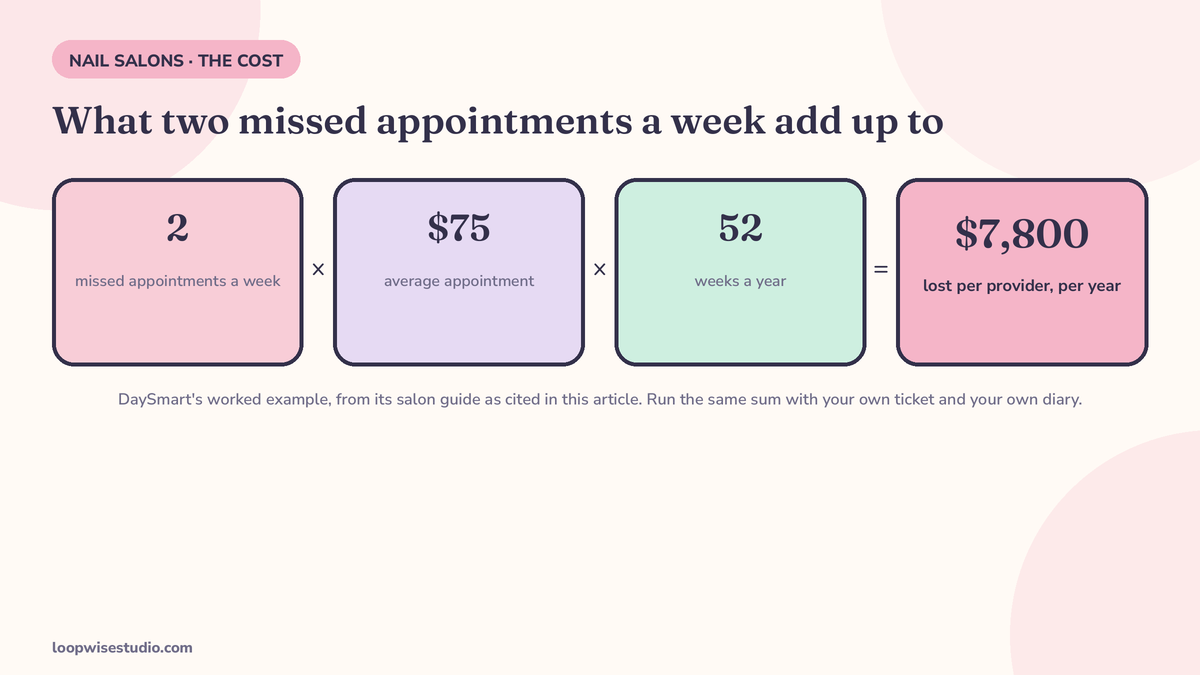
- DaySmart’s salon guide works the same sum with its own example: reducing two missed $75 appointments per week recovers $7,800 a year for one provider. That is their arithmetic on stated inputs — and it is the right shape. Run it with yours.
Notice what the service length does. A 30-minute polish change no-show stings. A 90-minute set no-show — with soak-off booked after it — can wreck three appointments, not one. That is why the protections below are sized to the service, not applied flat.
There is a second cost nobody counts: the tech. A no-show in a commission or booth-rent salon is unpaid, unbookable time for the person whose chair it was. Do it often enough and your best tech starts looking at the salon down the road.
Step 1 — Measure your real no-show rate
DaySmart’s guide starts where every good system starts: don’t guess, measure. It is the strongest part of their approach, and it takes about twenty minutes.
For the last four weeks, count:
- Total appointments booked.
- Appointments where the client did not arrive and did not cancel inside your policy window.
- Divide the second number by the first. That percentage is your no-show rate.
DaySmart’s benchmark, from their salon reporting guidance: under 5% is healthy; 10% or above is worth a proper audit. That is a vendor benchmark, not an industry study — treat it as a yardstick, not gospel. What matters is your number, and whether it moves.
Also split the count by service. If your no-shows cluster on full sets booked by new clients, that is a deposit problem. If they cluster on fills booked six weeks out, that is a reminder problem. Different diseases, different medicine.
Step 2 — Deposits sized to the service, not one flat rule
The deposit is the single strongest behaviour-changer in this system, because it turns “I might come” into money already spent. Reported practice from nail industry sources:
- Function of Vex (nail-tech education) puts the common non-refundable deposit at $15–$25, or 25–50% of the service price, with no-show fees often $20–$30 flat or 25–50%.
- DaySmart recommends $25–$50 flat for new clients, or 20–50% of the service total, and deposits specifically for appointments over 90 minutes; their FAQ notes no-show fees of 50–100% of the missed service are common in salons generally.
A sensible structure for nails:
| Appointment | Protection that fits |
|---|---|
| Polish change / repair (under 45 min) | Card on file; no deposit for regulars |
| Fill (45–75 min) | Small deposit or card on file |
| Full set / detailed art (90 min+) | Deposit at booking — flat or % — always |
| New client, any long service | Deposit at booking, no exceptions |
| Client with one previous no-show | Deposit rises; see the ladder below |
Two rules make deposits work rather than backfire. First, the client sees the policy before she pays — on the booking page, in plain language. Second, the deposit must be effortless to pay: taken inside the booking flow, not via a separate app she has to download and fund. Every extra step between “book” and “deposit paid” leaks clients who genuinely intended to come.
Deposits only work if booking collects them automatically — which is why they belong inside your online booking website for your nail salon, not in a DM thread where you feel awkward asking.
Step 3 — The reminder cadence, with the actual texts
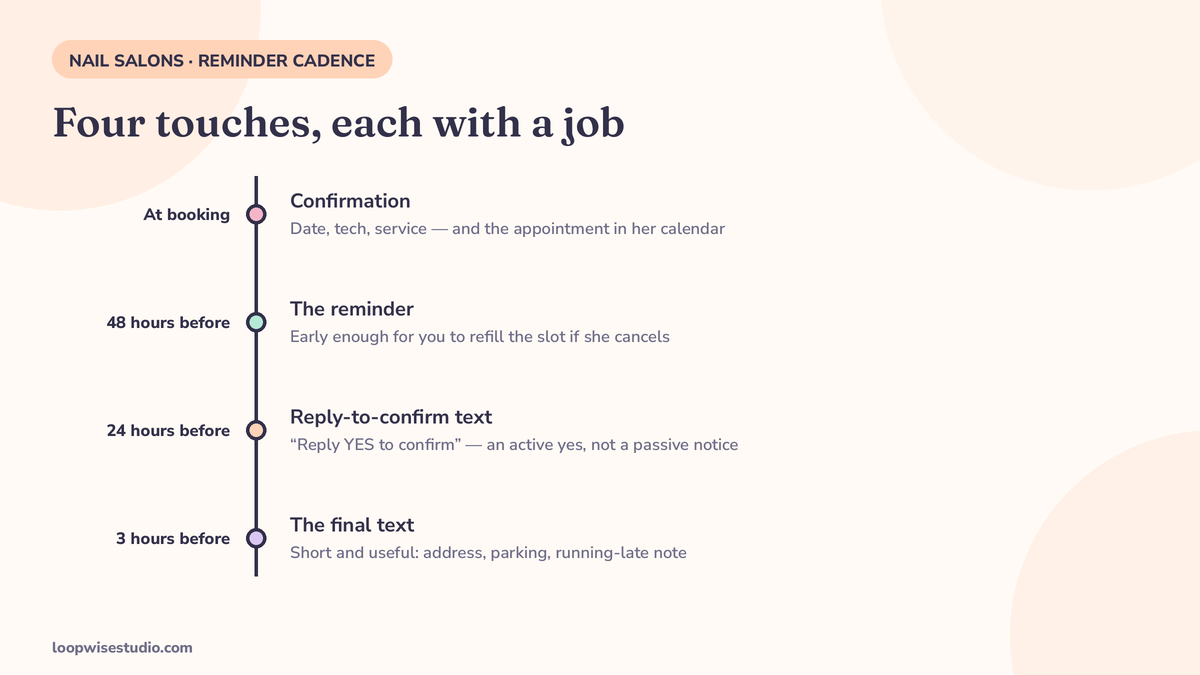
One reminder is a hope. A sequence is a system. The cadence recommended by Function of Vex — and echoed by DaySmart’s three-point reminder approach — has four touches. Copy these and adjust the tone to your salon:
At booking (confirmation):
You’re booked! [Name], your [service] with [Tech] is on [day, date] at [time]. Your deposit of $[X] is paid. Need to move it? Reply to this text or tap here: [link]. Our cancellation policy: [link].
48 hours before:
Hi [Name], a reminder that your [service] with [Tech] is on [day] at [time]. Running late or need to move it? Let us know today so we can offer the slot to someone on our waitlist.
24 hours before (the important one — reply to confirm):
Hi [Name], please reply YES to confirm your [service] tomorrow at [time] with [Tech]. If we don’t hear from you, we may release the slot.
3 hours before:
See you at [time], [Name]! Your [service] with [Tech] is coming up. If you’re running late, reply here — we’ll do our best.
The 24-hour reply-to-confirm text does double duty. DaySmart describes using confirmations predictively: a client who has not confirmed by a set hour gets a follow-up, and if she stays silent, the slot can be released to the waitlist while there is still time to fill it. Silence becomes information instead of a surprise at 2pm.
Match the channel to the client. Text reaches people fastest for same-week appointments; WhatsApp works well for regulars who already message the salon there. Email is fine for the 48-hour touch. What matters is that all four go out automatically, every time, including the Saturdays when nobody has a spare minute to send them manually.
Step 4 — Make rescheduling easier than ghosting
People rarely no-show out of malice. They no-show because life moved, and moving the appointment felt like more effort — or more embarrassment — than just not coming.
Remove every gram of friction:
- The reminder texts carry a reschedule link. One tap, new time, done — no phone call, no apology speech.
- The policy says rescheduling inside the window keeps the deposit. Punish the ghosting, not the honesty.
- Answer the phone problem. A client who calls to move her appointment and reaches nobody may simply give up — and then no-show. If your salon cannot pick up mid-service (most cannot), a missed call text back for your nail salon turns that unanswered call into a text thread where she can reschedule herself. A share of your “no-shows” are really failed reschedules.
Step 5 — Day-of triage: late, shortened, or filled
Even a good system leaks. Plan for the day itself, the way Function of Vex’s guide does:
Client is 10–15 minutes late. Shorten the service, don’t cancel it: swap the full set for a fill, skip the art, keep the slot productive. Say it kindly and clearly: “We have time for the fill today — let’s book the art for your next visit.”
Client texts that she can’t make it, an hour before. Thank her, rebook her on the spot in the same thread, and immediately offer the slot to your waitlist (below).
Client simply doesn’t arrive. Send the no-show text within the hour, while it is still today’s news:
Hi [Name], we missed you at [time] today. Your deposit of $[X] has been applied per our policy. Want to rebook? [link]. If something came up, reply and talk to us.
Firm, human, door left open. What you never do is pretend it didn’t happen — a no-show with no consequence trains the next one.
The waitlist refill. Keep a short list of clients who want earlier slots, and text them the moment a gap opens: “A [service] slot with [Tech] just opened today at [time] — reply BOOK and it’s yours.” Short nail services — repairs, polish changes, soak-offs — are perfect gap-fillers sized to odd holes in the day. Our guide to filling cancelled salon appointments automatically covers the waitlist mechanics in more depth.
The fill-cycle rule: a missed fill costs you twice
This is the part general salon advice never mentions, and for nails it might be the most important section in this article.
A regular’s fill is not a standalone appointment. It is one turn of a two-to-three-week cycle — the cadence SimplyBook.me builds its fill reminders around, and the maintenance window nail educators like Nail Frens describe for enhancement and gel clients. When she no-shows a fill:
- You lose that slot.
- The set keeps growing out. By the time she rebooks, it needs removal and a fresh full set — a longer, more expensive appointment she may dodge because of the price.
- Her rhythm breaks, and broken rhythms are how regulars quietly become someone else’s regulars.
So fill clients get an extra layer of protection the others don’t: they should leave every appointment with the next fill already booked, and if they didn’t book it, a reminder should fire on the fill clock, days after the visit — not wait for a generic monthly marketing text. The full system is in our guide to reminding nail clients to rebook their next fill on time.
Repeat offenders: the fair three-step ladder
DaySmart’s tiered approach, adapted for nails:
- First no-show: the text above, deposit applied, rebook offered. Benefit of the doubt, once.
- Second no-show: a polite, clear message — future bookings need a larger deposit (50% works), and she hears it from the policy, not from a tech’s frustration.
- Third: prepayment in full, or booking only on the day. Some salons dismiss at this point. Either way, decide the ladder now, write it down, and apply it to everyone equally. A ladder applied consistently is fair; ad-hoc anger is not.
Keep the tone warm at every step. You are protecting the diary, not winning an argument.
Three myths that keep nail salons’ no-shows high
Myth: “Deposits scare clients away.” The clients a deposit scares away are disproportionately the ones who were not sure they would come. A client who has chosen her tech, picked her set and put $20 down has made a decision; a client who clicked “book” on a free calendar has made a suggestion. Industry guides treat deposits as standard practice for long services precisely because the good clients barely notice them — the deposit comes off the total they were paying anyway.
Myth: “More reminders will annoy people.” What annoys people is irrelevant reminders: a generic blast about a promotion. A confirmation of their appointment, with their tech’s name and an easy way to move it, is service, not spam. The cadence in Step 3 sends four messages across the life of one booking. If a client finds that excessive, the problem is not the reminders — it is that she never intended to be there, and finding that out at the 24-hour confirmation is exactly what the system is for.
Myth: “My regulars would never no-show.” Regulars no-show differently: not by vanishing, but by drifting. They book six weeks out because that is when the diary was open, life fills in, and the appointment quietly loses to everything else. That is why regulars get the fill-cycle protection — next appointment booked before they leave, reminder on the fill clock — rather than the new-client deposit treatment. Different risk, different tool. Applying one flat policy to both groups is how salons end up strict with the loyal and soft with the strangers, which is precisely backwards. The same drift shows up in no-show reduction for massage practices, where the return interval is set by the treatment rather than a fill cycle and the reminder has to follow the body’s calendar, not the salon’s.
The DM booking problem: appointments that exist outside the system
A chunk of nail bookings never touch a booking page at all. They happen in Instagram DMs — “hey girl, can you fit me in Friday?” — answered from the chair, agreed in chat, and written into the diary by hand, if at all.
Those bookings carry none of the protections in this article. No deposit. No policy shown. No confirmation sequence, because the software does not know the appointment exists until someone types it in — and on a busy day, nobody does. Ask any tech where her last three no-shows came from and watch how many started as a DM.
The fix is not banning DM bookings; clients love the channel and it is where your work gets seen. The fix is a one-line bridge: the reply that moves the booking into the system. “Yes! Friday I have 11 or 2:30 — grab it here so your deposit holds it: [link].” The conversation stays warm and personal; the booking becomes real, deposit-backed and reminder-covered. Every DM booking either crosses that bridge or stays a rumour in your diary — and rumours are what no-shows are made of.
The two weeks after you switch this on
Expect a small, temporary dip in bookings from the clients your old system was carrying: the maybes. They will not pay deposits, and some will not reply to the confirmation text, and their slots will release to your waitlist. That dip is the system working — those slots were never really sold.
What to watch in the first month: your measured no-show rate (Step 1), the share of 24-hour texts answered with a confirmation, and how many released slots the waitlist refills. If confirmations are high but no-shows persist, your problem is day-of — look at the 3-hour text and your late-arrival handling. If confirmations are low, the problem is upstream: the booking was never real, and the deposit step is where to tighten.
Putting it together
Measure the rate. Deposit the long slots. Run four reminder touches, with a reply-to-confirm at 24 hours. Make moving an appointment easier than vanishing. Triage the day, refill from the waitlist, and guard the fill cycle like the recurring revenue it is. That is the system — none of it is exotic, and all of it together is what separates salons that complain about no-shows from salons that rarely see one.
If you’d like, get a free audit and we’ll review your current deposit policy, reminder setup and booking page, and tell you which step is missing.
FAQs
What is a normal no-show rate for a nail salon?
DaySmart’s salon guidance treats under 5% as healthy and 10% or more as a sign to audit your system. That is a vendor benchmark rather than an industry study, so use it as a yardstick — the important measure is your own rate, tracked monthly.
How much deposit should I charge to stop no-shows?
Industry sources put common practice at $15–$25 flat or 25–50% of the service price (Function of Vex), with DaySmart recommending deposits especially for appointments over 90 minutes. Match it to the slot: the longer the appointment, the stronger the protection.
When should reminder messages go out?
A four-touch sequence works well: confirmation at booking, 48 hours before, 24 hours before with a reply-to-confirm, and 3 hours before. The 24-hour confirmation is the one that lets you release and refill a slot in time.
Should I charge a no-show fee or take a deposit?
Deposits work better. A fee after the fact has to be chased and creates an argument; a deposit is agreed and paid before the appointment, when everyone is friendly. Many salons do both — deposit up front, with the policy reserving a fee for repeat offenders.
What do I do about a client who keeps no-showing?
Use a ladder: first offence, deposit applied and rebook offered; second, a higher deposit for future bookings; third, prepayment in full or same-day booking only. Write it in your policy and apply it evenly.
Do reminders alone fix no-shows?
No. Function of Vex and DaySmart both build the same three-legged stool: a written policy, deposits, and reminders. Reminders fix forgetting. Deposits fix not-caring. The policy makes both feel fair.