How to Reduce No-Shows at a Lash Studio: The 4-Part Fix
Cut lash no-shows with a deposit ladder ($20–30 or 30–50%), three reminders with copy, a backfill routine for late cancels, and a two-strike rule for repeat offenders.
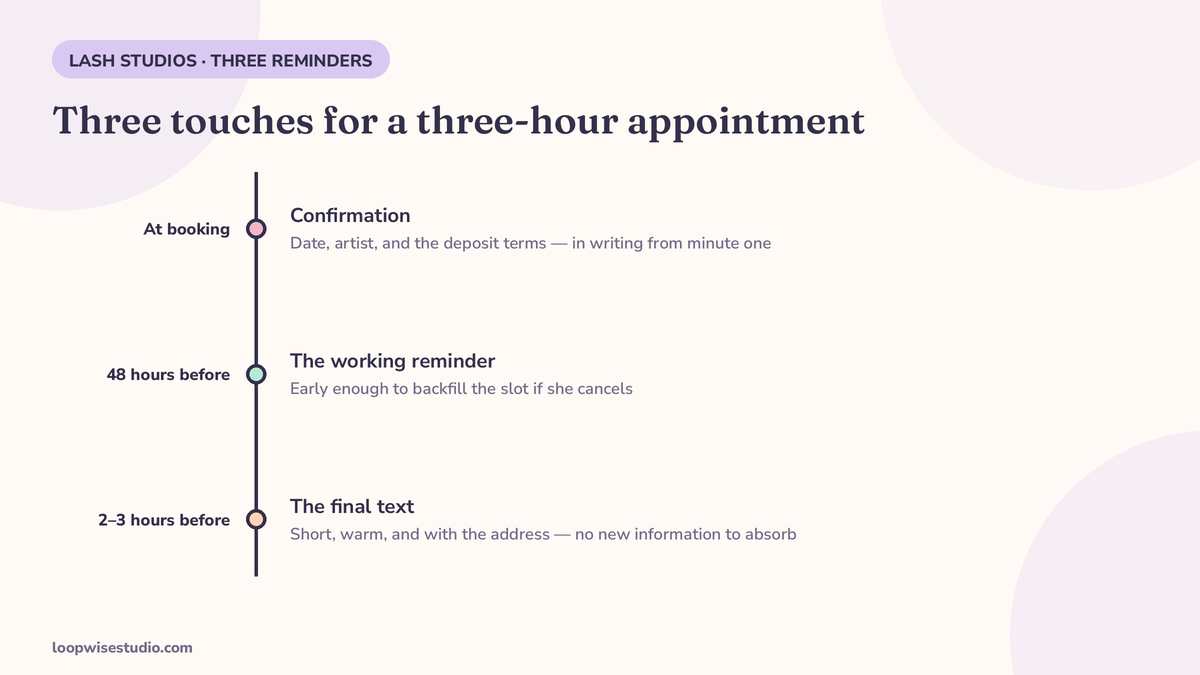
Reduce lash studio no-shows with a deposit at booking (commonly $20–$30 flat or 30–50% of the service), a written 24–48-hour cancellation policy, and three reminders: a confirmation at booking, one 48 hours before, and one 2–3 hours before the appointment.
Every lash artist knows the specific silence of it. The bed is set up, the lashes are fanned out, the tweezers are down — and the client is simply not coming. She is not answering either.
No-shows hurt every beauty business. In a lash studio they hurt in a specific, expensive way, and the fix has to match the shape of the problem. This is the four-part system: a deposit ladder, a three-touch reminder sequence, a backfill routine for the ones who cancel late anyway, and an escalation path for repeat offenders.
A lash no-show is not a gap in your day — it is a three-hour hole
A missed haircut costs a stylist thirty minutes. A missed full set costs you two to three hours of bookable time, plus the product you opened for a client who never sat down.
SuiteCal, in its 2026 comparison of lash booking apps, frames it this way: a single no-show on a 90-minute lash appointment can cost $150 to $250 in lost income. That is a vendor’s framing, not a study — but any lash artist can check the shape of it against her own price list in about ten seconds.
There is a second loss hiding inside the first. When a regular misses a fill, the damage lands weeks later: the overgrowth means a longer removal and, usually, a full set at the next visit instead of a fill. The no-show did not just empty one slot. It made a future slot longer, tighter, and harder to give away.
That is why generic “reduce no-shows” advice underperforms for lashes. The system below is built for long appointments and a two-to-three-week fill cycle — the same logic med spas use on their own long, high-value appointments in our guide to reducing no-shows at a med spa.
Why lash clients no-show: three causes, three different fixes
Before the system, the diagnosis — because each cause has a different cure, and throwing all four parts at the wrong cause wastes your effort. ThousandLashes’ guide for lash artists splits no-shows into three causes, and the split is worth stealing:
- She forgot. Booked three weeks ago, mid-scroll, and the appointment never made it into her real life. This is the largest group and the easiest fix: the reminder sequence in Part 2 exists for her.
- She never took the booking seriously. A DM conversation, no money down, nothing signed — in her head it was a pencilled intention, not an appointment. Reminders do nothing for her. The deposit ladder in Part 1 is her fix, because money converts an intention into a commitment.
- Life genuinely happened. A sick child, a car that will not start. No system prevents this group, and punishing them costs you good clients. The backfill routine in Part 3 is the fix — not for her, for the slot she leaves behind.
Most studios have all three, in roughly that order. If your no-shows mostly come from brand-new clients who booked through Instagram, your problem is cause two and the deposit matters more than the reminders. If your regulars are the ones drifting, it is cause one — your sequence is too thin. Match the fix to the cause before you rebuild anything.
Part 1 — The deposit ladder: small money down, big behaviour change
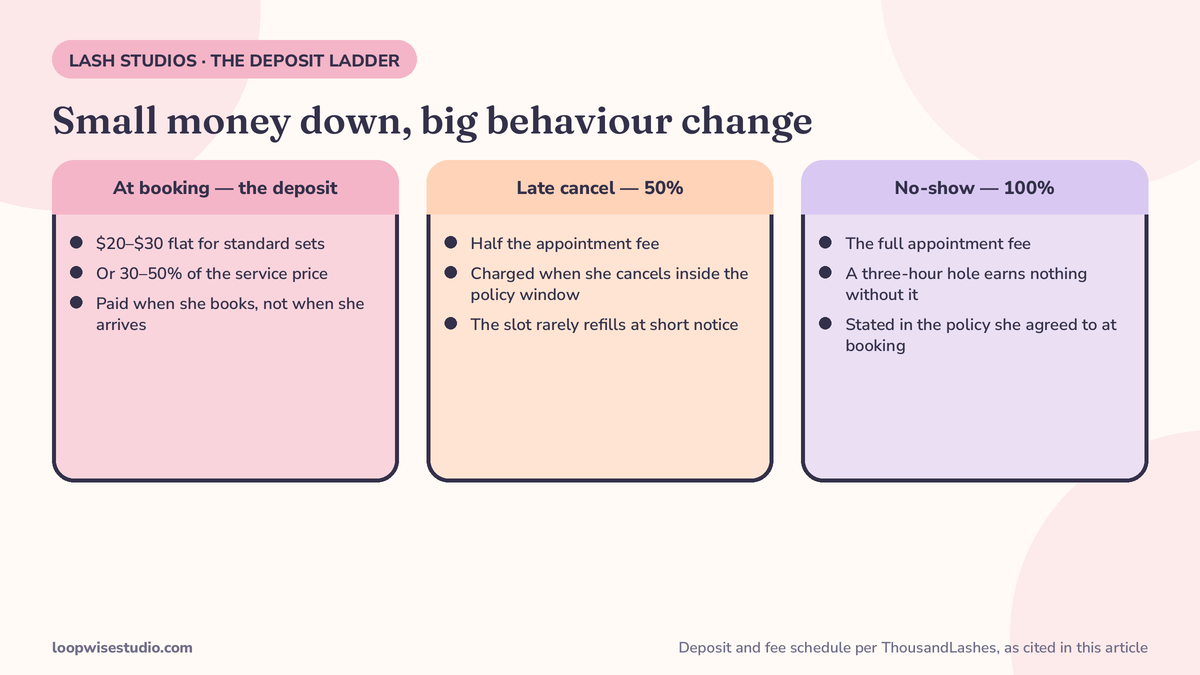
ThousandLashes, the lash supplier, publishes the fee structure most lash artists actually use. Treat it as the going rate for the niche:
| Situation | Common practice |
|---|---|
| Deposit at booking | $20–$30 flat, or 30%–50% of the service total |
| Cancellation window | 24 or 48 hours’ notice |
| Late cancel (inside the window) | 50% of the service price |
| No-show | 100% of the service price, or the deposit is forfeited |
A ladder, not a single rule — because a first-time full set and a standing fill are different risks:
- New client, full set: deposit at the top of the band. She has no history with you and the block is your longest.
- Regular, fill: flat deposit or card on file. The commitment matters more than the amount.
- Anyone booking your longest or latest slot: deposit regardless of history. That slot cannot be refilled at short notice.
The deposit only works if the client agrees to the terms before she books — inside the booking flow, not in a policy page she will never open. That means the deposit has to live in your booking system, with the policy attached to the appointment she is taking. Our breakdown of a booking system for lash artists with deposits and reminders covers how to set the amounts per service type.
And then the hard part: charge it. Every time. A fee you waive for people you like is not a policy, it is a mood — and clients learn the difference fast.
Part 2 — Three reminders that catch the forgetters (with copy)
Most lash no-shows are not malice. They are a client who booked three weeks ago, during a scroll, and simply forgot the appointment existed. Reminders fix forgetting — but only if there is more than one, and only if each one does a different job.
The timing that lash suppliers Prolong Lash and LashTribe both describe is the niche consensus: a confirmation at booking, a reminder at 48 hours, and a final message 2–3 hours before.
Copy-paste set:
Confirmation (at booking):
Booked, [Name]! [Service] on [day, date] at [time]. Your deposit of $[amount] is on file. Life happens — if you need to move it, reply here at least 48 hours ahead and we’ll reschedule you once, no charge.
48 hours before:
Hi [Name], lashes on [day] at [time] — that’s in 48 hours. Come with clean lashes (no mascara, no strip glue) so your full time goes on lashing. Reply YES to lock it in, or reschedule here: [link]
2–3 hours before:
See you at [time], [Name] 💛 Running behind? Reply here — up to [15] minutes we can work with, after that the set gets shorter, not cheaper.
Notice what each message carries. The confirmation restates the deposit while the client still remembers agreeing to it. The 48-hour message asks for a reply — a client who texts YES almost never ghosts. The final message gives her a graceful way to say she is late, which turns some would-be no-shows into shortened sets instead of empty beds.
Part 3 — When they cancel late anyway: backfill the slot
A late cancel with 48 hours’ notice is not a loss yet. It is a slot with a deadline. The routine:
- Keep a real waitlist. Not a notes app — names attached to services and rough availability (“wants a full set, free weekday evenings”).
- Message the waitlist first, with a reply window. “A full set slot opened Thursday 5pm — first to reply YES gets it, held for 30 minutes.” The window creates the urgency that gets answers.
- Then post the opening publicly. Instagram story, same day: service, time, deposit terms. Openings posted as stories are the one gap-filling tool lash artists already have — the mistake is posting before the waitlist, when the waitlist clients are your warmest buyers.
- Offer the slot at fill length if it will not sell at full length. A 90-minute hole that will not take a full set can still take a fill plus a removal. Partial money beats an empty bed.
Nail salons run the same four steps against the same fill-cycle problem — the backfill routine in our nail salon no-show guide is nearly identical, because a 90-minute nail block and a 90-minute lash block fail in the same way. Massage practices run into the same problem with longer treatment blocks — our guide to massage no-shows adapts the same four steps to a room where the therapist cannot step out to chase a reply.
One discipline makes the whole routine work: the waitlist message goes out within minutes of the cancellation landing, not when you next sit down. A slot freed at 10am and offered at 4pm has already lost its best buyers — the people who would have rearranged their day around it.
If setting up the ladder, the sequence, and the waitlist sounds like an evening of admin you keep postponing, that is the normal state of things — get a free audit and we will look at your current booking setup and tell you which of the four parts is missing, in order of what it is costing you.
Part 4 — Repeat offenders: the escalation path
Deposits and reminders fix the forgetful majority. What is left is a small group who will keep doing it — and the answer for them is a ladder, not an argument. ThousandLashes describes the version artists use: a two-strike pattern.
- First no-show: charge the fee, send the polite message, no drama. Script below.
- Second no-show: full prepayment to book. Not a bigger deposit — the whole service, up front.
- Third: last-minute-only booking. She can have slots that open inside 24 hours, when a ghost costs you nothing you could have sold.
The message after a no-show matters. Angry loses the client; silent loses the fee. The middle path, adapted from the script lash artists pass around:
Hi [Name], you missed your [service] today at [time] — hope everything’s okay. Per the booking policy, today’s appointment is charged at [the deposit / 100%]. I have held [day, time] if you’d like to rebook — that one needs prepayment to secure. Just reply here.
Two enforcement details from the supplier guides are worth stealing. Apply the policy fairly and to everyone — the moment a favourite client gets a free pass, the policy is finished. And allow one genuine emergency exception per client, said out loud as an exception: “I’m waiving it this once.” A rule with a visible, human exception is stronger than a rule nobody believes you will enforce.
One more reality check: the card on file sometimes declines when you charge the fee. The ladder handles that too — a declined fee moves that client straight to prepayment-only, automatically, without a confrontation. Put it in the policy text so the system says it, not you.
What one no-show a week costs a lash studio
Do this maths with your own prices — here is the shape, with the assumptions stated so you can swap yours in:
- One missed full set a week, at a mid-range price of $200 a set (inside the $150–$250 range SuiteCal cites for a missed 90-minute appointment)
- $200 × 4 weeks = $800 a month
- $800 × 12 = $9,600 a year — from one empty slot a week
That is before the second-order loss: the missed fills that turn into removals and full-price resets, and the waitlist clients who would have filled some of those beds. Even if your deposit ladder and reminders only recover half of it, the system has paid for itself many times over — the software that runs it costs less per month than a single set.
One honest caveat: run your own count before you trust the shape of that example. For the next month, mark every no-show and late cancel in your diary with the service it was and what it would have earned. Studios that count usually find the pattern is not random — it clusters on new clients, on one day of the week, or on bookings made through one channel. That cluster tells you which of the four parts to build first. A month of your own marks beats any industry statistic, including the ones quoted in this article.
Three parts stop the no-show before it happens: a deposit with teeth, three reminders that each do a job, a policy you actually enforce. The fourth part — backfill and escalation — limits the damage from the rest.
If you run the studio alone, your booking page is the only staff member who can run this system at 11pm. That is the whole idea behind the way we build sites for one-person beauty businesses — the same approach we describe for a website for a one-person aesthetic clinic applies to a solo lash studio almost word for word. Get a free audit and we will check your booking flow against all four parts and show you where the holes are.
FAQs
How much deposit should I charge to stop no-shows? The common lash-artist range, per ThousandLashes’ policy guide, is $20–$30 flat or 30%–50% of the service total. Full sets for new clients belong at the top of the range; regulars booking fills can run on a smaller deposit or a card on file.
How many reminders should a lash studio send? Three touches: a confirmation at booking, a reminder 48 hours before, and a final message 2–3 hours before. Both Prolong Lash and LashTribe describe the same sequence — the 48-hour touch catches clashes early enough to refill the slot, and the final touch catches day-of drift.
What should my cancellation policy charge? The widely used structure is: free reschedule outside 24–48 hours, 50% of the service price for a late cancel inside the window, and 100% (or the deposit forfeited) for a no-show. Whatever you choose, the client must see and accept it during booking — a policy she never saw cannot be enforced without a fight.
A regular of two years no-showed. Do I really charge her? Yes — kindly, and with the one-time exception if it is genuinely a first offence: charge or waive as a stated exception, and tell her the next booking follows the standard policy. Waiving silently teaches every client watching that the policy is optional.
Do deposits put clients off booking? A deposit framed as “it comes off your total” is a discount-shaped commitment, not a fee. The clients it puts off are disproportionately the ones who were not sure they would come — which is the point. Artists using the $20–$30 / 30–50% structure report it as normal practice in the niche, per the supplier guides.
What if the card on file declines when I charge the no-show fee? Move the client to prepayment-only for future bookings and say so in one short message. Do not chase the declined charge through multiple emotional texts — the ladder (deposit → prepayment → last-minute-only) exists so the system delivers the consequence, not you.