How to Remind Nail Clients to Rebook Their Next Fill
Remind nail clients to rebook a fill on the fill clock, not the calendar: book it at the chair, fire a timed reminder if they didn't, catch them before they lapse.
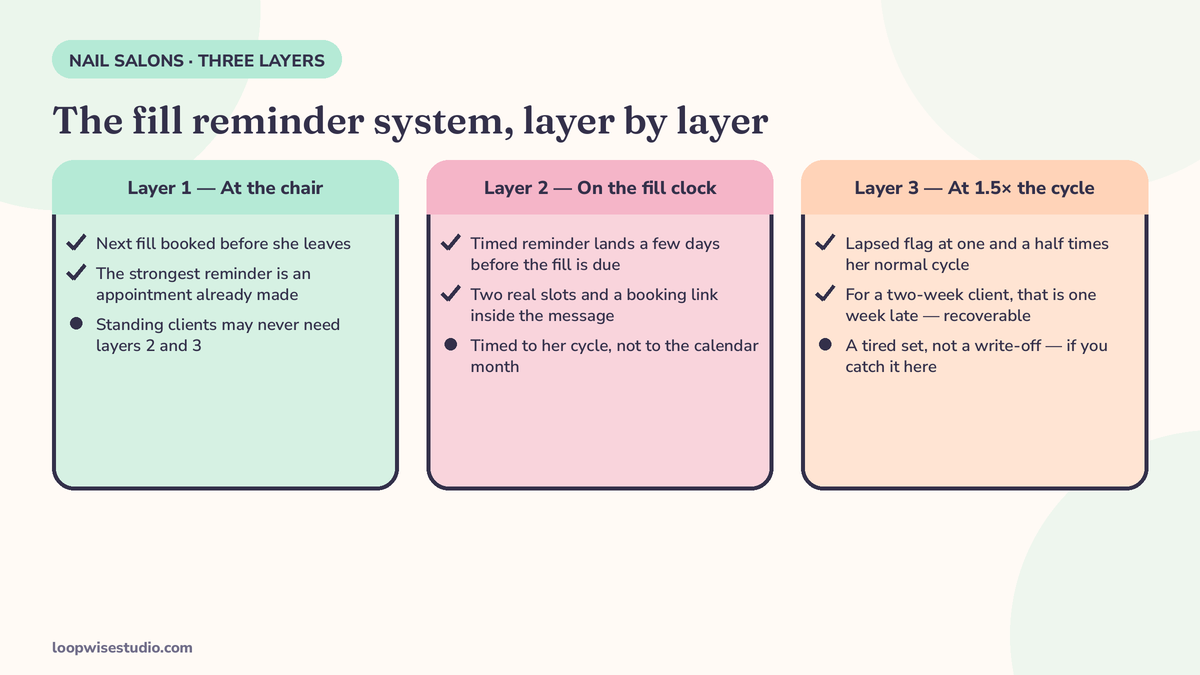
Remind nail clients to rebook a fill by timing the reminder to the fill cycle, not the calendar: enhancements and gel typically need maintenance every two to three weeks, so the reminder should land a few days before the set is due — with two real slots and a booking link. The first reminder is the one sent in the chair: booking the next fill before the client leaves.
Most salons think of the fill reminder as a marketing message — something sent when the salon is quiet. It is not. It is a maintenance schedule, and it works like one: every client has a due date that starts counting down the moment her set is finished.
Get the timing right and the reminder feels like service. Get it wrong — too late, too generic — and it reads as a sales text landing on a client whose nails are already lifting. This article lays out the three layers: book it at the chair, remind on the clock if they didn’t, and catch them early if they drift. If you’d like us to look at how your salon currently handles rebooking, get a free audit — otherwise, here is the whole system.
The fill clock: why two to three weeks, and why late costs the client more
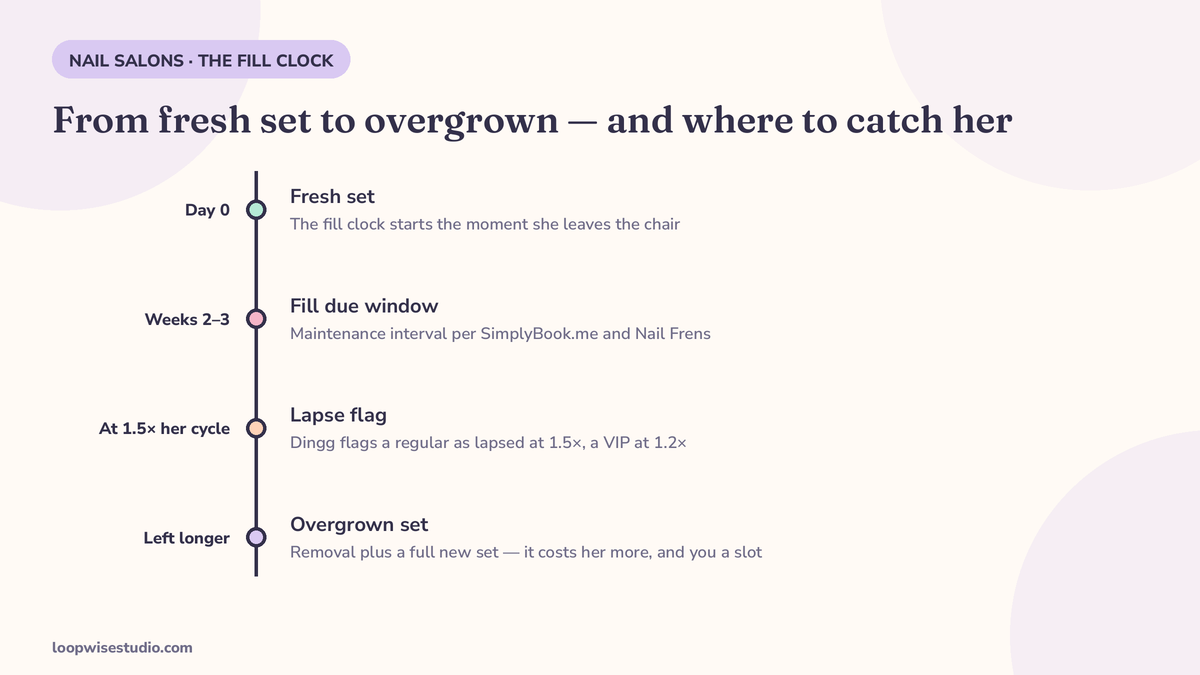
Start with the interval itself. SimplyBook.me’s fill-reminder feature, Book Soon, is timed to “your two-to-three-week fill and refill cadence.” Nail Frens’ maintenance guidance for nail techs lands in the same place: most enhancement and gel clients need regular maintenance, for many around two to three weeks, although the right schedule varies with nail growth, product and lifestyle.
Keep that caveat — it is what makes the system below work. There is no single magic day count. What there is, for every client, is her cycle: the interval her tech already knows from her last three sets. The reminder system should run on her number, not on a salon-wide guess.
And there is an honest reason to book on time that has nothing to do with your diary: as Nail Frens explains to techs, the product grows forward with the nail, the structure shifts out of balance, and waiting too long leads to lifting and cracks — which turns a one-hour fill into a longer, more expensive removal and new set. A reminder that teaches this, briefly and without scare tactics, gets booked. A reminder that just says “time for your fill!” gets ignored.
Layer 1 — Book the fill before they leave the salon
The best fill reminder is the one you never have to send. Every client who leaves with the next appointment in her calendar is one the system below never has to chase.
The ask works best at three moments (a sequence beauty rebooking coaches describe for the chair-to-desk journey, and which nail techs will recognise):
- During the finishing touches, while she is admiring the set: “These will want a fill in about two weeks — shall I hold your usual slot?”
- At the handoff to the desk, with two concrete options, not an open question: “I have Tuesday the 14th at 10, or Thursday the 16th at 4:30 — which suits you?”
- At checkout, as the fallback, with the cancellation policy as the pressure-release: Young Nails’ rebooking guidance for techs uses the two-week default — “Should I put you in for two weeks from now?” — and handles hesitation honestly: you have a 24-hour cancellation policy, so booking now costs her nothing if plans change.
For the client who genuinely cannot commit, use the soft hold: send her the booking link before she leaves, pre-filled with her tech and service, and name the window out loud — “if you book by the weekend, your usual slot is still there.” She leaves with the door open instead of a vague intention to call.
Realistic expectation-setting: some clients will always refuse to book ahead. That is fine. Layer 1 exists to shrink the number Layer 2 has to work on.
Layer 2 — The timed reminder, for clients who left without booking
For everyone who left unbooked, the reminder fires off the fill clock: a set number of days after her last visit, matched to the cadence her tech set for her. This is exactly the mechanism SimplyBook.me’s Book Soon uses — a nudge sent a set number of days after the last visit, timed to the salon’s typical fill window, to clients who opted in to messages — and Booxi’s appointment recalls work the same way: a configurable delay after a completed appointment, which can even be set at checkout (“book now, recall later, or no reminder” — a nice workflow worth copying whatever software you use).
The timing rule: the reminder should land a few days before the fill is due — early enough that her usual tech still has slots, late enough that the set actually needs doing. For a two-week client, that is roughly day 10–12. For a three-week client, day 16–18.
The message, written out. Note what it contains: her tech, her due window, two real slots, a link, and the honest reason — one line of education, no guilt:
Hi [Name], your fill with [Tech] is due this week. She has [day] at [time] and [day] at [time] open — tap to grab one: [link]. Booking on time keeps it a fill; leave it much longer and it usually becomes a removal + new set.
Then one follow-up, and only one, if she doesn’t reply in two or three days:
Last call on those slots, [Name] — after [day] they’ll open to the waitlist. Your fill link is still here: [link]. No pressure if you’ve gone elsewhere — just reply and I’ll stop the reminders.
Two messages. Then stop. A reminder system that nags weekly teaches clients to ignore the number it comes from — and poisons the channel you also need for appointment confirmations.
Which channel? The one she already talks to you on. For most US salons that is a text; for regulars who message the salon on WhatsApp, it is WhatsApp. Email is the weakest choice for this job — a fill reminder needs to be seen this week, not in a promotions folder next month. (Clinics in WhatsApp-first markets run the same clock on WhatsApp — the pattern behind our WhatsApp rebooking campaigns guide is the same machine with a different treatment cycle.)
Layer 3 — Catch them at 1.5× the cycle, not six weeks later
If the timed reminder didn’t land, the next trigger is not “a month later.” It is arithmetic.
Salon software vendor Dingg’s re-engagement framework flags a regular as lapsed at 1.5× her normal cycle and a VIP at 1.2× — cycle multiples, not fixed dates. Run those numbers on a nail cycle and something jumps out: for a two-week fill client, 1.5× is three weeks. She is one week late. Her set is tired, not a write-off.
That is the moment the recovery message should fire — while the fix is still a fill:
Hi [Name], it’s [Salon] — we haven’t seen you for your fill and your set must be feeling it by now. [Tech] can sort it this week: [two slots]. Book here: [link] and we’ll get you back on schedule.
Compare that with the traditional win-back text sent at week six, when the set has been soaked off at home or done elsewhere and the message is really asking her to switch back. Dingg’s sequence runs its touches at weeks 1, 3 and 5–6 of the lapse — by then, for nails, the horse has bolted. Move the whole idea earlier, onto the fill clock, and recovery becomes a reminder instead of a resurrection.
One caution: skip the discount spiral. Dingg’s third touch leans on an incentive; for a client who is one week late, a slot with her own tech is incentive enough. Save offers for the genuinely long-lost.
Permission first: who you are allowed to remind
One practical note before you switch any of this on: fill reminders are marketing messages, not appointment confirmations, and the rules treat them differently. SimplyBook.me’s Book Soon, for example, only nudges clients who have opted in to the salon’s marketing messages. That is the right default everywhere: get the opt-in at booking or checkout (“Can we text you when your fill is due? Most clients say yes — it takes two seconds”), keep the list clean, and honour every “stop” instantly.
The good news is that this particular opt-in is easy to earn. You are not asking to send offers; you are offering a maintenance reminder for a service the client already pays for, timed to when she will actually need it. Frame it that way at the desk — it is a service, and clients hear it as one.
The flip side matters too: a client who declined marketing messages still gets her appointment confirmations and reminders for bookings she has made. She just does not get the fill-due nudge. Respect that split and your texts keep the high open-and-answer rates that make the whole system work.
What the cadence looks like by service
Techs set the exact day count per client, but the starting defaults look like this. Treat the table as a template to argue with your own techs, not as medical guidance — growth rates differ, and Nail Frens’ advice is explicit that the schedule varies by client.
| Service | Typical cycle the sources describe | Reminder fires |
|---|---|---|
| Acrylic / enhancement fill | 2–3 weeks | A few days before the due date |
| Gel maintenance | 2–3 weeks | A few days before the due date |
| New set (first cycle unknown) | Set at the first fill, by the tech | After the tech has seen the growth |
Notice what is not in this table: borrowed intervals from hairdressing. Hair rebooking advice runs on four-to-six-week cycles, and importing those timings into a nail reminder quietly sets every reminder two to three weeks late — arriving after the lifting has started. The fill clock is a nail clock. Keep it that way. For the longer end of the spectrum, the same clock is worked through for Botox rebooking reminders on a three-month cycle.
Standing appointments: the clients who should never need a reminder
Your most regular regulars — the every-two-weeks, same-time, same-tech clients — should graduate out of the reminder system entirely. A standing appointment (same slot, repeating, confirmed by the normal appointment reminder) removes the whole question.
Pitch it as what it is: her slot, protected. She never competes for it, never gets the “fully booked” reply, never drifts. You get a spine of guaranteed bookings through every week of the diary. Most salons reserve standing slots for clients with a clean attendance record — which also makes it a quiet reward for the behaviour your no-show system is trying to encourage.
What good looks like, on one timeline
| Day | What happens |
|---|---|
| Day 0 | Set finished. Fill booked at the chair — or the client leaves with a pre-filled booking link |
| Day 10–18 (her cadence minus a few days) | If unbooked: timed fill reminder with two real slots |
| +2–3 days | One follow-up, then silence |
| 1.5× her cycle | Lapse flag. Recovery message while the fix is still a fill |
| Always | Standing clients skip all of this — their slot repeats |
The system runs on your existing booking software’s recall features or as part of a built online booking website for your nail salon — either way, the setup work is a weekend, and after that the clock does the remembering. If the software cannot run recalls at all, an automated rebooking follow-up layer can sit on top of the diary instead of replacing it.
A fill reminder is not a promotion. It is the second half of the appointment the client already had — due on her cycle, carrying her tech’s real slots, and honest about why on-time matters. Book at the chair first, remind on the clock second, recover at 1.5× the cycle third, and the diary starts filling itself. Want a hand setting the clock up for your salon’s services? get a free audit and we’ll map your fill cycles and reminder timings with you.
FAQs
When exactly should a fill reminder be sent?
A few days before the fill is due: around day 10–12 for a two-week client, day 16–18 for a three-week client. Both SimplyBook.me’s Book Soon feature and nail maintenance guidance from Nail Frens work on the two-to-three-week cadence; the exact day count should be set per client, by her tech, from her growth rate.
What should the reminder message say?
Her tech’s name, the due window, two real open slots, a booking link, and one honest line about why on-time matters — a fill booked late often becomes a removal plus a full set. Skip discounts and guilt; neither is needed one week before a due date.
How many reminders are too many?
One timed reminder, one follow-up two or three days later, then stop — and a single recovery message if she crosses 1.5× her normal cycle. More than that trains clients to ignore your number, which you also need for confirmations.
My booking software doesn’t have fill reminders. What can I do?
Use whatever recall feature it does have — Booxi’s appointment recalls, for example, send a reminder a set number of days after any completed appointment, and can be set per visit at checkout. If your tool has nothing, the fallback is a weekly ten-minute routine: filter clients whose last visit was 10–18 days ago and who have nothing booked, and send the message by hand until the volume justifies better tooling.
Does this work for gel polish clients, or only enhancements?
Both — the cycle is just different. Nail Frens gives the same two-to-three-week maintenance framing for enhancement and gel clients, varying by growth, product and lifestyle. Set each service’s cadence once, with your techs, and let the clock run.
How is this different from a no-show reminder?
A no-show reminder protects an appointment that exists; a fill reminder creates the appointment in the first place. They run on different triggers — before a booked slot versus days after a completed visit — and a salon needs both systems. The protection side works the same way across treatment businesses, as our guide to reducing no-shows at a med spa shows.