Missed Call Text Back for Nail Salons: How It Works
When a nail salon can't answer, missed call text back texts the caller in seconds with a booking link — so she books with you instead of the next salon.
Missed call text back automatically texts a caller within seconds when a nail salon cannot answer, so the client books by text instead of calling the next salon. It matters more for nails than most salons because technicians work hands-busy through a full service and often have no front desk. Simple versions send a booking link; fuller versions answer questions and book inside the thread.
Picture a Saturday at 11am. Three techs, three clients, hands in bowls, gloves on, a set curing. The phone rings — a new client who wants in today, or a regular asking if her tech has anything Friday. Nobody can pick up without stopping a service mid-stream. The caller waits, hangs up, and does the obvious thing: she calls the salon two doors down.
That call is the most expensive sound in your salon. This article explains the fix built specifically for it: what text back does minute by minute, the exact texts (written out, copy them), how it handles walk-in questions, and what it honestly costs. If you would rather have us check how many calls your salon is missing, you can get a free audit — but you can also count them yourself using the method below.
Why nail salons miss more calls than other salons
Every salon misses calls. Nail salons miss a particular kind, for three structural reasons:
Hands are busy for the whole service. A hair stylist has moments between clients. A nail tech’s hands are occupied — wet, gloved, or holding a client’s hand steady — for the length of the appointment. Conduit, an AI answering company that analysed call data from the nail salons it works with, describes techs as hands-busy for 45–90 minutes at a time. Even if you take that as a vendor’s framing, any tech reading this knows the shape of it is true.
Calls arrive in waves, at the worst times. Lunch hours, Friday afternoons, Saturday mornings — clients call when they are free, which is exactly when every chair is full. Conduit’s analysis of its salons put missed calls at 30–45% of incoming calls. That is the company’s own client data, not an industry census — but the pattern will feel familiar to any salon without a receptionist.
Often there is no front desk at all. No receptionist, no spare pair of hands. The phone is answered by whoever is between clients, which means: by nobody, at exactly the moments it rings most.
A voicemail does not save this. The caller who wanted a pedicure today does not leave a message and wait hopefully — she books somewhere that answered. Which is why the reply has to be instant, automatic, and able to actually book her.
What missed call text back does, minute by minute
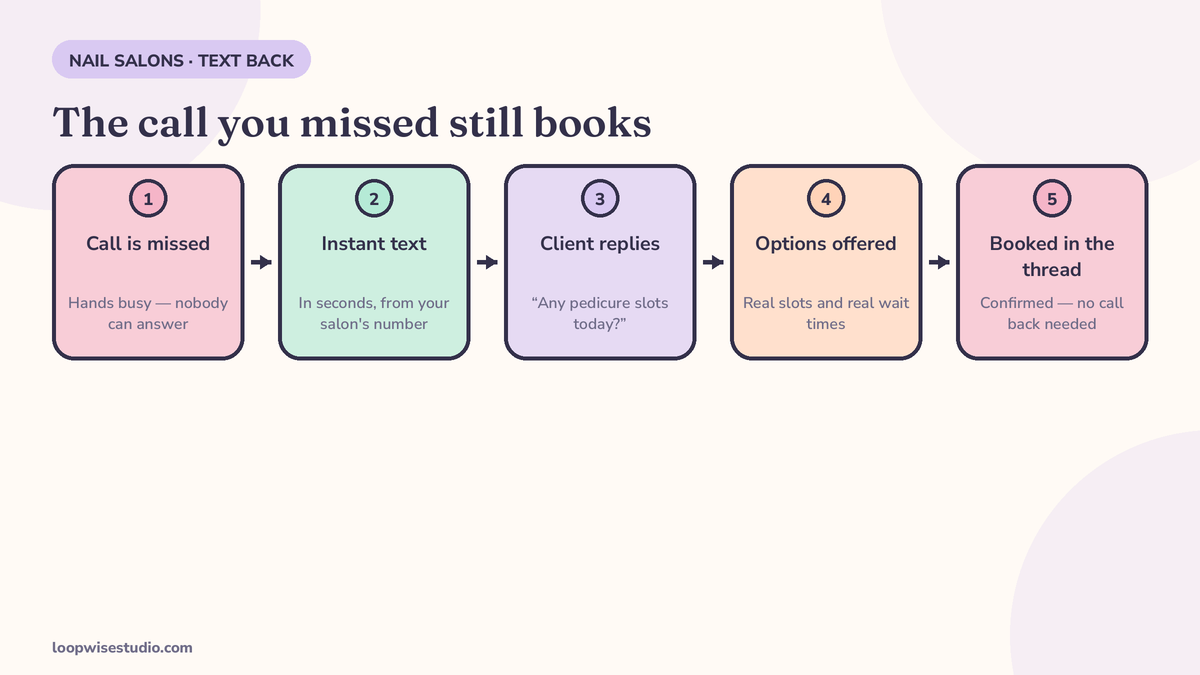
Here is the whole mechanism. It is simpler than the name suggests:
- A call comes in and isn’t answered — busy, after hours, or no pickup after a few rings.
- Within seconds, the caller gets a text from your salon’s number: an apology, a promise, and a way forward (usually your booking link).
- She taps the link and books — real slots, her tech, deposit taken — or she replies to the text with her question.
- Replies land in an inbox you can answer between clients — or, in fuller setups, the conversation itself handles the common questions and books her in the thread.
- You see the recap: which calls were missed, which ones booked, which ones still need a human.
Nothing about your phone setup changes for callers you do answer. Your number stays your number. The text only fires when a call would otherwise have vanished.
We cover the general version of this for salons in missed call text back for salons and barbershops, but nails have two twists the general version misses — walk-ins and language — and both get their own section below. The same mechanism works wherever hands are the constraint: our guide to missed call text back for massage therapists applies it to a treatment room where the therapist is working over a client, not just gloved at a nail desk.
The texts, written out
The first text does most of the work, so it has to be right: apologise, name the salon, give the link, invite a reply. Copy these:
The first text (fires in seconds):
Hi, this is [Salon Name] — sorry we missed your call, we’re with clients. You can book here: [link]. Or reply to this text and we’ll help you out.
A regular asking for her tech:
Hi [Name]! [Tech] has [day] at [time] or [day] at [time] open for a fill. Want me to hold one? Or see all her slots here: [link].
A price question:
Hi! A gel full set starts at $[X] and a fill at $[X] with [Tech]. Exact price depends on length and art — book here and we’ll confirm the total before your visit: [link].
After hours:
Hi, this is [Salon Name] — we’re closed right now, but booking is open 24/7 here: [link]. We open at [time] tomorrow and we’ll reply to texts then.
Notice what these have in common: every one of them moves the caller toward a booking or a reply, in the same thread. Nobody is told to “call back during business hours” — that sentence is where nail salon bookings go to die.
Walk-ins by text: the question only a live answer can save
“How long is the wait for a pedicure?” is a question with a five-minute half-life. If the answer comes in an hour, she is already in someone else’s chair.
This is where text back earns its keep for nails specifically, because walk-in questions are time questions:
Caller (by text, after the instant first message): Hi, how long is the wait for a pedicure right now? Salon: We’ve got a chair opening in about 20 minutes. Want me to put your name down for it? Caller: Yes please! Salon: Done — you’re on the list for [time]. If you’re running late, reply here and we’ll hold it for 10 minutes.
A link-only text back cannot do this — it can only point at the booking page. A book-in-the-thread setup can hold a walk-in spot, and a human picking up the thread between clients can too. Either way, the caller got an answer while her intent was still warm. Voice-agent vendors talk about walk-ins a lot; the same save works by text, in the channel clients already use with salons.
Text in the client’s language
Here is a fact about this industry that answering services rarely plan for: Vietnamese-American ownership in US nail salons is around 50% nationally, per a Nails Magazine industry survey cited by Conduit — and in states like California, Texas and Florida, higher. Spanish and Korean are common in many markets too. Your callers and your techs often share a language that is not English.
Voice stumbles here. Accents, salon noise, and a robot voice mishearing a service name make phone AI awkward fast. Text is forgiving: it can be written once, correctly, in the client’s language, and it reads the same every time. If a share of your clients would rather text in Vietnamese or Spanish, your text-back can open in that language — and a client who gets a reply she fully understands is a client who books.
Keep it simple: match the first text to the language your salon actually speaks with its clients, and let replies continue in whichever language the client uses.
Link-only vs book-in-the-thread vs AI voice: the honest ladder
You have three real options, at three price levels. Published pricing, checked October 2026 — always confirm current pricing before you buy:
| Route | What it does | Published pricing (as listed by the vendors) |
|---|---|---|
| Pure text back, link-only | Texts every missed caller one message with your booking link; replies come to your phone | Tally: $79/mo flat. CallKatch: $15/mo (100 texts), $25 (300), $49 (1,000) — though note CallKatch markets mainly to hair and does not list nails among its industries |
| Book-in-the-thread | The text conversation itself answers common questions and books against your diary | Usually bundled in salon platforms or small tools in the same $15–$79/mo range |
| AI agent / receptionist services | Voice and/or text agents that handle calls, chats and DMs, set up for you | WebSuiteAI lists done-for-you AI booking agents at $99–$499/mo across three tiers |
For most nail salons, the honest advice is: start at the level that matches your leak. If you mainly lose callers because nobody can pick up, link-only text back plus a good booking page solves most of it at the lowest price. If walk-in questions and “does Mia have Friday?” messages are your leak, you need the thread to actually answer. Voice agents are the top of the ladder — worth it for high-volume salons, overkill for many.
And notice the real comparison: WebSuiteAI’s own framing puts a part-time receptionist at $18/hour, 25 hours a week — $23,400 a year before taxes. You do not need to beat that by much for text back to pay for itself; one saved full set a month covers the link-only tier.
Count your own missed calls this week
Do not take any vendor’s headline number — including the ones quoted in this article — as your number. Count your own. It takes ten minutes:
- Pull last week’s call log from your phone provider or phone system.
- Count the calls that went unanswered or to voicemail during opening hours.
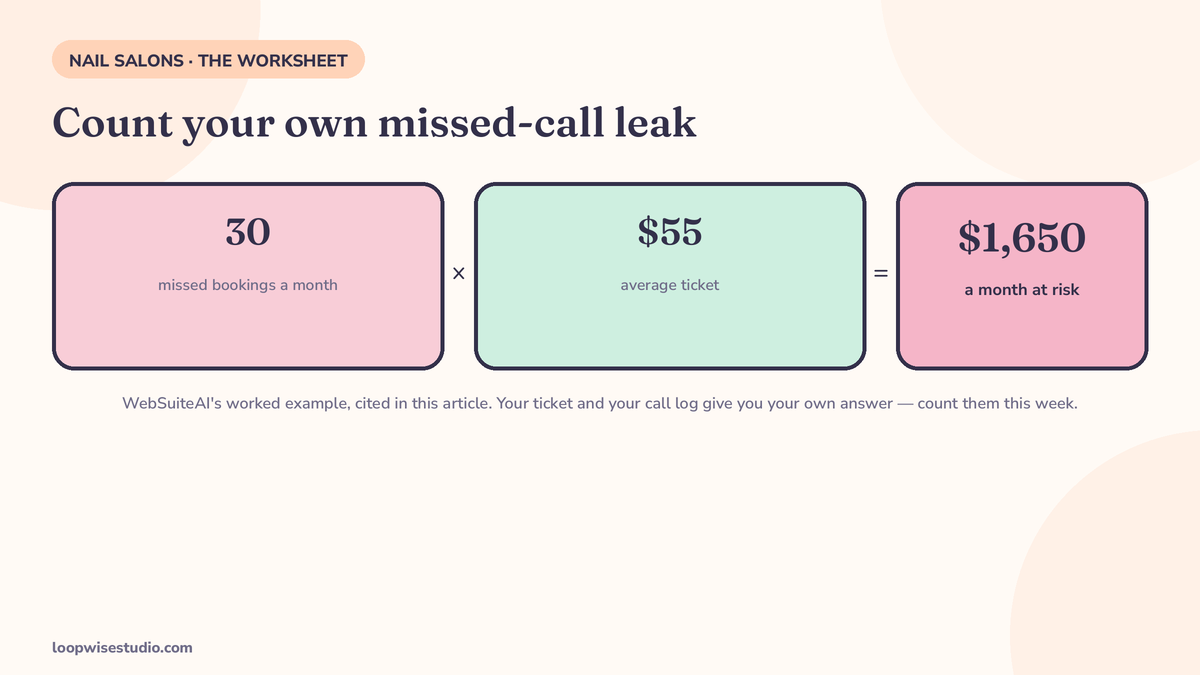
- Take a conservative share — say a third — as people who would probably have booked (agency WebSuiteAI, which audits salons’ call logs, reports roughly one in three missed calls as a booking attempt in the salons it audits; use your own judgement).
- Multiply by your average ticket.
That is your real monthly leak, in your real numbers. If it comes out near zero, congratulations — spend your money elsewhere. If it comes out at a few hundred dollars or more, the fix costs $15–$79 a month at the entry level. WebSuiteAI’s worked example uses the same shape: 30 missed bookings a month at a $55 average ticket is $1,650 a month. Your ticket, your call log — your answer.
Missed calls are only half of the leak, by the way. The other half is clients who did book and then didn’t show — the fix for that is deposits and a reminder sequence, covered in our guide to reducing no-shows at your nail salon.
How to judge whether it is working
Give it a month, then read the numbers most systems report automatically:
- Missed calls caught: how many callers got the text. If this number surprises you — it usually does — that alone settles the “we don’t miss many calls” argument.
- Bookings from texts: how many of those threads ended in an appointment. CallKatch’s product page shows what an honest version of this looks like: its sample monthly recap reads “11 calls answered, 6 appointments booked, ≈ $520 revenue recovered” — and it labels the recap as a sample, which is how vendor numbers should be treated. Yours will be your own diary, not a sample.
- Threads that still need you: the questions the system could not answer. Read them once a month; they are a free survey of what clients actually ask, and half of them usually deserve a saved reply.
The kill-switch test is simple: if bookings recovered in a month do not comfortably exceed the subscription, cancel. Entry-level text back costs less than one full set. A system that cannot recover one full set a month in a salon missing calls every Saturday is a system set up wrong — usually pointing at a booking page that is itself broken, which is worth fixing first anyway.
One more honest note. Text back recovers callers who wanted you. It does nothing for the client who found a competitor first, or whose friend recommended another tech. It closes one leak — a big, measurable, cheap-to-close one — and that is all it promises.
Setup: what actually changes
Very little, which is the point:
- Your number stays. Text back attaches to your existing salon number (or a forwarding rule triggers it when a call is unanswered).
- Your booking page does the heavy lifting. The text is a doorbell; the page is the door. It needs real slots, your techs, and deposit-taking — the anatomy we laid out in online booking websites for nail salons.
- Replies need an owner. Either a human checks the inbox between clients, or the setup answers common questions itself and flags the rest. Decide which before you switch it on.
- After hours is included by default. The salon that loses evening callers to a salon with online booking is the one this fixes — the same after-hours leak we wrote about in how clinics stop losing bookings after hours applies, chair for chair, to salons.
Set it up once, then read the monthly recap: missed calls, texts sent, bookings recovered. If the recap shows bookings, it stays. If it doesn’t, you’ve learned something cheap.
A missed call at a nail salon is not bad luck; it is what happens when every pair of hands is busy for 45–90 minutes at a stretch. Text back turns that ringing phone into a text thread that books. If you want us to run the count on your call setup and tell you which tier fits your salon, get a free audit — no pitch, just the numbers.
FAQs
How fast does the text go out after a missed call?
Within seconds on most systems — that speed is the entire point. Some setups check for unanswered calls on a short cycle (one vendor, Eleven88’s Ava, describes a check every two minutes). Anything under a minute or two keeps the caller from moving on to the next salon.
Will my clients think it’s a robot?
The first text is automated and most clients neither know nor mind — it names your salon, apologises, and helps them book. Replies can be handled by you between clients, or by the system for common questions. What clients dislike is not automation; it is ringing out with no answer at all.
Does text back work with my existing booking software?
Usually, yes. Link-based systems point the text at whatever booking page you already use — Booksy, Square, Fresha, your own site. The booking lands in the same diary your techs already work from.
What does missed call text back cost for a nail salon?
Published entry-level pricing runs from $15–$49/mo (CallKatch, by text volume) to $79/mo flat (Tally) for text back with a booking link, as listed in October 2026. Fuller AI agent setups run $99–$499/mo. Check current pricing — these vendors adjust tiers often.
What if the caller actually needs to talk to a person?
The text invites a reply, and some questions — a complaint, a complicated set, a nervous first-timer — deserve a human. The thread makes that easier, not harder: she can explain by text, and you can call her back between clients with the context already in front of you.
Does it help with walk-ins, or only bookings?
Both. A walk-in question (“how long for a pedicure?”) arrives by phone, goes unanswered like any other call, and the text thread can answer it and hold a spot. That save is specific to nails — and it is one most text-back vendors, who demo with hair examples, never show.