How to Reduce No-Shows in a Massage Therapy Practice
Massage no-shows idle a therapist and a room for 60–90 minutes. Fix them with 48h + 2h reminders, a 20–50% deposit or card on file, and a signed 24-hour policy.

Reduce massage no-shows with automated reminders sent 48 hours and 2 hours before the session, a card on file or a 20–50% deposit at booking, and a written 24-hour cancellation policy the client signs at intake. Keep advance bookings within four to six weeks, when clients can still predict their schedules.
A massage no-show looks like a quiet hour. It is actually two losses stacked on top of each other, and most no-show advice written for salons or clinics misses that completely.
This guide is the massage version: the reminder sequence with copy, the deposit and card-on-file rules, the policy wording clients sign, the booking-horizon trick almost nobody uses, and the three client types — members, first visits, and mobile appointments — where the standard advice breaks down.
One no-show costs you twice: the therapist and the room
A salon no-show empties a chair. A massage no-show empties a chair that comes with a room attached.
Mindbody’s guide to massage scheduling puts the operational fact plainly: a single missed massage appointment can leave a treatment room idle for 60 to 90 minutes or more. Read that as a practice owner: the therapist is paid (or loses paid hours), the room earns nothing, the laundry and setup for that slot already happened, and the hour is too specific — this therapist, this room, this duration — to sell at ten minutes’ notice.
That double loss shapes the whole fix. Everything below is designed to do one of two things: stop the no-show, or shrink the window in which it can hurt you. (The leak on the other side of the phone matters too — while you are in session with your phone off, new clients are calling and getting voicemail. That is a separate hole, covered in our guide to missed call text back for massage therapists.)
The reminder sequence — 48 hours out, then 2 hours out, on the client’s channel
The booking software Bookeo’s massage no-show guide gives the timing that practice owners converge on: reminders at 48 hours and 2 hours before the session, sent on more than one channel where possible, and — the detail most practices skip — let the client choose whether she wants text, email, or both.
Why these two touches work for massage specifically: 48 hours is inside the window where you can still backfill a freed slot from your waitlist. Two hours is close enough that “I forgot it was today” stops being true, and far enough that a client across town can still get to you.
Copy-paste set:
Confirmation (at booking):
You’re booked, [Name] — [60/90]-minute massage on [day, date] at [time] with [therapist]. Your card is on file to hold the slot; you’re only charged if you late-cancel or don’t show. Need to move it? Reply here or use this link: [link] (free up to 24 hours before).
48 hours before:
Hi [Name], your massage is [day] at [time]. Anything we should know — new injury, area to focus on, pressure preference? Reply and we’ll note it for [therapist]. To confirm, just reply YES. To move it, tap here: [link]
2 hours before:
See you at [time], [Name]. We’re at [address / “same place as last time”]. Running late eats into your table time, so aim for 5 minutes early. Stuck? Reply here and we’ll do our best.
The 48-hour message does a quiet second job: asking about injuries and focus areas is good care and a commitment device. A client who has told you her shoulder is the problem shows up for the appointment she personalised.
Card on file or a deposit — the 20–50% band, and when full prepayment is fair
Bookeo’s guide sets out the deposit norm for massage bookings: 20%–50% of the service cost at booking, with full prepayment as the stronger option some practices use instead.
In practice, the split that works is:
| Client / slot | What to take | Reasoning |
|---|---|---|
| Regular, standard slot | Card on file, no charge up front | Lowest friction; the card backs the cancellation policy |
| First visit | Deposit in the 20–50% band, or card on file | No track record yet; first visits are the highest-risk booking in any practice |
| Peak slots (evenings, Saturdays) | Deposit, top of the band | These slots have a waitlist behind them — protect them like it |
| Repeat late-canceller | Full prepayment | The ladder’s last step; see the policy section |
| Gift certificate / package booking | Booked against the balance | The money is already committed — your problem is habit, not payment (members section below) |
Whatever you take, state the refund terms in the same breath as the deposit. “Deposit” without “refundable until 24 hours before, then it converts to the cancellation fee” is where chargebacks and arguments are born.
The policy clients actually sign: 24-hour window, a fee menu, intake signature
Bookeo’s guide describes the standard shape of a massage cancellation policy: a 24-hour window (some practices use 48), and a fee menu that runs from a first-time grace, through a flat $25–$35, or 50–75% of the session, up to 100% for a no-show. The piece almost every practice misses: the client signs the policy at intake, alongside the health form she already signs. A policy she signed is a policy you can enforce without a debate.
Sample wording, ready to adapt:
Cancellation policy. Your appointment is reserved for you, with your therapist and treatment room held for the full session. Please give at least 24 hours’ notice to cancel or reschedule. Cancellations inside 24 hours are charged 50% of the session fee; missed appointments without notice are charged in full. Your first late cancellation is on us — life happens once. Your card on file is only charged under this policy.
Two things in that wording earn their place. “Your therapist and treatment room held for the full session” explains why the fee exists, in the two-resource language the client can picture. And the built-in first-time grace makes the second enforcement feel fair, because it is.
Spot the appointment that is about to no-show
There is a signal most practices ignore: the client who never replies to the 48-hour reminder. Mindbody’s massage scheduling guide makes the point that two-way reminders let a practice track confirmations and identify at-risk appointments early. Use that. An unconfirmed appointment 48 hours out is not a booking — it is a probability.
The play for an unconfirmed slot:
- One personal message, not a second automated one. From you or the front desk, in a human tone: “Hi [Name], just checking Friday at 11 still works — I have someone on the waitlist for that room if your plans changed.” The waitlist mention is not a bluff or a threat; it is true, and it gives her a cost-free exit.
- A reply either way saves you. She confirms: the slot is solid. She releases it: you have 48 hours to fill it, which is the window where filling actually works.
- Silence by the morning of means you treat the slot as soft — the therapist knows, the room is not fully set up, and if a walk-in or waitlist client appears, you are ready rather than hopeful.
This costs you one text per risky appointment and turns your least reliable bookings into either confirmed ones or fillable ones. It is the cheapest section in this whole guide.
Getting the sequence, the card capture, and the signed policy wired into your booking flow is a one-time setup job. If you would rather hand that job off, get a free audit and we will check what your current booking page is missing — deposit, reminders, policy, horizon — and cost it out with your own numbers.
Stop booking six weeks out: the horizon rule and the waitlist
Here is the cause nobody lists: the appointment was simply too far away when she booked it. A client booking eight weeks out is booking for a person whose schedule, health, and motivation she cannot know. Bookeo’s guide names the fix: keep advance bookings within four to six weeks, when clients can still predict their own lives.
Practical version for a massage practice:
- Open your online diary four to six weeks ahead, not three months.
- Regulars get rebooked at checkout for their next session inside that window — the standing rhythm (every two weeks, every month) is what keeps members and regulars attending at all.
- Keep a waitlist sorted by service length. A freed 90-minute slot needs a 90-minute client; a waitlist that only records names, not durations, will fail you at the exact moment you need it.
And when a slot does free up inside 48 hours, work the waitlist in order with a reply window: “A 60-minute slot opened Friday at 11 with [therapist] — yours if you reply YES in the next 30 minutes, then it goes to the next person.” This is the same system, run for a different diary, as the one in our med spa no-show guide — long appointments, high slot value, same mechanics.
The three special cases: members, first visits, and mobile appointments
Members and package holders are the strangest no-shows in massage: they have already paid. The money is safe; the habit is not. A member who no-shows twice is a member quietly cancelling in her head. Handle them differently: the session is deducted as used (that is the deal they signed), and the follow-up message is a check-in, not a charge notice: “Missed you today — I’ve taken it from your package as booked. Want me to lock your next one for [date] before the diary fills?” Retention first, fee second.
First visits carry the highest no-show risk and the highest value — a first visit that lands becomes years of bookings. Give first visits the full treatment: deposit in the band, both reminders, and the intake form sent with the 48-hour reminder, so arriving feels like a plan, not an errand.
Insurance and clinical clients arrive by a different road — referred, often booked in a series, sometimes booked for them by someone else. Two adjustments: the reminders carry practical weight (what to bring, where to park, how long the session runs) because this client may never have chosen a massage in her life; and the rebooking conversation matters more than the deposit, because a series abandoned at session two is a no-show problem spread over six weeks instead of one hour.
Mobile massage is the worst no-show in the niche: you have driven to the client, with the table, and she is not there. The fee menu is not enough. Mobile bookings need a confirmation reply requirement (no YES by the morning of = the visit is not confirmed and you do not drive), plus the travel reality stated in the policy. If you do mobile work, make the 2-hour reminder a confirmation gate, not a courtesy.
Do your own maths (because nobody else’s numbers are yours)
You will see percentage claims about reminder systems all over the internet. Notice how few of them name a source you can check. Rather than borrow anyone’s percentages, run your own practice through the only calculation that matters, assumptions stated:
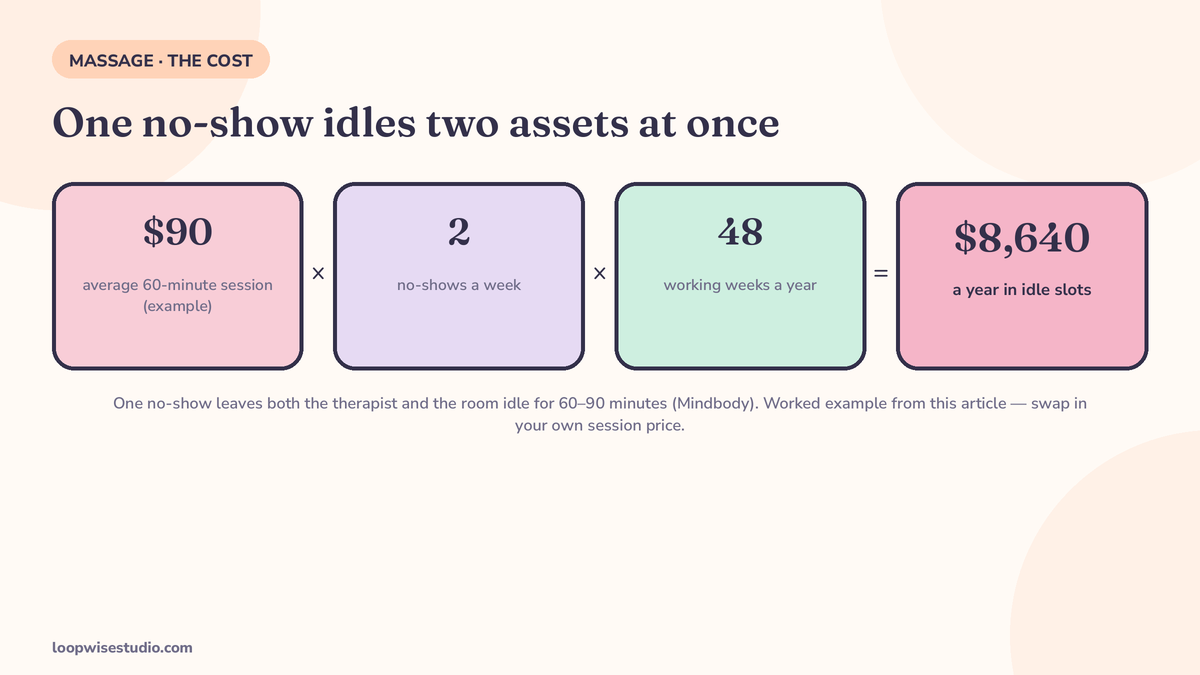
- Your average session: $90 for 60 minutes (swap in your price)
- No-shows and unfilled late cancels: 2 per week (count yours for a month — most owners who count are surprised)
- $90 × 2 = $180 a week → about $8,640 across a 48-week working year
Count yours properly before you change anything: for one month, log every no-show and every late cancel that stayed empty, with the session value beside it. Most practices find the losses cluster — first visits, one weekday, one booking channel. That cluster is your real problem, and it tells you which part of this guide to build first instead of rebuilding everything at once.
Now the honest part: reminders, card-on-file, and the horizon rule will not take that number to zero. If they recover even half, that is roughly $4,300 a year — from a system that, once set up, runs while you are in session with your phone off. And it explains the order of the fixes in this guide: the deposit and card protect the slot’s value, the reminders protect the slot itself, the horizon rule stops you manufacturing no-shows six weeks in advance.
None of this needs a new platform, either. Deposits, two-touch reminders, and a signed policy are settings and wording in the booking software most practices already pay for — the cost question is really about your website and booking layer together, which is what our massage therapist website cost guide breaks down route by route.
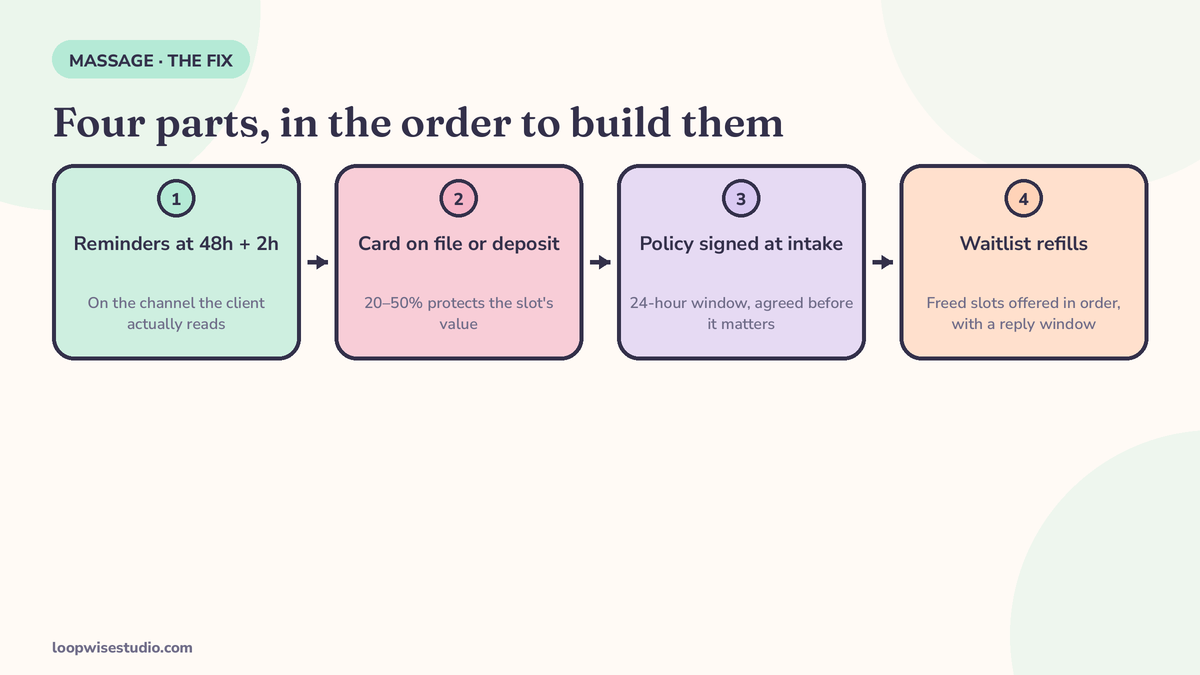
A massage practice loses no-show money twice — therapist and room, 60 to 90 minutes at a time. The fix is four parts: reminders at 48 hours and 2 hours, card on file or a 20–50% deposit, a signed 24-hour policy, and a diary that only opens four to six weeks out. Set it up once and it works every day you are on the table.
If you are a solo therapist, that setup does the work of a receptionist you do not have — the same logic we lay out for a website for a one-person aesthetic clinic. Get a free audit and we will map your booking flow against the four parts and show you which one is costing you the most.
FAQs
How many reminders should a massage practice send? Two timed touches: one 48 hours before and one 2 hours before, plus the confirmation at booking. Bookeo’s massage guide sets out that timing, and advises letting clients pick their channel — text, email, or both — since the best reminder is the one the client actually reads.
Deposit or card on file — which is better for massage? Card on file for regulars and standard slots: zero upfront friction, and it backs the cancellation policy. A deposit in the 20–50% band (Bookeo’s range) for first visits, peak slots, and anyone who has late-cancelled before. Full prepayment is fair for repeat offenders and mobile visits.
What cancellation window and fees are normal for massage? A 24-hour window is the standard (some practices use 48). Common fees: a first-time grace, then a flat $25–$35 or 50–75% of the session for late cancels, and 100% for a no-show. Whatever you choose, have the client sign the policy at intake.
Should members who no-show lose the session? Yes — that is what “booked from your package” means, and it should be in the membership terms they signed. But send a retention message, not just a deduction notice. A member no-showing is usually drifting away, and saving the membership is worth more than the session.
How far ahead should I let clients book? Four to six weeks. Beyond that, clients are guessing at their future schedules, and guess-bookings become no-shows. Book regulars into their next session at checkout, inside the window, instead of opening the diary for months. If a regular insists on a standing slot beyond the window, hold it as a recurring booking with the same reminder and policy rules attached.
A client’s card declined when I charged the no-show fee. Now what? Note it on the file and move that client to prepayment for future bookings — the system enforces it, so you do not have to have the conversation twice. One short message explaining the change, framed by the policy she signed, is enough.