Missed Call Text Back for Massage Therapists
Missed call text back for massage therapists: the text that goes out while your hands are busy, the exact wording, honest costs, and how booking follows.
Missed call text back sends a personal text to anyone whose call you miss — for a massage therapist, usually “Sorry I missed your call, I’m with a client right now” plus a link to book. Because you can’t answer mid-session, the text keeps the enquiry alive: the caller replies or books themselves instead of ringing the next therapist on Google.
That is the whole mechanism. What makes it matter for massage more than for most businesses is the shape of your day. Your phone rings exactly when you are least able to touch it, and the person calling knows three other therapists within a mile who might pick up.
This page walks through how it works, the exact wording for the situations a massage practice actually gets, how it compares with a voice bot or voicemail, what your current booking platform already does (and where it falls short), and what the options cost.
Your hands are busy. Your phone knows it.
Most appointment businesses miss calls because the front desk is swamped. A massage practice misses calls for a simpler reason: there is no front desk. There is you, a client on the table, and a phone on silent in the corner.
Think about when the calls come:
- Mid-session, when answering is not an option and never will be.
- In the ten minutes between clients, when you are changing sheets, washing your hands, and drinking water.
- After your last client, when someone finishing work at 6pm finally has time to book the massage they have wanted all week.
- On your day off, when a regular’s back has gone and they need you this week, not next.
Every one of those callers hears ringing, then voicemail. Some leave a message. Many do not — they go back to the search results and call the next name. You never find out they existed. There is no record of the booking you lost, which is why missed calls are the quietest leak in a solo practice.
Text back exists because the fix is not “answer faster.” You cannot. The fix is that the caller’s phone buzzes with a message from you before they have finished dialling someone else.
How it works, step by step — from the ring you miss to a name in your diary
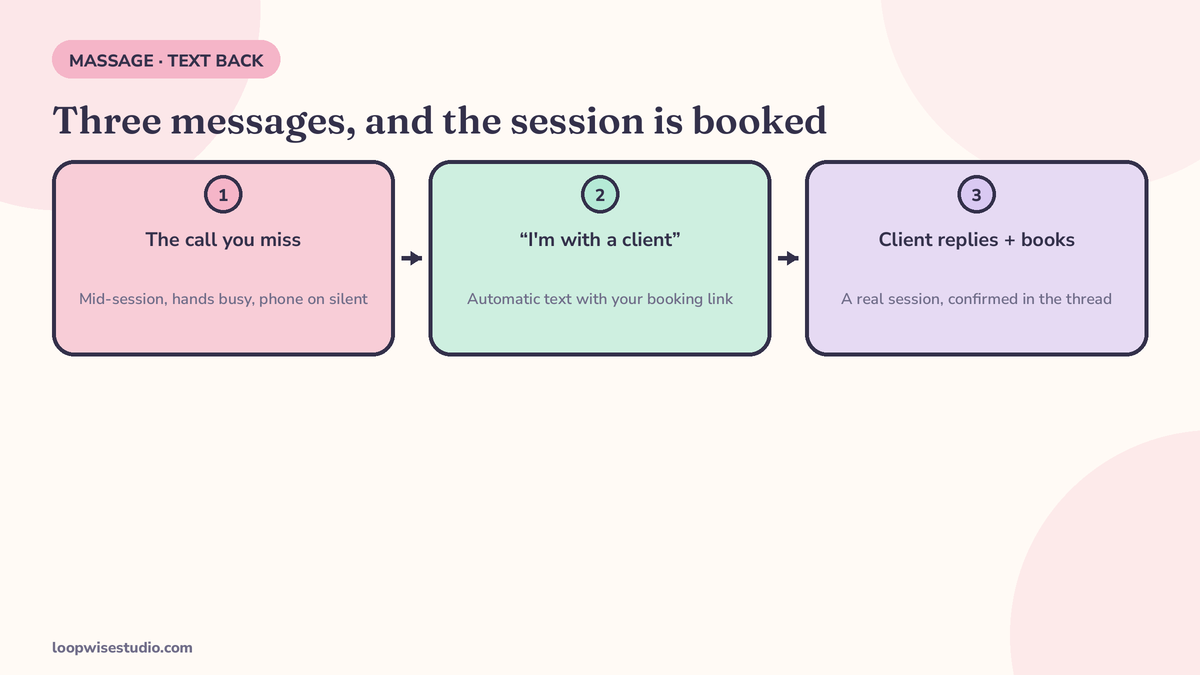
- A call comes in and you can’t pick up. The call goes unanswered or to voicemail, like it does now.
- A text goes out automatically, in under a minute. It comes from your business number, in your name, written the way you would write it. One med-spa text-back service, SpaSignal, promises its text lands within 30 seconds of the missed call — the point is speed, because the caller is still holding their phone.
- The caller replies, or taps the booking link. The text carries a link to your live availability. A caller who knows what they want books there and then. A caller with a question just replies, and the conversation continues as a normal two-way text thread.
- The booking lands in your diary. Between clients, you glance at your phone and see a confirmed appointment and any replies waiting — instead of a voicemail you have to return during your lunch break.
No app for the client to download. No robot answering your phone. The call still rings and still goes unanswered; what changes is what happens in the sixty seconds after.
The texts, word for word — copy this set and change the names
Generic templates do not survive contact with a real massage practice. These are written for the five calls you actually get. Copy them, adjust the voice, and they are ready to send — by hand at first, if you want to test the idea before automating anything.
The mid-session miss (your default text):
Hi, this is [Your Name] at [Practice Name]. Sorry I missed your call — I’m with a client right now. You can see my openings and book here: [booking link]. Or reply to this text and I’ll come back to you between sessions.
The after-hours enquiry:
Thanks for calling [Practice Name] — we’re closed for today. If you’d like to book, my live diary is here: [booking link]. Otherwise reply here and I’ll pick it up first thing tomorrow.
The price question (as a reply, when they ask by text):
Of course — 60 minutes is [$X] and 90 minutes is [$Y]. Most first-timers start with 60. You can grab a time here: [booking link], and if you’re not sure which you need, tell me what’s going on and I’ll point you right.
The regular trying to rebook:
Hi [Name], sorry I missed you! Your usual slot type is free [day/time] and [day/time] this week — want me to hold one? Or book any time here: [booking link].
The first-time enquiry who doesn’t know what they need:
Hi, thanks for calling [Practice Name]. Happy to help you pick the right session — is it for pain somewhere specific, or more for switching off? Either way, my openings are here: [booking link].
Notice what none of these do: none of them sound like a call centre, none promise things you can’t deliver, and every one gives the caller two ways forward — reply, or book. That second door is what turns a text into an appointment instead of a polite dead end.
If this is the part you’d rather not set up yourself — the wording, the link, the diary connection — that is exactly what we build. You can get a free audit and we’ll map the missed-call flow for your practice before you spend anything.
Text-back vs a voice bot vs voicemail vs calling back later — an honest comparison
You have four real options when a call comes in mid-session. They are not the same product wearing different clothes.
| Option | What the caller gets | What it asks of you | The catch |
|---|---|---|---|
| Missed call text back | A text from your number within a minute, with a booking link | Read replies between clients | Caller has to be willing to text (most are) |
| AI voice receptionist | A robot voice answers live and takes the booking | Trust a bot to speak as your one-person practice | Some callers dislike it; for a practice built on personal trust, the voice is the brand |
| Voicemail | A beep | Return calls later, play phone tag | Many callers never leave a message — you never learn they called |
| Call back when free (Google Voice / your mobile) | Nothing, until you call back | Remember, find the time, reach them before a competitor does | The gap between their call and your callback is where the booking dies |
Voice AI is the option most heavily marketed to massage clinics right now, and it is a genuine product — it answers at 2am. But it answers as you, out loud, to people who chose a small practice partly because a human runs it. Text back makes a different trade: nobody pretends you picked up, and the client gets a message they can answer in their own time. For a solo therapist, that honesty is usually the better fit. For a multi-room clinic with a real phone problem at the desk, the maths may differ.
The text your booking platform already sends — and why replies go nowhere
Here is something most massage therapists never learn about the tools they already pay for.
MassageBook, the booking platform built for this industry, sends texts to clients — and in its own support documentation, it tells you what happens when a client replies to one. The reply triggers this message: “This is an unmonitored SMS number. Please contact your service provider directly.”
Read that from the client’s side. They got a text from your practice, they answered it like a person, and a machine told them the conversation was fake.
That is the difference between notification texts and text back. A notification talks at the client. A text-back service holds the conversation: replies come to you, questions get answered, and the booking link sits in the same thread. If your current setup sends texts nobody can answer, you do not necessarily need a new platform — you need the layer on top of it fixed. The same pattern shows up in bigger practices too; our guide to missed call text back for med spas covers the multi-room version of the same problem.
What it costs, three ways — and how to count what it’s worth to you
There is no single price for text back, and anyone who quotes you one number for every practice is selling, not informing. The three routes:
Do it yourself — free, and it costs you time. A Google Voice number and the templates above, sent by hand when you see a missed call. This works if your missed calls are few and you check your phone between every client. It stops working the first busy Saturday.
A text-back tool — a monthly subscription, prices vary. Standalone tools and CRM add-ons exist at a range of prices, and several vendors in this space — SpaSignal included — do not publish theirs; you have to ask, and you should check current pricing on any tool’s own site before budgeting. What you are paying for at this tier is the automation: the text fires whether you are watching your phone or not.
Done for you — the setup is the product. The text-back is connected to your number, your diary, and your booking page, with the wording written for your practice. More expensive than a bare tool, cheaper than the bookings walking away — and it is the route to take if the honest answer to “will I set this up myself?” is no.
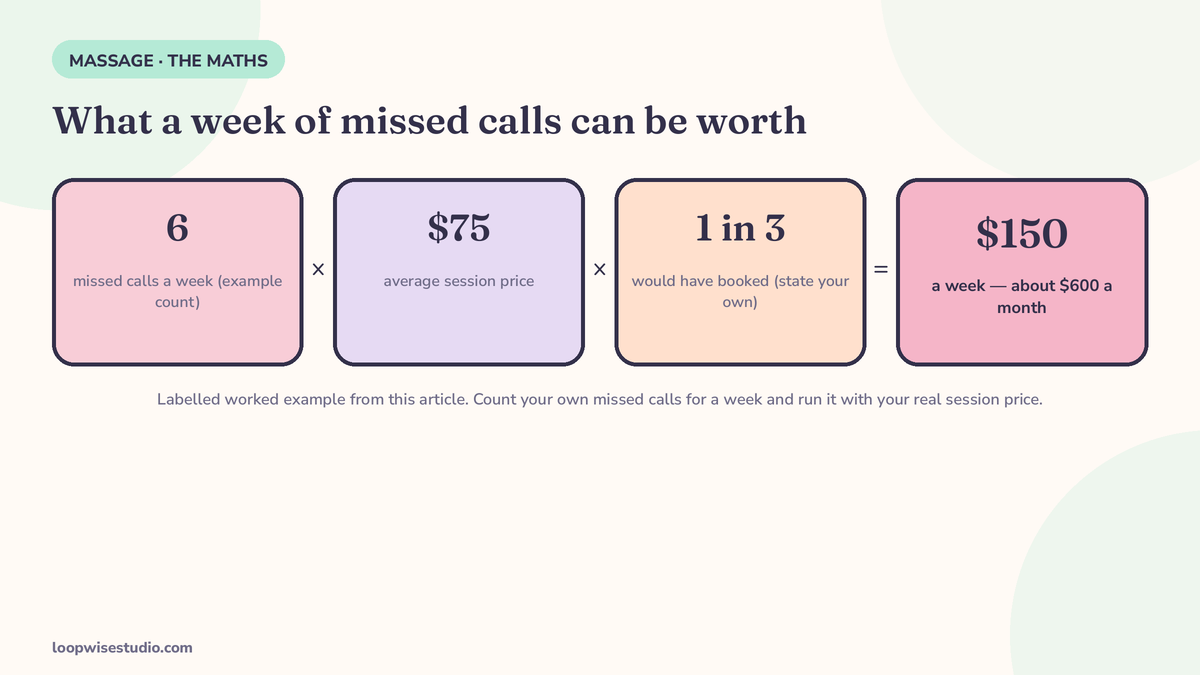
Now the worth-it count, which you should do with your own numbers rather than anyone’s statistics. For one week, count your missed calls — your phone log already has them. Multiply by your average session price. That is the money that asked for you this week.
Say the count is 6 missed calls and your average session is $75. That is $450 of demand that rang your phone. Not all of it was bookable — some were sales calls, some would have rebooked anyway, some wanted a time you never had. State your own assumption: if even a third of those callers would have booked with you had a text caught them, that is roughly $150 a week, or $600 a month, decided by whether a message went out in the first minute. Run it with your real count. The arithmetic is the argument.
However the count comes out, the partner problem is what happens after they book — a recovered caller who then no-shows is a leak moved, not fixed. Our guide on how to reduce no-shows in a massage therapy practice covers the reminder side, and if you are costing the whole front door at once, how much a website costs for a massage therapist breaks the website half down.
The quiet rules — consent, opt-outs, and no clinical detail
Texting clients is not a free-for-all, and a one-person practice has a reputation to protect. Four rules keep you safe:
- Only text people who contacted you first. A missed call is an invitation to reply to that call. It is not permission to market to a bought list, ever.
- Always honour a stop. If someone replies STOP or asks not to be texted, that is the end of it — your tool should handle the opt-out automatically.
- No clinical detail in texts. Texts sit on lock screens. “Your deep-tissue session is moved to Thursday” is fine. Anything about a condition, treatment notes, or health history does not belong in an SMS.
- Write like the therapist, not the brand. Your clients come to a person. The texts should read like you wrote them between clients — because in every way that matters, you did.
Frequently asked questions
Will clients think a robot is texting them? The text comes from your business number, in your words, and it says plainly that you are with a client. Clients reply to it like a normal text thread — because it is one. What reads as robotic is the opposite setup: a platform text that tells them replies are not monitored.
Does it work if I use MassageBook / another booking platform? Yes — text back sits on your phone number and points callers at your existing booking link. You do not have to change platforms to fix the missed-call layer, though it is worth checking what your platform’s own texts do with replies before you layer anything on.
What happens when someone replies with a question I can’t answer by text? The reply waits in the thread until you are between clients, like any text. The point is not to automate you out of the conversation — it is to make sure the conversation exists at all, instead of the caller booking elsewhere while your phone sat on silent.
Can it send the text outside my working hours? Yes, and it should — with different wording. The after-hours template above acknowledges you are closed and offers the booking link or a next-morning reply. A caller at 9pm who gets that text books at 9pm, in bed, instead of forgetting by morning.
Do I need a separate business number? You need a number the text-back service can send from and receive replies on. Many therapists use their existing business line if it supports texting; others keep a dedicated number so practice texts stay off a personal phone. Either works — what matters is that it is your number, so the client list and the conversation history stay yours.
Is texting patients about appointments allowed? Appointment-related texts to people who called you or booked with you are standard practice, with the consent and opt-out rules in the section above. Keep marketing messages separate, never text clinical details, and check the rules that apply in your state if you plan anything beyond appointment replies and reminders.
You miss calls because you are doing the work your clients pay for. That will never change, and it shouldn’t. What can change is the sixty seconds after the ring — a text in your voice, a link to your real diary, and a conversation the client can actually reply to.
If you want to see what that flow would look like on your own number and your own diary, get a free audit — we’ll count the leaks in your current setup and show you the fix before you commit to anything.