How to Reduce No Shows at a Med Spa: A Working System
How to reduce no shows at a med spa with a confirmation and reminder sequence, deposits, a waitlist, and a 15-minute rescue message. Exact wording included.
To reduce no shows at a med spa, you need four things working together: a confirmation that lands the moment someone books, a short sequence of reminders that lets them confirm or move the appointment with one tap, a deposit rule for the appointments that cost you most when they vanish, and a waitlist that fills the gap when someone cancels anyway. None of it requires new software. Most of it is turning on, and writing properly, the messages your current booking system can already send.
This guide gives you the whole system in the order you would build it, with the exact wording for each message. That wording is the thing missing from almost every other page on this subject. They will tell you reminders help. They will not show you a reminder.
What a no-show actually costs you
A no-show is not an empty slot. It is two losses in one.
First, the slot itself. You held an hour of a room, a machine, and a practitioner’s time that another client would have paid for. Second, the money you spent getting that booking in the first place — the ad click, the Instagram post, the referral offer, the front-desk time. A client who books and vanishes costs more than a client who never booked, because you paid for her twice and earned nothing.
If you want the number in money rather than a percentage, run your own month through the no-show cost calculator — it is free, needs no email, and stays in your browser.
How common is it? A Gracero buying guide for med spa owners, citing ScaleHaven’s 2026 industry statistics, put the med spa no-show rate at 15 to 25% without automated reminders, and 8 to 12% with SMS reminders. That same guide worked an example: a spa taking 200 appointments a month at $350 each, cutting no-shows from 15% to 8%, has 14 fewer no-shows a month — $4,900. Cutting from 25% to 12% is 26 fewer, or $9,100 a month.
For wider context, and to show the limit of the numbers: the same page cited a review of 105 studies that found an average no-show rate of 23.0% — but that figure covers healthcare in general, not med spas. Use the med spa range for your planning, and treat all of it as a range to test against your own diary, not a promise.
Use your own ticket if you have it. AmSpa’s 2024 Medical Spa State of the Industry Report put average spend at $527 per visit, and the Gracero guide put average Botox appointments at $350 to $550. Either way, multiply your monthly no-shows by a number in that range and the “annoyance” becomes a line item.
One more figure worth keeping in mind while you build this: AmSpa also reported an average of 245 patient visits a month. At that volume, a 15% no-show rate is about 37 empty slots a month. You do not have a marketing problem if you are filling 245 slots and losing 37 of them. You have an attendance problem, and it is cheaper to fix.
Why clients really no-show
Owners tend to assume no-shows are rudeness. A few are. Most are a booking made in a moment of enthusiasm that life then buried. Working through the real reasons matters, because each one has a different fix.
They booked too far ahead. A client who books a peel four weeks out, in a burst of motivation after seeing a photo, is a different risk from one who books for Thursday. The longer the gap between booking and appointment, the more life gets in the way, and the more touches they need.
They forgot. Not carelessly — just normally. No calendar entry, no reminder, a busy week. This is the biggest group and the easiest to fix.
They could not cancel without phoning. This one is on us. If cancelling means calling during opening hours, waiting on hold, and explaining themselves to a person, many clients will simply not show up instead. Ghosting is the path of least resistance when you have made the honest path awkward.
Nothing was at stake. No deposit, no card on file, no policy they ever saw. Skipping cost them nothing, so when the day got busy, the appointment was the easiest thing to drop.
Something went wrong and they felt awkward. A reaction to a previous treatment, a worry about cost, a bad week. These clients often want to come back. They need a door that does not require a confession.
Notice what is not on that list: bad clients. If your no-show rate is above 15%, it is a system design problem, not a clientele problem. That is good news, because systems are fixable this week.
The system at a glance
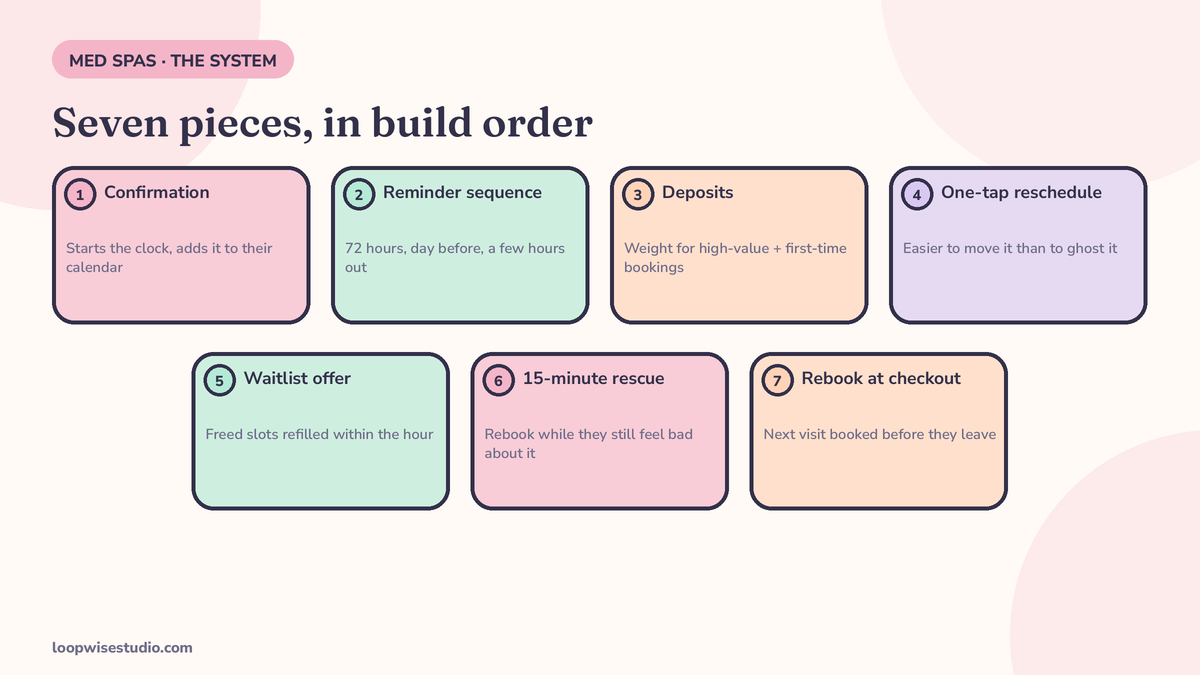
Seven pieces, in build order. Every one of them can be set up in the booking tool most med spas already have. If yours cannot do a piece, that is useful information about the tool, and it is covered at the end of this guide.
| # | Piece | When it happens | What it does |
|---|---|---|---|
| 1 | Confirmation with a calendar invite and a plain-language policy | The moment they book | Starts the clock, puts the appointment in their own calendar |
| 2 | The reminder sequence | 72 hours before, the day before or morning of, a few hours before | Gives them a one-tap way to confirm or reschedule while there is still time to refill the slot |
| 3 | A deposit rule | At booking, for high-value and first-time appointments | Gives the booking weight without punishing your regulars |
| 4 | One-tap rescheduling | Inside every reminder | Makes moving an appointment easier than vanishing |
| 5 | An automatic waitlist offer | The moment a slot frees up | Refills a cancelled slot within the hour |
| 6 | The 15-minute rescue | 15 minutes after a no-show | Recovers the client while she still feels bad about it |
| 7 | Rebook before they leave | At checkout, for clients who did show | Stops the next no-show from being created |
Piece 1: A confirmation that starts the clock
The confirmation message is the most underused message in the whole sequence. Most spas send “Your appointment is confirmed for Tuesday 14 May at 2 pm” and stop. That message should do three jobs: confirm, get the appointment into the client’s own calendar, and state the cancellation policy in words a person would say out loud.
You’re booked, [Name]. [Treatment] with [Practitioner] on [Day, Date] at [Time]. Add it to your calendar here: [link]. Running late or need to move it? Reply to this text any time — please give us 24 hours if you can, as we hold this slot just for you. A [deposit amount] deposit has been taken and comes off your total on the day.
Why each part is there:
- The calendar link matters more than the text does. A text can be buried by Thursday. A calendar entry with an alert on the client’s own phone survives.
- “Reply to this text any time” is an invitation to reschedule early. You want to hear about a problem on Monday, not discover it on Thursday at 2 pm.
- The policy is framed as the reason, not a threat. “We hold this slot just for you” is the same rule as “24-hour cancellation policy applies”, in language that does not make a new client feel warned before she has met you.
- The deposit is mentioned with its benefit. It comes off the total. Say that. Clients who hear only “deposit taken” feel charged. Clients who hear “comes off your total on the day” feel organised.
Send it immediately. Not in a batch at the end of the day. A client who books at 9 pm and hears nothing until 10 am has had thirteen hours to wonder if it worked, and some of them book somewhere else in that window.
Piece 2: The reminder sequence
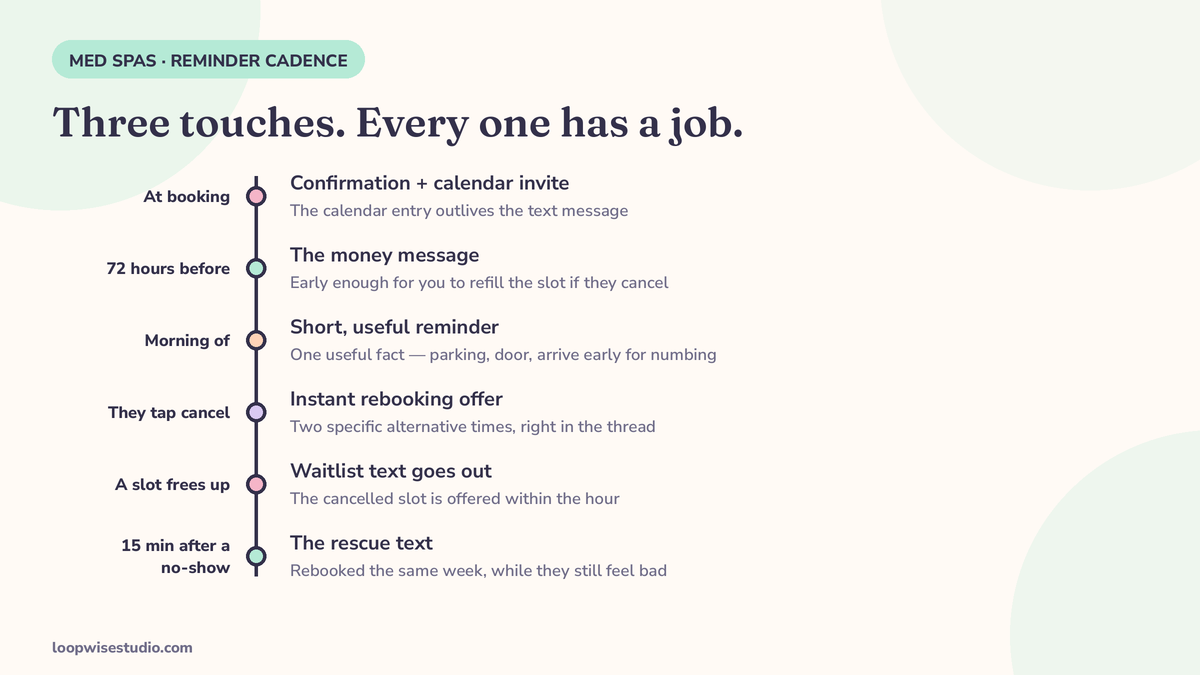
This is the heart of the system, so here it is in full. Three touches, no more. Workee’s guide to med spa software makes the same point in its FAQ: use two to three reminders at most, with one-tap confirm or reschedule, and the policy made clear up front. More than three and you start training clients to ignore you — and you look desperate.
The cadence below follows the three-touch pattern Clinairo, a clinic growth agency, describes in its own no-show guide: a confirmation at booking, a reminder at around 72 hours — “the one most practices skip, and the one that recovers the slot” — and a short one a few hours before. Other sources use slightly different timing. Illumination Consulting describes 7 days, 48 hours, and 2 hours. Workee describes 48 hours to confirm, 24 hours with a reschedule link, and a short reminder at 2 to 3 hours. The exact hours matter less than the principle: one early enough to act on, one close enough to remember.
| When | Channel | Message | What the client can do |
|---|---|---|---|
| At booking | Text (and email if you have it) | “You’re booked, [Name]. [Treatment] on [Day, Date] at [Time]. Add it to your calendar: [link]. Need to move it? Reply here — please give us 24 hours if you can.” | Add to calendar, reply, reschedule |
| 72 hours before | Text | “Hi [Name], looking forward to seeing you on [Day] at [Time] for [Treatment]. Tap to confirm: [link]. Need a different time? Tap here and pick one: [reschedule link].” | Confirm, or reschedule in two taps |
| Morning of, or 2–3 hours before | Text | “See you today at [Time], [Name]. We’re at [short address]. Parking: [one useful detail]. Running late? Reply here and we’ll do our best.” | Reply, get directions, warn you |
| If they tap cancel at any point | Text, immediately | “No problem, [Name] — your [Treatment] on [Day] is cancelled and your deposit has been [refunded / held as credit]. Want me to offer you [two specific alternative times]? Reply 1 or 2, or see all times: [link].” | Rebook on the spot |
| 15 minutes after a no-show | Text | See Piece 6 below | Rebook the same week |
| When a slot frees up | Text to the waitlist | See Piece 5 below | Claim the slot |
Four details that make this sequence work rather than just exist.
The 72-hour message is the money message. Not because it reminds them — because it is early enough for you to refill the slot if they cancel. A reminder the morning of the appointment tells you about a problem you can no longer solve. A reminder three days out gives you a slot you can offer to a waitlist client with time to arrange her day.
Every reminder needs two buttons, not one. Confirm, and reschedule. A reminder that only says “reply Y to confirm” leaves the client who cannot come with two options: an awkward phone call, or silence. Give her the second button.
The day-of message should carry one useful fact. Parking, which door, arrive five minutes early for numbing cream, no makeup for a facial. Useful messages get read. Repetition of the same “reminder: your appointment is tomorrow” gets skimmed and then ignored.
Ask them to confirm, and use the answer. If a client has not confirmed by the morning of a high-value appointment, that is a flag for a human to pick up the phone. Software cannot do that bit. But it can tell you who needs the call, which is most of the work.
Clinics outside the US run the identical sequence on a different channel. If your clients live in WhatsApp rather than text messages, the timing and the wording are the same and only the app changes — we covered that version in our guide to WhatsApp appointment reminders for clinics in the UK, where WhatsApp is the default way clients expect a business to reach them. Australian dental practices have an extra registration step on top of the sequence, explained in our guide to text message appointment reminders for dental clinics in Australia, and the same mechanics applied to hands-on treatment courses are in our guide to reduce no-shows in a massage therapy practice.
Piece 3: Deposits, without scaring clients off
Deposits are where most no-show advice stops at “take a deposit”. Here is the detail that decides whether it helps or quietly costs you bookings.
Take deposits where the loss is real, not everywhere. A workable rule for a small spa:
- Full deposit or card on file for first-time clients booking high-value treatments — laser courses, filler, anything over an hour of practitioner time.
- A flat deposit for consultations with your senior practitioner, where the slot is scarce.
- No deposit, or card on file only, for established regulars booking routine appointments. They have a track record. Trust it, and let them feel trusted.
Clinairo’s guide makes the same call in fewer words: deposits only on high-value consults, explained in the payment message itself, framed as “a commitment device, not a fee”. That framing is the difference between a deposit that works and a deposit that starts an argument.
How much? Two shapes work. A flat amount that feels like a token — $50 is common — or a percentage of the treatment, typically 20 to 30%. Flat is simpler to explain and simpler to refund. Percentage scales better if your prices run from $80 facials to $900 combination treatments. Pick one rule. A policy with four exceptions is a policy your front desk will apply unevenly, and uneven is where complaints come from.
Card on file vs paying upfront. Card on file with a stated no-show charge is softer: nothing leaves the account unless they vanish. Paying a deposit upfront is stronger: the money has already moved, and people show up for things they have paid toward. For first-timers, upfront tends to work better. For regulars, card on file is plenty. Either way, the charge only works if you actually apply it. A no-show fee that is always waived teaches clients it is not real within two visits.
The exact words. Put this in the booking flow and repeat it in the confirmation text:
To hold your appointment we take a [amount] deposit. It comes straight off your total on the day. If you need to move your appointment, reply to any of our texts up to 24 hours before and we’ll move the deposit with it, no charge. Inside 24 hours, or if you don’t come in, the deposit is kept — because that hour was held for you and can’t be offered to anyone else at short notice.
And for a regular you are introducing it to for the first time:
Quick note, [Name] — we’ve started taking a card to hold appointments, after a run of last-minute gaps we couldn’t fill. Nothing is charged unless someone doesn’t show. You’re on our regulars list, so nothing changes about how you book. Just tap here once to add your card: [link].
Say it plainly, say it once, and do not apologise twice. Owners worry this will put clients off. What puts clients off is finding out about a fee after the fact.
Halfway check: if your diary is full and your chairs are not, that is an attendance problem, not a demand problem. get a free audit and we’ll mystery-book your spa, then grade your confirmation and reminder flow against the sequence above — including whether your deposit wording would survive a real client reading it.
Piece 4: Make rescheduling easier than ghosting
This is the cheapest piece to build and the one most spas skip entirely.
Every reminder and every confirmation should carry a reschedule route that works in two taps, at 10 pm, without speaking to anyone. Not “please call us to reschedule”. Not a link to a homepage. A link that opens the appointment, shows other times, and moves it.
Then, at the moment someone cancels, offer the alternative in the same message. Do not let a cancellation be the end of the conversation. The cancellation text in the table above gives two specific times, not an open “let us know when suits”. Two named times get an answer. An open question gets forgotten.
Why this matters more than it looks: a client who reschedules is worth as much as a client who shows. Same revenue, same client, one week later. A client who ghosts often feels too guilty to rebook at all, and quietly becomes a client of the spa that did not make her feel bad. You are not just saving a slot when you make cancelling easy. You are keeping the client.
Piece 5: The waitlist that refills the slot
Every guide mentions a waitlist. Almost none of them explain how one works. Here it is.
Who goes on it. Clients who asked for a time you could not give them. Clients who booked further out than they wanted. Clients who cancelled and could not take either alternative you offered. Ask at the moment of disappointment — “That Saturday is full. Want me to text you if it opens up?” — and you will build a useful list in a month without trying.
What happens when a slot opens. The moment a cancellation lands, text the best matches. Match on treatment length and practitioner first, then on who asked most recently. Do not blast the whole list. Three to five people is plenty, and it keeps the offer feeling like a favour rather than a marketing send.
Give the offer a window.
Hi [Name], a [Treatment] slot has just opened on [Day] at [Time] — you asked about that day. It’s yours if you want it: tap here to claim it [link]. I’ll hold it for the next 30 minutes, then offer it on. No deposit needed to claim, your usual one applies.
The 30-minute hold does three things. It creates a reason to reply now. It stops three people booking the same slot. And it makes the client feel she was thought of, which she was.
Then stop. If nobody claims it, the slot goes to your stories or your next-day list. Do not send a second round of texts that afternoon. A waitlist that nags becomes a list people leave.
Piece 6: The 15-minute rescue
Someone no-showed at 2 pm. What do you do at 2:15?
Most spas do nothing until the end of the day, then either send a stiff message or write the client off. Clinairo’s guide puts this better than anyone else we read: send the rescue message inside the first fifteen minutes, because she knows she missed it and probably feels slightly guilty about it. Wait until the end of the day and that window has closed. She has decided you are annoyed with her, and the easiest way to avoid an annoyed business is to book somewhere else next time.
So the message must be warm, short, and assume an innocent explanation.
Hi [Name], we had you down for [Treatment] at [Time] today — hope everything’s okay. No charge this time. Want me to grab you another slot this week? I have [Time A] on [Day] or [Time B] on [Day]. Reply A or B and it’s yours.
Note what is and is not in there.
Concern first, business second. “Hope everything’s okay” is not a script trick — sometimes something genuinely happened, and the spa that asked will be remembered for asking.
The fee position is stated once, whichever way your policy goes. If you waived it, say so; it buys goodwill you can see. If you charged it, say that instead, kindly and without a lecture: “Your deposit has been applied per our policy.” Either is defensible. Ambiguity is not.
Two specific times, again. Not “when would suit you?” She is flustered and mid-crisis in whatever made her miss. Hand her a choice of two.
And: send it once. If she does not reply, one more message a week later is fair, offering to rebook with no mention of the miss. After that, she goes into your normal reactivation flow.
Piece 7: Rebook before they leave
The easiest no-show to prevent is the one that never gets created. A client who leaves with her next appointment already booked, on the right interval, with a confirmation text already in her hand, is far less likely to drift than one who leaves with “book next time”.
AmSpa’s 2024 report said 73% of medical spa patients are repeat patients, and the average spa sees 245 visits a month. That repeat business is the business. Neurotoxin on an 8-to-12-week cycle, laser in a course, facials monthly — all of it has a natural next date, and your practitioner knows what it is while the client is still in the room.
Make it part of leaving, not an extra:
Before you head off — [Practitioner] wants to see you again in [interval] for [next step]. I’ve put you in for [Day, Date] at [Time]. You’ll get a text now to confirm, and you can move it any time by replying to that text.
Book it, then let the reminder sequence do its work. If she later moves it twice, that is information about the interval or the time of day, not a character flaw.
The other half of the leak
No-shows are bookings that never happened. Missed calls are bookings that never got made. Owners usually treat them as two separate problems with two separate fixes, and they are not. The client you lost at the phone on Monday is the same client whose empty chair you are staring at on Friday.
So it is worth knowing what the first half costs. Our breakdown of how much revenue med spas lose from missed calls works through the formula with published figures — including a 2026 estimate from Lani AI that put the loss above $100,000 a year for a mid-sized spa, and the assumptions inside that number, which its own release does not state. Run it alongside your no-show count and you will have your total leakage in one sitting.
And if the calls are the bigger half of your problem, the fix is its own system: our guide to missed call text back for med spas sets out the text that goes out within seconds of a missed call, the six scripts for the situations med spas actually get, and the booking page that text has to land on. Text back catches them at the door. Reminders keep them in the chair. You need both, but you can build them one at a time.
What to track every week
Measurement advice usually arrives as “monitor your no-show rate”. Here is the version you can actually run in five minutes on a Friday.
| Number | How to count it | What good looks like |
|---|---|---|
| Booked | Appointments in the diary for the week | Your baseline |
| Showed | Clients who arrived | Booked minus the rest |
| No-show rate | No-shows ÷ booked, split by new vs returning clients | Under 10% overall — the 8 to 12% range ScaleHaven’s 2026 statistics give for spas using SMS reminders |
| Rescued | No-shows who rebooked within 7 days of the rescue text | Rising month on month |
| Refilled | Cancelled slots filled from the waitlist | Any number above zero is money the old system lost |
Split by new versus returning, and by treatment type if you can. Clinairo makes this point and it is the most useful measurement tip in the batch: a 20% no-show rate on first-time consults and a 5% rate on regulars is not one problem, it is a deposit policy for consults waiting to be written. A blended 12% tells you nothing to act on.
Give it four weeks before you judge it. One bad Saturday is weather, traffic, or a local event. Four weeks is a pattern.
If you are building this yourself, build it in this order
- Fix the confirmation. Add the calendar link and write the policy in plain words. One hour of work, immediate effect.
- Turn on the 72-hour reminder with two buttons. Confirm and reschedule. This is the touch that recovers slots.
- Add the reschedule link everywhere. Confirmation, reminders, your website’s contact page, your Instagram bio.
- Set the deposit rule for high-value and first-time bookings. Write the wording before you switch it on.
- Write the rescue message and save it as a template. Your front desk will not compose a warm message from scratch at 2:15 pm on a busy day. Give them the words.
- Start the waitlist. A note in the client record is enough to begin. Automate the offer once you have twenty names.
- Add the day-of message last. It is the least valuable of the three reminders, so it goes in after the ones that recover slots.
What done-for-you looks like, for comparison: we build the sequence, write the messages in your voice, set the deposit rule in your booking system, check the booking page the messages point to, and hand you the weekly four numbers. The work is not mysterious — it is the list above, done and tested, without it landing on a front desk that already has no spare hour.
One honest warning about doing it inside a platform switch. If your current booking software cannot send a 72-hour reminder with a reschedule link, or cannot take a deposit on selected services only, you have a real reason to look at alternatives. That is a bigger project than this guide, and it should be a deliberate one, not a reaction to a bad week.
Frequently asked questions
How many reminders is too many?
Three, including the confirmation. One at booking, one around 72 hours before, one on the day. Workee’s guidance to vendors makes the same point — two to three reminders at most, with one-tap confirm and reschedule. Beyond that, clients start ignoring all of them, including the ones that matter, and your messages begin to look like marketing rather than service.
Do deposits put clients off booking?
A deposit explained badly will. A deposit explained as money that comes off their total, with free rescheduling up to 24 hours before, mostly puts off the people who were not sure they would come. That is rather the point. Start with first-time clients and high-value appointments only, watch your booking numbers for a month, and extend it only if the numbers say you can.
What should I do about long-time regulars who no-show?
Talk to them like regulars. First time, waive it, send the rescue message, and rebook them. Second time, a short honest conversation at their next visit: you hold that hour for them, and when it empties you cannot fill it. Third time, they join the deposit rule, and you say so plainly and kindly. What does not work is applying a silent penalty, or letting it slide forever while your team resents it.
What if my booking software can’t send a 72-hour reminder?
Check whether it can send reminders at a custom interval rather than only its defaults — many can, and the option is buried. If it genuinely cannot, run the 72-hour touch manually for high-value appointments only, from a saved template, until you change systems. Ten appointments a week is manageable by hand. Fifty is not, and that is your signal.
Should reminders be texts or emails?
Texts for the touches that need an action. Email open rates on the day of an appointment are too slow to rescue a slot. Email still has a job: the confirmation, with the calendar invite and the full policy, is easier to file and find in an inbox. Use both where each is strongest. If your clients are on WhatsApp rather than SMS, the same logic applies and the same timings work.
How quickly will I see a difference?
The 72-hour reminder and the rescue message usually show up in the numbers inside two to three weeks, because they act on bookings already in your diary. Deposit changes take longer to judge, because they change who books as well as who shows. Give any single change a month before you decide it worked or did not.
The short version
Clients no-show because they forgot, because the appointment was weeks away, because cancelling meant an awkward phone call, and because nothing was riding on it. All four of those are design choices in your booking system, and all four can be changed this week.
Confirmation with a calendar invite. A reminder at 72 hours that lets them move it in two taps. A deposit on the appointments that hurt when they vanish. A waitlist that fills the gap. A kind message fifteen minutes after a miss. Then rebook the ones who did come before they walk out.
If you want a second pair of eyes on your current flow before you rebuild it, get a free audit. We will book a test appointment at your spa, sit through your own confirmation and reminder sequence as a client does, and send you a short report on where a real client would have quietly dropped out.