WhatsApp Reminders & Booking for UK Vet Practices
Send vet appointment reminders, booster recalls and rechecks on WhatsApp — no client app to download, no PMS swap. Templates, costs and UK consent rules.
A UK vet practice can run appointment reminders, booster recalls and recheck follow-ups on WhatsApp by connecting the WhatsApp Business Platform to its existing booking diary. Confirmations and reminders go out automatically, replies land in one shared inbox, clients book from a link in the message — and nobody has to download an app.
That last point is the whole story. The tools UK practices are usually offered — practice management systems and client apps — ask pet owners to install something new or ask the practice to change the software it already runs. WhatsApp is already on your clients’ phones. This page covers the three messages that matter, the booking flow, what it costs, and the consent rules that apply in the UK.
Why WhatsApp, specifically, for a UK practice
Most reminder software sold to UK vets is SMS-first. Remindlo’s 2026 comparison of UK veterinary reminder tools is a good map of the market: of the five tools it profiles, only one — PetsApp — includes WhatsApp at all, and PetsApp works through its own client app. The others send SMS, email, or in iRecall’s case even post.
An app is a reasonable product. It is also a hurdle. Every owner who hasn’t downloaded it, or who downloaded it for a previous practice, is outside the system. WhatsApp has no install step, no new password, and no second inbox for the client to learn. The message arrives in the same thread as their family group chat.
There is a second, quieter reason: two-way replies. A reminder the client can answer — “can we move Tuesday to Thursday?” — turns a no-show risk into a rebooking while the slot can still be filled. That is the same principle behind the after-hours capture we describe in our guide to after-hours WhatsApp booking for UK clinics, and it applies to routine vet visits just as much.
The three messages that matter — with the copy
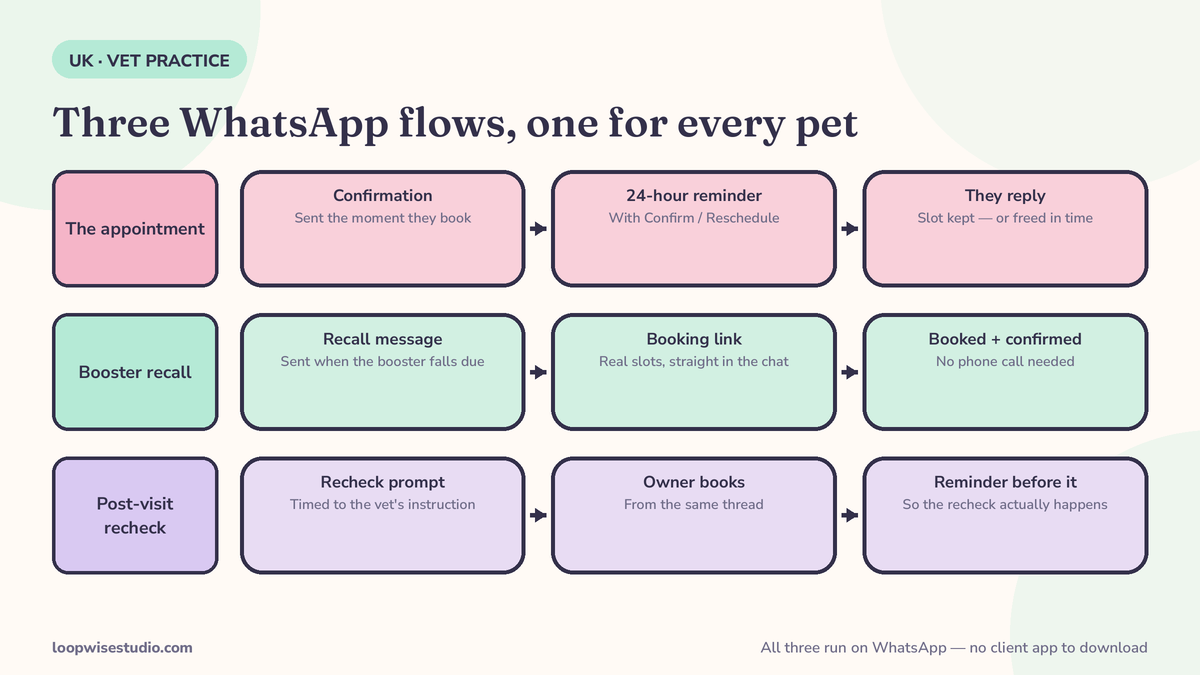
Reminder tools tend to be sold as one feature: “appointment reminders.” In a vet practice there are three separate jobs, and they fail in different ways.
Job 1 — the appointment reminder: protect the booking you already have
Sent when the appointment is booked, again 24 hours before, with a reply route for changes.
Hi [Name], [Pet] is booked in at [Practice] on [day, date] at [time] for [appointment type]. Reply CHANGE if you need a different time, or call us on [number]. See you then.
Hi [Name], a reminder that [Pet] has an appointment tomorrow at [time]. If anything has changed, reply here and we’ll find another slot.
Job 2 — the recall: bring back the pet who was never booked
This is the message most practices never send, and it is where the money sits. A booster due date passes, no appointment exists, and nothing in a normal diary prompts anyone. Remindlo’s comparison makes this distinction well: confirmation reminders protect booked visits, while reactivation reminders chase due care that was never booked — and it frames lapsed clients as the bigger leak.
Hi [Name], [Pet]’s annual booster is due this month. You can book here: [booking link] — it takes about a minute. Any questions, just reply to this message.
The same pattern covers six-month health checks and parasite-control reminders tied to your recall list.
Job 3 — the recheck: close the loop after treatment
Hi [Name], [Pet] is due a recheck after [his/her] visit on [date]. Book a time here: [booking link], or reply and we’ll arrange it.
Medication follow-ups work the same way: a short message at the point the course should be reviewed, with a booking link attached.
If reminders are new to your practice entirely, our US-focused page on missed call text back for veterinary clinics covers the phone-side version of the same problem — calls that never become bookings in the first place.
Booking on WhatsApp — how the flow actually works
The flow is short, and it should be:
- The client taps the link in a recall message, on your website, or on your Google profile.
- They see live slots from your diary — not a request form that someone processes later.
- They pick a time and confirm. The appointment lands in the diary.
- The confirmation goes out on WhatsApp instantly, and the 24-hour reminder is scheduled at the same moment.
- Replies come back to one shared inbox your team works from, instead of a nurse’s personal phone.
The wider pattern — WhatsApp as a booking channel rather than a chat toy — is the subject of our pillar guide to WhatsApp booking systems for aesthetic clinics in Dubai; the mechanics are identical, only the appointment types change. For the human-clinic version in Ireland, see our guide to WhatsApp booking for clinics.
It sits on top of your PMS — you don’t swap systems
Every rival in this market asks for a bigger decision than you need to make. iRecall integrates deeply with RxWorks, Merlin and VetIT; Vetstoria (PetDesk) sells online booking across 30+ practice management systems; PetsApp is an all-in-one platform. Those are fine products. But if your PMS — Animana, Merlin, RxWorks, VetIT, ezyVet, Teleos — already runs your clinical records and diary, the booking and messaging layer can sit on top of it.
That matters for two practical reasons. First, no migration: no client records move, no team retrains on clinical software. Second, the layer can be removed or changed without touching the system your vets document cases in. The diary stays the diary; WhatsApp becomes the front door clients actually use.
What it costs — published figures, and the gap in them
Honest pricing in this corner of the market is patchy, so here is exactly what is published and what is not:
| Route | Published price | Source |
|---|---|---|
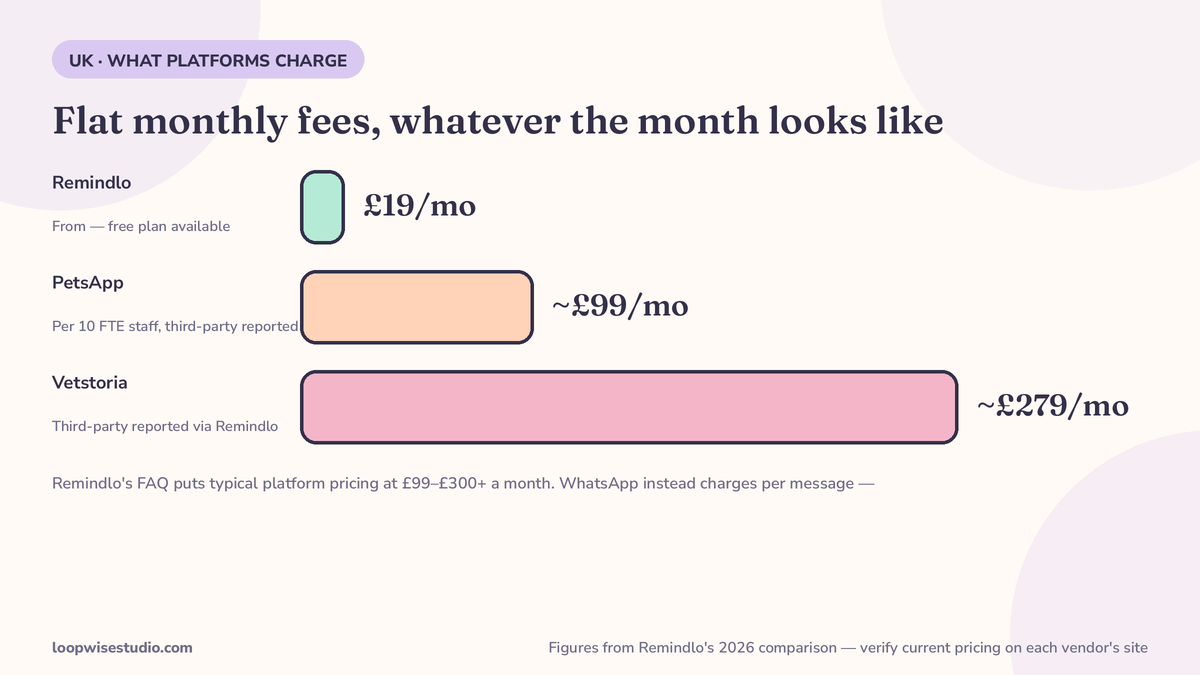
| Remindlo (SMS reminder tool) | From £19/month, free plan available | Remindlo’s own comparison page |
| GoReminders | Listed at ~£6–£19/month | Via Remindlo’s comparison |
| PetsApp (app platform) | ~£99/month per 10 FTE staff | Third-party reported via Remindlo — verify with PetsApp |
| Vetstoria (booking) | ~£279/month | Third-party reported via Remindlo — verify with Vetstoria |
Remindlo’s own FAQ puts typical platform pricing somewhere between £99 and £300+ a month. Check current pricing on each vendor’s site before relying on any of these figures.
The WhatsApp route prices differently. On the WhatsApp Business Platform you pay Meta per delivered template message, and utility messages — the category reminders and confirmations fall into when they are worded as service messages about an existing booking — are priced well below marketing messages. One vendor guide to WhatsApp mechanics (Happy Pet Tech) puts utility templates at roughly 80–90% cheaper than marketing templates. Meta moved to per-message billing for in-window service and utility messages from 1 October 2026, so check Meta’s current UK rate card for the exact pence figure before budgeting — it changes, and any page quoting you a fixed rate without a date is guessing.
On top of the per-message cost sits the build: connecting the platform to your diary, writing and getting the templates approved, and setting up the shared inbox. That is a one-off setup job, not a per-seat subscription — which is why the comparison that matters is total cost over a year, not the monthly headline.
Consent and the rules — UK GDPR and PECR, in plain terms
Reminders are not marketing, and the distinction decides what you may send:
- Service messages about an existing appointment — confirmations, reminders, recheck prompts tied to care already arranged — are the low-risk category. Remindlo’s comparison summarises the position used across the UK vet market: reminders are generally sent under legitimate interests.
- Marketing messages — offers, promotions, anything selling something the client hasn’t booked — need explicit consent under PECR. A booster recall sits close to the line: it is about care that is due, but write it as a care reminder, not a promotion, and keep offers out of it.
- Capture the opt-in at booking. Ask for the mobile number and messaging permission when the appointment is made, record it, and honour opt-outs immediately. WhatsApp also requires its own opt-in before template messages are sent, and templates must be approved before use.
- Keep clinical detail out of the message. Pet name, appointment type and time are enough. The record stays in the PMS.
None of this is exotic, but it has to be set up once, properly — template wording is where the utility/marketing line is actually drawn.
Getting the templates approved — the unglamorous step that decides whether this works
WhatsApp does not let a business send whatever it likes. Messages sent outside an open conversation window must use pre-approved templates, sorted into categories — and the category decides what you pay and whether the wording passes at all. The mechanics guide in this market (Happy Pet Tech’s WhatsApp automation guide for pet businesses) sets out the rules clearly, and they shape how the three messages above are written:
- Utility templates cover messages about an existing booking or an ongoing care relationship: confirmations, reminders, recheck prompts. They are the cheapest category — that guide puts utility templates at roughly 80–90% cheaper than marketing templates — but the wording must stay transactional. Add a promotional line (“20% off dental checks this month!”) and the template no longer qualifies as utility.
- Marketing templates cover anything promotional. They cost more per message and need explicit marketing consent under PECR, not just a booking.
- Opt-in comes first. WhatsApp requires the client to have agreed to receive messages before templates are sent. In practice this is the tick-box or verbal yes captured at booking or registration, recorded against the client.
- Your quality rating caps your sending. If clients block or report messages, WhatsApp restricts how much you can send. This is the technical reason the recall message must read as care, not as a sales blast: a flagged number sends fewer reminders to everyone.
One more date to know: Meta changed its pricing model on 1 October 2026, moving in-window service and utility messages to per-message billing. If a vendor quotes you a WhatsApp price from before that change, ask them to re-quote it against the current UK rate card.
What the setup looks like, step by step
- Register the practice number on the WhatsApp Business Platform — a dedicated number, not a nurse’s mobile.
- Connect the diary. The booking layer reads live availability from your PMS or practice diary so slots offered on WhatsApp are slots that actually exist.
- Write and submit the templates — confirmation, 24-hour reminder, booster recall, recheck — worded to stay in the utility category, and approved before go-live.
- Turn on the recall feed. Due boosters, health checks and rechecks are pulled from your recall lists on a schedule, so the recall message goes out because a date arrived, not because someone remembered.
- Set up the shared inbox with named responsibility per shift, so replies get answered inside the hour.
- Add the fallback. Clients without WhatsApp get the same sequence by SMS or email.
None of this touches your clinical system, and it can be live without a diary migration or a closed-for-training afternoon.
A worked volume example — what a month of messages looks like
Per-message pricing sounds abstract until you count your own diary. This is arithmetic, not a statistic — substitute your numbers. A practice with 600 appointments a month sends roughly 600 confirmations and 600 reminders: 1,200 utility messages. Add 150 booster and health-check recalls and 80 recheck prompts and the month totals around 1,430 messages, almost all in the cheapest utility category because none of them sells anything. Even before you look up Meta’s current UK rate, the shape of the bill is clear: the messaging layer costs pence per appointment, while the platform routes in the table above charge £99–£300+ a month regardless of how quiet the month is. That difference — paying per message versus per month — is the structural reason the WhatsApp layer is worth costing separately instead of buying the biggest bundle.
What we’d check first in your practice
Before choosing any tool, count three things in your own diary: how many booster recalls went unsent last quarter, what share of appointments are rechecks booked late or not at all, and how many reminder replies currently land on personal phones. Those three numbers tell you whether you need a reminder tool, a recall system, or the full booking layer.
If you’d like those numbers pulled together for your practice, get a free audit — we’ll map your current reminder and recall setup and show you exactly where bookings leak.
Frequently asked questions
Do clients need to download anything?
No. That is the point of using WhatsApp rather than a client app: the message arrives in an app your clients already have. App-based platforms such as PetsApp ask owners to install the practice’s app before reminders and booking work.
Will this replace our practice management system?
No. The WhatsApp layer connects to your existing diary in Animana, Merlin, RxWorks, VetIT, ezyVet or a similar PMS. Clinical records, billing and the diary itself stay where they are.
Is a booster recall a marketing message under PECR?
It depends on the wording. A message that a named pet’s booster is due, with a booking link, is framed as a care reminder; add a discount or a promotion and it becomes marketing, which needs explicit consent. Keep recalls factual and offer-free.
How much do WhatsApp messages cost?
Meta charges per delivered template message, and utility (service) messages cost substantially less than marketing ones — one vendor guide puts the gap at roughly 80–90%. Meta changed its billing model on 1 October 2026, so check the current UK rate card rather than trusting any fixed figure, including ours.
Can clients reply, or is it one-way?
Two-way. Replies land in a shared team inbox, so a client asking to move an appointment gets an answer from whoever is on shift — not from whichever nurse’s personal phone received it.
What about clients who don’t use WhatsApp?
Keep SMS or email as the fallback channel for them. The system should follow the client, not force a channel: WhatsApp first where it’s used, text or email where it isn’t. Solo groomers face the same mix — our page on WhatsApp booking for dog groomers in the UK covers the smaller-practice version.
A UK vet practice does not need a new app or a new PMS to fix its reminders. It needs the three messages — reminder, recall, recheck — sent automatically on the channel clients already read, with booking one tap away. Get a free audit and we’ll show you which of the three your practice is missing.