WhatsApp Booking for Dog Groomers in the UK
How WhatsApp booking should work for a UK dog groomer: breed-aware questions, the right slot length, deposits in the chat, and recalls that bring dogs back.
WhatsApp booking for a UK dog groomer means a client messages your number and an automated flow asks the dog’s breed, coat and last groom date, offers a slot of the right length, and takes a deposit — instead of days of back-and-forth. Grooming software that works this way costs from £29–£59 a month (GroomRules, Fluffday, October 2026) and still leaves setup to you; a done-for-you system builds it into your own website and WhatsApp number.
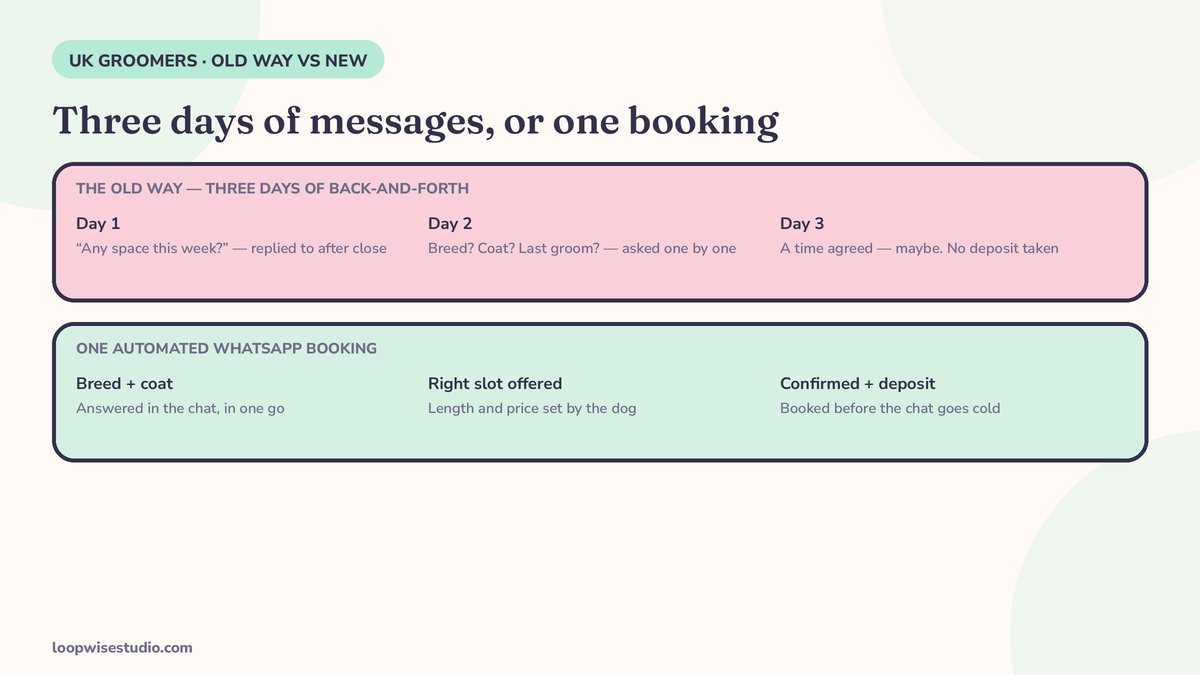
Picture the booking you took last week. It probably did not start on a booking page. It started with a WhatsApp message — “Hi hun, can you fit Bella in next week?” — and somewhere between the bath and the dryer you replied, asked which groom, asked when she was last done, offered a day, got a “can I check with my husband”, and confirmed three days later.
GroomRules, a UK grooming platform, builds its entire homepage around exactly this: a WhatsApp thread mock showing three days of messages to arrange one booking. They are right about the problem. Where every tool on the market stops short is the fix: almost all of them use WhatsApp as the place you paste a booking link, not as the channel where the booking actually happens.
This page is about the version where the booking happens inside WhatsApp — with the one thing a generic booking flow cannot do: asking about the dog first.
How UK groomers actually take bookings now
Be honest about the current system, because it has real strengths. Clients message your WhatsApp because they know you, trust you, and can send a photo of the dog’s coat looking like a sheep. One Hastings salon, Fairy Tails Dog Grooming, ranks on Google for this very search purely for having a WhatsApp number with “WhatsApp us… quickest reply” on its site. Manual WhatsApp. No system at all. That is how unmet the intent behind this search is.
The weaknesses are not in the channel. They are in your hands:
- You are the bottleneck. Messages arrive while you have shears in one hand and a nervous Cockapoo in the other. Replies go out at lunch, at 6pm, at 10pm from the sofa. One groomer quoted on Tuft’s site says she’d get home at 10 o’clock at night to hundreds of WhatsApp messages. That is not admin. That is a second, unpaid shift.
- The thread takes days. Every question you would ask at a reception desk — breed, coat condition, last groom, size — happens one message at a time, across days, and the slot you offered on Tuesday is gone by Thursday.
- Nothing is written down. The booking lives in a chat thread. The deposit, if there is one, was a bank transfer you hope to match later. The dog’s quirks live in your memory.
WhatsApp is not the problem. WhatsApp without a system behind it is the problem. The fix keeps the channel and removes you from the typing.
What WhatsApp booking should do
A proper WhatsApp booking flow for a groomer does five things, in order:
- Answers instantly. The client messages your number; the reply comes in seconds, at 9pm as reliably as at 9am. Not a chatbot conversation that wanders — a short, structured flow.
- Asks about the dog before offering anything. Breed, size, coat type, when the last groom was, anything the groomer needs to know (nerves, matting, health flags). This order matters — it is the entire difference between a grooming booking and a calendar booking.
- Works out the slot length and price from those answers. A Cockapoo in full coat is not a 45-minute job. The flow prices and times the appointment based on the dog, including coat surcharges, instead of quoting a generic slot the groomer then has to absorb.
- Offers real slots and takes a deposit in the chat. Payment link, card on file, done. The appointment exists in your diary the moment the deposit lands.
- Confirms, reminds and recalls — automatically, on the same WhatsApp thread. Covered below.
One UK tool already leads with WhatsApp automation: Fluffday, built by grooming salon owners, includes WhatsApp reminders with one-tap confirm in its plans (from £39/mo, messages included) and lets you keep your existing WhatsApp number. GroomRules owns the breed-intake side. Nobody combines the two — breed-aware intake inside the WhatsApp flow, on a website and number you own. That combination is the whole opportunity, and it is the same own-your-channel logic behind WhatsApp booking systems for clinics in every other appointment business.
The breed question: why the slot length and price depend on the dog
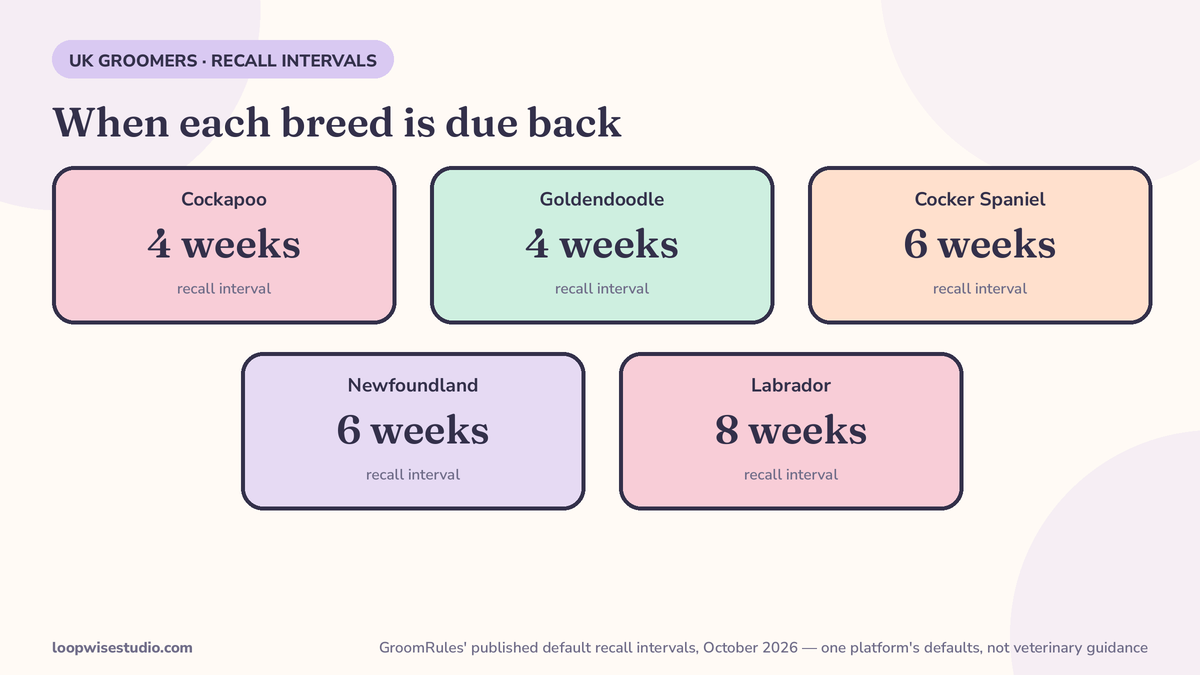
A Labrador and a Newfoundland are both “a dog” in a generic booking system. In your diary, one is a wash-and-go and the other is the whole morning. This is where grooming booking breaks generic software, and where the sourced numbers are unusually clear.
GroomRules publishes the default rules its system ships with (read October 2026; every default is editable by the groomer per dog):
| Breed | Extra time | Coat/extra charge | Recall interval |
|---|---|---|---|
| Cockapoo (curly) | +30 min | +£15 | Every 4 weeks |
| Goldendoodle (curly, large) | +45 min | +£20 | Every 4 weeks |
| Cocker Spaniel (medium) | +15 min | +£5 | Every 6 weeks |
| Newfoundland (double coat, XL) | +60 min | +£30 | Every 6 weeks |
| Labrador | — | — | Every 8 weeks |
Treat those as what they are: one platform’s published defaults, not veterinary guidance, and your own intervals may differ. But the shape is right, and it is the shape your booking flow should copy. When the client answers “Cockapoo, last groomed nine weeks ago,” the system should not offer her the standard hour. It should offer the longer slot, flag the coat charge, and price it before anyone is standing at your table with a matted dog and a diary that no longer works.
This intake also quietly fixes your hardest conversations. The surcharge for a coat that has gone too long is much easier to accept when it appeared on screen at booking than when it appears at the till.
Reminders and recalls: the messages that bring dogs back on schedule
Booking is only half the system. The other half is the calendar running itself after the booking:
- Reminders before the groom. GroomRules sends appointment reminders 5 days and 24 hours before, by text and email; on WhatsApp the same pattern applies, with one-tap confirm so the client answers in the thread.
- Recalls when the dog is due. This is the money feature nobody explains properly. GroomRules starts recalls up to 4 weeks before a dog is due, with follow-ups. The interval is the one from the table: the Cockapoo gets nudged at four weeks, the Labrador at eight.
- The arithmetic of coming back on time. GroomRules’ own worked example: a dog that comes back every six weeks instead of every ten is three more grooms a year; across a hundred dogs, that is three hundred grooms a year. Label that properly — it is vendor arithmetic, not a study — then check it against your own diary. The direction is not in doubt. Slippage is where solo groomers quietly lose a month of revenue a year.
Tuft, another UK grooming platform, builds recurring bookings at 6, 8 or 12-week intervals (or custom) into its plans — the same recognition that grooming is a cycle, not a series of one-offs. A WhatsApp recall flow does the same job on the channel the client already reads: “Bella’s due her groom next week — Thursday 10am or Saturday 1pm?” Two taps, booked, deposit rules applied. If the client does not answer, one follow-up, then silence. Recall messages that nag get blocked; recall messages that help get bookings.
The recall has one more job nobody talks about: it protects the coat. A Cockapoo recalled at four weeks arrives in the condition your diary expects. The same dog recalled at nine weeks arrives matted, runs over time, and turns a tidy booking into a hard conversation about surcharges. Recalls are diary management as much as they are marketing.
Done properly, this is also most of how to reduce no-shows in a dog grooming salon: a dog that is booked on its cycle, reminded twice and holding a deposit very rarely becomes a no-show.
Deposits inside WhatsApp: card on file without the awkward phone call
The deposit conversation is the one groomers dread. Asking a nice regular for money upfront, over the phone, feels like accusing her of something. So most groomers skip it — and eat the no-shows.
Inside an automated flow, the awkwardness disappears, because the system asks everyone, the same way, every time:
- The flow states the deposit as part of booking: GroomRules’ own worked example is a £55 full groom with a £15 deposit by card and £40 on the day. Reasonable, proportionate, explained in one line.
- The card is saved. If the client cancels inside your policy window or does not show, the no-show fee charges to that card — no chasing, no “can you transfer me…”, no bad feeling invented on the spot.
- Regulars in good standing can be exempted if you choose. The point is that you choose, in the settings, once — not at the desk, per client, under pressure.
A deposit asked for by a system is admin. A deposit asked for by you, personally, feels like distrust. Same money, completely different conversation.
Want us to look at how your bookings currently run — how long threads take, where deposits would fit, which breeds drive your recalls? You can get a free audit. We will map it before suggesting anything.
Software vs done-for-you: what £29–£59/mo tools make you do yourself
The UK tools are decent and honestly priced. Know what you are buying (prices read 21 October 2026 — check current pricing before deciding):
| Tool | Price | The catch |
|---|---|---|
| GroomRules | Free plan (up to 100 clients, no texts); Starter £29/mo (200 texts incl., then 6p); Professional £59/mo (500 texts) | Payments carry Stripe’s 1.5% + 20p plus 2% to GroomRules; WhatsApp is where you share the link, not where booking happens |
| Fluffday | From £39/mo, messages included; top-ups 500 £22 / 1,000 £42 / 2,500 £99 | Leads with WhatsApp reminders, but no breed/coat intake logic |
| Tuft | Pro £35/mo (£29/mo billed annually) per its FAQ — note its own plan cards display dollar prices, which is why we date-stamp everything | App-based: clients book via the Tuft app or a website widget; clients booking through the app pay a convenience fee |
All three share the same fine print: you set it up. Your services, your breed rules, your reminder wording, your deposit policy — configured in the evenings, by you, between grooms. And the booking page lives on their platform, not on a website of yours.
The done-for-you route costs more and removes that entirely: your own website, your own WhatsApp number, the breed questions and recall intervals set up with you, the diary running while your hands are in a bath. That is what we build — the same system we set up for salons across the UK and Ireland with WhatsApp reminders, shaped for a grooming diary.
FAQ
Do I keep my existing WhatsApp number?
You should, yes. Fluffday explicitly lets groomers keep their number (or sets up a fresh one), and our builds work on your existing business number too. Clients already have it saved; the number is part of your brand. What changes is what answers when a message lands.
My clients are older and not all of them use WhatsApp. What happens to them?
They get a fallback, not a dead end. Fluffday, for example, includes SMS fallback for customers who are not on WhatsApp. The flow should always offer the same booking by text, and your phone number stays your phone number — anyone can still ring you. Automation handles the majority who do message; it never locks out the ones who do not.
How do deposits work for regulars I’ve known for years?
However you tell the system. A sane default: deposits for new clients and for long appointments, card on file for everyone, and exemptions for regulars you flag. The system applies the rule uniformly, so there is no per-client negotiation — and if a trusted regular ever does no-show, the conversation afterwards is about the policy, not about your friendship.
What information does the booking flow ask about the dog?
Breed, size, coat type and condition, when the last groom was, plus your own flags — nervous dogs, matting history, health notes. Platforms like GroomRules hold 230+ editable breed profiles covering time, price and recall per breed. We set your version up with you, using your intervals and your prices, not a template’s.
Will this replace my grooming software or work with it?
Either. If you are happy with your current diary software, the WhatsApp layer can sit in front of it — enquiries, booking and reminders handled in chat, appointments landing in your diary. If you are on paper or a personal calendar, the whole thing can be built fresh. Tell us what you run now on the audit and we will say honestly which pieces are worth keeping.
How much time does this actually save?
Count your current thread. GroomRules’ homepage frames the problem as three days of messages for one booking; even at a few minutes each, a full book of dogs means hours a week of evening typing. The system removes the typing, not the relationship — you still see every booking, every note, every photo of the coat. You just stop being the one who types “Thursday ok?” at 10pm.
The short version: your clients already book you on WhatsApp. The only question is whether a system answers, asks about the dog, takes the deposit and brings the dog back on schedule — or whether you keep doing all of it by hand, at night, for free. If you’d rather it ran itself, get a free audit and we will show you exactly how your diary would work.