WhatsApp Booking for Clinics in Ireland: How It Works
WhatsApp booking for Irish clinics: patients book on your own website, then confirmations, reminders and recalls run on WhatsApp. The admin-only boundary, the costs, and why now.
WhatsApp booking for a clinic in Ireland means patients book on your own website and then get their confirmation, reminders and reschedule links on WhatsApp — the app Irish patients already use — instead of phone tag with reception. WhatsApp carries the booking admin only, never clinical details, and the model is already proven next door: an Irish company, Spryt, won the first NHS approval for WhatsApp appointment scheduling and is in talks with the HSE, as reported by Pulse+IT.
No Irish clinic group is offering this as a packaged system yet. The pieces exist — your patients message you, your reception drowns in calls — but nobody has assembled them for Irish private clinics: GP practices, physios, dental and aesthetic clinics. This page explains how it works, where the safety line sits, and what it costs to run.
Why now: the NHS has approved it, and the HSE is talking
This isn’t a speculative channel any more. As reported by Pulse+IT, the Irish health-tech start-up Spryt has partnered with NHS bodies in north London to pilot WhatsApp-and-AI appointment scheduling across 26 GP practices — described as the first time WhatsApp and AI have been approved by the NHS for appointment scheduling. Spryt is also in talks with the HSE about piloting in Ireland.
Spryt’s target is the public system — GP scheduling at state scale. It is not building booking systems for Irish private clinics. But its approval does two things for you: it proves regulators accept WhatsApp as an appointment channel in healthcare, and it starts a clock. When public-system patients get used to booking by message, a private clinic still running on phone tag will feel older than it is.
Private clinics can move first, with a simpler version: no AI diagnosis, no clinical chat — just booking, reminders and recalls done properly.
How it works with your own website
The system has two halves, and the order matters:
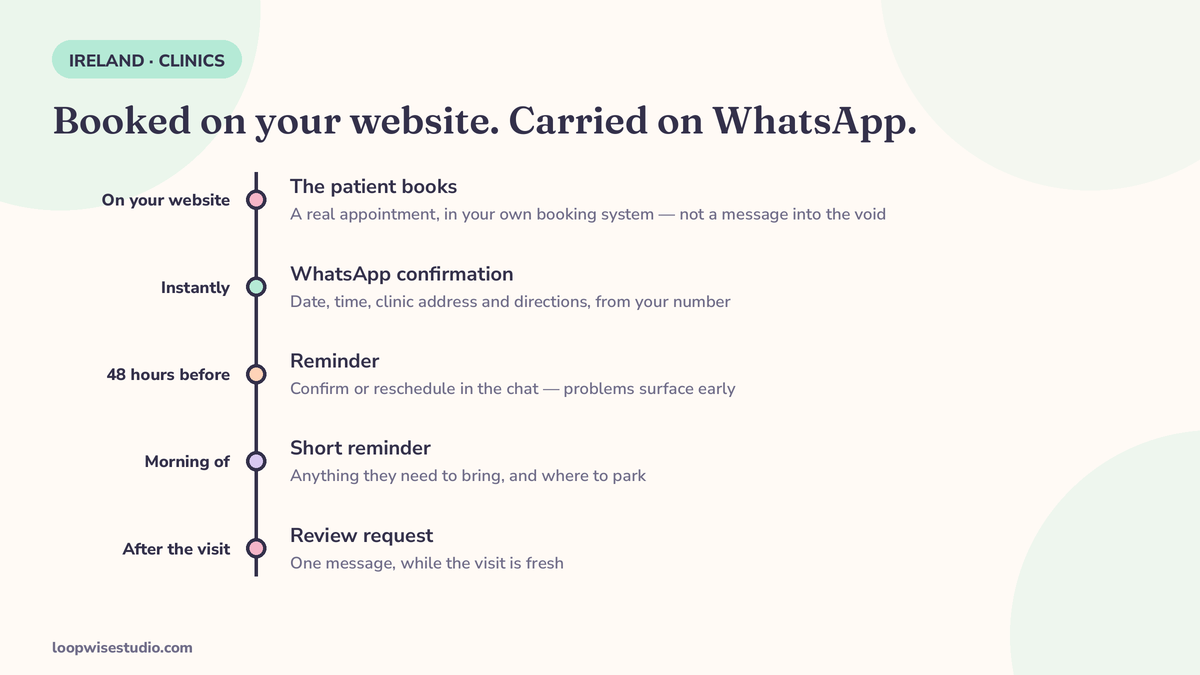
Your website takes the booking. The patient picks the appointment type, the clinician and a real free slot on your own site — your domain, your branding, no marketplace taking a cut or owning the relationship. This is the same owned-website model behind our WhatsApp booking system for aesthetic clinics in Dubai; the channel changes by country, the structure doesn’t.
WhatsApp runs everything after the booking:
- Instant confirmation in the patient’s WhatsApp, with date, time, clinician and directions.
- A reminder at 48 hours, with a one-tap reschedule link — rescheduling happens while there’s still time to refill the slot.
- A morning-of reminder for the appointments most at risk.
- Recalls and rebooking after the visit (next section).
- A review request after a completed appointment, in the same thread.
The patient’s experience: they booked on your site and their phone just handles the rest. Reception’s experience: the phone stops ringing with “just confirming my appointment” calls.
The line you don’t cross: admin on WhatsApp, clinical details never
This is the part that makes clinic owners nervous, and rightly — so be precise about it.
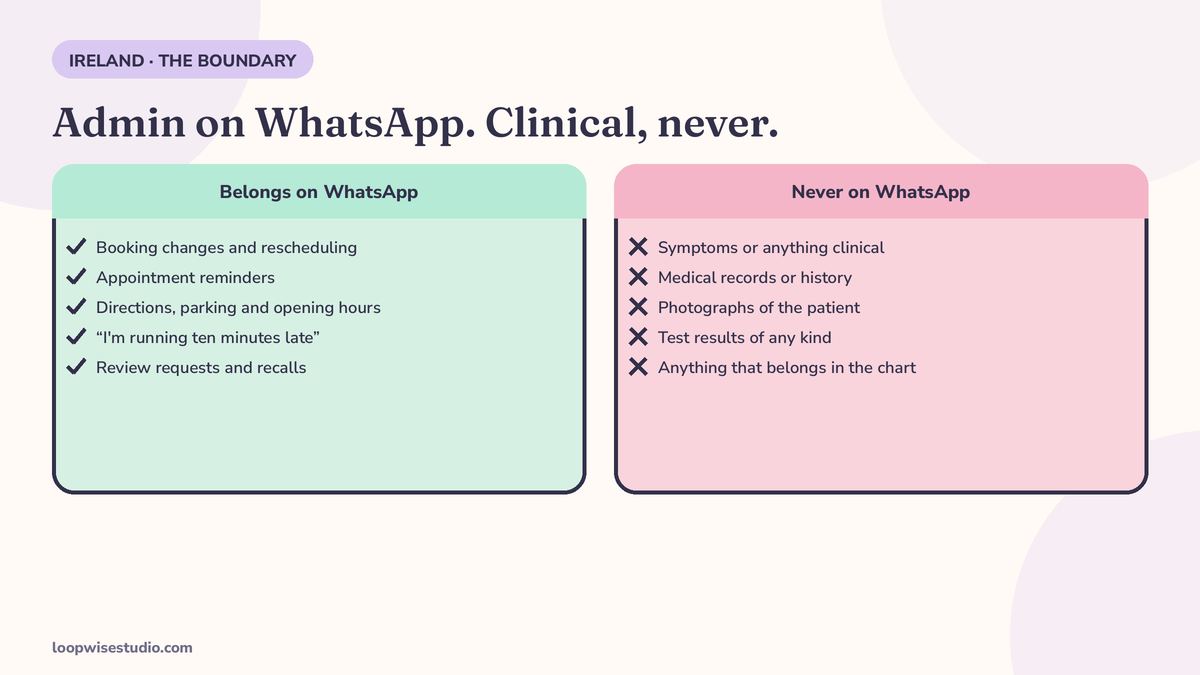
On WhatsApp: booking confirmations, reminders, reschedule links, directions, parking, “please arrive 10 minutes early”, opening hours, admin questions.
Never on WhatsApp: symptoms, medical records, photographs, results, anything clinical. That stays in the consultation and your clinical systems, where it belongs.
This isn’t a theoretical boundary — Irish clinics already practise it. Swift Med, an Irish telehealth clinic, tells patients on its own site that WhatsApp is for “general questions, booking support” and states plainly: do not send medical records, photographs or detailed symptoms by WhatsApp, and that it isn’t monitored for emergencies. That’s the model to copy: WhatsApp as the front desk, never as the consulting room. Patients respect the line when the clinic states it clearly — and your confirmation messages can state it too.
What Irish patients are already doing without you
Look at the consumer side of Irish healthcare booking. BookMyDoc, an Irish online GP service, sells consultations from €35.99 (from €40.00 evenings and weekends, per its own booking page): pick a time, answer the health questions, pay, get your call. And how do patients reach it with questions? A +353 WhatsApp number — listed for support.
Read that pattern carefully, because it’s the whole Irish market in miniature: Irish patients will book online and pay online happily, and when they want to talk to a clinic, they reach for WhatsApp. But in every current example, WhatsApp is the support channel bolted onto somebody else’s booking system — usually not the clinic’s own. No Irish clinic-facing page we could find in researching this article offers the combined thing: your website taking the booking, your WhatsApp running the follow-up. That gap is the opportunity, and it won’t stay empty.
The messages themselves — copy the set
These are the four messages every clinic system in this model sends. Adapt the wording; keep the structure:
Confirmation (instant): “Hi [Name], you’re booked with [Clinic] on [day, date] at [time] with [Clinician]. Directions: [link]. Need to change it? Reply here or tap [reschedule link]. Please don’t send medical details by WhatsApp — bring anything clinical to your appointment.”
48-hour reminder: “Hi [Name], a reminder of your appointment on [day] at [time] with [Clinician]. Still suits? Reply YES. Need to move it? Tap here: [reschedule link] — moving it now lets us offer the slot to another patient.”
Morning-of reminder: “Morning [Name] — see you at [time] today at [Clinic]. We’re at [short location line]. Running late? Reply here.”
Recall (when due): “Hi [Name], it’s [Clinic]. You’re due your [hygiene visit / next session / review] around now. Book here in under a minute: [booking link].”
Four templates. That’s the system patients experience — everything else is diary plumbing.
The reminder sequence that cuts no-shows
No-shows are the tax every Irish private clinic pays quietly. No Ireland-specific no-show figure is published — anyone quoting you one is guessing — so judge the system on its mechanics, not on a borrowed statistic:
- Confirmation instantly — the appointment exists in the patient’s chat history, not on a Post-it.
- 48 hours before, with one-tap reschedule — the patient who can’t make it tells you when you can still fill the slot, instead of simply not appearing. A reschedule you know about is a refill opportunity; a silent no-show is a dead hour.
- Morning-of reminder — short, practical: time, clinician, location.
- A no-show follow-up — a polite message offering two new slots turns some no-shows into rebookings instead of lost patients.
The pattern is the same one used in our guide to WhatsApp appointment reminders for UK clinics — reminders work when they’re timely, specific and easy to act on. Yours will be too.
Recalls and rebooking: where the recurring revenue sits
Clinics run on cycles, and every cycle is a message:
- Physio treatment plans — session 4 of 6 shouldn’t depend on the patient remembering to ring. The system books the plan and reminds each step.
- Dental hygiene recalls — six months after a clean-and-polish, a message with a booking link brings the patient back before a competitor’s ad does. (This is the engine of our WhatsApp automation for dental clinics in Ireland page.)
- Aesthetic top-up cycles — when a treatment’s natural repeat window opens, the patient hears from you first.
Each of these is a patient you already have, reminded at the moment they’re due. It’s the cheapest appointment in your diary to fill.
Which clinics gain the most
The model fits any appointment clinic, but the gains concentrate where three things are true: a diary that fills days ahead, patients who book from their phones, and repeat cycles. In practice:
- Private GP and health-screening clinics — high call volume for simple admin; every confirmation call deflected is reception time back.
- Physio clinics — treatment plans live or die on attendance across 4–6 visits; plan rebooking plus reminders is the whole game.
- Dental clinics — hygiene recalls and treatment-plan follow-ups are pure recurring revenue currently chased by phone or not at all.
- Aesthetic clinics — consultation bookings arrive from Instagram at all hours; the clinic that confirms instantly, in WhatsApp, books the patient the slow clinic loses.
What reception gets back
Nobody’s job disappears in this model — the worst part of it does. The calls that vanish are the repetitive ones: “just confirming Thursday”, “can I move my appointment?”, “where do I park?” Each is answered by a message the system already sent. What remains for your reception team is the work that needs a person: the worried patient, the complex case, the human welcome at the door. Clinics that make this switch usually describe it the same way — the phone still rings, but now it’s worth answering.
What changes first, if you do this
You don’t switch the whole clinic over in a weekend. The sane order is: bookings first (every new booking gets the instant WhatsApp confirmation), reminders second (the 48-hour and morning-of sequence switches on for those bookings), recalls third (once a cycle of patients has come through the new system). Reception feels the difference inside a fortnight — the confirmation calls stop first, because the answer is already sitting in the patient’s pocket.
What it costs to run
Honestly, and in two parts:
The messages: WhatsApp automation runs on Meta’s Business Platform, which charges per delivered message. Meta publishes a euro rate card — but per-message euro rates change, and we won’t quote you a figure we haven’t verified against the current card. What can be said from the UK equivalent (utility messages at £0.0159 each on the card effective 1 October 2026) is the scale: reminder messages cost cents each, and a clinic’s monthly message bill is a small line next to staff time. The full cost structure — Meta fees, platform, setup — is broken down in our guide to what WhatsApp automation costs; the layers are identical in Ireland, only the currency differs.
The system: a platform fee if you rent software and set it up yourself, or a one-off build if it’s done for you and connected to your own website. There is no commission per booking — that’s the point of owning it.
Run the arithmetic for your clinic before you decide: one filled slot that would have been a no-show, per week, at your own appointment price. Compare it with a monthly message bill measured in cents per reminder. The gap between those two numbers is the whole argument.
If you’d like that maths done on your real diary — where your no-shows cluster, which recalls you’re missing — get a free audit and we’ll go through it with you.
The short version
Patients book on your website; WhatsApp confirms, reminds, reschedules and recalls. Clinical details never touch WhatsApp — bookings and admin only, the boundary Irish clinics like Swift Med already publish. The NHS has approved WhatsApp scheduling and the HSE is in talks; Irish private clinics can have the simple version running now, on a system they own.
FAQs
Is WhatsApp appropriate for a medical clinic at all?
For booking admin, yes — and regulators are treating it that way: an Irish company, Spryt, has won the first NHS approval for WhatsApp appointment scheduling, as reported by Pulse+IT. The discipline is keeping WhatsApp to admin — confirmations, reminders, rescheduling — and never clinical information. Irish telehealth clinic Swift Med publishes exactly that boundary on its own website.
What should never be sent over WhatsApp?
Symptoms, medical records, photographs, results — anything clinical. Those belong in the consultation and your clinical record systems. Your automated messages should say so, and your confirmation template can repeat the line: “Please don’t send medical details by WhatsApp.”
How is this different from patients just messaging our reception number?
Structure. Informal messaging depends on a person watching a phone; messages get missed at lunch, after hours and on busy mornings. A booking system confirms instantly, reminds on schedule, offers one-tap rescheduling and sends recalls automatically — the patient’s experience is the same friendly channel, but nothing depends on someone noticing a phone buzz.
Does it work for physio and dental clinics, or just GPs?
All three — the mechanics are identical, only the cycles differ. Physios gain from treatment-plan rebooking, dental clinics from hygiene recalls, aesthetic clinics from top-up reminders. Salons use the same system too; see online booking with WhatsApp reminders for salons in Ireland.
What does it cost per message in Ireland?
Meta charges per delivered message on a published euro rate card, and reminder-type (utility) messages are the cheapest category — cents per message. Rates are revised periodically, so we verify the current euro card before quoting any figure rather than publishing one that goes stale. Budget-wise, clinics should expect the message bill to be trivial next to the value of one recovered appointment.
Can patients reschedule through WhatsApp?
Yes — that’s one of its main advantages over a phone call. The 48-hour reminder carries a reschedule link; the patient picks a new slot from real availability, the diary updates, and the freed slot can be offered to your waitlist. You hear about a reschedule when there’s still time to refill it.
To see how this would sit on your clinic’s website and diary, get a free audit — no obligation, and we’ll show you the reminder sequence written for your appointment types.