After Hours WhatsApp Booking for Clinics in the UK
After hours WhatsApp booking for UK clinics: enquiries answered at 9pm, real appointment slots booked overnight, deposits taken, clean handover at 8am.
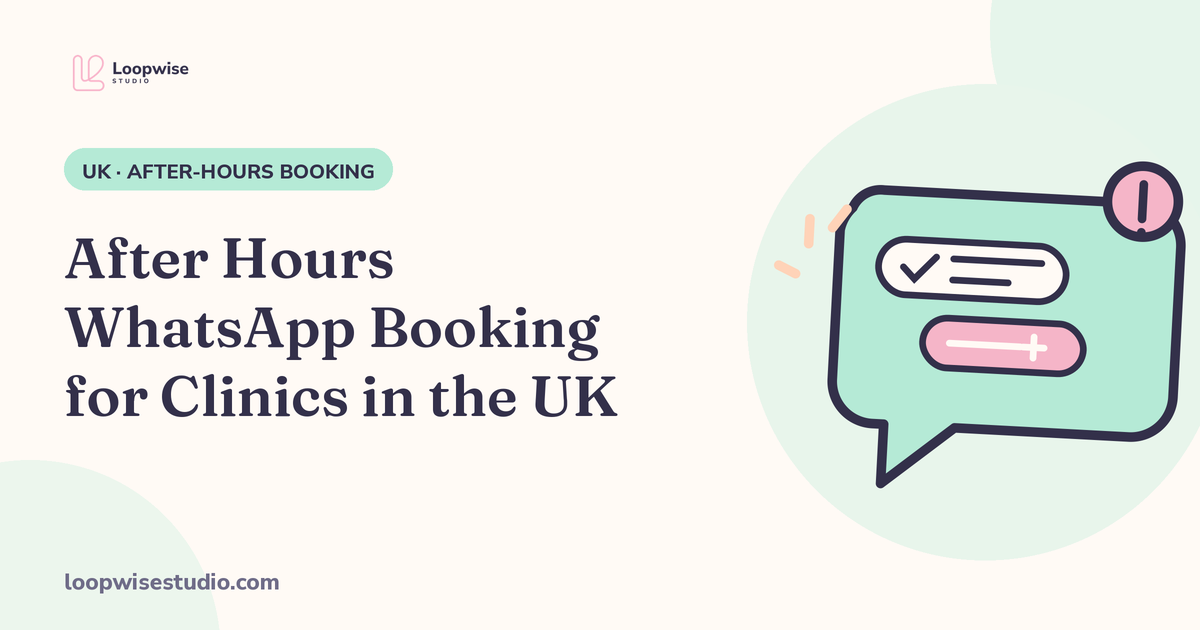
After hours WhatsApp booking for a UK clinic means this: when a patient messages at 9pm, they get an instant, useful reply — real appointment slots offered from your diary, the booking completed or the request properly captured, a deposit taken where your policy asks for one — and your receptionist walks in at 8am to a tidy handover instead of a pile of unread chats. This page walks through what happens overnight, step by step, what must never be automated, and what it costs compared with staffing the phones into the evening.
It is worth saying plainly: almost no UK clinic offers this today. Even large UK aesthetic chains answer WhatsApp only during opening hours, and NHS practices that take requests on WhatsApp monitor them in office hours only. The evening enquiry — which is when most working patients actually have time to think about their health — goes unanswered almost everywhere. That is the gap.
What “after hours” really costs a UK clinic
Run the honest calculation on your own numbers. You only need three figures, and your current inbox already holds two of them:
- Evening and weekend enquiries per week. Count the WhatsApp messages and website enquiries that arrived after closing over the last four weeks and were not opened until the next working day. Most clinics have never counted this. Count it once and the abstract problem gets a size.
- What fraction would book if answered well. Do not copy a vendor’s percentage. Look at your daytime pattern instead: of the enquiries your team answers promptly during opening hours, roughly what share become bookings? Your evening figure will not be identical, but it is your best honest estimate — and it is certainly not zero, which is what an unanswered inbox delivers.
- Your average appointment value. One line from your diary or accounts.
Multiply the three together and you have a weekly figure you can argue with — your figure, built from your clinic. Compare it with what you would pay to cover the phones until 9pm every night, or an answering service that takes messages but cannot book. The widely shared story of a London clinic gaining eighteen after-hours appointments a week traces back to a single unsourced anecdote repeated from post to post; it may be true, but it is not evidence, and you should not plan on it. Plan on your own count instead.
What is not in dispute is the direction of travel. A patient who messages three clinics at 8.45pm books with the one that answers. If that is never you, you are not losing a fair contest — you are not in it.
What an after-hours WhatsApp booking system does at 9.47pm
Here is the journey, exactly as the patient experiences it. The clinic in this example is a dental practice, but the shape is the same for aesthetic, physio, and private GP clinics.
9.47pm. A patient messages: “Hi, do you do Invisalign? What does it cost roughly and when could I be seen?” She has sent a version of this to two other practices.
9.47pm, seconds later. She gets a reply in the clinic’s voice. It answers what can be answered — what a consultation involves, that exact costs are confirmed after an examination, with the published guide range if the clinic has one — and offers the next real consultation slots from the diary: Thursday 6.20pm, Saturday 9.40am. Not “we are closed, please call after 9am”.
9.49pm. She picks Saturday. If the clinic takes a deposit for private consultations, the payment link is in the same chat. She pays, and the confirmation arrives immediately: Saturday 9.40am, the address, what to bring, and how to reschedule if she needs to.
Overnight. The appointment sits in the diary like any other booking. If she replies at midnight with a question the system cannot answer properly — something clinical, something worried — the reply does not guess. It tells her the team will pick it up first thing, and flags the conversation.
8.00am. Reception opens a handover list: last night’s bookings, the flagged conversation at the top, any requests captured for treatments the system is not allowed to complete on its own. Nothing is buried in a chat thread. Nothing depends on who was holding the phone.
That last point is the one clinics underestimate. The system is not just answering patients; it is organising the morning.
Booked outright vs captured for the morning
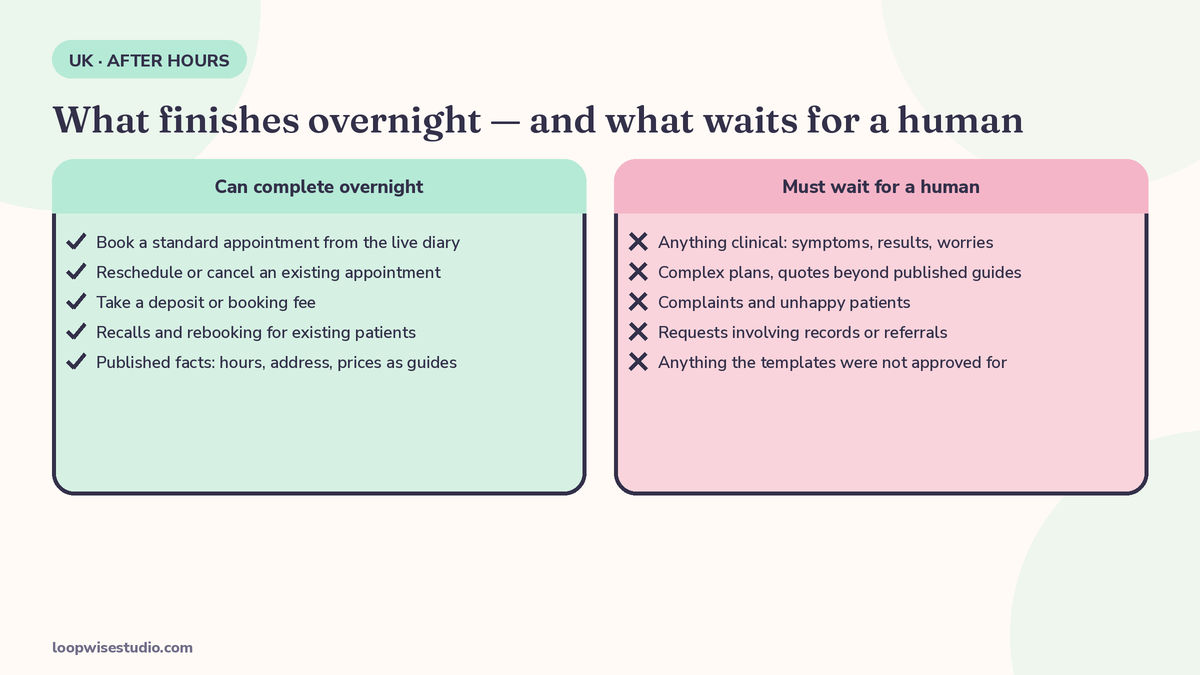
A good overnight system does not try to finish everything. It sorts requests into two honest piles:
| Can complete overnight | Must wait for a human |
|---|---|
| Booking a standard appointment from the live diary | Anything clinical: symptoms, results, worries about treatment |
| Rescheduling or cancelling an existing appointment | Complex treatment plans, quotes beyond published guides |
| Taking a deposit or booking fee | Complaints and unhappy patients |
| Recalls and rebooking for existing patients | Requests involving records, referrals, or another clinician |
| Answering published facts: hours, address, parking, prices as guides | Anything the templates have not been written and approved for |
Why is the second pile a feature, not a limitation? Because a clinic that automates judgement calls will eventually automate a bad one, at night, with nobody watching. Capturing a request properly — acknowledging it, telling the patient exactly when a person will respond, and flagging it so that actually happens — is what trustworthy looks like after hours. Patients accept it readily. What they do not accept is silence, or a bot pretending to be a clinician.
The same division runs through the daytime system. If you are setting up messaging for a practice from scratch, the dental version of the full setup is covered in our guide to WhatsApp automation for dental clinics in the UK, including how the diary connection has to work.
The morning handover
Ask any vendor one question: “Show me what my receptionist sees at 8am.” If the answer is “the chat inbox”, walk away. A handover is a list, sorted by what needs a human:
- Flagged first. Anything clinical, worried, or unhappy, with the full conversation attached.
- Captured requests. Enquiries the system took details for but did not complete, each with the promised response time.
- Overnight bookings. New appointments and deposits, already in the diary, needing nothing.
- Anything the system could not understand. Every automation meets a message it cannot parse. It should say so, capture it, and list it — not improvise.
Five minutes with that list replaces the first chaotic hour of the day, and it means the promise made at 9.47pm — “the team will pick this up first thing” — is a fact, not a hope.
Midway check: if your clinic’s evenings are a black hole between closing time and the morning scramble, get a free audit and we will count a month of your after-hours enquiries with you and show you exactly which of them a system could have booked, captured, or safely redirected.
Safety first: emergencies, red flags and NHS 111
This is the section the marketing pages skip, and it is the section that decides whether overnight automation is responsible.
Your clinic is not monitoring messages clinically at night, and your messages must never imply it is. The first automated reply after hours should carry the safety line where a patient with an urgent problem will see it: this inbox is not monitored for emergencies; if you have [the relevant urgent symptoms], call 999 or go to A&E; for urgent advice, contact NHS 111.
Red-flag wording belongs in the templates. For dental: spreading swelling, difficulty breathing or swallowing, uncontrolled bleeding, facial trauma. For aesthetic clinics: the post-treatment warning signs your own aftercare sheets list, with the instruction to use the clinic’s urgent aftercare route or NHS 111. These replies do not book anything. They redirect, clearly and fast, and flag the conversation for the morning.
Real UK practice, as a contrast: an NHS GP practice taking appointment requests on WhatsApp states openly that its WhatsApp service is monitored 08:00 to 17:00, Monday to Friday, and tells patients not to use it for urgent queries — phone the surgery, NHS 111, or 999 in an emergency. That honesty is the model. A private clinic’s advantage is not pretending to be staffed at midnight; it is booking the routine things at midnight while being just as clear about the urgent ones.
After-hours booking is not the same as reminders
The two get lumped together because both involve WhatsApp, but they solve different problems. Reminders protect appointments you already have: confirmations, the 24-hour nudge, the reschedule button that saves a slot. After-hours booking wins appointments you do not have yet: the new enquiry, the lapsed patient rebooking at 10pm, the Sunday-evening diary filling for Monday. Most clinics need both, and they run on the same system — but if your diary is full and your inbox is quiet, reminders come first; if your evenings leak enquiries, start here. The reminder side is covered in full in our guide to WhatsApp appointment reminders for clinics in the UK.
And if the leak in your clinic is bigger than the evening — phones unanswered in the day as well — the fix starts with the whole pattern of how to stop losing bookings after hours at a clinic, of which this overnight system is one part.
GDPR and PECR for overnight messages
Overnight automation collects personal data while your team is asleep, so the basics have to be right by design, not by someone remembering.
- Consent and clarity in the first reply. The first automated message should make clear the patient is talking to the clinic’s automated system and what will happen to their details. Booking a patient who asked to book is service, not marketing — but any later promotional use of that conversation needs consent under PECR, separately.
- Staff phones. The classic UK private-clinic habit — patient chats living on a receptionist’s or clinician’s personal phone — is a genuine ICO risk: no access control, no deletion when staff leave, records outside your systems. An after-hours system should run on the clinic’s number, in a shared inbox your practice controls.
- Retention. Chats should be kept to a written retention rule, like any other record, not forever by default. Clinical detail should not be in the chat at all; the diary and your clinical system hold the record.
- The paperwork. Whoever runs the system for you is your data processor and should sign a data processing agreement. Loopwise does, as standard.
What it costs vs an evening receptionist or an answering service
Labelled ranges, in the shape of the real comparison — your quotes will vary, but the categories will not:
| Option | What you pay | What you get overnight |
|---|---|---|
| Do nothing | Nothing | An inbox read tomorrow; enquiries answered hours late or never |
| Answering service | A monthly fee plus per-minute or per-call charges, typically | A message taken politely; no booking, no deposit, still a callback tomorrow |
| Evening reception cover | Staff wages for every evening, plus cover for sickness and holidays | A human who can book — if you can recruit and keep the shift filled |
| After-hours WhatsApp system | Setup plus a monthly service fee, and Meta’s conversation charges on top | Real bookings completed, deposits taken, requests captured and handed over at 8am |
The honest test is not the fee column. It is the count from the first section: your evening enquiries, your booking rate, your appointment value. If that number is small, you do not need this yet — and a proper audit will tell you so. If it is large, the system is usually the cheapest row in the table that actually books.
How it gets set up
Four steps, and none of them is “learn a new platform”:
- We map your evenings. Which enquiries arrive after hours, which appointment types can be booked outright, and which must be captured for the morning. Your red-flag wording and NHS 111 line are agreed here, with your clinicians, before anything is automated.
- We connect your number and your diary. Your existing clinic WhatsApp number, your real appointment slots, your deposit rules. No new app for patients, no change to your booking software.
- The templates are written in your voice and approved by you. Every overnight message — the first reply, the safety line, the deposit request, the morning promise — is read and signed off by your team before it ever reaches a patient.
- It runs, and the handover lands at 8am. You watch the first week’s handover lists with us, adjust what gets flagged, and the system settles into the routine your reception team actually wants.
FAQs
Does this work for NHS practices?
The pattern fits private and mixed clinics best, where the clinic controls its own diary and deposits. NHS practices use WhatsApp mainly for appointment requests within monitored hours, with NHS 111 and 999 signposting outside them — and any NHS setup has to follow its own organisation’s rules first.
What if a patient messages something urgent at night?
The reply does not try to help clinically. It gives the emergency wording — 999 or A&E for the red-flag symptoms in the template, NHS 111 for urgent advice — and flags the conversation at the top of the morning handover. The system books appointments; it does not monitor patients.
Can it take deposits overnight?
Yes. If your policy takes a deposit or booking fee for the appointment type, the payment link goes in the same chat, the booking confirms once paid, and the deposit shows in the morning handover and the diary entry.
Will patients know they are talking to a system?
They should, and the first reply should make it plain. Patients accept automation for booking, rescheduling, and facts — especially at 9pm, when the alternative is nobody. What damages trust is a system pretending to be a person, or guessing at clinical questions.
What does my team have to do differently?
Very little, and mostly at 8am: work the handover list instead of excavating an inbox. The flagged conversations and captured requests need humans; the completed bookings need nobody. Most teams find the morning gets quieter, not busier.
Your competitors are not answering at 8pm either. That is the whole opportunity — it will not stay open forever, but it is open now. Get a free audit and we will count your after-hours enquiries, show you the overnight journey working on a live diary, and give you one fixed price for building it.