WhatsApp Rebooking Campaigns for Aesthetic Clinics
WhatsApp rebooking campaigns for aesthetic clinics: rebooking moments, per-treatment timing, copy-ready messages, segments and rules that protect your number.
A WhatsApp rebooking campaign is how an aesthetic clinic systematically brings its existing patients back: a short, well-timed message when the next session is due, offering two or three real appointment times, sent only to the patients it applies to. Your past patients are the cheapest bookings you will ever win — they already trust your clinic, know where you are, and have already paid you once. Yet most clinics spend their energy chasing new patients on Instagram while the list of people due back sits untouched in the diary. This guide covers the four rebooking moments, how to time them per treatment, the actual messages, who should and should not get them, and the rules that keep your WhatsApp number in good standing.
Notice what is missing from most of the tools and guides in this space: they treat rebooking as a discount broadcast. A message saying “20% off this weekend” to your whole list is not a rebooking campaign. It trains patients to wait for offers, it goes to people who were seen last week, and it ignores the one thing that actually decides whether someone rebooks — timing. A patient rebooks when the next session is due, not when your clinic is quiet.
Your cheapest bookings are already in your patient list
Every aesthetic clinic is sitting on four groups of people who are more likely to book than any stranger who sees an ad:
- Patients whose next session in a course is due or overdue
- Patients whose package has one or two sessions left in it
- Patients who finished a treatment cycle and were told to come back for a review — in an interval your practitioner set — and never booked it
- Patients who have simply drifted away over the past year
Reaching them is not a marketing project. It is diary hygiene, done on the channel they already talk to you on. And it belongs inside the same WhatsApp system that handles your bookings day to day — the setup described in our guide to a WhatsApp booking system for aesthetic clinics in Dubai — not in a separate broadcast tool someone at reception opens twice a year. If the rebooking layer is the part your current platform lacks, our comparison of an automated follow-up and rebooking alternative to Mangomint shows what that looks like bolted onto a diary you keep.
The four rebooking moments
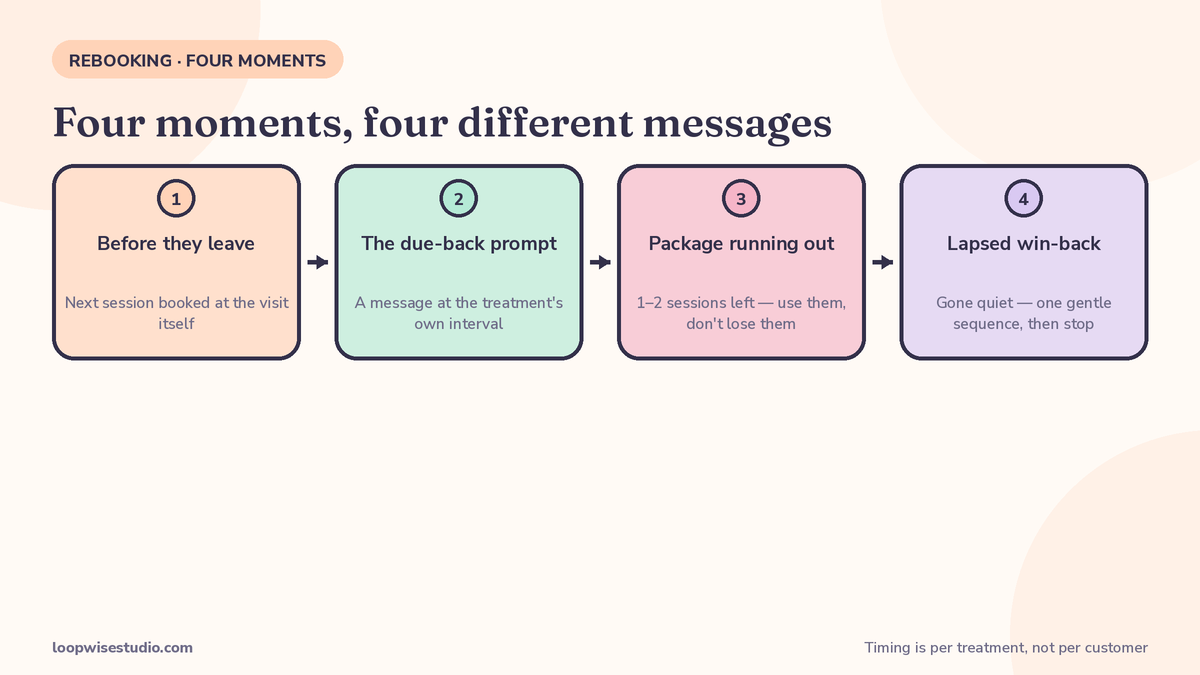
Each moment is a different job, with a different message. Clinics that merge them into one generic “we miss you” blast get generic results.
Moment 1: Book the next session before they leave
The highest-converting rebooking message is not a message at all — it is the conversation at the end of the appointment, while the patient is happy and the practitioner is in front of them. “Let’s get your next session in while you’re here — same day of the week suit you?” If they will not commit on the day, that is when the follow-up message gets scheduled: a short note a few days later, referring to the plan the practitioner made with them, offering the slots that fit it.
Clinics skip this because the front desk is busy. That is a workflow problem, not a patient problem — the prompt to ask should be built into the end-of-visit routine, and the message should go out automatically when no booking was made.
Moment 2: The due-back prompt
This is the core of the campaign. When a patient’s next session falls due — at whatever interval applies to their treatment — they get a message naming the treatment in the terms they booked it under, and offering two or three actual times:
“Hello [First name], you’re due for your next [treatment] session with [practitioner]. She has [day] at [time] or [day] at [time] free this week. Reply 1 or 2 and we’ll confirm it for you — or tell us a day that suits you better.”
Two details matter. First, real slots, not a bare booking link and a hope. Both the template libraries and the better guides in this space make the same point: offer actual times. Second, the message sells timing and continuity — your practitioner, your plan, the session that completes what you started — not a discount. Price is the weakest reason to return and the hardest habit to break once patients learn it.
Moment 3: Package and course rescue
A patient with sessions left in a package has already paid you. If those sessions expire unused, you keep the money once and lose the patient, the result they wanted, and every future booking — a bad trade dressed as a good month.
The template libraries for clinic messaging put the trigger precisely: send the package renewal or remaining-sessions message when one or two sessions remain. Not when the package has expired. While there is still something to rescue:
“Hello [First name], you have [two] sessions left in your [package name] package, and they run until [date]. [Practitioner] has [slot] and [slot] available — reply with the one you want and we’ll book it in.”
The same rescue applies to a course abandoned after the first session, which is the saddest leak in aesthetics: the treatment was sold, the plan was made, and then nothing. One message, a few weeks after that first session, offering the next step with real times, recovers a share of them. Silence recovers none.
Moment 4: The lapsed win-back
Patients who have not visited in six to twelve months are a different segment and need a lighter touch: one message, no offer pressure, an easy door back in. Acknowledge the gap without guilt-tripping, remind them what they came for, offer a concrete next step:
“Hello [First name], it’s [Clinic name] — it’s been a while since your last [treatment] with us. If you’d like to pick it back up, [practitioner] has appointments on [day] and [day]. Just reply and we’ll find you a time. If you’d rather not hear from us, reply STOP and we won’t message again.”
If they do not reply, that is the end of it. Win-back is a single knock on the door, not a siege. Patients who return this way often become regulars again; patients chased monthly become blocks and complaints, which put your number at risk (more on that below).
Timing is per treatment, not per customer
The single most useful idea in the spa and wellness writing on this subject — Zellbox’s guide to WhatsApp booking conversion states it plainly — is that the rebooking cadence belongs to the service, not to the customer: their examples run at four weeks for a facial, two to three weeks for lymphatic treatments, four to six weeks for deep tissue work. Send the prompt at the wrong point in the cycle and it fails both ways: too early and the patient has not decided anything yet; too late and they have booked somewhere else.
Apply the same logic to aesthetics, with one honest caveat: for clinical treatments, the interval is set by your clinic, not by a marketing calendar.
| Rebooking trigger | When to send | Basis |
|---|---|---|
| Next session in a course | At the interval your clinic set for that course | The treatment plan made with the patient |
| Review / top-up appointments | When the practitioner said to review — the interval is the clinic’s decision | Set at the appointment, recorded in the notes |
| Facial and skin treatments | Around the cycle your clinic works to (Zellbox cites 4 weeks for facials) | Attributed guidance from Zellbox’s spa guide |
| Body / wellness treatments | Per service: lymphatic 2–3 weeks, deep tissue 4–6 weeks | Attributed guidance from Zellbox |
| Package running out | When 1–2 sessions remain | Medicolize clinic template pack |
| Missed or cancelled, no new booking | Two days after the missed visit | Medicolize clinic template pack |
| General check-in after treatment ends | Around three months after the course ends | Medicolize clinic template pack |
Build this table into your system once, treatment by treatment, with your own clinic’s intervals. After that, the campaign is not something you “run” in a panic when the diary looks empty. It is a queue that fills itself from the diary every week. The three-month cycle is the most predictable of them all, and we work through it step by step in remind Botox patients to rebook at 3 months.
While patients are still in their current course, the other half of keeping them is making sure they actually attend each session — the reminder side of that is covered in how clinics in the UAE reduce appointment no-shows on WhatsApp, and the two systems share the same number, the same diary and the same rules.
Segment before you send
A campaign sent to “all patients” is how clinics annoy their best customers. Before anything goes out, split the list:
- Due back — cycle point reached, no future booking. The core audience.
- Package / course rescue — sessions remaining, course stalled. Send before expiry, not after.
- Lapsed — no visit in six to twelve months. One message, then stop.
- Never send to: patients with a future booking already in the diary (the classic own goal — nothing says “we don’t know you” like a rebooking prompt to someone booked in on Thursday); patients who opted out; patients with an open complaint or an unresolved problem from their last visit — those get a person, not a campaign; and patients whose treatment your practitioner has paused or ended for clinical reasons. The clinic’s judgement outranks the campaign calendar, always.
Segmentation is also what keeps the message relevant enough to be welcome. A patient should be able to read your message and think “yes, that is me, that is due” — if half your list reads it and thinks “this isn’t about me,” you sent it to the wrong half.
If your patient list lives in a diary, a spreadsheet and someone’s memory, the segmentation above sounds like a week’s work. It isn’t, once the system is set up properly. Get a free audit and we’ll show you what your due-back and lapsed lists actually look like — for most clinics, seeing those two numbers is the whole argument.
Rules that keep your number safe
A rebooking message with an offer in it is a marketing message in WhatsApp’s terms, and marketing messages need marketing opt-in. That single fact shapes the rules:
- Opt-in first. Prompts and offers go only to patients who agreed to receive them. Appointment logistics and marketing are separate consents — do not spend the first on the second.
- Frequency cap. The Medicolize clinic template pack sets a clear rule worth adopting: no more than three messages a month to a patient who is not in treatment. For rebooking specifically, one message per due-back moment, plus at most one gentle follow-up, is plenty.
- Sensible hours. Send in daytime hours — the same template guidance says 9am to 9pm, and to be mindful of prayer times in the Emirates. A rebooking prompt at midnight is a block waiting to happen.
- No clinical detail. Treatment logistics only, in the terms the patient booked under. No results, no diagnoses, nothing you would not want on a lock screen.
- Every reply gets answered. If a patient replies to a campaign, a person or a proper flow picks it up the same working day. A campaign that starts conversations nobody answers is worse than no campaign.
Get these wrong and the cost is not just annoyed patients. High block and report rates put your WhatsApp number itself at risk — and for a clinic that takes bookings on that number, losing it is losing the front desk.
What to measure
You do not need a dashboard project. Four numbers, reviewed monthly:
| Measure | What it tells you |
|---|---|
| Rebooking rate | Of patients who finished a session with a next one due, how many have it booked? |
| Recovered bookings per month | Bookings that came from due-back, rescue and win-back messages — count them |
| Course completion rate | Of courses started, how many finished? This is the clinical and commercial score in one |
| Opt-outs and blocks per send | Your early-warning gauge: if these climb, your targeting or frequency is wrong |
Track them per segment, not in total. If due-back prompts convert and win-backs do not, you will see it here first — and you will stop spending effort where it does not work. For a solo practitioner, this whole system is smaller than it sounds: our guide to a website for a one-person aesthetic clinic shows how the same booking and follow-up machinery fits a diary of one.
Frequently asked questions
How often should we message patients about rebooking?
Once per rebooking moment: when the next session falls due, when a package is down to its last sessions, or once to a lapsed patient. Adopt the cap used in clinic template guidance — no more than three messages a month to a patient who is not in treatment — and treat one follow-up as the maximum for any single prompt.
Should rebooking messages include a discount?
Usually not as the lead. A patient who is due back needs a time, not a price cut — offer real slots and continuity with their practitioner. Discounts train patients to wait for the next offer and quietly tax the patients who would have paid full price. If you run an offer, it goes only to patients who opted in to marketing messages.
When is the right time to send a due-back message?
At the treatment’s own cycle point, set by your clinic. As attributed guidance from the spa side: facials around four weeks, lymphatic at two to three weeks, deep tissue at four to six weeks. For clinical treatments — top-ups, reviews, course sessions — the interval is whatever your practitioner set with the patient. Record it at the appointment and let the system count the days.
What if a patient ignores the message?
Then, at most, one gentle follow-up, and then silence. Non-response is an answer. Repeated chasing creates blocks and complaints, which endanger the WhatsApp number your whole booking operation runs on.
Can we send rebooking messages from the free WhatsApp Business app?
You can send individual messages, but a campaign needs the parts the app does not have: segments drawn from the diary, timed sends at each patient’s cycle point, approved marketing templates, and opt-out handling across the whole list. Campaigns are a Business Platform job, set up once and then run from the diary.
We have thousands of past patients. Where do we start?
With the smallest, warmest segment: patients whose package or course still has sessions in it — they have already paid, and the message is a service, not a pitch. Then due-back patients from the last few months. Leave the deep lapsed list until the first two are working and measured.
The patients you already won
New patients will always matter. But a clinic that books the next session at the visit, prompts at the right week with real times, rescues packages before they expire and knocks once on a lapsed patient’s door will fill a meaningful share of its diary from people it has already earned — at a fraction of the cost of winning strangers.
That system is buildable, and it runs itself once it is built. If you want it running on your clinic’s number, get a free audit — we will start with your own patient list and show you the due-back and lapsed bookings sitting in it right now.