
How to Remind Botox Patients to Rebook at 3 Months
Botox rebooking runs on a 3-month cycle: book the next visit at checkout, then send the reminder 2 weeks before it is due. The full automated ladder.
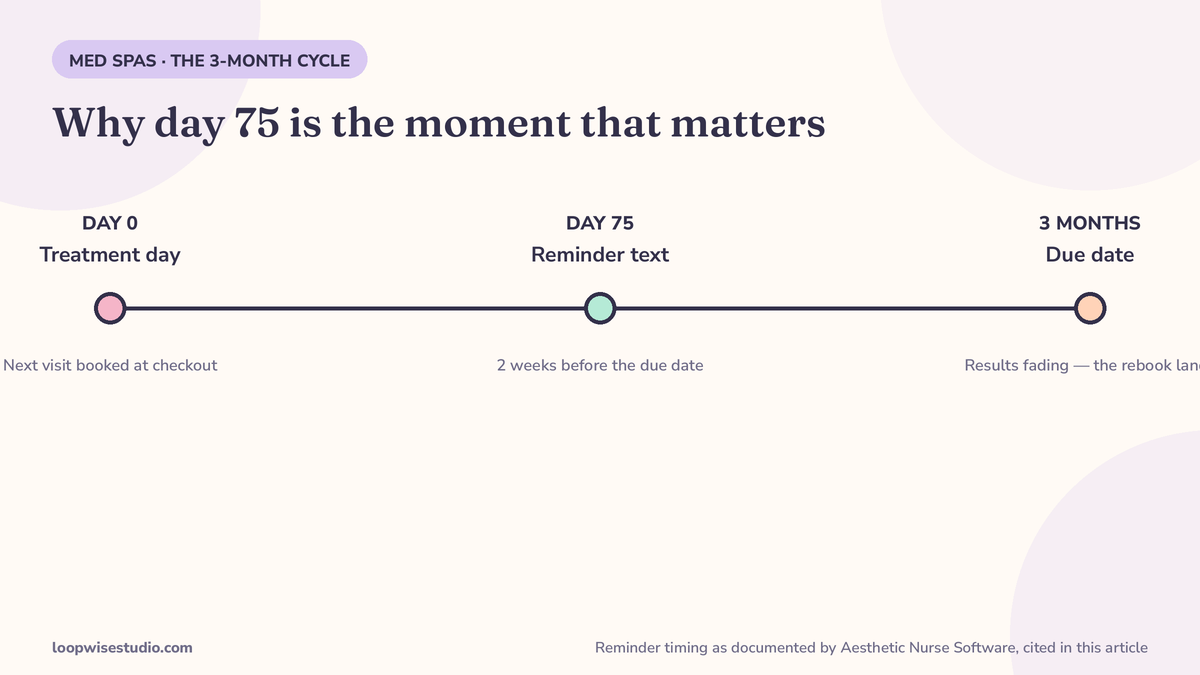
Set the rebooking reminder to land 2 weeks before the 3-month interval is due — around day 75 after treatment, while the result still looks good and the patient still feels like your patient. Aesthetic Nurse Software’s help documentation uses exactly this pattern: a 3-month botulinum toxin rebook interval, with the reminder sent 2 weeks before it falls due. Automate it off the treatment date, and no one has to keep a list.
That timing is the whole trick. Send the reminder at month three and you are competing with a result that has already faded — the patient is looking in the mirror thinking about her lines, not about your clinic, and any competitor’s ad can reach her in that mood. Send it at day 75 and you are reminding a happy patient of an appointment she already half-expected to make.
Below is the full ladder: the checkout habit that makes the reminder almost unnecessary, the automated texts that follow, the exact words to use, and what to do when a patient goes quiet.
Why month three is where your diary leaks
A Botox patient is the most predictable rebooking in aesthetics. The treatment runs on a repeat cycle — rebook intervals for botulinum toxin are set at 3 months in the documentation of clinic software built for this work — and the patient knows she will want it again. Nobody has to be persuaded. She just has to be reached at the right moment, by you, before the moment passes.
Yet most clinics leave it to chance, or to a front desk working from memory and good intentions. The patient who was delighted in January drifts in February, means to call in March, and by April she has booked wherever an offer reached her first. You did the hard part — the consultation, the trust, the good result — and lost the easiest sale in the building to a missing text message.
This is a diary problem, not a marketing problem. The fix is a sequence attached to the treatment date, running the same way for every patient, whether or not anyone at the desk remembered.
Step 1 — book the next appointment before she leaves the building
The strongest rebooking reminder is the one you never have to send, because the appointment is already in the diary. Booking platforms for clinics push the same habit: ask at checkout, while the patient is at the desk, pleased, and has her phone in her hand anyway.
The script is short. Copy it onto a card at reception:
“Your next treatment will be due in about 3 months — shall I put you in now, around [date]? It holds your slot with [practitioner], and you can move it any time with the link we’ll text you.”
Three things in that script do the work. It names the due window without making a medical promise. It offers her usual practitioner, which is who she wants. And it removes the fear of commitment — she can move the appointment herself, from the reminder, without ringing anyone.
Not everyone will book. Some patients genuinely do not plan 3 months ahead, and that is fine — they are exactly who the automated ladder below exists for. But every patient who does book at checkout is one your front desk never has to chase, and her slot is protected before your competitors ever get a look in.
The automated ladder — four touches, then stop
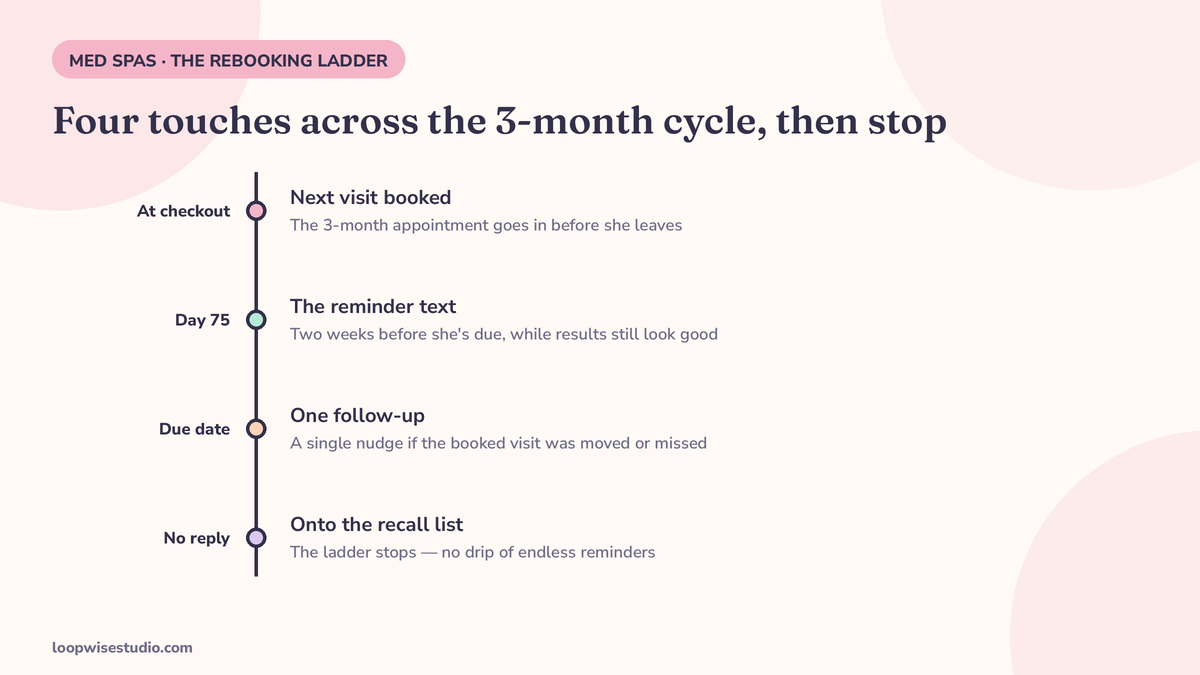
Whether she booked at checkout or not, the sequence below runs off the treatment date. It is deliberately built on text or WhatsApp rather than email alone: the best-known published version of this sequence, Pabau’s, is six emails across five dates — well structured, but sitting in an inbox. A text lands on the lock screen. Run both if you have email; never rely on email only.
| When | Touch | Job it does |
|---|---|---|
| Day of treatment | Next appointment booked at checkout (script above) | Locks the slot before she leaves |
| ~Day 75 | Text: “Your next treatment is coming due” + booking link | Reaches her while the result still looks good |
| 2 weeks before due date | Reminder text with her held slot or a booking link | The ANS-documented timing — converts intention into a booking |
| Due week | One short nudge, only if nothing is booked | Catches the “I meant to” patients |
| After that | Nothing. She moves to the recall list | Chasing further spends goodwill |
The day-75 touch deserves a note, because two independent sources land on the same day. Webvify’s med spa marketing guidance puts its 90-day Botox renewal push notification on day 75 — “before the product fully wears off, while the patient is still happy with their results.” Aesthetic Nurse Software’s documentation pattern — reminder 2 weeks before a 3-month due date — puts the send at roughly the same point in the cycle. When a marketing vendor and a clinical-software manual agree on a day, that day is probably right: it is the last moment the patient still feels like your current patient rather than your lapsed one.
Notice the ladder is short. Four touches, two of them only if she has not booked. Reminder systems fail by nagging as often as by forgetting — the goal is to be present at the decision moment, not to campaign at her for a month.
Copy-paste reminder texts
Swap in the names, the date and your booking link. Keep them plain; a reminder that reads like an ad gets treated like one.
The day-75 text (no appointment booked yet):
Hi [First name], it’s [Clinic]. Your last treatment with [Practitioner] was on [date], so your next one is coming due in the next couple of weeks. Book here whenever you’re ready: [link]
The 2-weeks-before text (appointment held at checkout):
Hi [First name], your appointment with [Practitioner] is on [date] at [time] — reply here if you need to move it, or tap to change it yourself: [link]
The 2-weeks-before text (nothing booked):
Hi [First name], just a reminder that your next treatment is due around [date]. [Practitioner] has slots that week — grab one here: [link]
The due-week nudge (final touch):
Hi [First name], last nudge from us — your treatment is due about now. If you’d like to rebook, here’s the link: [link]. No pressure either way.
That last line matters. “No pressure either way” is not weakness; it is what keeps the message welcome, and a patient who skips this cycle but still likes you is worth far more than one extra booking squeezed out of someone who now dreads your texts.
The no-reply path — what happens when she goes quiet
Silence is not rejection. Patients go quiet because the week was busy, the phone changed, or the timing genuinely is not right — and a clinic that treats silence as a closed door loses patients it had already won.
The no-reply path is simple:
- The ladder ends. After the due-week nudge, no more rebooking messages this cycle. She goes onto a recall list, not a chase list.
- One recall touch, later. A single message weeks after the due date — not another nudge in the same sequence, a fresh, short note: she is due, the link is here, and if her plans have changed she can say so and the messages stop.
- Then she hears from you like everyone else. Normal clinic news, seasonal messages, nothing targeted. If she comes back in 8 months, she comes back as a patient, not as a lead you wore down.
What you never do: keep texting weekly, escalate to phone calls about a cosmetic top-up, or let a marketing tool keep “following up” indefinitely because nobody set an end. The ladder has an end because your clinic’s name is on the messages.
This same structure — book at checkout, automated ladder, dignified stop — is the spine of every recall we build. It runs the laser course recalls inside an online booking system for laser hair removal clinics, and it is the active ingredient in keeping course clients from drifting in how to stop clients dropping out of laser packages. One machine, different clocks.
Who should set the interval — a note on the clinical side
The 3-month figure in this article is a workflow default, taken from how clinic software documents rebook reminders for botulinum toxin treatments — Aesthetic Nurse Software’s help centre sets the interval at 3 months and the reminder 2 weeks before due. Actual treatment intervals are a clinical decision: your practitioners set them per patient and per treatment plan, and the system should store whatever interval the clinician chose and time the ladder off that.
Set the default once, let practitioners override it on the patient record, and never let the marketing calendar overrule a clinical judgement. The automation’s job is to remember, not to prescribe.
If building this ladder inside your current software sounds like another weekend project, that is because it usually is. When Loopwise builds a clinic’s booking system, the rebooking ladder is part of it — treatment date in, four touches out, recall list at the end. If your platform cannot run the ladder natively, our comparison of an automated follow-up and rebooking layer covers what can sit on top of the diary you already have. get a free audit and we will show you where your current rebooking leaks.
Setting it up — the one-page checklist
The ladder needs four pieces of information on every treatment record, and about an hour of setup. After that it should run untouched.
The setup checklist (copy this):
- ☐ Treatment date recorded on the patient record at every visit — the whole ladder times itself off this date, so it must be the treatment date, not the booking date.
- ☐ Interval set per treatment — 3 months as the default for botulinum toxin, per the software documentation pattern, overridable by the practitioner on the individual record.
- ☐ Channel chosen per patient — text or WhatsApp, whichever she already uses with your clinic. One channel, not both; the same message arriving twice reads as a glitch.
- ☐ The four touches loaded — day-75 text, 2-weeks-before reminder, due-week nudge, and the recall-list rule at the end. Load them once, with your clinic’s name, practitioners and booking link.
- ☐ Opt-outs honoured instantly — a patient who replies STOP or asks not to be messaged comes off the ladder that day. The recall list is for quiet patients, not for patients who have said no.
- ☐ A weekly glance at the recall list — five minutes, one human, looking for the names that deserve a personal call instead of another automated touch.
Two mistakes to avoid at setup. First, do not let the sequence keep running after a patient rebooks — the ladder must check the diary before every touch and switch itself off the moment an appointment exists. Second, do not write the messages like promotions. The moment a reminder carries an offer, a deadline and three exclamation marks, it competes with every other ad in her messages — and loses the one advantage it had, which is that it came from her clinic about her appointment.
Test the whole ladder on your own phone number before it goes near a patient. Every clinic that skips this step finds its typo in a screenshot sent back by a patient, usually the one patient they least wanted to impress that way. Run it once, end to end, read every message the way a patient would — tired, one-handed, mid-commute — and fix whatever makes you wince before a single real patient sees it.
The short version
Book the next appointment at checkout with a 20-second script. For everyone who does not book, run four automated touches off the treatment date: a day-75 text, a reminder 2 weeks before the 3-month due date, one due-week nudge, then stop. Quiet patients go to a recall list, not a chase list. Do that and month three stops being where your diary leaks.
Want the ladder running on your own booking system instead of a spreadsheet and good intentions? get a free audit — we will map it against your current setup, free.
FAQs
When exactly should a Botox rebooking reminder be sent?
Two timings matter: about day 75 after treatment, while the result still looks good (the point Webvify’s renewal guidance uses), and 2 weeks before the 3-month due date (the pattern in Aesthetic Nurse Software’s documentation). In practice they land close together. Send the first as a text with a booking link, the second as a confirmation or a final prompt — then one due-week nudge, and stop.
Should the reminder go by text, WhatsApp or email?
Text or WhatsApp first, email as backup. The best-known published sequence (Pabau’s) is six emails across five dates — thorough, but email gets read hours or days late, if at all. A reminder whose whole job is timing should arrive on the lock screen. Use the channel your patients already reply to your clinic on.
What if the patient already booked her next appointment at checkout?
Then the ladder changes job: no rebooking asks, just the appointment’s own confirmation and reminders, with a self-service link to move it. Sending “time to rebook” texts to a patient who is already booked is the fastest way to teach patients to ignore your messages.
How many reminders is too many?
Four touches across the cycle, including the checkout ask — and only two of them if she books early. After the due-week nudge, stop and move her to a single later recall. More than that buys very few extra bookings and costs you the welcome your future messages depend on — the same over-messaging trap behind the wider problem in how to reduce no-shows at a med spa, where the clinics that remind best remind least, but at the right moments.
Can I offer returning patients a discount to rebook on time?
You can run your clinic’s pricing however you choose — but do not tie the reminder system to it. The ladder works because it is timed well and effortless to act on, not because it bribes. A patient rebooking at day 75 at full price is worth more than one trained to wait for an offer.
Does this work for other injectables and treatments, not just Botox?
Yes — the ladder is identical; only the interval changes, and the interval is whatever your clinicians set for that treatment and patient. Store the due date on the treatment record and let the same four touches run off it, whether the clock is 3 months or 12.