How UAE Clinics Reduce No-Shows on WhatsApp
How clinics in the UAE reduce appointment no-shows on WhatsApp: the reminder flow, English and Arabic templates, deposits, consent rules and measurement.
UAE clinics reduce appointment no-shows on WhatsApp with a simple system, not a single reminder: an instant confirmation when the patient books, a reminder a day or two before with Confirm and Reschedule buttons, a short message on the morning of the visit with your location, and a polite recovery message if they still do not show. Every step runs automatically from the clinic’s real appointment book, in the patient’s language, with rescheduling one tap away. This guide walks through that flow for UAE clinics specifically — the timings, the actual message wording in English and Arabic, when to take a deposit, what must never go in a message, and how to measure whether any of it is working.
Most no-show advice online is written for clinics in India, the US or Malaysia. The mechanics travel well; the details do not. A clinic in Dubai or Abu Dhabi deals with Arabic-first patients next to English, Hindi and Russian speakers, enquiries that land late at night, and patients who booked two weeks ago and have simply forgotten it exists.
Why UAE clinics lose booked patients between booking and the chair
A no-show is rarely a patient being rude. It is usually a booking that was made days ago, confirmed by a phone call or a scribbled diary entry, and then never mentioned again. Life happens in between. The patient forgets, something at work moves, or they meant to reschedule and could not face calling reception during opening hours.
Three patterns show up again and again in UAE clinics:
The booking was made too long ago, with nothing since. A patient books a consultation ten days out. They get no confirmation they can look back at, no reminder, and no easy way to move the appointment. By the day itself, your clinic is competing with everything else in their week — and losing silently.
The enquiry arrived after hours and the booking started weak. Patients research clinics in the evening. If the first reply comes the next morning, the booking that follows is already half-hearted. Weak bookings, made without a proper confirmation in writing, are the ones that evaporate.
Rescheduling is harder than disappearing. This is the quiet one. A patient who cannot make their slot often has two options: phone the clinic during working hours and explain, or just not come. Many pick the second. The fix is not stricter patients. It is making “move my appointment” a one-tap action inside a message they already have open.
That last point is the thread through this whole guide: patients do not vanish because they do not care. They vanish because your system gives them no easier move.
What a no-show actually costs a Dubai clinic
Do this with your own numbers, because nobody else’s percentages mean anything for your clinic. You will see large reduction figures advertised for reminder software. Treat any percentage that comes without a method or a source as marketing, not evidence. The honest approach — the one the better vendors in this space take — is to promise no percentage up front and measure the same clinic before and after.
Here is the arithmetic, with the assumptions stated so you can swap in your own:
| Line | Your number (example) | How to get it |
|---|---|---|
| Booked appointments per week | 120 | From your diary for last month |
| No-shows per week | 12 | Count the empty slots honestly |
| No-show rate | 10% | No-shows ÷ bookings |
| Average value of a missed slot | AED 400 | Consultation or treatment value for that slot type |
| Revenue walking out per week | AED 4,800 | No-shows × average slot value |
| Revenue walking out per month | ~AED 20,800 | Weekly figure × 4.33 |
The example uses round, deliberately modest numbers — a long aesthetic treatment slot is worth far more than AED 400, and the table ignores the idle practitioner and room. Even so, the point stands: if a reminder flow recovers a share of those slots, or frees them early enough to refill, it pays for itself quickly. If it does not, your measurement (below) will tell you, and the problem sits elsewhere — booking lead time, or deposit policy.
The WhatsApp reminder flow, step by step
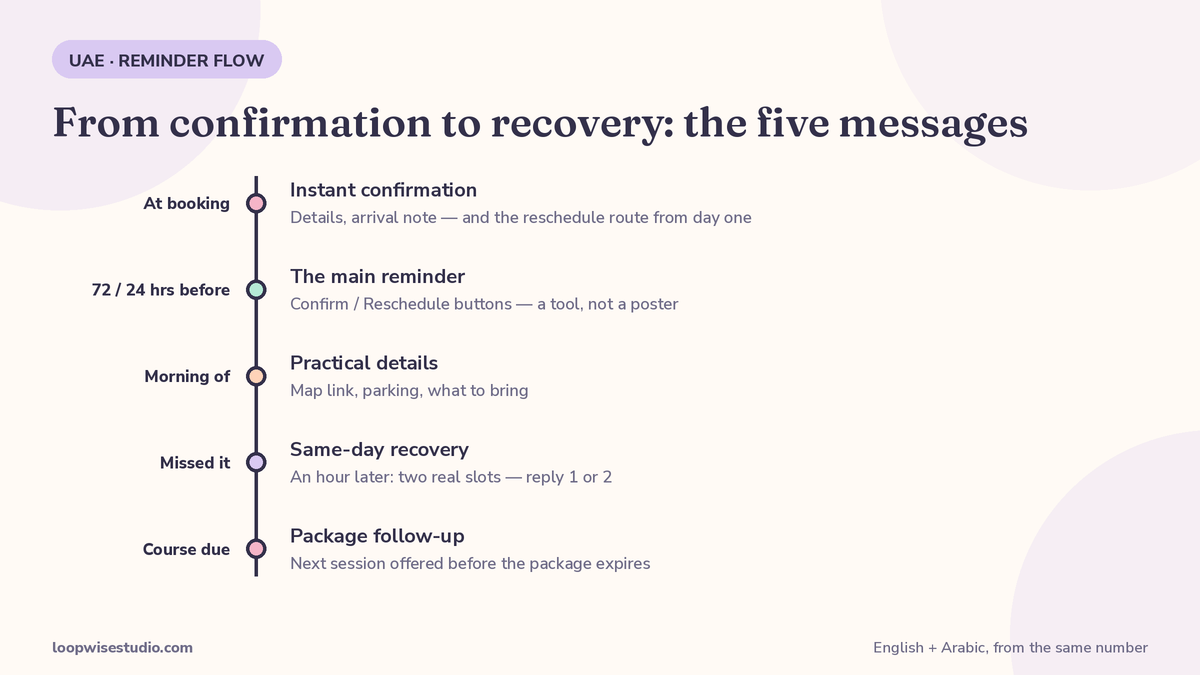
This is the full sequence. It assumes the messages run on the WhatsApp Business Platform with approved templates and a proper opt-in — not the free WhatsApp Business app on a receptionist’s phone, which cannot send timed sequences to a diary it cannot read. The flow only works if it is connected to your actual appointment book. Reminders triggered from a spreadsheet or someone’s memory fail the first time the diary changes and nobody updates the sheet.
Step 1: Instant confirmation, the moment they book
The confirmation does four jobs: it proves the booking exists, puts the details somewhere the patient can find again, starts the opt-in record, and gives them the reschedule route from day one.
English: “Hello [First name], your appointment at [Clinic name] is confirmed for [day, date] at [time] with [practitioner]. Please arrive 10 minutes early. Need to change it? Reply to this message and we will offer you other times.”
Arabic: “مرحباً [الاسم]، تم تأكيد موعدك في [اسم العيادة] يوم [اليوم والتاريخ] الساعة [الوقت] مع [اسم المعالج]. نرجو الحضور قبل الموعد بعشر دقائق. إذا أردت تغيير الموعد، رد على هذه الرسالة وسنعرض عليك أوقاتاً أخرى.”
Step 2: The main reminder — 72 or 24 hours before
Send this one early enough that a reschedule still leaves you a refillable slot. For appointments booked far ahead, a message around 72 hours before, then the day-before message, works better than a single reminder. The key feature is the two buttons: Confirm and Reschedule. A reminder that can only be read is a poster. A reminder that can be answered is a tool.
English: “A reminder of your appointment at [Clinic name] tomorrow, [date] at [time]. Please tap Confirm if you are coming, or Reschedule and we will send you other times — no need to call.”
Arabic: “تذكير بموعدك في [اسم العيادة] غداً [التاريخ] الساعة [الوقت]. اضغط «تأكيد» إذا كنت قادماً، أو «تغيير الموعد» وسنرسل لك أوقاتاً بديلة — لا حاجة للاتصال.”
If they tap Reschedule, the system offers real free slots from the diary, in the chat. Not “please call us.” Not a link to a generic booking page that makes them start again. Slots.
Step 3: Morning-of message, with the practical details
Short, and mostly logistics: location link, parking or building entrance notes, what to bring, anything they need to do before the treatment (arrive without makeup for a skin treatment, for example — instructions about the visit, never clinical detail).
English: “We look forward to seeing you today at [time]. We are here: [map link]. Parking is [detail]. If you are running late, reply here and we will do our best to hold your slot.”
Step 4: Same-day recovery, when someone still does not show
Some no-shows will still happen. What happens in the next hour decides whether that patient is lost or rebooked. A same-day message, sent an hour or so after the missed slot, works because it is kind and because it offers actual times:
English: “We missed you at [time] today — no problem at all. Would you like to move your appointment? [Practitioner] has [slot 1] or [slot 2] this week. Reply 1 or 2 and it is booked.”
No guilt, no penalty lecture in the message itself (your cancellation policy lives in the booking terms, where it belongs). Clinics that run this step recover patients they would previously have written off — and they learn, from the replies, why people miss: traffic, work, childcare, fear of the treatment. That is useful information, not failure.
Step 5: Course and package follow-up
For aesthetic clinics this is where recovered revenue quietly piles up. A course of treatments abandoned after the first session is a treatment that was sold and never delivered — and a patient who never got the result they paid for. A gentle WhatsApp message when the next session is due, with two or three real times offered, is a clinical follow-through as much as a booking one. The same applies to patients on packages with sessions remaining: remind them what they have already paid for, before the package expires.
For Dubai clinics building the wider system around these reminders — booking itself, not just reminding — our guide to a WhatsApp booking system for aesthetic clinics in Dubai covers the full front-desk setup this flow plugs into.
Make rescheduling easier than disappearing
Everything above depends on one design rule: at every step, changing the appointment must be easier than ignoring the message.
In practice that means:
- Real slots in the chat. The reschedule reply offers actual availability from the diary. If the patient has to phone, browse a website or wait for a human to check, most will not bother.
- The freed slot goes straight to your waitlist. When someone reschedules early, the system offers the gap to patients waiting for that practitioner or treatment — automatically, while the slot is still worth having.
- Two-way, not broadcast. These messages invite a reply and a person can step in at any point. The moment a conversation needs judgement — a patient is anxious, unwell, or unhappy — it leaves the automation and lands with a named member of your team.
If rescheduling takes effort, patients will keep choosing the zero-effort option. Build the flow so the zero-effort option is the tap.
Running a version of this by hand at the moment, or not at all? Get a free audit — we will map your current booking-to-chair path, show you exactly where patients are dropping out of it, and tell you what the fixed system would look like for your clinic. No obligation either way.
Deposits: useful for some slots, harmful for others
Deposits come up in every no-show conversation, so here is the honest version.
A deposit or card hold makes sense for long, high-value slots — the two-hour treatment that blocks a practitioner and a room for half a morning. It protects the scarcest thing you sell, and patients booking something serious generally accept it.
For first consultations, a deposit often costs you more bookings than it saves. A new patient comparing three clinics, asked to pay before they have met anyone, frequently just books with the clinic that did not ask. Several of the better guides in this space make the same point: deposits are a scalpel, not a blanket.
What works for most UAE clinics:
| Slot type | Sensible approach |
|---|---|
| First consultation | No deposit; strong reminder flow instead |
| Short treatments | No deposit; cancellation policy stated at booking |
| Long / high-value treatments | Deposit or card hold, stated plainly before booking |
| Repeat no-show patient | Deposit for future bookings, explained politely and personally |
Whatever you choose, state it at booking, in writing, in the confirmation message. A policy a patient first hears about after missing an appointment is not a policy. It is an argument.
What never goes in the message
WhatsApp messages appear on lock screens, on shared family phones, on a screen colleagues can glance at. Build the flow as if every message will be read by someone other than the patient.
| Never send | Send instead |
|---|---|
| Diagnosis or condition names | “Your appointment with [practitioner]” |
| Sensitive treatment details | The treatment category the patient booked, in the terms they used |
| Results, photos or clinical advice | “Please message us if you have any questions about your visit” |
| Anything a patient has not opted in to receive | Only send to patients who agreed to WhatsApp messages |
The practical rules underneath this: get a clear opt-in for WhatsApp messages and keep a record of it, in line with UAE personal data protection expectations (the UAE’s federal PDPL is the framework your clinic works under — consent, purpose and the ability to opt out are the principles to build around). Send appointment messages as the utility messages they are, through approved templates. Keep marketing messages separate, separately opted in. And keep clinical detail out of chat entirely — WhatsApp is for logistics: times, places, confirmations. Care happens in the clinic.
Language deserves the same care. Send the reminder in the language the patient has been speaking to you in. An Arabic-first patient who gets an English reminder from your clinic feels processed, not looked after — and the clinics that get this right treat the bilingual template set as one system, not a translation chore. The same applies to the other languages your patient base actually speaks.
Measure it properly, or you are guessing
“No-shows feel lower” is not a result. Track the rate the same way every month, and break it down so you can see where the remaining problem lives:
- By lead source — website, Instagram, phone and walk-in bookings behave very differently.
- By lead time — bookings made two-plus weeks out usually no-show most; the fix may be an extra mid-way touch, not more pressure near the day.
- By practitioner and branch — multi-branch groups often find one location or one diary is the whole problem.
- By day and time — evening and weekend patterns in the Emirates do not match a foreign Monday-to-Friday template.
- New vs returning patients — different problems, different fixes.
This breakdown is what separates a system from a gadget. The med-spa version of the same thinking — reminder cadences, deposits and post-no-show recovery — is covered in our guide on how to reduce no-shows at a med spa, and much of it transfers directly. And once your existing patients are reliably showing up, the next leak is the ones who finished a course and never came back: WhatsApp rebooking campaigns for aesthetic clinics covers that side of the same system.
Frequently asked questions
Do WhatsApp reminders actually reduce no-shows?
They reduce the forgetfulness and friction causes, which for most clinics are the biggest share. You will see vendors advertise very large reduction percentages without showing a method — do not buy on those numbers. Set the flow up, measure your own clinic’s rate before and after, broken down by source and lead time, and judge it on that.
How many reminders should a clinic send?
Four touchpoints around a normal appointment: confirmation at booking, the main reminder (72 or 24 hours before), a short morning-of message, and — only if they miss — one recovery message. More than that feels like pressure and gets your number muted or blocked.
Is it allowed to message patients on WhatsApp in the UAE?
With a proper opt-in, yes — appointment messages sent through the WhatsApp Business Platform using approved templates, to patients who agreed to receive them, are the normal, accepted pattern. Keep clinical detail out of messages, keep a record of consent, honour opt-outs immediately, and treat marketing messages as a separate consent. If in doubt about your clinic’s exact position, take advice — but do not let uncertainty keep you sending nothing while patients forget appointments.
Should we take deposits from every patient?
No. Deposits suit long, high-value slots and repeat no-show patients. For first consultations they commonly reduce bookings by more than they save. Decide by slot type, and state the policy at booking, in the confirmation message.
What if our patients speak different languages?
Send each patient their reminders in the language they use with your clinic, from the same number and the same flow. A bilingual English and Arabic template set covers a large share of UAE clinics; add languages only where your patient base actually needs them. The system should route replies to a team member who can handle that language.
We already send reminders by SMS or from our booking software. Is WhatsApp different?
The difference is what happens next. A reminder inside WhatsApp is a conversation: the patient can confirm, ask a question, or pick a new slot in the same thread, and your team sees the whole history in one place. A reminder that cannot be answered only informs. The reschedule-in-chat step is where most of the recovered appointments come from.
Booked patients who actually arrive
A UAE clinic does not fix no-shows by reminding harder. It fixes them by building the small, polite machine described above: confirmation, reminder with a real reschedule route, morning-of logistics, same-day recovery, course follow-up — in the patient’s language, connected to the real diary, measured every month.
If you would rather not build and maintain that yourself, that is exactly what we set up. Get a free audit and we will look at your current reminders, your diary and your no-show pattern, and show you — with your own numbers, not borrowed percentages — what this flow would recover for your clinic.