Fresha Alternative for Clinics That Want WhatsApp Booking
Looking for a Fresha alternative? Keep Fresha and add WhatsApp, or own your booking page — an honest comparison for clinics, with costs and a migration checklist.
If you are looking for a Fresha alternative because you want patients to book and be reminded on WhatsApp, here is the honest starting point: you may not need to replace Fresha at all. There are two separate decisions hiding inside that search — whether to keep Fresha as your diary and marketplace, and how to add the WhatsApp booking and reminder layer it does not give you as your clinic’s front door. This page separates the two, costs both honestly, and gives you the checklist to use whichever way you decide. For some clinics the right answer is “stay, and add a layer”. For others it is “leave, and own your bookings”. Both are covered below.
First, a word of fairness, because no comparison is worth reading without one. Fresha is good software. For a clinic starting out, its core booking tools are easy to use, patients know the app, and its marketplace genuinely puts new businesses in front of people searching for treatments nearby. Plenty of clinics are right to be on it. The clinics that start searching for an alternative usually are not saying Fresha is bad. They are saying something more specific: the costs have become hard to predict, too much of the client relationship lives inside someone else’s marketplace, or — the reason behind this search — patients keep trying to book on WhatsApp and the system keeps pushing them somewhere else.
Why clinics start looking for a Fresha alternative
Four complaints come up again and again when clinics talk about leaving, and they are worth separating, because they have different solutions.
The total cost is layered, and hard to predict. The subscription is only the first line. In its 2026 comparison of Fresha alternatives, chatbot platform Chatfuel lists Fresha’s pricing as “from $14.95/month/team member + 20% marketplace fee for new clients”, with further charges described around payments, marketing texts and add-ons. Check the current figures on Fresha’s own pricing page before you act on any of this — prices change, and a competitor’s comparison table is not a contract. But the shape of the complaint is consistent enough to take seriously: the same article quotes a reviewer on Software Advice saying they pay $72/month for basic booking needs, and describes reviewers objecting to a 20% marketplace fee for clients who, they argue, did not even come through the platform. Whether or not that attribution was fair in any individual case, the feeling behind it — “I cannot tell what a booking will cost me until it happens” — is the most common reason clinics give for looking elsewhere.
The marketplace owns the front door. Your reviews, your ranking and your clients’ booking habits live inside Fresha’s marketplace, on Fresha’s terms. That is a fair trade while the marketplace sends you new clients. It is a worse trade when most of your bookings come from your own Google profile, your Instagram and word of mouth — you are paying marketplace economics for clients you found yourself, and building your repeat business on an asset you do not control.
Booking friction for the patient. Marketplace booking can mean accounts, verification steps and being shown other businesses along the way. Compare that with your patient’s actual instinct: they found you on Instagram, they want to message you. Every step between “I want to book” and “booked” loses people, and a clinic does not get to see most of the ones it lost.
WhatsApp is not the centre of it. Fresha can sit alongside WhatsApp — your number is on your profile, patients message you — but the booking flow itself lives in the marketplace and the app, with reminders and communication shaped around Fresha’s tools. For clinics whose patients overwhelmingly live on WhatsApp, that is the wrong way round: WhatsApp is where the patient is, and the booking system should meet them there, not redirect them.
Notice what is not on that list: the diary itself. Fresha’s calendar, its handling of a working day, its payments — these are rarely what clinics complain about. Which leads directly to the decision most comparison pages never let you make.
First, decide what you are actually replacing
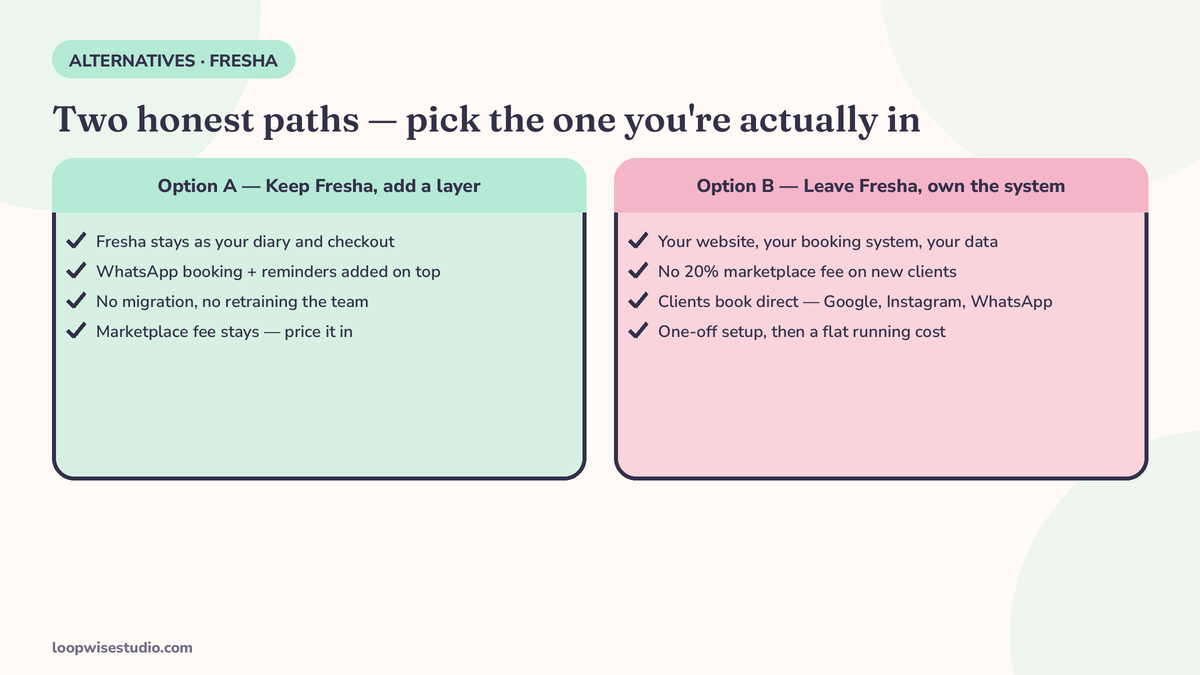
Almost every “Fresha alternative” page on the internet answers one question: which software should you switch to? But a clinic searching because it wants WhatsApp booking is usually asking a different question, and it helps to pull the two decisions apart.
| Decision | The question | Your options |
|---|---|---|
| 1. The diary and marketplace | Where do appointments live, and who owns the client relationship? | Stay on Fresha, or move to a booking page on your own website, under your own domain |
| 2. The WhatsApp layer | How do patients book, confirm, reschedule and get reminded on WhatsApp? | This layer can be added on top of Fresha, or built as part of an owned system |
Decide them separately and three sensible answers appear, not one:
- Your problem is only the WhatsApp layer → keep Fresha, add the layer (Option A below). Cheapest, fastest, no migration.
- Your problem is commission, ownership and booking friction → move the booking home to your own website with WhatsApp built in (Option B below).
- Your problem is neither — you are just early and the marketplace sends you clients → stay exactly as you are. There is a whole section below on when not to leave, and it is meant seriously.
What no clinic should do is migrate diaries because a comparison article told it to, and then discover the new software has the same gap on WhatsApp that caused the search. That happens constantly, and it is expensive in time even when the software itself is cheap.
Option A: Keep Fresha and add WhatsApp booking and reminders on top
This is the right call for more clinics than the software industry will ever tell you. You keep the diary your team knows, your marketplace presence and your existing bookings. What gets built around it is the layer patients actually touch:
- Click-to-WhatsApp everywhere it matters. Your website’s booking buttons, your Google Business Profile and your Instagram profile route patients into a WhatsApp conversation instead of dropping them at a marketplace page. The conversation opens with context — which treatment they were looking at — rather than a blank “hi”.
- A real booking conversation. The patient is offered times, picks one, and the appointment is created in your Fresha diary by your team from the shared inbox, or through the connection route available for your setup — agreed and tested with you before it goes live, not assumed.
- The reminder sequence Fresha-shaped systems rarely give you on WhatsApp. Confirmation at booking, a reminder 24 hours ahead with Confirm and Reschedule buttons, a short message on the morning, a same-day rebooking offer after a no-show, and a Google review request after the visit — on your number, in your clinic’s name, pointing at your Google profile, not the marketplace. The clinical end of that system — fewer empty chairs — is the subject of our guide to reducing no-shows at a med spa and other appointment-based clinics.
- Replies owned by your team. Patient replies land in one shared inbox with a named owner. Nothing sits unanswered on one person’s phone overnight.
When is Option A wrong? When the commission and ownership problem is the real problem. If a meaningful share of your revenue is paying a marketplace percentage for clients who found you themselves, a WhatsApp layer makes your service better while leaving the economics untouched. That is when Option B earns its disruption.
If you are unsure which camp you are in, that is precisely what a proper audit works out — including, where it is true, the answer “stay”. To run it for your clinic, get a free audit and we will cost your current setup with you and map both options before you decide anything.
Option B: Leave Fresha and own your booking system
Option B means your bookings live on your own website: a booking page under your own domain, showing your real availability, feeding a diary you control, with WhatsApp as the conversation layer patients use to book, confirm, reschedule and return. No marketplace takes a cut of the appointment, because there is no marketplace in the middle.
What this looks like when it is built properly is described in full on our system page for a WhatsApp booking system for aesthetic clinics in Dubai — the market is different, the machinery is the same: website and Google profile feed enquiries into one WhatsApp flow, reminders run automatically, missed calls trigger an instant WhatsApp message, and your client list, reviews and repeat bookings accumulate on assets with your name on them.
Who Option B suits:
- Established clinics with their own demand. Your patients come from Google searches for your treatments, your Instagram, referrals and repeats — not from browsing a marketplace. For you, the marketplace stopped being a discovery channel and became a tax on your own reputation.
- Clinics with high repeat rates. Aesthetic and dental patients come back — top-ups, courses of treatment, hygiene visits, reviews and check-ups. Repeat booking is where an owned system pays: rebooking messages to your own list, at the interval each treatment needs, with no percentage taken on the way.
- Clinics tired of unpredictable per-booking costs. A flat, known running cost is easier to plan around than a small subscription plus a percentage of some bookings plus add-ons — even before you compare the totals.
Who it does not suit is covered honestly below: if the marketplace is genuinely your main source of new patients, leaving it is a growth decision, not a software decision, and it should not be dressed up as one.
Fresha vs an owned website + WhatsApp system, side by side
| Fresha | Owned website + WhatsApp system | |
|---|---|---|
| Where the patient books | Inside Fresha’s marketplace and app | On your website and in WhatsApp, on your number |
| Commission on bookings | Marketplace fee on new clients it attributes to the platform — listed in Chatfuel’s 2026 comparison as 20%; verify current terms with Fresha | None. Nobody takes a percentage of your appointments |
| Who owns the client relationship | Shared with the marketplace — reviews, ranking and booking habits live on Fresha | You. Your list, your number, your Google reviews |
| Discovery | Strong — the marketplace actively sends browsing patients, especially to newer businesses | Yours to earn — Google, Instagram and referrals, which established clinics already have |
| Reminders | Through Fresha’s own tools and channels | WhatsApp sequence in your clinic’s name: confirmation, 24h with Confirm/Reschedule, morning-of, rebook, review request |
| Setup effort | Low — self-service, you configure it | Done for you — flow, templates, diary connection and staff handover are built and tested with your team |
| Cost shape | Low headline subscription, then per-booking and add-on charges that vary with your volume | Fixed setup, then a flat running cost agreed in advance |
| Best for | Starting out, marketplace-led growth, teams happy inside one app | Established clinics whose demand is their own, and who want WhatsApp as the front door |
The same ownership question comes up with other platforms, by the way — salons weighing up their options will find the same framework in our guide to a Vagaro alternative for salons without commission fees.
What 12 months on Fresha really costs a clinic
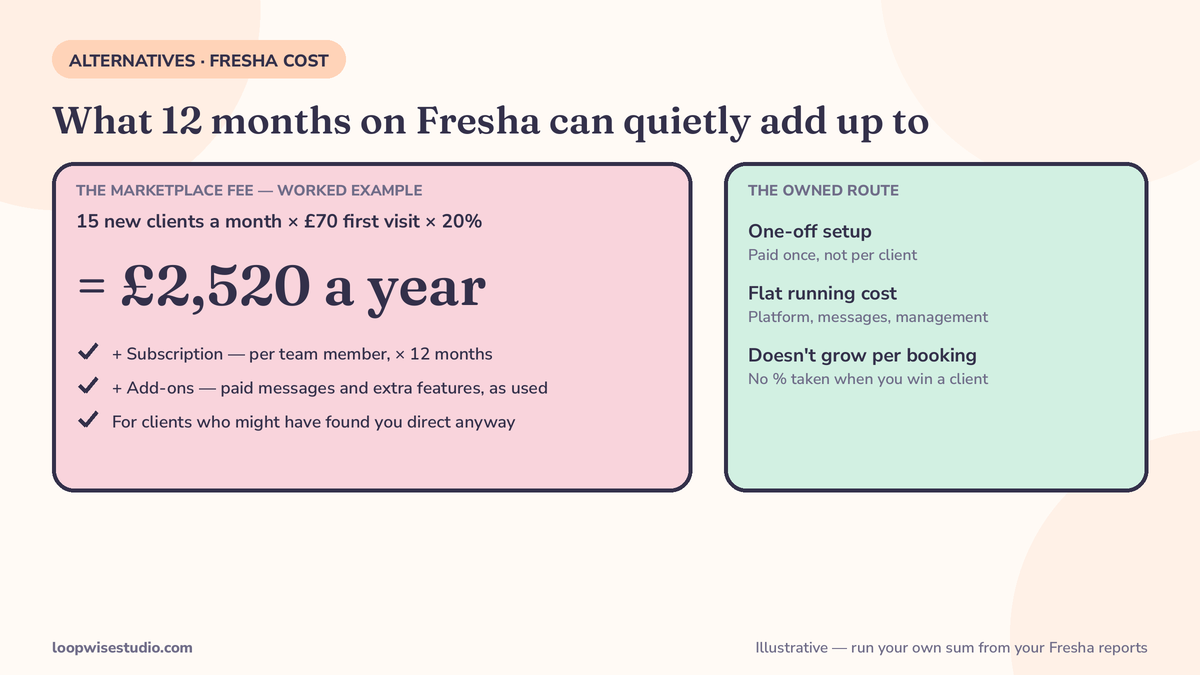
Nobody can total your Fresha bill from an article, and you should not trust anyone who tries to do it to the penny. What you can do is run your own sum in five minutes, and the framework below is the one to use. The worked figures are illustrative only — they use the fee shape described earlier (a marketplace fee listed as 20% on attributed new-client bookings) so you can see how the arithmetic behaves. Replace every number with your own from your Fresha reports and current pricing.
Take a modest, busy clinic — again, illustrative:
- Marketplace new clients: say the platform attributes 15 new clients a month to itself, at an average first-visit value of £70. Those first visits total £1,050 a month, or £12,600 a year. A 20% marketplace fee on that is £2,520 a year — for clients who, in a clinic with a strong Google profile, might have found you directly.
- Subscription: even at entry-level pricing per team member, multiply it by your actual team and by twelve. This is the number everyone quotes; it is usually the smallest of the three.
- Add-ons: paid marketing messages and additional features, as used. Pull last quarter’s actual figure rather than estimating.
Now compare honestly with the owned route: a one-off setup, then a flat running cost for the platform, messages and management. The flat number can look bigger in month one and smaller by month twelve, because it does not grow every time the marketplace attributes a client to itself. Which side wins depends entirely on how many of those attributed clients were truly the marketplace’s — and that is a judgement call about your clinic, not a fact anyone can hand you.
Do this sum before you talk to any supplier, us included. Clinics that have done it negotiate better and choose better, whichever option they take.
The clinic checklist: what to check before you switch (or add a layer)
Salons can swap booking apps over a weekend. Clinics carry more: consultations, deposits, clinical information and patients mid-course in a treatment plan. Whichever option you choose, work through this list first — it is also the list to judge any supplier by, because if they cannot answer these, they have not migrated a clinic before.
- Deposits for long slots. Which treatments take a deposit, how much, and what happens to deposits already held against future appointments in the old system?
- Consultation and intake flow. How do new patients get routed to a consultation first, and where do your intake and consent forms live during and after the change? Clinical records stay in your clinical systems — a booking change is never a reason to move health information into a chat app.
- Packages and courses. Patients part-way through a paid course of laser, or a treatment plan, must arrive in the new setup with their remaining sessions correct. Get the balances exported and checked, patient by patient if needed, before go-live.
- Clinical questions in chat. Once patients can message you easily, some will ask clinical questions. Decide in advance who picks those up, and how fast. The automated layer must never answer them.
- Opt-in for messaging your existing list. This is the trap almost nobody warns switchers about: having a client’s number in Fresha for appointment purposes does not give you a free pass to start sending them WhatsApp marketing. Appointment messages rest on the booking relationship; broadcasts and reactivation campaigns need proper consent, recorded. Any supplier who suggests importing your list and messaging everyone on day one is creating a problem with your name on it.
- Your number and your reviews. Keep your existing phone number — it is on your Google profile and your patients’ phones. And be clear-eyed that Fresha reviews live on Fresha: your Google reviews are the asset that travels with you, which is why the post-visit review request in any new system should point at Google.
- Future appointments. Every booking already in the diary beyond go-live day must land in the new system, verified, before the old one is switched off.
How a switch actually works, step by step
Whether you add the WhatsApp layer (Option A) or move fully (Option B), the safe sequence is the same in outline. Rushing step 4 is where migrations go wrong.
- Audit and decision. We review your current Fresha setup, run the 12-month cost sum with you, and agree which option fits — including “stay on Fresha as you are” if that is the honest answer.
- Export and check your data. Clients, future appointments, package balances and gift vouchers are exported from Fresha and checked against the checklist above. Gaps get fixed while the old system is still live.
- Build. Your booking page or WhatsApp layer is built, templates are written in your clinic’s voice and sent for approval, deposits and cancellation terms are set exactly as you specified.
- Run both in parallel. For an agreed period, the new system runs alongside Fresha. Staff book in the new way, the old diary is the safety net, and discrepancies are caught while they cost nothing.
- Tell your patients, with templates. Patients hear about the change from you, warmly and simply — a short message explaining the new way to book, sent through proper, consented channels. We draft these with you; you approve every word.
- Go live and switch off cleanly. Fresha is closed down (or kept as diary-only, under Option A) only after the parallel run is clean, and your team has a named contact for the first weeks while new habits settle.
Most single-clinic switches complete in weeks, not months. The slow parts are the human ones — agreeing deposit rules, checking package balances, approving message wording — which is another reason to start with the audit rather than a deadline.
When you should NOT leave Fresha
This section is in this article because it is true, not as a sales device.
- You are solo or very new, and the marketplace sends you real clients. Discovery is the hardest problem a new clinic has, and Fresha solves it. A percentage of bookings you would not otherwise have had is a good deal. Revisit this page when your repeats and referrals carry the diary.
- Your patients love the app and book happily through it. If your no-shows are low, your costs feel proportionate and your patients are not asking for WhatsApp, the system you have is working. Do not fix it.
- You have no other demand channel yet. An owned booking page does not create demand; it converts demand you already have from Google, Instagram and reputation. If those are not flowing yet, build them first — the marketplace is your bridge in the meantime.
- You simply need reminders on WhatsApp. Then you need Option A, a layer, not a migration. Anyone who sells you a full switch for a reminder problem is selling you their product, not your solution.
Frequently asked questions
Can I keep my phone number if I leave Fresha?
Yes — your number belongs to your clinic, not to Fresha, and it is the number on your Google profile and in your patients’ phones. Any new setup should be built around that existing number, so from a patient’s point of view nothing changes except that booking gets easier.
What happens to my Fresha reviews?
They stay on Fresha. Reviews written inside a marketplace belong to that marketplace’s profile, and they are one of the real costs of leaving — be clear-eyed about it. Your Google reviews, however, are yours permanently, which is why an owned system builds its post-visit review requests around Google from day one. In time, a strong Google profile outweighs a marketplace one, because patients searching for your treatments find Google first.
Will my clients still be able to book online?
Yes — that is the point of the move. Under Option A they can book exactly as before, with WhatsApp added. Under Option B they book on your own website’s booking page or in WhatsApp, at any hour, without an account or an app. What they lose is only the step where a marketplace shows them other clinics on the way to booking yours.
How long does a migration take?
For a single clinic, weeks. Data export and checking, building and template approval, then a parallel run — the timeline stretches mainly when package balances and future appointments need careful untangling. Your audit will give you a realistic timeline for your clinic rather than a generic promise.
Do I lose my client list if I leave?
No — your client records can be exported from Fresha, and step 2 of the process above exists precisely to verify that export before anything is switched off. What you must handle properly is consent: having those contacts for appointments is one thing, messaging them for marketing is another, and your new system should record who has agreed to what.
We are a small clinic. Is an owned system overkill for us?
For a solo practitioner still building a client base, quite possibly — see the “when not to leave” section above. For a small clinic with a full diary, repeat patients and marketplace fees adding up every month, an owned system is not overkill; it is usually the moment the numbers start favouring ownership. The audit exists to tell you which side of that line you are on.
Find out which option your clinic is actually in
You came here looking for an alternative. You might need one — or you might need a WhatsApp layer on the system you already have, or nothing at all yet. The worst outcome is a migration you did not need, and the second worst is another year of commission on clients you found yourself.
To start, get a free audit and we will do the sums with you: what your current Fresha setup really costs over twelve months, what each option would look like for your clinic, and a straight recommendation — including “stay” if that is what the numbers say.