WhatsApp Automation for Dental Clinics in Ireland
WhatsApp automation for Irish dental clinics: instant enquiry follow-up, booking, reminders and recall on your existing software, with GDPR and costs explained.
WhatsApp automation for an Irish dental clinic means every enquiry, booking, reminder and recall runs on rules instead of memory. A patient who asks about treatment and doesn’t book gets followed up automatically. A booked patient gets reminded without the front desk chasing. The automation sits on top of the clinic’s existing software — it doesn’t replace it.
That last point matters, because most of what is sold to Irish dental clinics under this label is narrower than it sounds. Some tools do follow-up only. Some are DIY chatbot platforms you have to build yourself. This page separates the four jobs properly, shows where Irish enquiries actually leak, and explains what to ask before you sign anything.
The four jobs — and why vendors blur them together
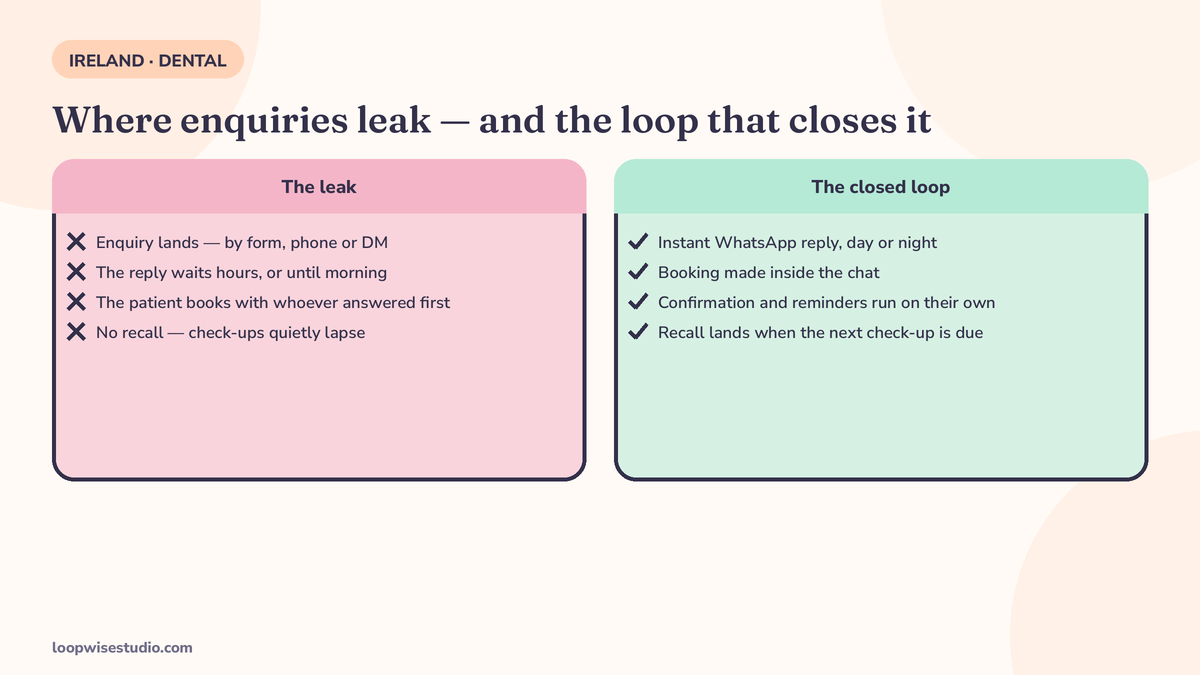
“WhatsApp automation” gets used for four different things:
| Job | What it does | What happens without it |
|---|---|---|
| Enquiry follow-up | Replies instantly to new enquiries and chases the ones that go quiet | The enquiry waits for a gap in the front desk’s day, then goes cold |
| Booking | Offers real slots and confirms the appointment inside the chat | Phone tag, or a form that someone has to process by hand |
| Reminders | Sends confirmations and reminders before the appointment | Reception works through a call list every afternoon |
| Recall | Brings due patients back — hygiene visits, reviews, unfinished treatment plans | Due patients drift until they book somewhere else |
A system that only does one job can still be worth having. The problem is buying one job while believing you bought all four. Patientcurve, an Irish vendor, is honest about this: its system covers enquiry capture, follow-up and recovery, and it says plainly that it is not a booking engine and not a website. That honesty is rare. Most other pages ranking for this topic are global chatbot or SMS-API blogs with nothing Irish in them at all — no Irish software names, no Irish pricing, no Irish consent rules.
Loopwise builds the full loop as one system on your own website and your own WhatsApp number — the same approach we use for WhatsApp booking for clinics in Ireland, applied to the dental diary. It’s the Irish dental version of the system we first built for Dubai’s aesthetic clinics, where the same four jobs run the diary.
Where Irish dental enquiries leak today
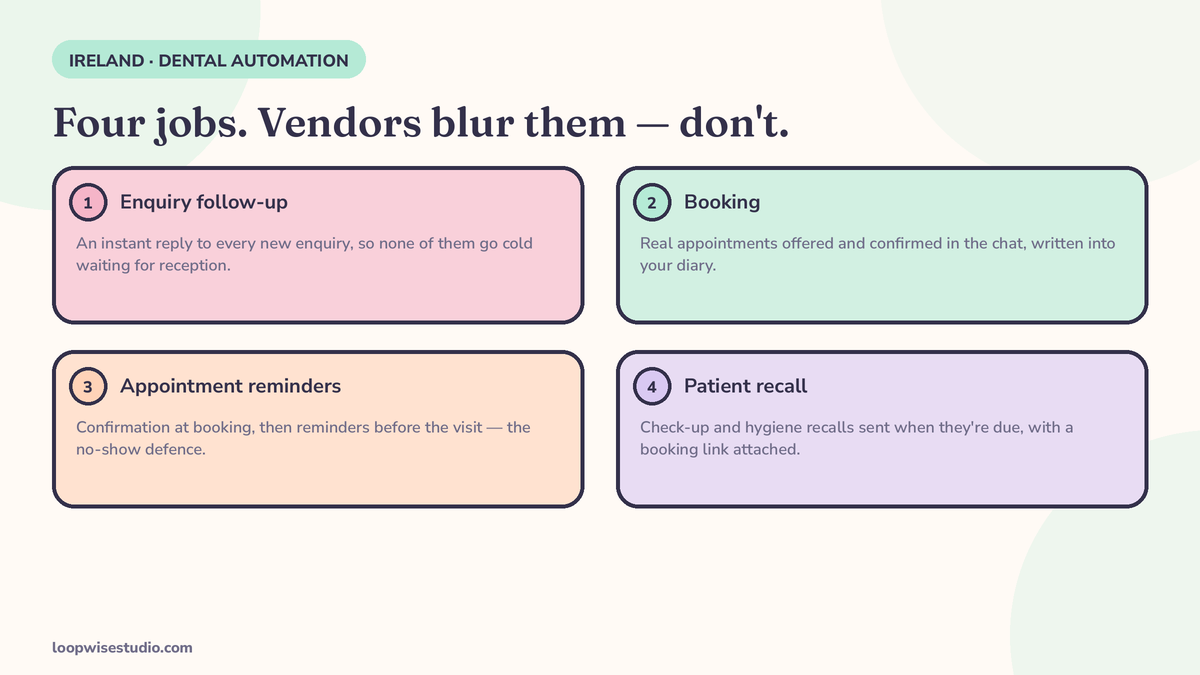
The leak is rarely a lack of enquiries. It follows a pattern:
- An enquiry arrives — a WhatsApp message about implants, Invisalign or a hygiene appointment, often in the evening.
- The conversation pauses. The front desk is with a patient, or the clinic is closed. The reply goes out hours later, or the next day.
- Follow-up depends on memory. If the patient doesn’t book, nobody owns the chase. There’s no list of “enquiries that never converted” anywhere.
- The patient books elsewhere — usually with whichever clinic answered first and followed up once more.
The same pattern runs in reverse for existing patients. A hygiene recall is due, a treatment plan was discussed and never started, a check-up interval passes — and nothing goes out, because recalls live in the practice software while the chasing was supposed to live in someone’s head.
None of this needs invented statistics to make the point. Count it in your own clinic: pull last month’s WhatsApp enquiries and check how many got a second message after they didn’t book. That number — usually close to zero — is the size of the leak.
The system — from first message to recall
Here is the closed loop, step by step:
Step 1 — the enquiry gets an instant first reply. Not a generic “thanks, we’ll be in touch”, but a reply that moves the conversation: what treatment, which location if you have more than one, and the next available consultation slots.
Step 2 — booking happens in the chat or one tap from it. The patient picks a real slot from your diary and gets an instant confirmation on WhatsApp. No app to download, no portal login.
Step 3 — the reminder sequence runs itself. A confirmation at booking, a reminder ahead of the appointment with a one-tap way to reschedule, and a short-notice message on the day for longer appointments. A patient who needs to move the appointment moves it in the chat instead of becoming a no-show.
Step 4 — the no-reply path is automatic. If a booked patient doesn’t confirm, the system nudges once more, then flags the slot to your team while there’s still time to fill it.
Step 5 — recall runs on intervals you set. Hygiene recalls, review appointments and unfinished treatment plans each get their own message at the interval your clinicians choose. This is the same rebooking logic we build for aesthetic clinics in the WhatsApp rebooking system — the diary drives the messages, not a marketing calendar.
In one view, the touchpoints for a typical patient look like this:
| Moment | Message | Sent by |
|---|---|---|
| Enquiry received | Instant reply with real consultation slots | System |
| No booking within a day | One follow-up with two held slots | System |
| Appointment booked | Confirmation in the chat | System |
| Before the appointment | Reminder with one-tap reschedule | System |
| Patient goes quiet mid-conversation | Thread flagged to your team | System → human |
| Recall falls due | Recall message with a booking link | System |
Nothing in that table needs a person watching a phone. The person’s time goes where it belongs — on the flagged conversations and the patients in the chair.
If your front desk is spending its afternoons on reminder calls and unanswered enquiries, get a free audit and we’ll map exactly where your clinic’s enquiries stop converting.
The copy-paste asset — three messages Irish clinics can lift today
You can run these manually this week, before any system exists:
Enquiry follow-up (sent the next morning if they didn’t book):
Hi [Name], it’s [Clinic] following up on your message about [treatment]. We still have consultation slots this week — [Day] at [Time] or [Day] at [Time]. Reply with the one that suits and we’ll hold it for you.
Hygiene recall (at the interval your hygienist sets):
Hi [Name], you’re due for your hygiene visit at [Clinic]. Book here: [link] — or reply and we’ll find a time together.
Unfinished treatment plan (two weeks after the consult):
Hi [Name], it’s [Clinic]. When you were in, Dr [Name] outlined [treatment] — you don’t need to decide today, but the next step is a short appointment to talk through timing and cost. Shall I book you in for that chat?
Notice what none of these do: no discounts, no pressure, no clinical detail. They move a conversation that already started.
What automation cannot do — where a human steps in
Be suspicious of any vendor who skips this section.
- Clinical questions stay with clinicians. The system can book the appointment where the question gets answered; it should never answer the question itself.
- Urgent problems need a person fast. Pain, swelling, a broken tooth before a wedding — the automation’s job is to recognise urgency words and hand over to your team immediately, not to run a script.
- Template and window rules apply. WhatsApp’s Business Platform works on approved message templates and a 24-hour reply window after the patient’s last message. Outside that window, you can only send approved templates — which is why reminders and recalls are templates, and open-ended chat happens inside the window. GetItSMS’s widely-read API guide lists ignoring opt-ins and the 24-hour window among the most common mistakes clinics make; both are avoidable with proper setup.
- Your practice software stays the record. Appointments, notes and patient data belong in your existing system. WhatsApp is the conversation layer, not the filing cabinet.
GDPR and consent in Ireland — the plain-English version
Three rules cover almost everything:
- Service messages are straightforward. Confirmations and reminders about an appointment the patient booked are part of the service they asked for. Keep them factual — date, time, place, how to reschedule.
- Marketing needs consent. A recall that is genuinely about the patient’s own care sits differently from a promotion for a new treatment. For anything promotional, you need the patient’s permission, captured and recorded — a tick-box at booking or a clear opt-in on your website form — and every message needs a working opt-out (“Reply STOP to end these messages”).
- Consent records are kept, not remembered. Who opted in, when, and to what. If a patient opts out, the system stops — automatically, not when someone remembers to update a spreadsheet.
This is general practice, not legal advice — your data protection obligations under GDPR are yours, and a system should make them easier to meet, not something you have to police by hand.
What consent capture looks like in the flow: when a patient books, one extra line under the booking button — “Send my confirmations and reminders on WhatsApp, and occasional messages about appointments I’m due” — with the box ticked or unticked by the patient, and the answer stored against their record with the date. Thirty seconds of design, and every message the system ever sends that patient is provably permitted. Clinics that skip this step and add consent later end up doing it the hard way: messaging their whole list to ask permission, which is itself a marketing message.
What it costs — and what to ask before you sign
No vendor in the Irish dental WhatsApp space publishes a price for the full system — because, as covered above, nobody else sells the full system. Patientcurve publishes no price at all (a quote follows a demo). So instead of a borrowed price list, here are the cost drivers and the questions that expose them:
- Scope: does the price cover follow-up only, or booking, reminders and recall too?
- Your number or theirs: does the system run on your clinic’s own WhatsApp number, so the patient relationship stays yours if you leave?
- Per-message costs: WhatsApp template messages carry a small per-message charge from Meta. Who pays it, and is it itemised?
- Setup: is diary connection, template approval and staff training included, or billed as extras?
- Exit: can you export your patient contact list and conversation history if you cancel?
A system scoped to one clinic’s diary, built on your number and your website, is a fixed project — which is why we quote it as one. If you’d like the numbers for your clinic specifically, get a free audit and we’ll price the exact build, no obligation.
FAQs
Does WhatsApp automation replace our practice management software?
No. Your practice software keeps the diary, records and billing. The automation connects to it (or to a live booking page) and handles the patient conversation — enquiries, bookings, reminders, recalls — on WhatsApp.
Will patients find automated messages impersonal?
Patients judge replies by speed and usefulness, not by whether a human typed them. A confirmation that arrives in seconds and a reminder that lets them reschedule in one tap feel like good service. The messages are written in your clinic’s voice, and your team can step into any conversation at any point.
What happens if a patient replies with a clinical question?
The system books them the appointment where the question gets answered, or hands the conversation to your team — it never gives clinical advice. Urgency words (pain, swelling, bleeding) trigger an immediate handover.
Do we need patients to install anything?
No. It runs on the WhatsApp they already have, from your clinic’s number. No app, no portal, no password.
How long does setup take?
The build itself is measured in weeks, not months: diary connection, message templates approved by WhatsApp, consent capture added to your booking flow, then testing with your team before it goes live. Your front desk’s time commitment is a few review sessions, not a project to manage.
Is this the same as the WhatsApp Business app?
No. The free Business app is one phone, manual replies, no connection to your diary. The Business Platform (API) is what allows approved templates, automated sequences, a shared team inbox and diary-connected booking. Automation needs the platform; the app alone can’t run it.
For the aesthetic side of the same system, see WhatsApp booking for aesthetic clinics in Ireland.