Website Design for Aesthetic Clinics in Singapore With Online Booking
What a Singapore aesthetic clinic website must do to turn visitors into booked consultations: online booking, WhatsApp enquiry flow, published prices, PayNow deposits.
Short answer: an aesthetic clinic website in Singapore earns its keep when a visitor can see the treatment, see the price, pick a doctor and a live slot, pay a deposit by PayNow, and get confirmed on WhatsApp — without phoning the front desk. Most clinic sites ranking for this today are brochure pages with a contact form; the booking half of the job is the gap.
Search for clinic website design in Singapore and you will find two kinds of pages: global template builders with “Singapore” pasted into the title, and marketing agencies selling traffic. Neither is selling the thing you actually searched for — a clinic website where the booking is built in.
This page is the specification for that website: the pages it needs, the booking flow step by step, the payment and reminder layer, and the questions that separate a clinic website from a clinic brochure. It follows the same conversion model as our guide to turning website visitors into booked appointments, set for Singapore’s rules and payment habits.
Why “DM for price” is costing you consultations
Singapore aesthetic patients research quietly. They compare three clinics on their phone at midnight, and they strongly prefer the clinic that answers their two questions on the page: what does it cost, and when can I come in?
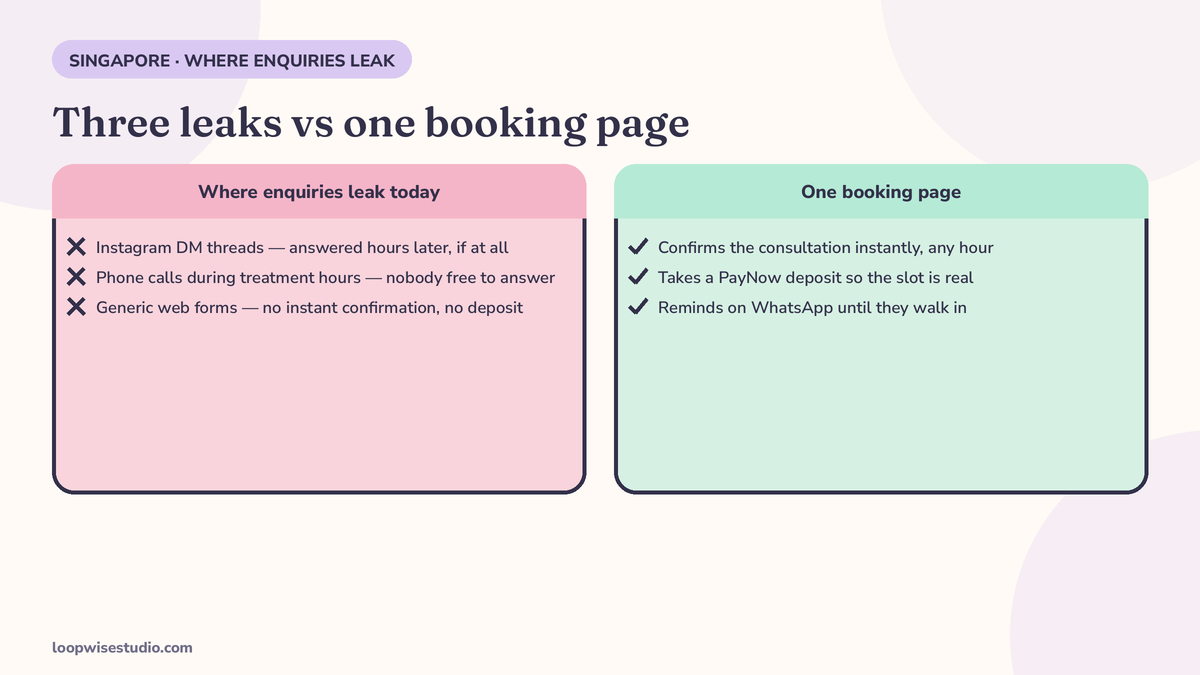
“DM for price” fails both. It pushes the patient into a chat thread, where the reply waits until front desk is free, the price arrives without context, and the booking — if it happens at all — happens days later or at the clinic that published its prices. One Singapore-focused page in our research names this directly: “DM for price” creates friction for buyers in Singapore. It is the only market point every local source agrees on.
The fix is not complicated, but it is specific:
- Published price ranges on every treatment page. “From S$X” with what moves the price. Patients don’t need a quote to the dollar; they need to know which bracket they’re in before they book.
- A book button that books. Not a form that promises a callback — a live calendar with real slots.
- WhatsApp as the confirmation channel, because that is where the patient will actually read it.
The pages the website needs — and the job of each
A clinic website is a small set of pages, each with one job. If a page has no job, it is decoration.
| Page | Its one job | What it must contain |
|---|---|---|
| Home | Route the visitor to a treatment or a booking in under 10 seconds | Top treatments, price anchors, doctor faces, book button above the fold |
| Treatment pages (one per treatment) | Turn a searcher into a booked consultation | What it treats, who it’s for, price from, session count, downtime, doctor, live booking |
| Doctor pages | Build the trust a consultation needs | Credentials, registrations, treatments performed, real photo, their bookable slots |
| Price page | Catch the “how much does it cost” searches | Full price list or honest ranges, package terms, what’s not included |
| Booking page | Convert intent into an appointment | Live slots per doctor, deposit payment, instant confirmation |
| FAQ / aftercare | Absorb the questions front desk repeats daily | Prep, aftercare, reschedule rules, location and MRT/parking detail |
Two Singapore specifics belong in that table. Payment options on the booking page should be the ones patients here expect — the Singapore pages in our research list PayNow, NETS, GrabPay and HitPay as the local gateway set. And your location content should answer the real question — which MRT, which exit, where to park — because “how do I get there” friction kills bookings quietly.
The booking flow, step by step
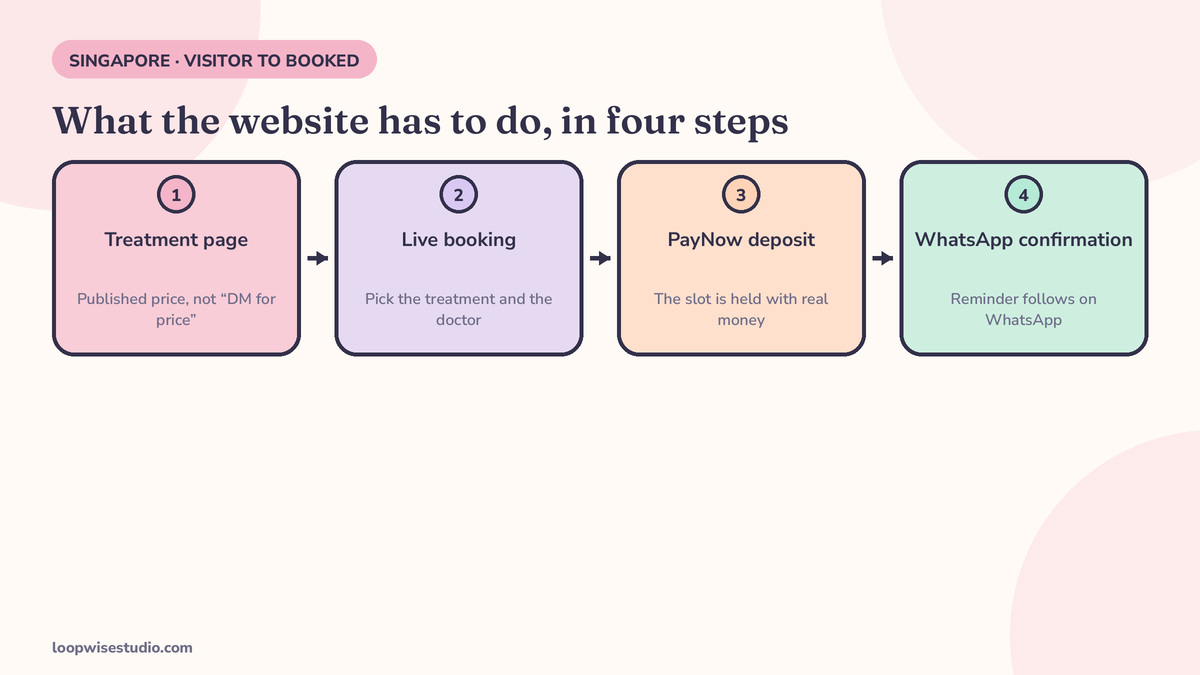
This is the part no ranking page for this query describes. Here is the flow your website should run:
- Visitor lands on a treatment page from Google or Instagram, with the price range and a book button visible without scrolling.
- She picks a doctor (or “first available”) and sees live slots — pulled from the clinic’s actual calendar, not a request form pretending to be one.
- She picks a slot and pays a consultation deposit by PayNow or card. The deposit is what turns a maybe into an appointment; it is also your no-show protection.
- Confirmation lands on WhatsApp instantly: treatment, doctor, date, time, address, prep instructions, and a CHANGE option she can tap if life moves.
- Reminders follow the published pattern used by WhatsApp booking tools in this market: one 24 hours before, one 2 hours before, each answerable in the chat.
- After the consultation, the follow-up message carries the treatment plan’s next step and its booking link — because the second appointment is where clinic revenue actually lives.
Every step a human has to touch is a step where bookings die after hours. Clinics lose a large share of enquiries simply because the enquiry arrived at 9pm and the answer arrived at 10am. The flow above has no 10am in it.
If your clinic also takes enquiries that start as chats rather than page visits, our page on WhatsApp booking systems for clinics in Singapore covers the chat-first route and the PDPA setup behind it — the two routes should land in the same diary.
What your website copy cannot do — the advertising line
Aesthetic medicine is regulated advertising territory in Singapore, and your website is advertising. Healthcare services here operate under Ministry of Health rules and the healthcare advertising regulations that sit under them; testimonials, outcome claims, and promotional framing for treatments are restricted territory, and the rules change.
We are a website studio, not your compliance counsel, so this page will not pretend to quote the regulations at you. What we will say is operational:
- Build the site so claims can be reviewed before launch — treatment descriptions, before-and-after imagery, and promotional offers should pass your own compliance check, not your web designer’s enthusiasm.
- Keep the booking system separate from the claims. A live calendar and a WhatsApp reminder never breached an advertising rule; a “guaranteed results” headline can.
- When a template builder offers to write your treatment copy in two minutes, that is a risk, not a feature. The global pages ranking for this query import US habits — HIPAA language on a Singapore page is the tell — and US habits are not your rules.
Have your final copy checked against the current MOH healthcare advertising rules before it goes live. That check is cheap. The alternative is not.
Brochure site, template builder, or clinic website with booking — the honest comparison
| Route | What you get | What you don’t |
|---|---|---|
| Generic template builder (the “website in 2 minutes” pages) | A fast, cheap site with your logo on it | Live booking tied to your diary, deposits, WhatsApp reminders, Singapore payment setup done properly, copy written for regulated treatments |
| Marketing agency site | A polished brochure, often with an SEO or ads retainer attached | Usually the booking flow — agencies sell traffic, and the enquiry still lands in a form or a phone queue |
| Clinic website built around booking (Loopwise) | Treatment pages with prices, live booking per doctor, PayNow deposits, WhatsApp confirmation and reminders, follow-up messages | Traffic itself — the site converts visitors; getting visitors is still your marketing’s job |
The middle row is the expensive mistake. A beautiful site that doubles your enquiries while your front desk still answers them one by one has just doubled your bottleneck. Convert first, then buy traffic. Our Dubai work follows the same order — website design for med spas in Dubai with online booking runs the identical booking-first spec in a different regulatory market.
The questions to ask any vendor — copy this checklist
Before you sign with anyone (including us), get straight answers to these:
- Does the booking page show live slots from my actual calendar, or is it a request form?
- Can a patient pay a deposit by PayNow during booking, on the website itself?
- Do confirmations and reminders go out on WhatsApp automatically — and can the patient reschedule from the message?
- Is the website on my domain, and do I keep the site, the content, and the patient list if we part ways?
- Who writes the treatment copy, and who checks it against Singapore’s healthcare advertising rules?
- What does the site cost in year two — hosting, maintenance, message fees — in writing?
- What happens to bookings that arrive at midnight?
A vendor who answers all seven clearly is selling a system. A vendor who answers with adjectives is selling a brochure.
One more comparison worth making before you decide: many clinics weigh a website against simply pushing harder on social. Our breakdown of online booking versus DM bookings for aesthetic clinics puts the two side by side, cost and conversion included.
Wondering which of the seven questions your current site fails? Get a free audit — we’ll run your site against this exact checklist and show you the gaps in writing.
What we build, and what it deliberately excludes
Loopwise builds the third row of that table: your website on your domain, treatment pages written to be checked for compliance, live booking per doctor, PayNow or card deposits, WhatsApp confirmation and reminders, and the post-consultation follow-up message. The same system our salon clients run is specified for Singapore salons on our booking system for salons in Singapore page — clinics get the stricter version of the same machine.
What it excludes: ad management, social content, and promises about patient volume. A booking website’s job is to stop the leaks between “interested” and “in the chair.” That job is measurable — enquiries, bookings, show rate — and we report it in those terms.
The short version
Publish prices. Let patients book real slots and pay a deposit without touching your front desk. Confirm and remind on WhatsApp. Keep the copy inside Singapore’s advertising rules. Own the site.
Get a free audit and we’ll tell you, page by page, what your current website is costing you in unbooked consultations.
FAQs
How much does an aesthetic clinic website with online booking cost in Singapore?
The pages ranking for this query mostly refuse to say — the largest template page in our research has a cost section with no figures in it. Honest answer: the price depends on the number of treatment and doctor pages, whether booking connects to your existing practice system, and who writes and checks the copy. Any vendor should give you a fixed written quote after looking at your clinic — Loopwise quotes after a free audit, and the quote separates the build from year-two running costs.
Can patients book with a specific doctor, not just the clinic?
Yes — and they should be able to. Aesthetic patients choose doctors, not clinics, once they have a preference. The booking page should offer doctor selection with each doctor’s own live slots, plus a “first available” option for patients who care about speed over preference.
Do I still need WhatsApp if the website takes bookings?
Yes — for the confirmation, the reminders, and the conversation around the appointment. The website takes the booking; WhatsApp carries everything after it. Patients in Singapore read WhatsApp; they do not reliably read email confirmations. The tools in this market publish a reminder pattern of 24 hours and 2 hours before the appointment, and your system should follow it.
Can I take deposits for consultations in Singapore?
Yes — deposits collected at booking are standard practice for protecting doctor time, and the local payment gateways named across Singapore service pages (PayNow, NETS, GrabPay, HitPay) support collecting them on your website. Publish your deposit and reschedule terms on the booking page itself, so the patient agrees to them before paying, not after.
Will a new website break our current advertising compliance?
It shouldn’t — if the copy is written and checked for Singapore’s healthcare advertising rules before launch. The risk comes from imported templates and AI-written treatment copy that follow US conventions. Keep control of claims, testimonials, and imagery, and have the final copy reviewed against the current MOH rules.
We get most enquiries from Instagram. Do we still need this?
Instagram is a fine front door and a poor booking desk. The website is where the Instagram visitor lands to check the price and book — if that page can’t take a booking, the DM thread becomes your booking system, with all its delays. Keep Instagram for discovery; let the website do the converting.