Online Booking vs DM Bookings for Aesthetic Clinics
Online booking vs DM bookings for aesthetic clinics: reply speed, deposits, reminders, intake, after-hours and your time per booking, compared fairly.
Short answer: DMs are a conversation, not a booking system — and the clinics that win on Instagram use both, for different jobs. DMs and WhatsApp are where clients ask questions, build trust and feel looked after. A booking page is where the diary work happens: the slot, the deposit, the intake questions, the confirmation, the reminder. Below is the head-to-head nobody publishes for aesthetic clinics — dimension by dimension, with DMs credited for what they genuinely do better — plus a transparent way to work out what DM booking is costing you in time, because no solid published number for that exists.
The head-to-head: DM bookings vs online booking
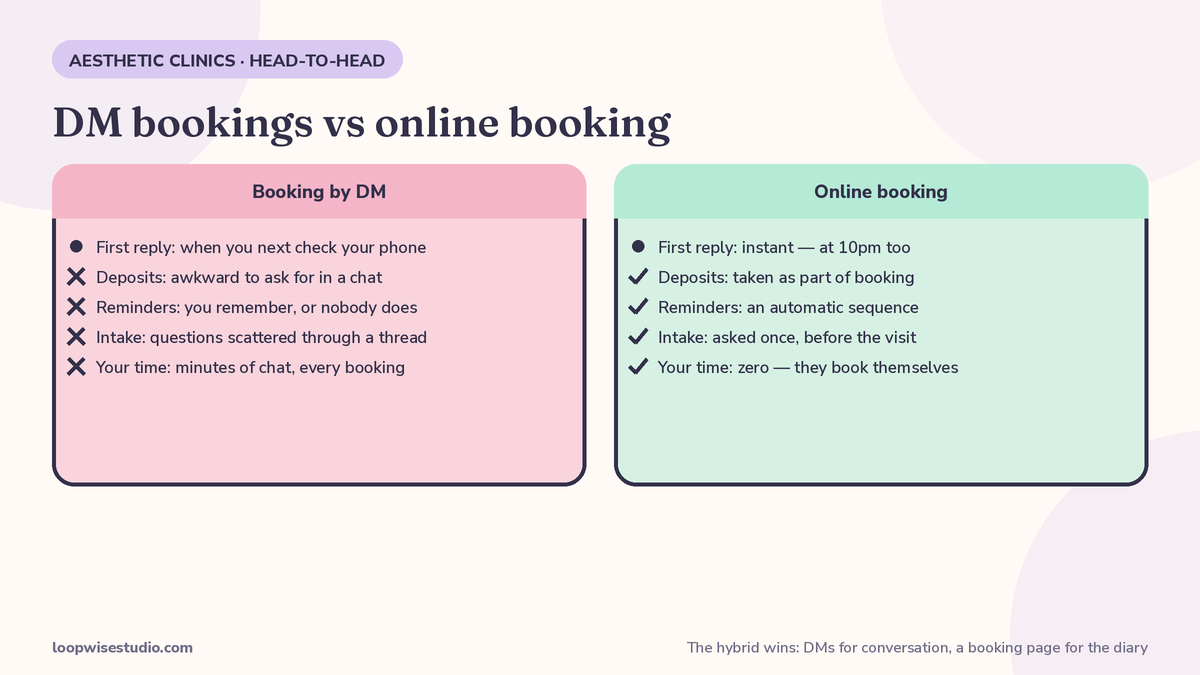
| Dimension | DM bookings | Online booking |
|---|---|---|
| First reply | When you see the message — minutes if you’re free, hours if you’re mid-treatment or asleep | Instant: the page itself is the reply, with live availability |
| Books at 10pm? | Only if you’re awake and answering | Yes — evenings and weekends are when a large share of clients decide |
| Deposits | Awkward to request in chat; usually skipped, so nothing protects the slot | Taken as part of booking, per your rules, without a conversation about it |
| No-show protection | Your memory and manual chase messages | Deposit + automatic reminders + your cancellation policy restated in the confirmation |
| Reminders | You type them, one by one, if you remember | Sent automatically, every time, whether you’re busy or not |
| Intake and medical questions | Asked when you remember to ask them; contraindications surface late | Asked every time, before the appointment, before payment where needed |
| Record of who booked what | Scattered across threads on Instagram, WhatsApp, Messenger | One diary, one client record, searchable |
| Rebooking regulars | Relies on them messaging, or you chasing | At the desk, by link, or on a reminder schedule from the last treatment |
| If your account is suspended | Every conversation and future-booking thread goes with it | Your site and diary are untouched — only one discovery channel is affected |
| Your time per booking | Several messages, spread across your day and evening | Close to zero — you handle exceptions only |
| Personal feel | DMs win this one, honestly — tone, reassurance, judgement | A page can’t read a nervous client’s mood |
Two rows deserve a paragraph each.
Reply speed is a race you’re often not in. Business-advice site Talented Ladies Club describes the pattern plainly: someone who has just seen a friend’s lip filler will often message three or four local clinics with the same question — usually some version of “how much for lips?” — and the first clinic that lets them book tends to get it. Their example of the reply lag: a message that arrived at 9.40pm and got its answer at lunchtime the next day was competing against every other clinic that person messaged. Your treatment may be better. The race was over before you were in it.
The suspension row is not hypothetical. In June 2025, TechCrunch reported weeks of mistaken Instagram bans and suspensions, with businesses caught in them and some appeals unanswered (reported in web agency SharpHaw’s analysis of the episode). If your diary lives in your DMs, a lockout does not just pause your marketing — it takes the booking records and the client conversations with it. With online booking, a suspension is a bad week for discovery, not the loss of your diary.
What DM booking actually costs in time: do your own maths
Here is an honesty point first: nobody publishes a solid figure for the time-cost of DM booking. We looked — the articles that assert DM booking is slow never size it. So instead of inventing a statistic, here is a model you can run with your own numbers. It is arithmetic, not research, and your result will differ from the example — that is the point.
The model:
- Bookings completed by DM per week. Count last week’s diary and mark which ones were arranged in messages.
- Messages per completed booking. Open five finished threads and count: the price question, the dates offered, the dates refused, the new dates, the confirmation, the directions or prep question, the reminder you sent by hand.
- Minutes per message. Not just typing — picking up the phone between clients, re-reading the thread to remember where you got to, replying, putting it down. Two minutes is a fair planning figure; use your own.
A worked example, with example numbers only: 12 bookings a week completed by DM, averaging 7 messages each, at 2 minutes a message, is 168 minutes — just under 3 hours a week. Across a 48-week year that is roughly 134 hours: more than three working weeks spent acting as a booking form. Run it conservatively instead — 10 bookings, 5 messages, 90 seconds each — and it is still over an hour a week, every week, much of it in the evening.
There are two further costs the model does not capture. The first is interruption: those minutes arrive scattered through treatment days, breaking concentration mid-appointment. The second is the enquiries that never became bookings at all — every “how much for lips?” thread that died waiting for a reply still consumed messages, and those minutes bought nothing.
Count yours in ten minutes: Talented Ladies Club suggests the same audit we would: go back through last month’s Instagram, WhatsApp and missed calls; count the enquiries that asked about price or dates; count how many of them booked; and check the reply times on the ones that didn’t. That ratio — enquiries to bookings, and hours to replies — is your real baseline.
Where DMs genuinely win
A fair comparison has to say this clearly: for conversation, DMs are better, and it is not close.
- Trust and reassurance. A nervous first-time client asking about pain, downtime or whether a treatment suits her skin does not want a booking form. She wants a person. DMs and WhatsApp give her one.
- Nuance. “I’ve had filler before but it migrated” is not a dropdown menu. Judgement calls belong in conversation with the practitioner.
- The personal feel is real. Talented Ladies Club concedes the point most fairly: practitioners run the diary through DMs because it feels more personal — “that’s a fair instinct, and the consultation is where the personal part belongs. The booking just needs to be quick.”
- Regulars like it. Some long-standing clients enjoy the chat, and forcing them through a cold process for its own sake would be a downgrade.
Notice what these wins have in common: they are all about the conversation. None of them is about the diary entry. The personal part of your clinic is the consultation and the treatment. Typing “does Thursday suit?” for the fourth time is not personal — it is admin wearing a personal costume.
If the diary side is the part you want to fix first, get a free audit and we will look at how your bookings currently flow and where the leaks are — the conversation side can stay exactly as it is.
Consult-first and clinical: where DM-only breaks first
General salons feel the DM strain as lost evenings. Aesthetic clinics hit harder, more specific walls:
Consultation-first treatments. Many treatments should not be booked cold — they need a consultation first. In DMs, that becomes an unstructured triage chat that eats practitioner time and still ends with no slot held. Online, the consultation itself is simply the bookable service: it sits in the diary, takes its own deposit, and the treatment is booked afterwards, in person or by link, once you’ve assessed the client.
Intake before payment. Contraindications, medication, pregnancy, recent treatments, patch tests that must happen a set time before the appointment — a booking form asks these every single time, in the same order, and flags the problem answers before money moves. DM intake depends on you remembering to ask, mid-thread, every time. The first time it is forgotten, it is forgotten for the client it mattered for.
Per-service deposits. A £30 top-up and a half-day laser course should not carry the same booking terms. Online booking applies a different deposit per service automatically. In DMs, asking for a large deposit by chat message feels so awkward that most practitioners skip it — on exactly the appointments where a no-show costs most. Our guide to reducing no-shows at a med spa goes deeper on deposits and reminder timing once the booking itself is in a system.
Courses and packages. Session four of six lives in a system as a count. In a DM thread it lives in your memory and a chat history you have to scroll. The same applies to advertising care: as Talented Ladies Club notes, botulinum toxin is a prescription-only medicine and rule 12.12 of the CAP Code says those cannot be advertised to the public — a rule the ASA applies to your social posts and your website alike. A treatment list written once, carefully, on your booking page is easier to keep compliant than wording improvised in chats.
The hybrid: keep the conversation, move the diary
The setup that works is not “stop using DMs”. It is a division of labour:
Step 1 — DMs and WhatsApp stay open for questions. Answer, reassure, advise, exactly as now. Change nothing about how you talk to clients.
Step 2 — Every price or availability answer ends with the booking link. “It’s £180, and the live diary is here — pick whatever suits you.” One sentence. The client can still reply in chat; most will just book.
Step 3 — The booking page does the admin. It holds the slot, takes the deposit, collects the intake answers, and sends the confirmation. Your cancellation policy is stated in writing, every time, without you typing it.
Step 4 — Reminders run themselves. Confirmation, a reminder ahead of the appointment, and a follow-up afterwards — sent whether you are mid-treatment, on a day off or asleep. That single change is most of what a website for an Instagram-first business adds, and it is why our wider answer to do I need a website if I get bookings from Instagram is “not instead of Instagram — underneath it”.
Step 5 — Rebooking moves to the system. End of treatment: “Shall I book your next one?” — done at the desk or by a link sent the same evening, while it is a yes. Not a DM thread three weeks later.
Moving your regulars over in two weeks, without losing anyone
The fear is that clients will resist. In practice, regulars resist losing you, not losing admin. Keep the first, remove the second:
Week 1 — announce and switch the signposts.
- Post and pin: “Booking is moving to the link — same me, same clinic, no more waiting for my replies between clients.”
- Swap the bio link and the “Book” highlight to the booking page.
- Every booking request that arrives by DM gets a personal reply plus the link: “Here’s the diary, love — grab your slot and it takes the deposit and sends your reminder so I can’t double-book you again.”
Week 2 — make the link the default.
- Set your DM quick-replies and WhatsApp greeting to include the booking link for price and availability questions.
- Message your top 20 regulars personally with the link before their next due date — framed as a favour (“you get first pick of slots”), because it is one.
- Keep answering questions in DM exactly as before. The goal was never fewer conversations. It was the diary out of the chat.
By the end of week two, new clients book themselves, regulars have used the link at least once, and your DMs are back to being what they are good at.
The verdict
DM booking wins on personal feel and loses on speed, deposits, reminders, intake, records, resilience and your evenings. Online booking wins on all of those and loses the conversation. Since the two are good at opposite things, the answer for an aesthetic clinic is not either/or: it is DMs for the relationship, a booking page for the transaction — and the sooner the diary moves out of the chat, the sooner the 10pm price questions stop being your second job.
Frequently asked questions
Will my clients hate booking online?
Most already book everything else in their lives online — flights, restaurants, their hairdresser. What clients hate is waiting hours for a reply and being asked for a deposit awkwardly in a chat. You are not removing yourself from the process: the consultation, the treatment and the conversation all stay personal. Only the slot-booking becomes self-service.
Can I keep DM bookings for regulars and use online booking for new clients?
You can, and many clinics start there. One caution: your regulars are your highest-value appointments, so they are the ones most worth protecting with deposits and automatic reminders. Most clinics find that once regulars have used the link once — usually sent by you, in the same chat — they prefer it, because they can rebook at 10pm without waiting for you.
What about clients who only use Instagram?
They never have to leave it in any way that matters: the booking link opens from your bio or from inside the conversation, on their phone, in under a minute. They do not need an account on your website — a name, a phone number and a deposit card is the whole ask.
My treatments need a consultation first. Doesn’t that make online booking pointless?
It makes consultation-first booking the design. The consultation becomes the bookable service — in the diary, with its own deposit — and treatments are booked after assessment. That is cleaner than DM triage, where the “consultation” is an unpaid, unstructured chat that holds no slot and asks no intake questions in a fixed order.
Does online booking make the clinic feel less personal?
Only if you let booking admin be your personality. The personal parts of an aesthetic clinic are the consultation, the honest advice (“you don’t need that yet”) and the treatment itself. Clients do not feel cared for because you typed out their reminder by hand; they feel it in the room. Moving the diary into a system protects the time and headspace that the personal parts need.
How long does the switch take?
The setup — booking page live, diary connected, reminders written — is days to a couple of weeks depending on your current setup. The migration pattern above runs over two weeks alongside your normal diary, with nothing switched off until the new flow is proven. Most clients need to be shown the link once.
Ready to move the diary out of your DMs without losing the personal touch? get a free audit — we will map your current booking flow and show you exactly what the hybrid would look like for your clinic.