WhatsApp Booking System for Clinics in Singapore
WhatsApp booking for Singapore clinics: the owned-website route, the confirmation + 24h + 2h reminder sequence, and PDPA-clean setup versus AI voice tools.
Short answer: a WhatsApp booking system for a Singapore clinic connects your own website’s booking page to WhatsApp confirmations and reminders, so patients book a real slot and get reminded in the app they already use. The published reminder pattern from tools serving this market is simple: instant confirmation, a reminder 24 hours before, and another 2 hours before. Buy it as an owned system on your website, not just an AI layer on your phone line.
Singapore patients live on WhatsApp, and Singapore clinics mostly still book by phone and paper-thin web forms. The tools rushing into that gap are real, but they cluster into two very different products — and the search results don’t separate them.
This page separates them, shows the reminder sequence that does the actual work, and covers the PDPA rules a Singapore clinic has to get right before the first message goes out. The system described here is the Singapore version of the model in our pillar guide to WhatsApp booking systems for aesthetic clinics in Dubai — same channel, local rules.
The two products being sold under one name
| Route | What it is | What the research found |
|---|---|---|
| AI on your phone line (Supercall and similar) | A voice/AI layer that answers WhatsApp and calls for you | Supercall publishes no pricing; its performance figures (“95% of calls resolved”, “no-shows down up to 60%”) are the vendor’s own marketing claims, not independent evidence |
| Booking tools with WhatsApp reminders (HalaFlow, moCal type) | Booking software where WhatsApp carries confirmations and reminders | HalaFlow documents a real sequence (below); its “up to 80% fewer no-shows” figure is likewise a vendor claim |
| Your own website + WhatsApp booking (done-for-you) | Your booking page, your number, reminders and recalls set up for you | Not sold by anyone ranking for this query in Singapore — the open route this page describes |
Read vendor percentages the same way you would read a supplement label. No independent study in our research supports any of them, so none is stated as fact anywhere on this page. What can be verified is the mechanics — and the mechanics are what you are buying.
The reminder sequence that does the work
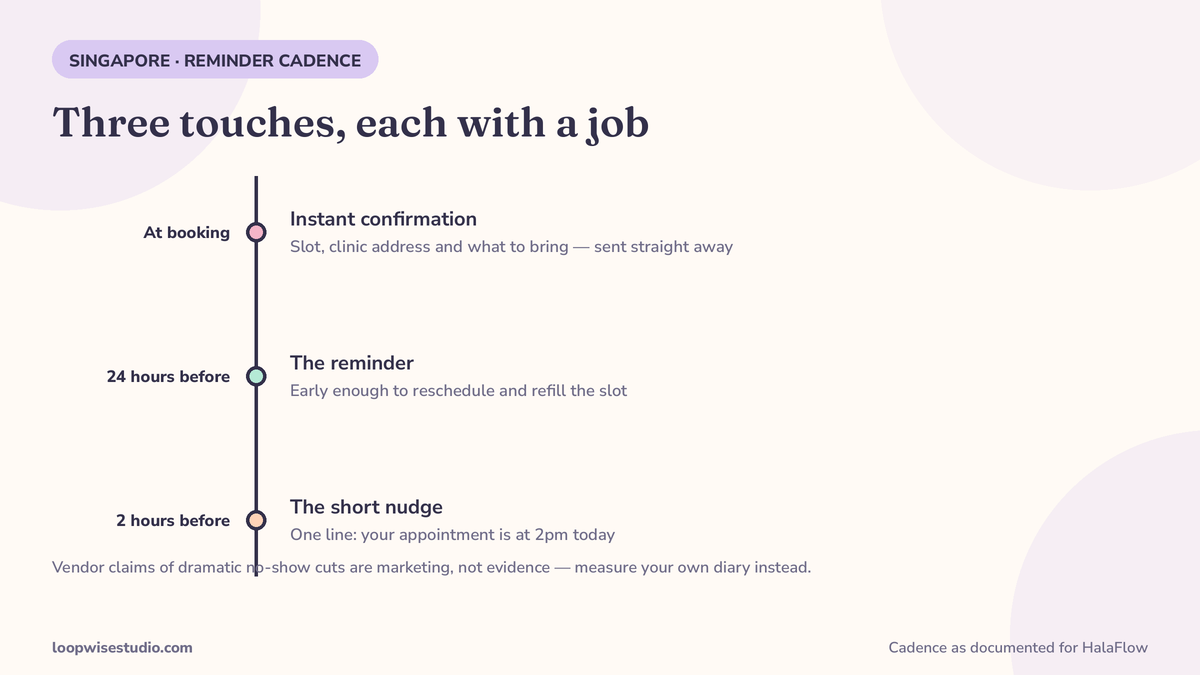
Strip away the AI language and a WhatsApp booking system is three things: a booking page that shows real slots, a confirmation the second the booking lands, and reminders timed close enough to matter. The cadence documented for HalaFlow, a tool serving this market, is the sensible baseline:
- Instant confirmation when the patient books — service, doctor, time, location, and a reschedule link.
- 24 hours before — a reminder with one-tap confirm or reschedule.
- 2 hours before — a short final reminder for the appointments most likely to be forgotten: early morning, lunchtime, first visits.
Add the two messages most clinics never send: a missed-appointment recovery message within the hour (“we missed you — here are the next three slots”) and a recall when the next check-up is due. The dental version of this sequence, with treatment-interval recalls, is set out in WhatsApp appointment reminders for dental clinics in Singapore.
How a booking actually flows, step by step
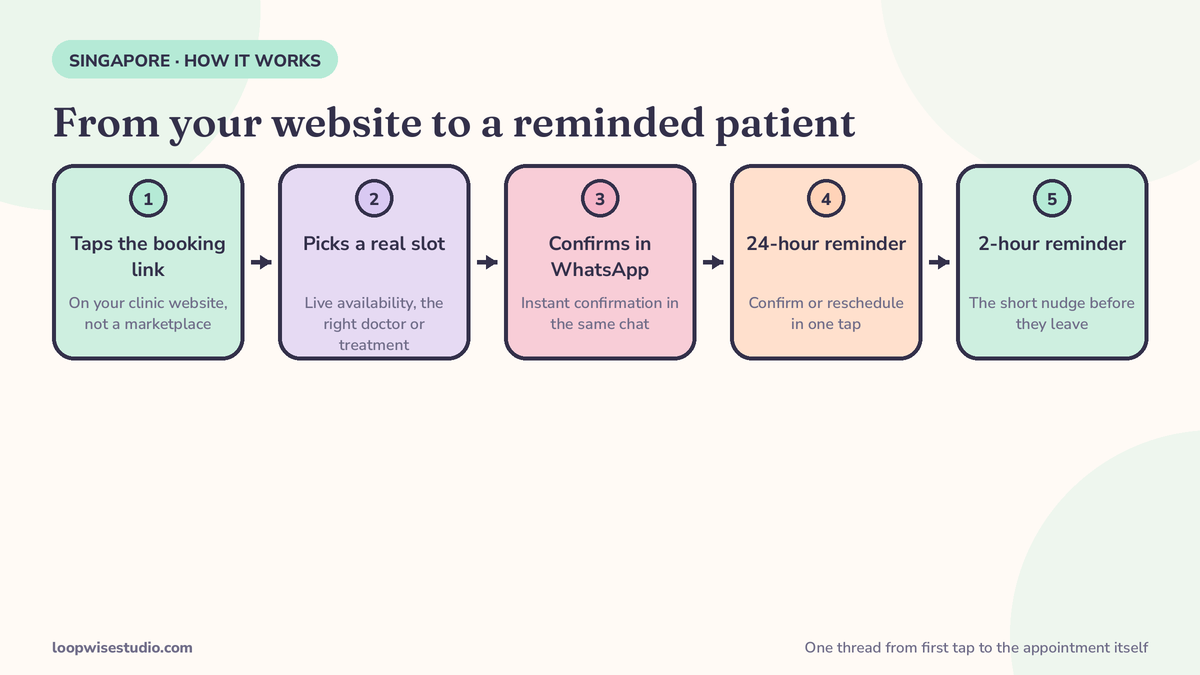
- The patient starts where she already is — your Google profile, your website, or a WhatsApp link you share. No app to download, no account to create.
- She picks a real slot. The booking page reads your diary, so the time she chooses exists. This is the step web forms get wrong: a “request” that the clinic confirms hours later loses patients who booked elsewhere meanwhile.
- She confirms in WhatsApp. One tap, and the confirmation message (below) lands instantly with the details and the reschedule route.
- The reminders run themselves. 24 hours before, then 2 hours before. A reply reschedules; silence means the appointment stands.
- The slot is protected either way. If she reschedules early, the slot reopens while it can still be filled. If she doesn’t come, the recovery message goes out within the hour with the next openings.
- The relationship stays yours. The conversation lives on your clinic’s WhatsApp number and the patient record in your system — not inside a vendor’s app she’ll delete.
Notice what is absent: no phone tag, no front-desk interruption mid-consultation, no paper diary. The front desk handles exceptions and people standing in front of them, which is what they are for.
After hours: where the quiet losses are
Clinics leak bookings at night and on weekends, when the phone is unanswered and the enquiry form waits until Monday. A WhatsApp booking system takes the booking at 11 p.m. because there is nothing to answer — the diary is the receptionist. The patient who books her slot at night does not call your competitor at 9 a.m.
This is also the honest limit of the AI-voice route: an answered call that ends in “we’ll call you back to confirm” has not booked anything. The measure of any of these systems is not conversations handled. It is appointments in the diary, attended. Judge every vendor, us included, on that number in your own clinic — not on percentages in a sales deck.
Copy this: the four messages, word for word
Confirmation: “Hi [Name], you’re booked at [Clinic] for [service] with [Doctor] on [date] at [time]. Reply R to reschedule or call us at [number].”
24-hour reminder: “Reminder: your appointment at [Clinic] is tomorrow at [time]. Reply C to confirm or R to reschedule.”
2-hour reminder: “See you at [time] today, [Name]. We’re at [address]. Running late? Reply here and we’ll do our best to hold your slot.”
Missed appointment: “Sorry we missed you today, [Name]. Your health matters more than the slot — here are the next openings: [link].”
Short, factual, no marketing inside a reminder. That last point is not a style choice in Singapore. It is the law, next section.
PDPA: the rules your system has to respect
Singapore’s Personal Data Protection Act draws a line your vendor may not draw for you. Per the PDPC’s position as summarised in FingerBooth’s compliance guidance:
- Appointment reminders are service messages. Confirmations and reminders about an existing appointment are transactional, not marketing.
- Marketing needs express consent. A patient booking an appointment has not consented to promotions. A transaction alone does not create consent, and a one-off visit does not count as an ongoing relationship.
- Keep service and marketing messages separate. The moment a “reminder” carries an offer, it is a marketing message and needs consent behind it.
- Check the Do Not Call Registry before sending marketing messages to Singapore numbers without consent, and honour opt-outs within the required window (21 days under the rules as summarised in vendor compliance guides — confirm current requirements with your provider).
Build the system so reminders can never accidentally become promotions, and marketing is a separate, consent-based list. That separation is a design decision, and it is much easier to make before launch than after a complaint.
What the system should include — the buying checklist
- Booking on your website and domain, not only inside a vendor’s app
- Your own WhatsApp Business number, so the conversation history stays yours
- The full sequence above — confirmation, 24h, 2h, recovery, recall — not just a booking confirmation
- Reschedule by reply, so a changed plan doesn’t become a no-show
- A PDPA-clean split between service messages and marketing
- Pricing in writing before you start (at least one major vendor in this market publishes none)
The same architecture serves beauty as well as medicine — see booking systems for salons in Singapore with WhatsApp reminders for the salon version.
What patients actually experience — and what they never forgive
From the patient’s side, the system succeeds or fails on three small things.
Speed of the first answer. A booking page answers instantly; a WhatsApp enquiry form that a human replies to at lunch does not. If your “WhatsApp booking” is really a chat window your staff monitor, say so honestly and staff it — a slow chat is worse than a clear booking page, because it promises conversation and delivers a queue.
Certainty. Patients forgive a full diary. They do not forgive uncertainty — “we’ll confirm shortly” followed by silence. The instant confirmation with real slot data is what converts an enquiry into a kept appointment. Every message after that is protection.
One door. Clinics confuse patients by offering five routes — call, form, WhatsApp, email, walk-in — monitored unevenly. Pick the front door (your booking page, fed by WhatsApp), make every profile and listing point at it, and let the other doors feed into it rather than compete with it.
None of this requires exotic technology. It requires the clinic to decide that booking is a system, not a task someone does between patients. The clinics that get this right in Singapore are not the ones with the most AI. They are the ones whose 11 p.m. enquiry becomes a 9 a.m. appointment without a human touching it — the same standard described for salons in website design for aesthetic clinics in Singapore with online booking, where the website itself has to carry the booking, not just describe the clinic.
A final caution on buying by demonstration
Every vendor demo in this market is polished, and every demo clinic runs perfectly. The differences that matter only appear in your second month: whose number the patients saved, whether a reschedule really moves the diary entry or just starts a chat, whether the consent split survives a staff member adding “PS: 20% off this month!” to a reminder template, and what it costs to leave. Ask vendors to show you those four things live, in the product, not in slides. The answers will sort the market faster than any feature list — including ours, which you should interrogate exactly the same way.
How we set it up
Loopwise builds the owned route: your website’s booking page, your WhatsApp number, the reminder and recall sequences written for your clinic, and the PDPA separation built in from day one. If a vendor tool fits you better, the checklist above will show it — either way you will know what you are buying.
To see what this looks like mapped onto your clinic’s actual appointment types, you can get a free audit. We will sketch your sequence and flag your consent gaps before you spend anything.
Implementation order — what to build first
If you are starting from phone bookings and a static website, build in this order; each step pays before the next begins:
- The booking page with real slots. Everything else hangs off this. A WhatsApp reminder for a booking that was never properly captured is decoration.
- Confirmation + the 24h/2h reminders. The three documented touches. Expect this step, not any AI, to do most of the no-show work.
- Reply-based rescheduling. The feature that turns changed plans into kept revenue instead of dead slots.
- The missed-appointment recovery message. Cheap to add, and it rescues the patients you have already disappointed once.
- Recalls. Last, because they sit on the marketing side of the PDPA line and deserve their own consent design rather than being bolted onto step 2.
Clinics that start at step 5 — buying “patient engagement” before the booking page works — end up marketing efficiently to people whose appointments still leak. The order is the strategy.
FAQs
Do I need an AI receptionist, or is booking + reminders enough?
For most small clinics, booking + reminders is the workhorse: it captures the booking and protects the slot. AI answering layers (Supercall and similar) target phone overflow. Their published performance figures are vendor claims — ask for references, not percentages.
What reminder timing should we use?
The documented baseline in this market is instant confirmation, 24 hours before, and 2 hours before (HalaFlow’s published sequence). Clinics with long-lead specialist bookings sometimes add a 3-day touch. More than that annoys patients and blurs into marketing.
Are WhatsApp reminders legal under the PDPA?
Reminders about an existing appointment are service messages, per the PDPC position summarised by FingerBooth. Marketing messages are different: they need express consent, and a booking alone does not provide it. Keep the two streams separate.
Can patients reschedule through WhatsApp?
Yes — a reply-based reschedule link in the 24-hour reminder is the single most useful feature after the confirmation itself. A rescheduled patient keeps the relationship; an unreminded one becomes a no-show.
Why not just use a booking tool’s built-in WhatsApp?
You can — check whose number the messages come from, whether your conversation history exports, and what the full sequence includes. On rented systems the patient relationship often lives with the vendor. On your own website and number, it lives with you.
What does it cost?
Vendor pricing in this market is often unpublished (Supercall lists none; another major name is demo-only). A done-for-you build is quoted as a project. Either way, get the full price — platform, messages, setup — in writing before you commit.
If your clinic is still taking bookings by phone while your patients live on WhatsApp, the gap is costing you slots every week. Start with a get a free audit request and we will map the booking-to-reminder sequence for your clinic, PDPA split included.