Med Spa Website Design in Dubai With Online Booking
Website design for med spas in Dubai with online booking built in: AED pricing, injector trust, WhatsApp booking and deposits, in Arabic and English alike.
Website design for a med spa in Dubai has one test: can a guest find a treatment, see what it costs in AED, trust the person who will perform it, and book it — on her phone, in Arabic or English, without phoning reception? A med spa website with online booking does all four on the page she lands on, and in Dubai that booking should finish where Dubai guests already live: in WhatsApp, with the treatment named, a real slot offered and a deposit taken. This page explains how we design med spa websites to that standard — the treatment pages, the pricing, the trust signals, the booking layer — and what it costs and how long it takes in this market.
Med spas are not quite aesthetic clinics and not quite day spas, and in Dubai the difference matters. Your guests mix resident regulars on packages with visitors booking a single treatment between a flight and a dinner. They compare you with hotel spas and clinic-grade competitors in the same search. The US med-spa design playbook — which is most of what ranks for this topic — gets the conversion anatomy right, then applies it to the wrong country: booking widgets that link out to American software, prices in dollars, American privacy law. The anatomy travels. Every mechanic underneath it has to be rebuilt for Dubai.
What a med spa website has to do in Dubai
Strip it down and a prospective guest makes three checks, usually in under a minute, usually on a phone:
- What does it cost? Not “contact us for pricing.” A price, a starting price, or a package price she can compare against the two other tabs open on her phone.
- Who treats me? A name, a face, credentials. For injectables and advanced treatments this check is not vanity — it is the whole decision.
- Can I book now? A real way to book, at the moment of decision, that ends in a confirmed appointment and a deposit — not a form that promises a callback tomorrow.
A design that passes all three, in the guest’s own language, wins the booking. A design that fails any one of them sends her to the next tab. Everything below is in service of those three checks, Dubai edition:
- the site works in Arabic and English, with the Arabic version properly laid out right-to-left, not mirrored by a widget;
- prices are in AED, with instalments where they fit;
- booking runs through WhatsApp, designed into the pages rather than bolted on as a green button;
- trust is shown the Dubai way — DHA licensing and practitioner credentials, consented results that follow the local rules, and reviews in both languages.
A page for every treatment
The most common med spa website mistake is the services page: one long page listing thirty treatments in cheerful paragraphs, one “book now” button at the bottom that opens a contact form. It ranks for nothing, and it converts the same way.
Give every treatment its own page, and build each page to a checklist:
- Price up front — the AED price, or an honest starting price where it depends on areas or units (per syringe, per area, per session). Explain what moves the price in one line; guests accept ranges they understand and abandon mysteries.
- Duration — how long she is with you, door to door, not just treatment time.
- Downtime and aftercare, plainly — back to work today, red for a day, no sun for a week. Half of all pre-booking questions are downtime questions; answer them on the page and the chat stays short.
- The practitioner — who performs this treatment, their photo, their credentials, and their DHA licence status where applicable. Injector pages matter so much in this market that they deserve their own fuller treatment below.
- Consented results — before-and-after photos that follow the local rules (see the trust section), with captions that describe rather than promise.
- One booking action — a button for that treatment, which starts a booking with the treatment already chosen. Not “call us.” Not a generic form.
Organise the menu twice: by treatment (laser, injectables, facials, body) and by concern (pigmentation, fine lines, acne marks, tired skin). Guests search and browse by concern at least as often as by treatment name — a guest who wants “something for pigmentation” should reach a page that gathers her options and gives each one a booking path. If your menu runs past thirty services, let guests filter it rather than scroll it.
This structure is also what general med-spa website checklists miss when they stop at page lists: our companion piece on what should be on a med spa website to get more bookings walks the wider content checklist — homepage, pricing page, memberships, FAQs — while this page stays on the Dubai design and booking mechanics.
Booking that stays in the chat
Here is where Dubai design genuinely departs from the US template. The standard US med spa site embeds a booking widget or links out to booking software: click, leave the site, land on a software page in another brand’s design, create an account, book. Every hand-off loses guests, and in Dubai it hands them a tool most of them were not using in the first place.
Design the site around the chat instead:
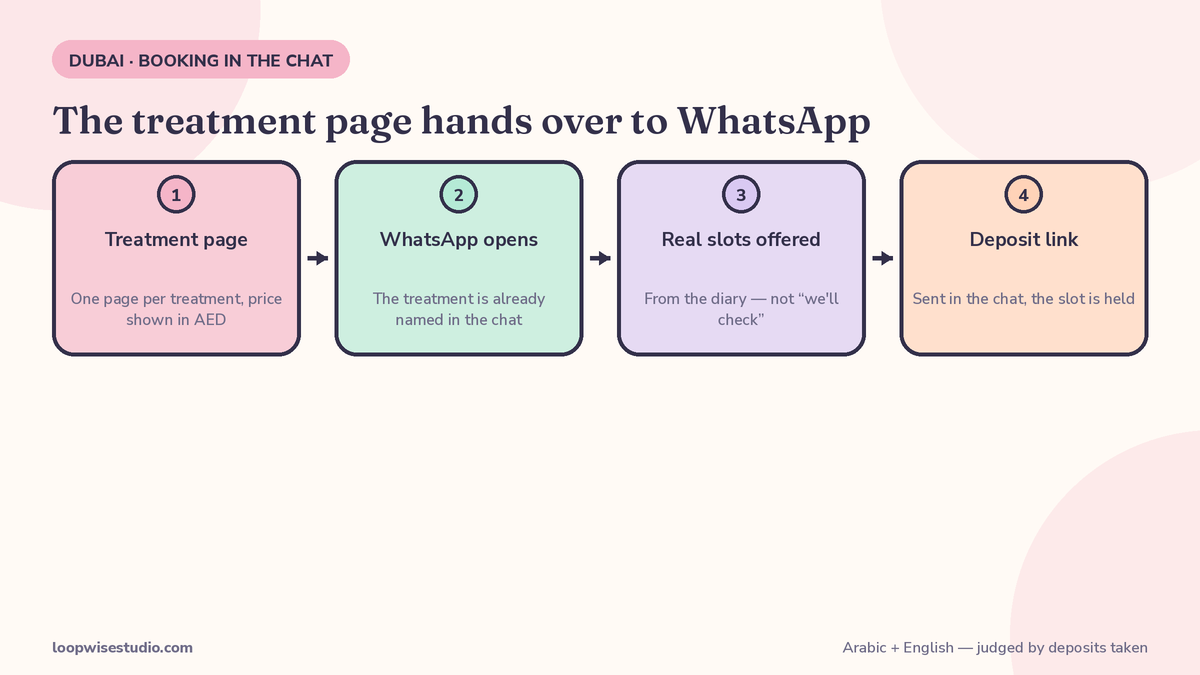
- Every treatment page’s booking button opens WhatsApp with the treatment pre-named. Her first message arrives already written: “I would like to book a HydraFacial.” She has said the thing she came to say without typing it — the conversation starts at the booking, not at “hello, what do you offer?”
- The chat offers real slots. Because the conversation runs on a connected booking setup, the reply offers actual availability from your diary — days and times, not “we will check and call you.”
- The deposit is a link in the chat. For long or high-value treatments she pays the deposit there and then, by card through a local gateway or by instalment where offered, and the slot is confirmed on payment.
- Confirmation, directions and preparation notes land in the same thread. One conversation holds the whole visit: booking, deposit receipt, reminder, and the review request after she has been in.
The design work is making that flow feel like one product: the button style, the pre-filled wording, the speed of the first reply and the look of the deposit step are all part of the website’s job, not the software’s. This page covers the flow from the design side at summary level; the machinery underneath — the automated sequence, the shared inbox, the reminder templates in English and Arabic — is what our page on a WhatsApp booking system for aesthetic clinics in Dubai explains in full. Read the two together if you are planning the whole build; if your site exists and only the booking layer is missing, that page is the one you need.
And note what this design does not do: it does not make WhatsApp the only door. Guests who prefer to book silently, without a conversation, should still find a proper online booking flow on the site itself — the two share one diary. We set out that website-first arrangement in our page on an online booking website for aesthetic clinics in Dubai; a med spa needs both doors because its guests split both ways, residents by chat and visitors by whichever is faster at midnight in another time zone.
Memberships and packages, with the maths shown
Residents are the economics of a Dubai med spa, and residents buy packages and memberships. Visitors buy once. Your website has to sell both without confusing either.
- Show the maths on the page. “Laser, 6 sessions: AED X per session alone, AED Y as a course — you save Z.” A package page that hides its arithmetic behind “ask in clinic” converts like a page with no prices, because that is what it is.
- Separate member and guest pricing where you have both, side by side, so the membership value is visible in the comparison rather than described in adjectives.
- Instalments belong on the package page. A course paid through Tabby or Tamara in four parts is a different decision from the same course paid today. If you offer instalments, say so on the page, next to the price — not at the checkout as a surprise.
- Gift cards get a page too. Dubai’s gifting occasions — Eid, birthdays, Mother’s Day — drive real med spa revenue, and a gift card is bought online, at night, by someone who will never visit you. If it cannot be bought on the website in two minutes, it will be bought from a hotel spa whose website can.
- Visitor treatments are their own small section: the express facial before an event, the single-session options, honest wording about what one session can and cannot do. Visitors who feel well served become the next trip’s package buyers, and they leave the Google reviews your resident guests forget to write.
Trust, Dubai edition
A pretty site with thin trust signals loses to a plainer site that proves itself. In Dubai the proof has local forms:
Licence and credentials, visible. Your facility’s DHA licensing, and for clinical treatments the practitioner’s own credentials, belong on the treatment and team pages — not on a compliance page nobody opens. Guests from the region actively look for this, and newcomers to Dubai look hardest of all.
Before-and-after photos under the local rules. As the Dubai agency PremiumPages states in its own advertising FAQ, the health authority’s rules for before-and-after images require the same patient, shot with the same lens and conditions, unretouched, with a disclaimer — in the same font size as the rest of the post — that results vary. We apply that standard to website galleries, with written patient consent on file for every image. A gallery that looks retouched does the opposite of its job in a market this experienced.
Injector and practitioner pages that read like people. Name — not first name only — photo, training, what they specialise in, how long they have practised, and the treatments they personally perform, each with its booking button. The US design literature is right about this and Dubai sites still mostly fail it: guests choose a person, not a logo, for anything that involves a needle.
Reviews in both languages, from Google. Show real Google reviews — Arabic and English — near the booking action, and run the after-visit request flow that keeps them coming. Do not curate only five-star praise onto a testimonials page nobody believes; link through to the live profile.
Found on Google and Maps first
Most med spa guests will meet you on Google before they meet your website: a treatment-plus-area search, a “near me” search on Maps, your Business Profile with its photos and reviews. Design has to start there:
- Treatment + area pages give Google something specific to rank for the searches guests actually make — the treatment, the neighbourhood, the city — rather than one homepage hoping to cover all of Dubai.
- LocalBusiness structured data on the site tells Google your address, hours, prices and services in a form it can show directly, and keeps the website and the profile telling the same story.
- The profile carries the same booking action as the site — the chat link and the booking page, current photos, current hours — because for many guests the profile is the website and yours is two taps away at best.
- Speed on mobile is a ranking and a conversion factor at once. A heavy, slow site in a market browsing on phones and hotel wifi loses the guest before the design gets a chance to work.
Wondering how your own site measures up on any of this? get a free audit and we will review it treatment page by treatment page — prices, practitioners, booking path, Arabic version — and show you where the bookings leak.
Judge the site by deposits taken
When the site launches, agree the numbers that matter and watch those, not page views:
| Measure | What it tells you |
|---|---|
| Bookings started | Whether treatment pages are doing their job |
| Deposits completed | The real conversion — money committed, not clicks |
| Deposit completion rate | Whether the booking/deposit step itself is leaking |
| Top treatment pages by bookings | Where to expand content and packages |
| Chat bookings vs site bookings | How your guests actually split between the two doors |
| Calls and “how much?” messages | What the pages still fail to answer — fix the page, not the reply |
A design judged by deposits gets better every month, because every weak number points at a specific page or step. A design judged by how it looks in the launch presentation stays exactly as good as launch day.
Custom site, template, or booking page only — which stage is your spa at?
Honest staging, because the right answer is not always the biggest build:
- Just opened, one treatment room, tight budget: a template or builder site is genuinely enough — if it has a page per treatment, prices showing, and a working booking path. The failure is not the template; it is the missing booking and the hidden prices, and those fail on expensive sites too.
- Established, growing menu, packages and memberships, guests in two languages: this is the custom stage. Templates start charging you in workarounds — the Arabic layout fights you, the package maths does not fit their blocks, the booking flow points at software your guests do not use.
- Happy with your site, losing bookings at the booking step: you may not need a website at all. A booking layer on the site you have — chat booking plus a real online flow on one diary — can be the whole project, with design work limited to the treatment-page buttons and the deposit step.
Anyone who quotes you the biggest option before asking which stage you are at is selling their package, not your spa’s next step.
What it costs and how long it takes in Dubai
For anchor points we will use published figures, labelled as such. The only cost table in the research for this keyword comes from OwnTechnologies, an Indian agency’s global med spa design guide, which puts a template med spa site at $3,000–$6,000 over 2–4 weeks, a custom site at $6,000–$15,000 over 4–6 weeks, and a website plus client platform at $15,000–$35,000 over 8–12 weeks. Those are global guide prices in dollars, not Dubai quotes — but they mark the shape of the market honestly: templates at the bottom, custom design in the middle, platforms at the top.
Against that shape: the established US med spa design agencies quote a fixed price in writing but publish nothing, and the best-known of them, The Digital Elites, states most builds take six to ten weeks. A Dubai build does not need to run that long for a single-location spa, because the scope is tighter: your treatment pages, your practitioners, your booking layer, in two languages.
At Loopwise, med spa websites are quoted as one fixed price after a short discovery conversation — the price depends on your menu size, whether Arabic is in from day one (it should be), and whether we are adding the booking layer or rebuilding the site. What we fix before starting: the price, the timeline, the page list, and the fact that the site and its content are yours. No hourly meter, no platform rent on your own front door.
Frequently asked questions
Does our med spa really need an Arabic version, or is English enough in Dubai?
English alone quietly excludes a large part of your market. It is not only about comprehension — many Arabic-preferring guests read English fine. It is about effort at the decision point: treatment details, prices and booking steps in her own language convert better and read as more trustworthy. Build Arabic in from the start, properly laid out right-to-left. Retrofitting it later costs more and usually ships worse.
We already use booking software. Does the design have to replace it?
Not necessarily. If your current software holds the diary reliably, the design can point to it — though in Dubai we usually recommend the booking finish in WhatsApp or in an on-site flow, because outbound software pages are where Dubai guests drop off. The honest test is your deposit completion rate: if guests start bookings and finish them, keep the software; if they start and vanish, the booking layer is the problem, not the diary.
Can guests really pay deposits and packages through Tabby or Tamara?
Yes, where your payment setup supports it — instalment providers such as Tabby and Tamara are a normal part of Dubai checkout through local gateways, and they matter most exactly where med spas need them: packages and courses, where four payments is an easier yes than one. We set the deposit step up through your gateway as part of the booking build, and the instalment option is shown next to the package price, not hidden at checkout.
What are the rules for before-and-after photos on a Dubai med spa website?
The same discipline as advertising: written consent from the patient, the same patient in both images, shot under the same conditions and lens, no retouching, and a clear disclaimer that results vary, displayed at proper size. The Dubai agency PremiumPages sets these rules out for ads in its published FAQ, citing the health authority’s requirements; we apply the identical standard to website galleries. If your current gallery cannot show consent paperwork for its images, fixing that comes before any redesign.
How long does a med spa website build take with you?
For a single-location spa, once your treatment list, prices, practitioner photos and consents are ready, the build is measured in weeks — the exact timeline goes in the fixed quote. What stretches timelines is rarely the build itself: it is late price lists, practitioner photos that never arrive, and result photos without consent. We will give you the content checklist at the start so those are gathered in parallel, not discovered in week three.
Who owns the website when it is finished?
You do. The site, the domain, the content and the guest data are the spa’s. That sounds obvious, but rented builder sites and some agency arrangements quietly keep the site — and its search rankings — hostage to a monthly fee. Our builds are handed over as your property, with the booking and messaging setup documented, whether or not you keep us on for updates afterwards.
Start with the leaks, not the redesign
You may not need a new website. You may need prices on the treatment pages, practitioners a guest can choose, and a booking action that finishes in a chat with a deposit taken — on the site you already have. The cheapest way to find out is to look before anyone quotes you a rebuild: get a free audit and we will go through your current site the way a guest does at midnight — Google, treatment page, price check, booking attempt — and show you the exact steps where bookings leak, what fixing each one involves, and what we would charge as one fixed price if you want us to do it. If a template and an afternoon would fix your spa, that is what the audit will tell you.