Booking System for Salons in Singapore With WhatsApp Reminders
The full WhatsApp booking system for a Singapore salon: booking page, reminder sequence with copy, PayNow deposits, package recalls, SGD costs and PDPA rules.
Short answer: a booking system for a Singapore salon with WhatsApp reminders takes bookings on a page you own, confirms and reminds clients inside WhatsApp, and takes deposits by PayNow. Salons here buy it as software — TunaiPro, one local platform, publishes pricing from SGD 1,200 a year — and set it up themselves, or have the whole system built and run for them.
Your clients already run their day on WhatsApp. They message your salon there, ask prices there, and try to book there. Then the booking itself happens somewhere else — a phone call, a DM thread somebody has to babysit, or a software link on a vendor’s domain.
This page lays out the whole system in one place: the booking page, the reminder sequence with copy you can lift, deposits, package recalls, what it costs in SGD, and the PDPA line you cannot cross. It is the salon version of the model in our guide to turning website visitors into booked appointments — same mechanics, Singapore rules.
“DM for price, DM to book” — the leak in the middle of your funnel
Most Singapore salons don’t have a traffic problem. Instagram and Google bring the enquiries. The leak is what happens next.
A client sees a balayage she likes. The caption says “DM for price.” She messages. Your therapist is mid-treatment, so the reply comes three hours later. The price goes out, she asks about Saturday, another hour passes, and by the time a slot is offered she has booked somewhere that answered in five minutes.
Every step of that chain is a person doing a machine’s job. A booking page kills the chain: service, price, stylist, live slots, deposit — done in one sitting, at 11pm, without anyone touching a phone. WhatsApp then carries the parts WhatsApp is good at: the confirmation, the reminders, the “running late?” reply, the rebook nudge.
That split — page books, WhatsApp reminds — is the system. Everything below is the detail.
The reminder sequence — timings and copy you can steal
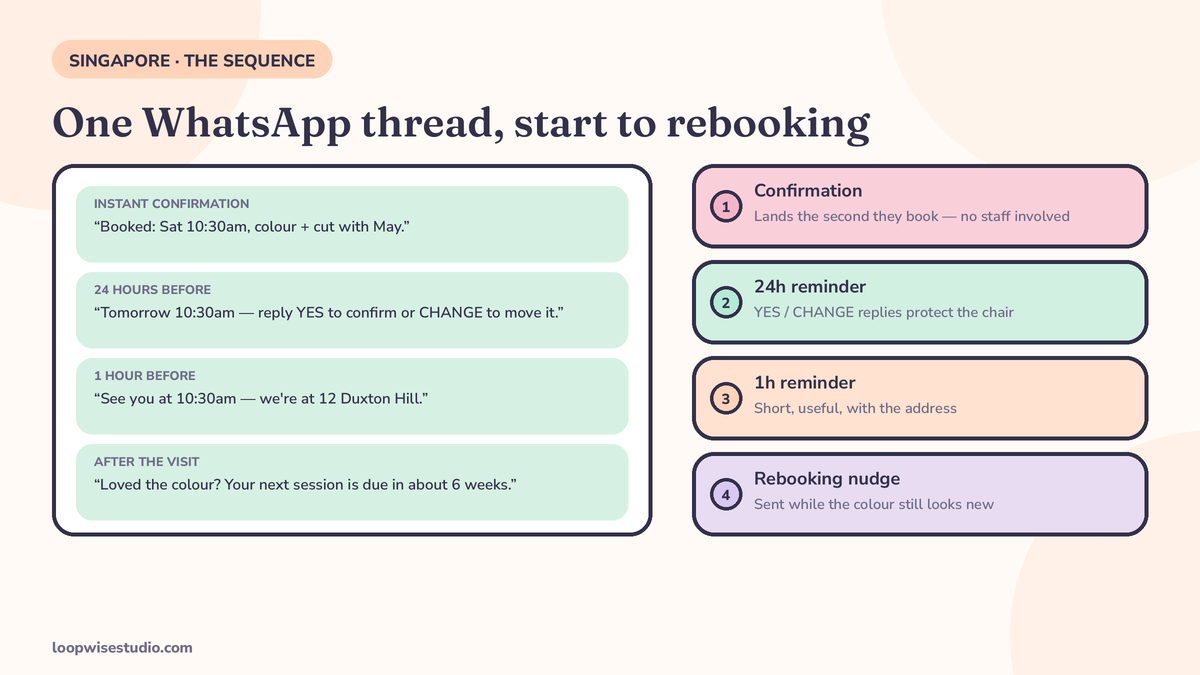
One local platform, App-ening, publishes its reminder timings on its Singapore salon page: a reminder 24 hours before the appointment and another 1 hour before. That two-reminder spine is the published pattern in this market. Here is the full sequence we recommend around it, with the actual words.
1. Instant confirmation (at booking). “Hi [Name], you’re booked: [Service] with [Stylist] on [Date] at [Time]. Your deposit of S$[X] is received. Need to change? Reply CHANGE and we’ll send new times.”
2. 72-hour heads-up (for services booked more than a week out). “Just a reminder you’re with us on [Day] for [Service]. Reply YES to keep it, CHANGE to move it. Moving now is free — the chair is still easy to fill.”
3. 24-hour reminder. “Tomorrow, [Time]: [Service] with [Stylist]. Reply YES to confirm or CHANGE to pick a new time. Please arrive 10 minutes early — late arrivals may shorten the service.”
4. 1-hour reminder. “See you at [Time] today, [Name]. We’re at [Address]. Running late? Reply here and we’ll do our best to hold your slot.”
5. No-reply rescue (2 hours after a missed 24-hour reminder). “We haven’t heard back about tomorrow’s [Service]. Reply YES in the next 2 hours to keep the slot, or CHANGE to move it.”
6. Post-visit rebook nudge (same evening or next morning). “Thanks for coming in, [Name]. [Service] looks best refreshed in about [X] weeks — want us to hold [suggested date]? Reply YES and it’s done.”
Two rules make the sequence work. Every message must be answerable — a reminder a client can’t act on is just noise. And the CHANGE path matters more than the YES path: a client who moves an appointment is revenue kept; a client who silently doesn’t show is revenue gone.
A note on the percentages you will see while shopping for this. Vendors in this market advertise large numbers — App-ening’s Singapore page claims 60% fewer no-shows and a 98% open rate; Happoin, a global comparison vendor, says its usage data shows WhatsApp reminders cutting no-shows by up to 39%. These are the vendors’ own marketing figures with no published methodology, and no independent study in our research backs any of them. Treat them as sales copy. What you can verify is the mechanics — and the mechanics above are what actually get bought.
Deposits and PayNow — how peak slots stop evaporating
Friday evening and Saturday slots are your scarcest stock. They are also the slots no-shows love most.
The fix is a deposit collected at booking, through the payment rails your clients already use: PayNow, NETS, GrabPay, card. The deposit does three jobs at once. It filters out the “book three salons, attend one” crowd. It makes the appointment feel real. And it gives your cancellation policy something to attach to, so the policy stops being a sentence nobody reads.
Keep it simple:
| Slot type | Deposit approach |
|---|---|
| Weekday off-peak, short service | No deposit — remove friction, fill the chair |
| Peak hours (Fri evening, Sat, eve of public holidays) | Fixed deposit (e.g. S$20–50) taken at booking |
| Long services (colour, rebonding, packages’ first session) | Percentage deposit (e.g. 30–50%) |
| Repeat no-show client | Full prepayment before the next booking |
State the policy inside the confirmation message, not buried on a page: “Deposit is transferable to a new date with 24 hours’ notice; it is forfeited on a no-show.” Clients accept clear rules. They fight surprise ones.
Packages — the recall sequence nobody in Singapore is running
Singapore salon money sits in packages: 10 sessions prepaid, used over a year. And package money leaks in a specific way — clients drift. Sessions sit unused, the client feels the package “expired in her head,” and when she next wants the service she buys from whoever is in front of her.
Local software names this problem — TunaiPro’s Singapore guide lists package and session tracking as a core need for salons here — but tracking is not recall. The recall sequence is three messages:
- Halfway nudge (at 50% of sessions used, or 60 days since last visit): “Hi [Name], you have [X] sessions left in your [Package]. Your next [Service] is due around now — reply YES and we’ll offer you times this week.”
- Expiry warning (30 days before expiry): “Your [Package] expires on [Date] with [X] sessions unused — that’s S$[value] already paid for. Book before [Date] to use them.”
- Last call (7 days before expiry): same message, shorter, with two concrete slots offered.
No ranking page for this query publishes a package-recall sequence. It is the single biggest gap in the Singapore salon market, and for package-heavy salons it is worth more than the reminders.
What it costs in SGD — the honest version
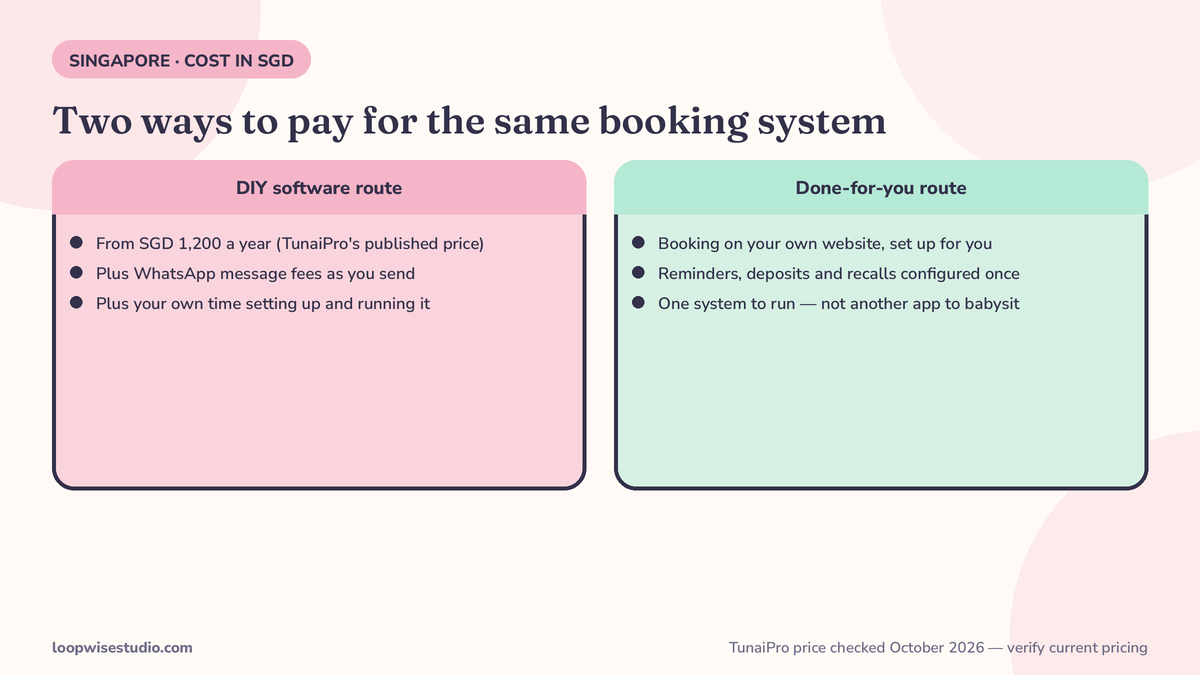
Nobody ranking for this query prices the full stack on one page, so here is the shape of it, with every figure attributed.
| Route | Published cost | What’s missing from the sticker |
|---|---|---|
| Local salon software (TunaiPro) | From SGD 1,200/year (TunaiPro’s own published pricing, checked October 2026) | Its WhatsApp AI is a paid add-on; the add-on price is not stated on the guide |
| WhatsApp-first platform (App-ening) | A Pro plan shown at “$99/mo” | The page does not state the currency — do not read it as SGD until the vendor confirms |
| New SG WhatsApp startup (BusinessKaki) | “Contact us for pricing” — no published prices | Everything; pricing sits behind a demo |
| Fresha (global platform) | Free subscription, per TunaiPro’s guide, plus 2–2.79% transaction fees | Third-party reported by a rival — verify on Fresha’s own pricing page before relying on it; no WhatsApp reminders or PayNow per the same guide |
| Done-for-you system on your own website (Loopwise) | Quoted per salon after a free audit | No subscription to a platform you don’t own; the booking page lives on your domain |
Two costs hide inside every route. First, WhatsApp itself: messages sent through the WhatsApp Business Platform carry per-conversation or per-message charges from Meta, billed at published rates — BusinessKaki states it passes Meta’s rates through with no markup, which tells you the fee exists on every route. Second, your time: DIY software is cheaper in dollars and more expensive in evenings. The setup — services, durations, staff, deposits, message copy, package rules — is the product. Whoever does it, it has to be done.
One compliance cost to budget for if your turnover grows: GST registration is mandatory in Singapore above SGD 1 million in annual turnover, so your invoicing needs to handle GST correctly before you cross the line, not after.
If your diary leaks after hours as well as at booking, a WhatsApp booking system for clinics in Singapore faces the same after-hours problem in a stricter setting — the mechanics transfer directly.
PDPA — what you can send, and what needs consent first
Singapore’s PDPA draws a line your salon has to respect, and it runs right through the reminder sequence.
Service messages — confirmations, reminders, “your stylist is running 10 minutes late,” the package-expiry notice for a package the client already bought — relate to an appointment or purchase the client made. These are the messages the system above is built from.
Marketing messages — promotions, festival offers, “20% off colour this month,” broadcasts to lapsed clients — are different. Marketing to Singapore numbers needs the client’s consent, and the Do Not Call Registry applies to marketing messages to Singapore numbers. A client booking an appointment is not consent to market to her forever.
Practical rules for your salon:
- Capture marketing consent as its own tick-box at booking or checkout — never bundle it silently into the booking.
- Keep service messages purely about the appointment. The moment a reminder carries a promotion, it starts behaving like marketing.
- Honour opt-outs immediately and record them.
- Store the consent record with the client profile, not in someone’s chat history.
Clinics in Singapore work under the same split — our page on WhatsApp appointment reminders for dental clinics in Singapore works through the reminder-versus-recall line in a dental setting, and the same discipline applies to your package recalls: a recall about sessions already paid for is a service message; a recall selling a new package is marketing.
Not sure which parts of your current setup you could automate without crossing the line? Get a free audit and we’ll map your booking flow, message by message.
DIY software or done-for-you — which fits a 1–5 chair salon?
Buy the software yourself if: you have a staff member who enjoys systems, your service menu is stable, and you are willing to spend the setup evenings. The local options are genuinely built for Singapore — PayNow, GST invoicing, package tracking — and from SGD 1,200 a year the software itself is not the expensive part.
Have it built for you if: the diary is run by whoever is free, your menu and packages change with promotions, and “set up the software” has been on the list since last Chinese New Year. The done-for-you route puts the booking page on your own domain, connects your own WhatsApp number, writes the reminder and recall copy with you, and leaves you with an asset instead of another login.
Either way, refuse two things: a booking page that lives only on a vendor’s subdomain (your Google profile and Instagram should point at your domain), and any vendor whose headline promise is a percentage. The honest vendors in this market publish prices and mechanics. Buy mechanics.
The salons filling weekday chairs with systems like this treat the gaps as a separate problem — our guide to filling cancelled appointments automatically covers the waitlist broadcast that pairs with the reminder sequence above.
The short version
Book on your own page. Confirm and remind on WhatsApp, with copy your clients can act on. Take PayNow deposits on the slots that matter. Recall package clients before their sessions die. Keep marketing consent separate, and buy mechanics, not percentages.
Get a free audit — we’ll look at your current booking flow and show you exactly where it leaks, in plain numbers, before you spend anything.
FAQs
Do I need the WhatsApp Business Platform, or is the free WhatsApp Business app enough?
The free app works for chatting with clients one by one. Automated confirmations, scheduled reminders, and package recalls sent at the right moment need the WhatsApp Business Platform (API) connected to a booking system — that’s what every vendor in this market is actually selling. The API route is also the one where Meta’s message charges apply.
How much does a salon booking system cost in Singapore?
Published prices found in our research: TunaiPro, a local salon platform, starts from SGD 1,200 a year (its own pricing, checked October 2026), with WhatsApp AI as a paid add-on. App-ening shows a Pro plan at “$99/mo” without stating the currency. BusinessKaki publishes no prices. On top of any software fee, budget for WhatsApp message charges and setup time — or a done-for-you build quoted after an audit.
Will WhatsApp reminders really cut my no-shows?
Vendors claim large reductions — up to 39% (Happoin’s own usage data) and 60% fewer no-shows (App-ening’s marketing page) — but none publishes methodology, and our research found no independent study for Singapore salons. What is verifiable: a reminder the client can answer, with an easy way to move the appointment, catches the clients who simply forgot or whose plans changed. Measure your own no-show rate before and after; that number is the one that matters.
Can I send promotions to past clients on WhatsApp?
Only with their consent, and marketing messages to Singapore numbers also have to respect the Do Not Call Registry. Service messages about an existing appointment or package are a different category from promotions. Capture marketing consent separately at booking or checkout, keep the record, and honour opt-outs straight away.
What happens to my bookings if I change systems later?
That depends on where the booking page lives. If bookings run on a vendor’s subdomain and inside their app, leaving means starting your client-facing presence again. If the booking page is on your own domain and the client list is yours, the system behind it can be swapped without your clients noticing. Ask every vendor, before signing, what you keep when you leave.
I run a one-chair home-based salon. Is this overkill?
The full platform route probably is. But the core of the system — a booking page with live slots, an instant WhatsApp confirmation, a 24-hour reminder, and a deposit for Saturday — is exactly what stops a one-chair salon losing its scarcest hours. Start with those four pieces; add package recalls when you sell packages.