Weave Alternative for Dental Practices: Price the Per-Location Maths First
Weave alternatives compared for dental practices: DemandHub, Solutionreach, NexHealth — or keep your phones and add booking, reminders and reviews as a service.
The main Weave alternatives for dental practices are DemandHub (from $59/mo), Solutionreach (from $329/mo) and NexHealth (from about $450/mo) — or keeping your existing phones and practice software and adding only the booking, reminders and reviews layer, run for you as a service. Weave’s published pricing starts at $199/mo per location, per Emitrr’s 2026 comparison, and that per-location multiplication is why most switchers start by doing this maths before they look at a single feature list.
The two biggest pages on this query are 6,500 and 8,500 words long. Both are good. Both are also written for twelve healthcare specialties at once, and both end at the same place: another platform subscription. This page is dental-only, totals the real bill at one location and three, and includes the option neither listicle sells — not migrating at all. (The scoring framework behind it is the same one we use in our roundup of the best booking software for a small aesthetic clinic owner-operator: true cost at your size, your team’s time, and what happens when the phone rings out.)
Why dental practices look for a Weave alternative — the bill grows by location
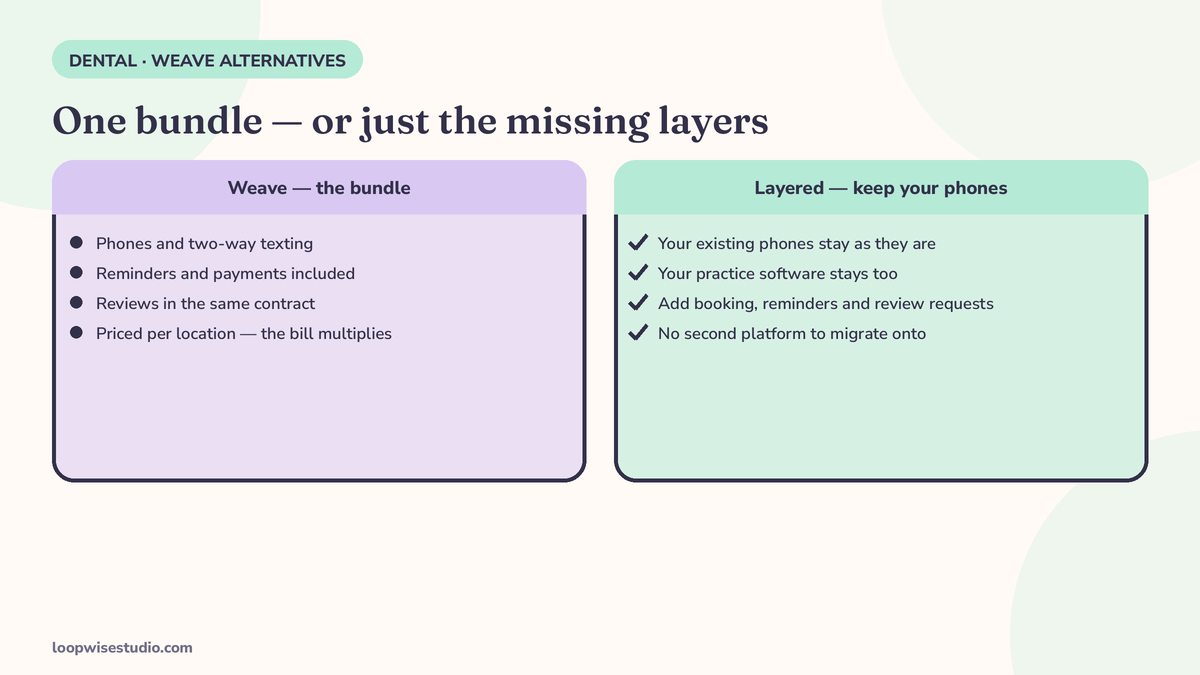
Weave is a genuinely capable bundle: phones, two-way texting, reminders and confirmations, review management, text-to-pay and payments, team chat and call analytics in one contract, month-to-month with no long-term commitment, per DemandHub’s profile of it. Practices do not leave because it does nothing. They leave at specific pressure points, and the comparison research behind this article (Emitrr interviewed 40+ former Weave customers across specialties) names the same ones repeatedly.
Per-location pricing. A starting point of $199/mo per location — Emitrr’s report of Weave’s published pricing — is tolerable for one practice. At three locations it is $597/mo before a single add-on, and at five it is a four-figure line item. Emitrr flags pricing growth as a named switching reason, and Capterra complaints about add-on and phone charges recur in its analysis.
Integration depth versus integration lists. Weave lists 40+ integrations including Dentrix and Eaglesoft, but Emitrr’s customer research found the depth varies — shallow syncs that move some data and strand the rest are a repeated complaint. A practice management system that half-syncs is worse than an honest manual step, because staff stop trusting both systems.
Support and call quality. Weave sits at 4.3/5 on Capterra across 673 reviews, per Emitrr — a decent score with a consistent tail of complaints about support consistency and call quality. For a product that is your phone system, that tail matters more than the average.
The acquisition question. Weave acquired TrueLark, an AI scheduling company, in 2025, per AINORA’s review of the combined product. Acquisitions are not a reason to leave by themselves — but practices whose setup was built around the old product are re-evaluating while the platform absorbs AI scheduling, and “our vendor changed” is a legitimate moment to re-price the whole stack.
Feature overload. A two-dentist practice paying for a bundle sized for a dental group uses a fraction of it. Several of the exit interviews in Emitrr’s research amount to the same sentence: we bought a platform, we needed our phones answered and our patients reminded.
What Weave actually costs — the one-location and three-location table
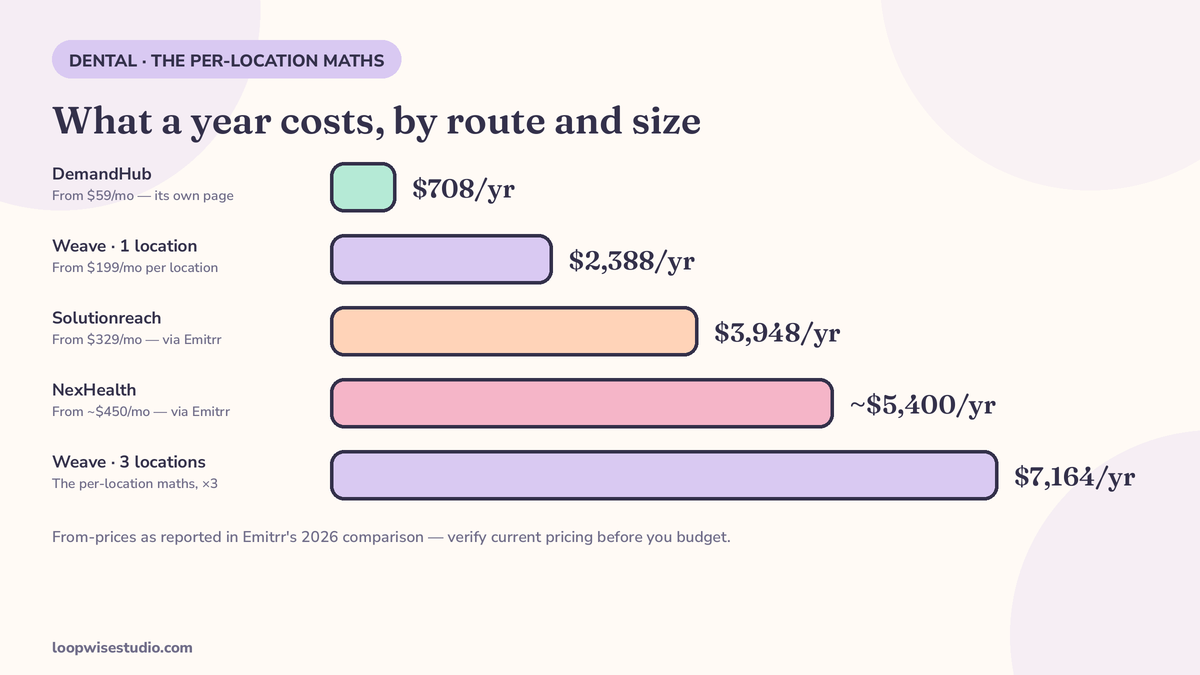
Start with the anchor figure and its source, because Weave was quote-only for years and old articles still say “pricing not published.” Emitrr’s 2026 comparison states: “Weave’s published pricing currently starts at $199 per month per location,” with Pro, Elite and Ultimate plans at different functionality levels and the Ultimate plan including up to 15 VoIP phones. Confirm the current figure on Weave’s own site before you budget around it — but as a sourced starting point:
| 1 location | 3 locations | |
|---|---|---|
| Weave from-price | $199/mo | $597/mo |
| Weave from-price, per year | $2,388 | $7,164 |
| DemandHub from-price (per its own page) | $59/mo → $708/yr | Plan-dependent |
| Solutionreach from-price (per Emitrr) | $329/mo → $3,948/yr | Plan-dependent |
| NexHealth from-price (per Emitrr) | ~$450/mo → ~$5,400/yr | Plan-dependent |
Two honest notes on that table. First, the rivals’ figures are starting prices from Emitrr’s comparison table and DemandHub’s own page — your quote will differ by users, locations and modules, which is rather the point of the transparency complaint. Second, Weave’s number is a floor, not a bill: phones beyond the included count, add-ons and the higher tiers sit on top, and it is the stack — never itemised on any vendor page — that practices actually pay. Before signing anywhere, demand the twelve-month total in writing, per location, with every add-on you will actually use. A vendor who will not total it is telling you something.
The alternatives, fairly — four platforms and one non-platform
DemandHub: the transparent-priced inbox
DemandHub leads its own roundup, from $59/mo, built around a unified inbox and review management. Its published material is unusually willing to quote real customer reviews of rivals, including the unflattering ones, which earns it credibility. If you want Weave’s messaging-and-reviews shape at a lower, published price, it is the first demo to take. It is still a platform you migrate communications into — the question is only whether the price and fit justify the move.
NexHealth: the patient-experience platform
NexHealth is the premium name in dental patient engagement — online booking, forms, reminders, reviews — estimated by Emitrr at from about $450/mo. G2’s own alternatives page rates it 4.8 stars across 107 reviews. For a practice whose bottleneck is the whole digital patient journey and whose budget matches, it is a strong product. For a practice whose problem is missed calls and hygiene recall, it may be a cannon aimed at a sparrow.
Solutionreach: the recall veteran
Solutionreach, from $329/mo per Emitrr, is the long-standing patient-relationship platform, strong on recall and campaigns. Practices that live and die by hygiene reactivation shortlist it for a reason. As with NexHealth, price it as a total: per location, per module, per year.
Podium and the messaging suites
Podium’s Core and Pro plans sit at $399 and $599/mo per Emitrr’s table. It is a broader local-business messaging and reviews platform rather than a dental-native one — worth a look if reviews across multiple locations are your main game, less tailored if dental workflows are.
The non-platform route: keep your phones, add the layer
Every option above replaces your communications platform. There is a fifth option the listicles cannot sell you, because none of them offer it: keep your existing phones and practice management software, and add only the layer that is actually leaking — online booking on your own website, automatic reminders, missed-call text-back, hygiene recall run as a system, and review requests after every visit — set up and run for you as a service.
This route exists because of what the exit interviews actually said. “Missed calls that never became actionable conversations” is Emitrr’s summary of a core switching reason. A missed call is not a platform problem. It is a front-door problem: the call rang out, nobody texted back, and the patient booked with the practice down the road. Our page on missed call text back for dental practices covers that single mechanism in depth, and it bolts onto the phones you already have.
Loopwise Studio builds that layer for dental practices and clinics: the website, the booking, the reminders, the recall and the reviews, without a phone migration and without a per-location platform licence. If you want your current Weave bill compared against it, line by line, get a free audit and we will do the per-location maths with your real numbers.
The dental specifics the big listicles skip — recall, treatment plans and the second location
DemandHub’s and Emitrr’s pages are genuinely researched, but both grade alternatives across a dozen healthcare specialties. Dental has three workflows that decide whether a communications tool earns its money, and a generic scorecard flattens all three.
Hygiene recall is a production line, not a reminder. Your hygiene book refills itself six months in advance when recall runs as a system: due-list generated, patients contacted in sequence, non-responders re-contacted, gaps offered to the waitlist. Every platform lists “recall” as a feature bullet. What differs is whether recall is a campaign your team builds and babysits each month, or a standing workflow that runs whether or not anyone remembers. When you demo alternatives, ask the vendor to show you a recall run end-to-end, on a Tuesday, with your real due-list — not the feature page.
Treatment-plan follow-up is where the money sits. The unscheduled treatment plan — the crown discussed in March, the implant consult that ended with “let me think about it” — is worth more than a month of hygiene gaps. Neither big listicle grades alternatives on treatment-plan follow-up as a workflow: who gets contacted, with what message, how many times, and what happens when they reply with a question only a human should answer. If your practice carries a large backlog of presented-but-unscheduled treatment, judge every option on this workflow first and the phone features second.
The second location is a different purchase. A tool that is charming at one location can be a tax at three — per-location pricing (the $199 starting point becomes $597), per-location reporting that never rolls up, and staff who float between sites fighting two setups. If expansion is even a two-year possibility, price every alternative at the location count you are growing into, not the one you have. The table above is built that way on purpose.
One honest paragraph about WhatsApp
No page in this search mentions WhatsApp at all, so we will, carefully. For most US dental practices, texting is the channel and that is fine. But if your patient base includes a large immigrant or international community — the patients who message your front desk on WhatsApp because that is how they message everyone — none of the platforms in this article lead with WhatsApp, and it is worth asking each of them, plainly, how a WhatsApp enquiry becomes a booked appointment in their system. For practices where that channel is real, it can be the deciding question. For practices where it is not, ignore this paragraph; the per-location maths above matters more.
When Weave is still the right choice — the honest case for staying
Stay with Weave if you are a multi-location group that genuinely uses most of the bundle — phones, texting, payments, reviews, team chat — and values one vendor and one contract over a lower total bill. Stay if your Dentrix or Eaglesoft sync is one of the deep ones and your team is trained and settled; migration pain is a real cost that comparison tables never price. And stay if the per-location bill is small against the revenue those locations produce and nobody on your team can name a specific leak.
Leave when the opposite facts hold: locations multiplying the bill faster than they multiply bookings, add-ons you cannot itemise, a sync your staff work around by hand, or a front door — missed calls, slow enquiry replies, recall done from a spreadsheet — that the platform was supposed to fix and has not. Pair this page with our look at the Acuity Scheduling alternative for clinics if your booking layer specifically is the weak point, and with how to get more Google reviews for a dental practice automatically if reviews are the gap — both problems are solvable without touching your phones at all.
How to run a trial that actually tells you something
Whichever route you shortlist, do not judge it from the demo. Demos are performed on the vendor’s data, with the vendor’s happiest workflow. Judge it from a two-week trial run on your own front desk, and measure four things. First, missed calls: how many rang out, and how many of those became a text conversation and then a booking — the exact failure Emitrr’s exit interviews describe. Second, recall output: appointments booked from the due-list, not messages sent. Third, sync truth: pick ten appointments at random and verify every detail matches your practice software. Fourth, staff verdict: ask the front desk, privately, whether the new inbox is faster or slower than the old phone routine at 8:45 on a Monday morning.
Write the four numbers down next to the same four numbers from your current setup. Vendors sell futures; trials produce figures. The practice that runs this test rarely makes the expensive mistake, because the decision stops being about which sales page read better and becomes about which system demonstrably answered more patients. If a vendor will not support a trial measured this way, that is also a measurement.
Switching without losing your number — the copy-paste checklist
- Write down your current twelve-month Weave total: every location, every add-on, every phone — if you cannot produce this number, produce it before you shop, because it is your baseline
- Check number porting with the new provider before signing: your main number moves with you in most cases, but timelines vary and a number stuck mid-port is a front-desk emergency
- Test the PMS sync on your real data: book, reschedule and cancel test appointments and watch what lands in Dentrix/Eaglesoft (or your system) — depth, not the integration logo, is the test
- Rebuild your reminder timings and templates in the new system; do not assume the defaults match what your patients are used to
- Train the front desk on the two workflows that change daily: the inbox and the missed-call flow
- Run old and new in parallel for one full hygiene cycle if you can — recall mistakes surface weeks later, not on day one
- Tell patients nothing unless their experience changes; a comms migration should be invisible from the chair
The short version
Weave is a solid bundle with a per-location price that compounds: from $199/mo per location, per Emitrr’s reporting, before add-ons. The platform alternatives — DemandHub from $59, Solutionreach from $329, NexHealth from about $450 a month — each win on a different axis, and all of them ask you to migrate. The option nobody lists is keeping your phones and fixing only the leaking layer: booking, text-back, reminders, recall and reviews, run for you. Price all five routes over twelve months, per location, in writing. If you want that comparison done against your actual bill, get a free audit and we will build the table with you.
FAQs
How much does Weave cost per month?
Emitrr’s 2026 comparison reports Weave’s published pricing starting at $199/mo per location, with Pro, Elite and Ultimate tiers and the Ultimate plan including up to 15 VoIP phones. Add-ons and extra phones sit on top of the starting price, and historically Weave sold by quote — so verify the current figure and, more importantly, your full twelve-month total on Weave’s site or in a written quote before comparing.
What is the cheapest Weave alternative?
Of the platforms with public starting prices in the sources we reviewed, DemandHub starts lowest at $59/mo (its own page). Emitrr’s comparison puts Solutionreach from $329/mo and NexHealth from about $450/mo. Cheapest is not the same as best value, though: compare twelve-month totals per location including add-ons, and weigh the service route — keeping your phones and adding booking, reminders and reviews — which avoids platform licences entirely.
Can I keep my phone number if I leave Weave?
In most cases yes — business numbers can be ported to a new provider, and if you take the service route (adding a booking and follow-up layer) your phones do not change at all. What matters is sequencing: confirm the port timeline with the new provider before cancelling anything, and never let the old contract lapse mid-port. The checklist above gives the safe order.
Why did Weave buy TrueLark, and should it affect my decision?
Weave acquired TrueLark, an AI scheduling company, in 2025, per AINORA’s review, and is integrating its AI scheduling into the platform. It should affect your decision only in this sense: when your vendor’s product changes direction, re-pricing your stack is due diligence, not disloyalty. If the AI features solve your actual problem, staying gets easier to justify. If your problem is per-location cost and a leaking front door, the acquisition changes nothing.
Does Weave work with Dentrix and Eaglesoft?
Weave lists 40+ integrations including Dentrix and Eaglesoft, but Emitrr’s research with former customers found integration depth varies — some syncs move less data than practices expect. Whatever you choose, test the sync on your own data during the trial: book, move and cancel appointments and verify what actually lands in your practice software. A logo on an integrations page is not a test result.
What if my real problem is just missed calls and recall?
Then you may not need a platform at all. Missed-call text-back, online booking on your own website, automatic reminders, a hygiene recall sequence and post-visit review requests can be added on top of your existing phones and practice software as a set-up-for-you service. It is the cheapest change that fixes the two leaks dental practices name most — and the one option the platform roundups have no reason to show you.