
How to Get More Dental Google Reviews Automatically
How to get more Google reviews for a dental practice automatically: the 3-touch sequence, timing by procedure, and the HIPAA and Google rules to follow.

To get more Google reviews for a dental practice automatically, you need a system, not a habit: your practice software triggers a short text 30 to 60 minutes after checkout with a direct link to your Google review page, one email follows at 24 hours for anyone who has not responded, and the sequence stops there — a maximum of three touches including a brief mention at the desk. Every patient gets asked, the message never mentions their treatment, and replies to reviews follow templates that confirm nothing about the reviewer being a patient.
That is the whole machine. The rest of this page is the detail that decides whether it produces a steady 10 to 40 reviews a month or a trickle: timing by procedure, the exact messages, the compliance rules (which are stricter in dentistry than anywhere else), and what results are realistic for a practice your size.
The short answer: the automatic system in four parts
- The trigger. An appointment marked complete in your practice management or booking system starts the clock. No trigger, no system — any process that depends on a receptionist remembering will decay within a month. DentalBase, the most automation-focused guide in this market, builds its entire model on this: the sequence fires from the appointment record, and it pulls only the patient’s name, appointment date and provider from the system.
- The timed text. One SMS, sent while the visit is still fresh, with the direct review link. DentalBase’s published sequence puts this at 30–60 minutes after checkout.
- The direct link. Not your Google listing, not your website — the link that opens the review form itself. Every extra tap loses people.
- The response workflow. An alert when a review lands, and a reply written from a template that cannot break privacy rules even if a tired staff member sends it half-asleep. Section six has the templates.
A note on order of operations: reviews are the last leak in the chain, not the first. If calls are going unanswered before patients even book, fix that leak first — it is the subject of our page on missed call text back for dental practices. Get them booked, get them seen, then ask — automatically, every time.
When to ask: timing by appointment type
The published timings cluster in the first few hours. Dominate Dental, a UK dental marketing agency, reports from its own practice data that requests sent within 2–4 hours of the appointment achieve far higher response rates than requests sent after 48 hours — their figures are 34% against 12%, from their own client analysis, so treat them as directional rather than universal. DentalBase’s sequence is faster still: a text at 30–60 minutes. Rework’s reputation guide lands in the same place from a different angle: routine care gets asked at checkout, involved procedures get a same-day or next-day follow-up.
What none of them publish in one place is the procedure table. Here it is:
| Appointment type | Send the text | Why |
|---|---|---|
| Hygiene / routine check-up | 30–60 minutes after checkout, same day | Nothing to wait for. The experience is complete and the patient feels the result — clean teeth — immediately |
| Whitening | Same day, a few hours later | The result is visible the same day; let them see it in daylight and at home first |
| Completed restorative work (crown fitted, treatment plan finished) | Same day or next morning | The natural “finished” moment of a multi-visit plan |
| Implants | After placement is healed or at a visible progress point — not at the first surgical visit | Dominate Dental’s guidance is to ask at placement milestones or visible progress for implants and orthodontics; asking a patient to review an unfinished result gets you a review of the waiting |
| Invisalign / orthodontics | At a visible-progress review appointment, and again at completion if the first ask was months earlier | Progress is the story these patients want to tell; completion is the second natural moment |
| Emergency pain relief | Next day — never the same evening | The patient arrived in pain. A same-evening text asking for a favour reads badly even when you fixed the problem brilliantly. Next day, they remember who got them out of pain |
| Nervous or anxious patients | Next day, with the gentlest copy | Give the relief a night to settle; these patients often write the most valuable reviews of all, because other nervous patients are reading specifically for them |
| First visit to the practice | Same day is fine | New-patient reviews carry weight with prospective patients in a way regulars’ reviews do not |
One timing rule sits above the table: texts go out in waking hours. A 9:45pm request is a small act of disrespect that colours the review it produces.
The sequence that works: three touches, then stop
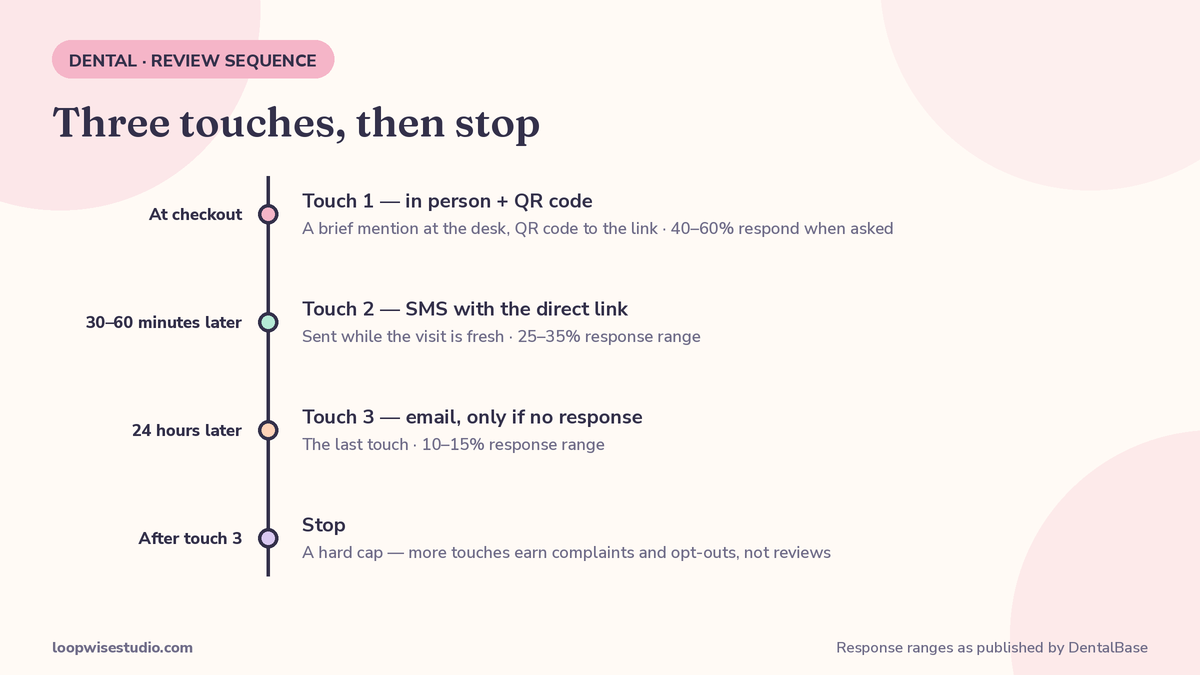
This is DentalBase’s published three-step sequence, which is the clearest in the market, with their response-rate ranges as they state them. Note that these are the vendor’s own figures for each channel — useful for planning, not a guarantee for your practice.
| Touch | When | Channel | Response range (DentalBase) |
|---|---|---|---|
| 1 | At checkout | Brief in-person mention, plus a QR code to the review link at the desk | 40–60% when asked |
| 2 | 30–60 minutes after checkout | SMS with the direct link | 25–35% |
| 3 | 24 hours later, only if no response | Email with the direct link | 10–15% |
And the cap, in DentalBase’s words, is a hard rule: never send more than three touchpoints total — one in-person, one text, one email. Their warning is specific: add a second text or a second email and complaint rates spike and opt-out rates roughly double. The automatic system earns its keep partly by what it refuses to do.
The three touches work as one system. The desk mention primes the patient (“you’ll get a quick text from us — if you have a minute, a review really helps”), so the text is expected rather than random. The text does the heavy lifting because it arrives while the visit is fresh. The email catches the people who meant to and forgot. If your reminder texts before appointments are already set up the same disciplined way — we covered that system in our article on text message appointment reminders for small dental clinics — the review sequence is simply its mirror image: same number, same restraint, opposite end of the visit.
Copy that fits in one text message. Short, neutral, no treatment named, ever:
Hi [Name], thanks for visiting [Practice] today. If you have a minute, a Google review would really help other patients find us: [link]
[Name], it’s [Practice] — thanks for coming in today. Would you mind sharing your experience on Google? [link] Reply STOP to opt out.
The email at 24 hours can carry slightly more warmth and one extra line explaining why it matters to a local practice — but the same link, and the same absence of treatment detail.
If you are wondering whether your current software can fire this sequence at all, that is a ten-minute check. You can get a free audit and we will trace your post-appointment flow — what fires, when, and what a patient actually receives — and tell you plainly what is missing.
The rules, plainly: Google, HIPAA and the FTC
Dentistry is where review automation has the strictest rulebook, and the good news is that the best sources in this market all state the same rules. DentalBase lists Google’s three prohibitions directly: (1) offering incentives — discounts, gift cards, prizes; (2) review gating — filtering patients through a satisfaction survey before sending them to Google; (3) fake or solicited reviews written by staff or purchased. The stated consequence is the removal of your entire review history and potential suspension of your Google Business Profile.
Rework’s guide adds the FTC layer in one sentence: offering discounts, gift cards, or any benefit in exchange for reviews violates Google’s policies and the FTC’s endorsement guidelines. MySocialPractice’s guidance to oral surgeons says the same thing in plainer words: never offer discounts or gifts for reviews, and never ask only happy patients.
Two of those rules deserve emphasis, because vendors blur both:
- No gating, including the polite kind. You will encounter review services — most visibly in the med spa market next door — that sell “negative feedback filtering”: a private satisfaction check first, happy patients passed through to Google, unhappy ones quietly diverted. In dental terms there is no ambiguity about this; DentalBase names it as prohibited gating, full stop. This article’s position is the same, and it is also just better strategy: ask everyone the same way, and spend your energy on the replies.
- No treatment details in the message — this is a HIPAA issue, not a style choice. DentalBase’s example is the one to tape to the wall: “Thanks for your visit” is compliant; “Thanks for your root canal” is a HIPAA violation, because the message itself discloses treatment to anyone holding the phone. Their stack rules follow from it: pull only name, date and provider from the practice system, and use a platform that has signed a BAA with you. Rework notes that HHS OCR has settled cases against dental practices over review-related disclosures, with penalties in the tens of thousands of dollars — mostly over replies, which is the next section.
A short compliance checklist for your setup:
- Same ask, to every patient, triggered by the appointment — never hand-picked
- No incentive of any value attached to reviewing
- Message copy contains no treatment, no clinical words, no appointment specifics beyond the visit itself
- Platform/vendor has a signed BAA (US practices); messages stored and handled as patient data
- Opt-outs honoured instantly, across review asks and reminders alike
- The review link is tested monthly — links rot when listings are merged or edited
US vs UK: what actually changes
Loopwise works with practices in both markets, and the honest answer is: less than the software salespeople imply. The bans are identical — no incentives, no gating, no fake reviews — because they come from Google and from basic advertising honesty, not from health privacy law. What changes is the privacy frame around the edges:
| United States | United Kingdom | |
|---|---|---|
| Privacy law in play | HIPAA — no PHI in messages or replies; vendor needs a BAA | UK GDPR / PECR — you need a lawful basis and consent discipline for marketing-style messages; appointment-related service messages are the easier category |
| The copy rule | “Thanks for your visit” yes; treatment names never | The same rule in practice — a text naming treatment is a confidentiality problem under professional standards even where HIPAA does not reach |
| Review rules | Google + FTC endorsement guidelines | Google + UK consumer protection law on fake/misleading reviews |
| Channel | SMS is the default | SMS works; WhatsApp is also a normal channel for UK patients |
If your practice is in the UK and your patients live on WhatsApp, the entire sequence above ports over — the WhatsApp-specific version, including how the link and the opt-in work there, is our guide to how to get Google reviews on WhatsApp for a clinic. The rules and the three-touch cap do not change with the channel.
Replying without breaking the rules
Automation asks. Humans reply — and replies are where dental practices get into privacy trouble, because it feels rude not to acknowledge what the reviewer just told the whole internet. Rework’s framework is the standard to copy, and its core rule surprises most practice owners: you cannot confirm or deny that the reviewer is a patient — even if the patient disclosed it themselves in the review. Their words, their choice. Your reply confirming it is your disclosure.
Frameworks adapted from Rework’s published guidance:
Positive review:
Thank you so much for taking the time to share this — kind words like these help other local patients feel confident about getting in touch. We really appreciate it.
No “glad your crown feels better, Mrs. Patel.” No treatment, no visit details, no confirmation.
Neutral or mixed review:
Thank you for the honest feedback. We hold ourselves to a high standard and there is clearly something here we can do better. I would welcome the chance to hear more — please call the practice and ask for [manager name].
Negative review:
I’m sorry to read this, and I take it seriously. I can’t discuss individual experiences in a public reply, but I would genuinely like to understand what happened. Please contact the practice directly on [number] so we can look into it properly.
Rework’s handling guidance adds the timing: respond within 24–48 hours, de-escalate, move it offline, and never argue facts in public — partly because you legally cannot argue them (the facts are clinical), and partly because every future patient is reading your temperament, not the dispute. Set an alert so reviews are seen the day they land; a thoughtful reply three weeks later helps nobody.
What to expect: realistic numbers by practice size
Most numbers in this market are vendor marketing. The two grounded sets are Rework’s velocity benchmarks and DentalBase’s funnel targets, both stated here as their publishers state them:
Reviews per month (Rework’s benchmarks for a well-tuned automatic system):
| Practice size | Expected new Google reviews per month |
|---|---|
| Solo practice, roughly 10–15 hygiene patients a day | 8–15 |
| Multi-doctor practice, roughly 30–40 patients a day | 25–50 |
The funnel targets to watch (DentalBase): ask rate of 90–100% of completed appointments (if your ask rate is 40%, your system has a trigger problem, not a patient problem); SMS link click rate of 25–35%; email click rate of 10–15%; overall conversion to a published review in the 30–45% range of those who click through the sequence.
Why it is worth the setup: BrightLocal’s 2024 Consumer Review Survey, as cited by DentalBase, found 70% of consumers will leave a review when asked directly — the demand is there; it is the asking that fails. And Rework, citing PatientPop (2023), puts the stakes plainly: 72% of patients check online reviews before selecting a dentist. The practices collecting reviews automatically are not gaming anything. They are simply present in the decision their future patients are already making.
Expect a ramp, not a switch: month one is the system bedding in and the ask rate reaching the 90s; by month three the velocity should sit inside the band for your size. If it does not, the metrics table tells you which stage is leaking — that is the entire advantage of a system over a habit.
DIY tool vs done-for-you on the system you already have
The guides in this market mostly route you to a platform: Rework names Birdeye, Weave and Podium, integrated with your practice software; DentalBase describes the stack (practice system + messaging platform + direct link + QR cards at the desk) and sells its own version of it. Those are legitimate routes, and if your practice has someone who will own the setup — timings per procedure, copy, BAA paperwork, link testing, reply alerts — a tool will serve you well.
The gap none of those pages addresses is the practice where nobody has that time, which is most small practices. The alternative is a done-for-you setup that runs on top of the website and booking system you already have: the trigger wired to your appointments, the three touches written in your practice’s voice, the reply alerts pointed at a named human, the metrics checked monthly. No new platform subscription to babysit, and the same build usually fixes the neighbouring leaks at the same time — the reminder sequence before the visit and the review sequence after it are one system wearing two hats.
Whichever route you choose, the questions to ask any vendor (including us) are the ones this page is built on: Does every patient get asked, or only the ones a survey approves of? Show me the message copy — does it name treatments anywhere? What is the maximum number of touches? Who has signed what on privacy? If the answers get vague, you have learned what you needed.
Frequently asked questions
How many reviews a month should a dental practice realistically get?
Use Rework’s benchmarks: a solo practice seeing 10–15 hygiene patients a day should expect roughly 8–15 new Google reviews a month from a well-tuned automatic system; a multi-doctor practice at 30–40 patients a day, roughly 25–50. Far above that band usually means someone is bending the rules; far below it means your ask rate or timing is broken, which the funnel metrics will locate.
Is it against the rules to text patients a review link?
No. Asking is allowed and normal — BrightLocal’s 2024 survey (via DentalBase) found 70% of consumers will leave a review when asked directly. What is prohibited is attaching an incentive, screening who gets asked based on satisfaction, or posting/buying reviews. And in the US, the text itself must contain no treatment information: “thanks for your visit,” never “thanks for your root canal.”
Why can’t I just ask the happy patients? They are the ones who will leave good reviews.
Because that is review gating, which Google prohibits explicitly — DentalBase lists it alongside incentives and fake reviews, with the stated penalty of losing your entire review history and risking your profile. It is also unnecessary: satisfied patients are the majority in most practices; they are just quiet. An automatic ask to everyone surfaces them without putting the profile at risk.
Can I reply to a review that mentions their treatment in detail?
Yes, but your reply must not confirm any of it. Rework’s rule: you cannot confirm or deny that the reviewer is a patient, even when they have described their own treatment publicly. Reply to the sentiment, thank them or apologise, and move specifics offline. Replies that repeat clinical details back are how practices end up in the HIPAA settlements Rework cites.
What if a patient leaves an unfair or false review?
Reply calmly using the negative template — sorry to read it, can’t discuss individual experiences publicly, please contact the practice — and flag it to Google if it breaches policy (for example, the reviewer was never a patient at all, which you can state in the flag report to Google even though you cannot litigate it in your public reply). Do not offer anything in exchange for changing it; that converts a bad review into an incentives violation by you.
Do I need a QR code as well as the automatic texts?
Yes, cheaply. DentalBase’s sequence starts with the desk: a brief in-person mention plus a QR code at checkout converts best of all their touches (40–60% when asked, per their figures). The card costs almost nothing, catches the patients who prefer to do it on the spot, and the automation catches everyone who walked out first and thought about it later.
The next step
Your patients are mostly happy and almost entirely silent, and the practices outranking you locally are collecting their praise on a schedule. The system that fixes it is unglamorous: a trigger, a 30-to-60-minute text, one email, a hard stop, and replies that confirm nothing. Built once, it runs after every appointment without anyone remembering.
Get a free audit and we will review your current post-appointment follow-up — what patients actually receive after they leave, and where the review ask should sit in it — and give you the sequence for your practice in plain language. If a DIY tool is the right call for you, we will say so.