Missed Call Text Back Service for Dental Practices
Missed call text back service for dental practices: every unanswered call gets a text in seconds, a reply that gets answered, and a booking link that books.
A missed call text back service for dental practices does one simple thing: the second a call to your practice goes unanswered, the caller gets a text from your number — “Sorry we missed you, how can we help?” — with a link to book. No voicemail. No hoping they call back. No watching a new patient ring the practice down the road instead.
That sounds small. It is not. Most dental practices miss calls at exactly the moments new patients call: Monday morning, lunch hour, and the twenty minutes when both front desk staff are with patients in the chair. A text that arrives in seconds keeps that caller in a conversation with you. A voicemail box does not.
This page explains how the service works for a dental practice specifically, what it should say, what it costs compared with buying a tool and setting it up yourself, and the compliance points a practice has to get right. If you want us to check your current setup first, that is what the free audit is for.
What missed call text back is — and what it is not
Missed call text back is an automatic text message triggered by one event: an unanswered call. The caller does not have to leave a message, fill in a form, or do anything at all. They called, nobody could pick up, and a text goes out within seconds.
It is not a chatbot bolted onto your website. It is not a marketing blast list. It is not a promise that a robot will handle a worried patient with tooth pain — or at least, it should not be.
And one text on its own is not a system. The text is the easy part. The part that decides whether you book the patient is what happens next:
- Who answers when the caller replies?
- Does the reply go to a person who is free, or to the same front desk phone that just missed the call?
- Does the conversation end with a booked appointment on your calendar, or with “we’ll call you back”?
- Does the patient then get a confirmation and a reminder, or silence until the day?
A good service answers all four. A cheap tool often answers none of them — it sends one text and leaves the rest to you. That gap is the whole reason this exists as a done-for-you service rather than just another software login.
For comparison, the same idea applied to med spas is covered in our guide to missed call text back for med spas — the mechanics are similar, but dental callers behave differently, and the messages below are written for dental.
What a missed call actually costs a dental practice
Nobody can give you an exact figure for your practice without your call log. But you can do the maths with your own numbers in about two minutes, and it is worth doing before you decide this is a minor problem.
Quo, a phone system provider, cites Invoca data that most businesses miss nearly a quarter of their incoming calls. Dental practices are not immune to that — in many ways they are more exposed, because the front desk is also checking patients in, taking payments, and confirming tomorrow’s schedule.
Here is a worked example using cautious numbers. Change them to match your practice.
| Item | Example figure | Your figure |
|---|---|---|
| Calls per week | 120 | |
| Missed (at roughly 1 in 4) | 30 | |
| Of those, new-patient enquiries | 6 (1 in 5) | |
| Lost if there is no fast follow-up (half) | 3 per week | |
| New patients lost per year | About 150 | |
| First-year value of one new patient | $500–$1,000+ |
Even if you cut every number in that table in half, the leak is still dozens of new patients a year — patients who found you, chose you, rang you, and then booked somewhere else because a phone rang out.
Not all missed calls are worth the same, either. That is the part most generic text-back guides miss:
| Type of call | What is at stake |
|---|---|
| New patient, general check-up | A patient who may stay with the practice for years, plus family members who often follow |
| Hygiene recall patient | Easy revenue to lose — they will book with whoever makes it simplest |
| Tooth pain / emergency | Urgent, high intent, will call the next practice within minutes if nobody responds |
| Implant, Invisalign or cosmetic enquiry | One case can be worth thousands — and these callers are comparing two or three practices at once |
| Existing patient rescheduling | Low value if handled well, a no-show if handled badly |
A text-back service that treats all five the same way is leaving money on the table. The first message can be the same. The follow-up should not be.
How the service works, step by step
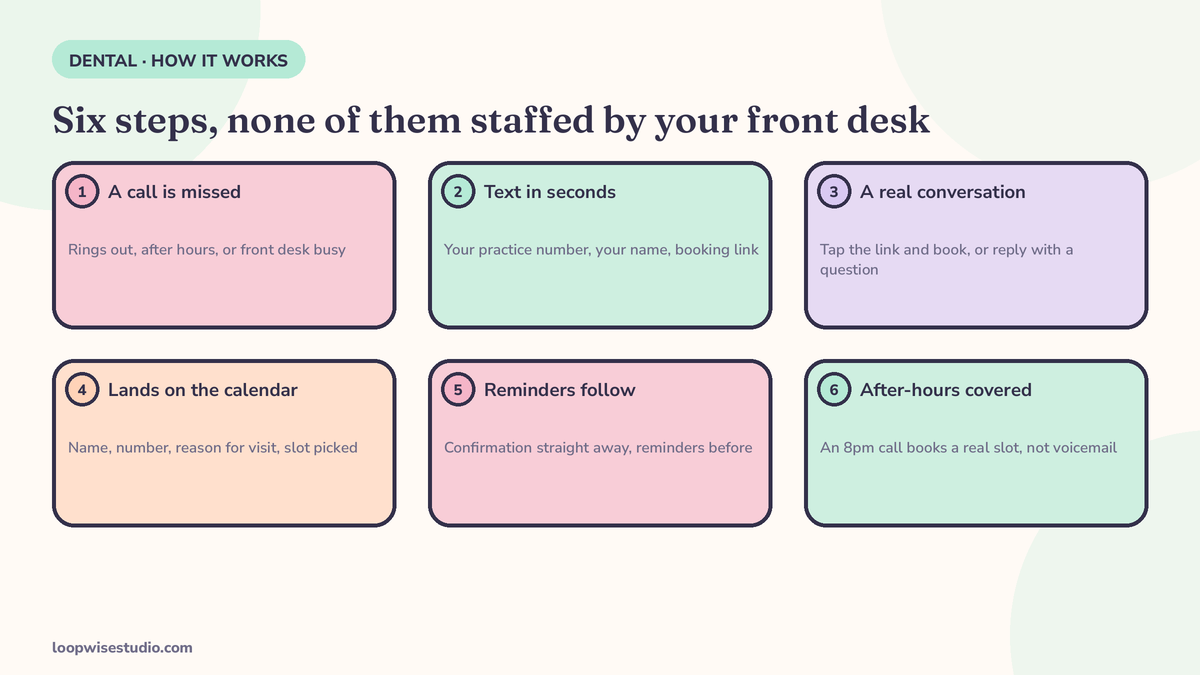
Here is the flow we set up, in plain order:
- A call is missed. It rings out, comes in after hours, or arrives while the front desk is busy. The reason does not matter.
- A text goes out in seconds. It comes from your practice number, uses your practice name, and includes a direct booking link. Speed matters more than wording — a text after 20 seconds reaches someone still holding their phone; a text after 20 minutes reaches someone who has already called another practice.
- The caller replies — and a real conversation starts. They can tap the link and book, or reply with a question. Replies land in an inbox your team can actually see and work from, not buried in a personal phone.
- The appointment lands on your calendar. Name, number, reason for the visit, and the slot they picked. Your team sees it like any other booking.
- Confirmation and reminders follow automatically. The patient gets a confirmation straight away and reminders before the appointment — the same reminder sequence that cuts no-shows, which we walk through in how to reduce no shows at a med spa, and which works the same way for a dental diary.
- After-hours calls are covered too. A call at 8pm gets the same text and the same booking link. The patient books a real slot instead of leaving a message your team finds the next morning — by which time they may have booked elsewhere.
Nothing in that flow asks your front desk to work harder. It asks the system to catch the calls the front desk physically cannot.
Not sure how many calls you are actually missing? get a free audit — we check your current missed-call path and your booking page, and show you where callers are dropping off. No charge, no obligation.
The five dental scenarios it has to handle
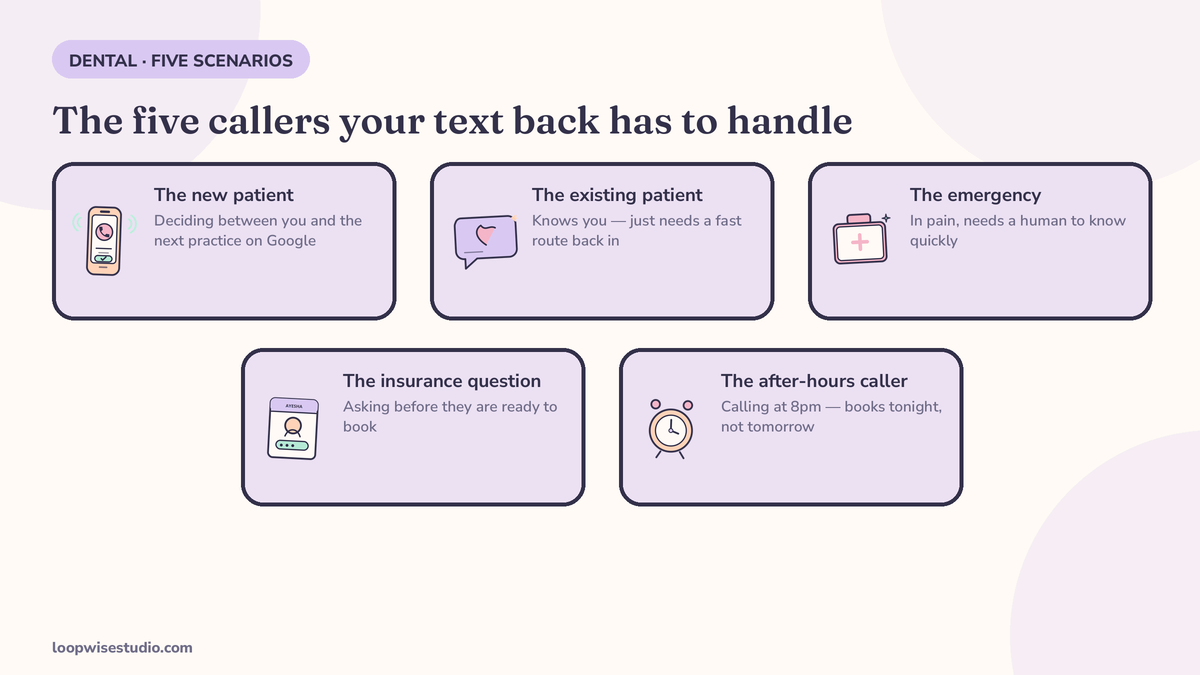
Generic templates fail in dental because dental calls are not generic. These are the five situations your messages need to be ready for.
1. The new patient
They found you on Google, liked your reviews, and called. They have no loyalty to you yet. The text needs to do three things fast: apologise briefly, name the practice so they know it is really you, and make booking one tap. Anything longer and they move on.
2. The existing patient
They already trust you. They are probably rescheduling, asking about a treatment plan, or chasing a referral. The text should acknowledge them and offer the quickest route — the booking link for simple changes, or a promise of a callback with a time attached for anything clinical.
3. The emergency
Tooth pain changes behaviour. That caller is not browsing; they are hurting and working down a list. The reply needs to be fast, human, and clear about the earliest you can see them. And it must never try to diagnose by text — the job of the message is to get them booked or speaking to a clinician, not to assess them. More on that under compliance below.
4. The insurance question
“Do you take my insurance?” is one of the most common reasons a new patient calls instead of booking online. If the text ignores it, the caller assumes the answer is no. A good setup has a short, honest reply ready — which networks you work with, or a clear “here is how we handle out-of-network” answer — so the question does not kill the booking.
5. The after-hours caller
Evenings and weekends are when working patients finally get round to booking a dentist. Your practice is closed, but their intent is at its highest. An after-hours text that offers real slots turns that intent into an appointment. An answering machine message turns it into a task for tomorrow that the patient often never completes — they book with the practice that answered first, even if “answered” just means a text.
Copy-paste text-back templates for dental practices
Steal these. Adjust the practice name, the link, and the tone to match how your team actually talks.
New patient, during hours:
Hi, this is [Practice Name] — sorry we missed your call, we’re with a patient. You can book here in under a minute: [booking link]. Or reply to this text and we’ll help.
Emergency / tooth pain:
Sorry we missed you — if you’re in pain, reply PAIN to this text and we’ll get back to you as fast as we can with the earliest slot we have. You can also see today’s availability here: [booking link].
After hours:
Thanks for calling [Practice Name] — we’re closed right now and open again at [time]. You don’t need to wait: you can book an appointment here [booking link], or reply and we’ll pick this up first thing.
Hygiene recall / existing patient:
Hi [First name], it’s [Practice Name]. Sorry we missed your call. If you were booking your next check-up or clean, you can pick a time here: [booking link]. Anything else, just reply.
A few rules that apply to all of them:
- Send one text, not a chain of them. One helpful message is service; three in a row is spam.
- Put the booking link in the first message. A text that only says “we’ll call you back” wastes the caller’s highest-intent moment.
- Keep clinical detail out of the text entirely (see the HIPAA section below).
- If the same person calls twice in one day, they should not get the identical auto-text twice.
Clinics outside the US take the same approach over WhatsApp rather than SMS — we explain that version in our guide to WhatsApp appointment reminders for clinics in the UK.
Already have Weave or GoHighLevel? Why practices that “have” text back still lose callers
This is the most common thing we find in audits: the practice is paying for a platform that includes missed call texting — Weave includes a feature called Missed Call Texting, and GoHighLevel can be configured to send one — but patients are still being lost. Usually it is one of these four settings:
- The feature is on, but there is no booking link in the message. The text says “sorry we missed you, please call back.” The caller has already called. Asking them to do it again loses most of them.
- The allowance runs out. In its comparison of text-back tools, Carly’s pricing table (checked 1 October 2026) notes Weave plans start at $199/month — and Quo’s roundup points out that Weave’s base plan includes 1,500 messages a month, with online scheduling requiring an upgrade. If your confirmations, reminders and text-backs all draw on the same pot, the pot can empty before the month does.
- Nobody owns the replies. The auto-text fires, the patient replies “do you have Saturday mornings?” — and the reply sits unread because it lands somewhere the front desk does not check. Peerlogic, a dental communications vendor, reports its own client data that AI text-back recaptures 30–40% of callers who would otherwise dial a competitor — vendor-reported figures, but the direction matches common sense: a reply that is answered books; a reply that is not, doesn’t.
- It only covers one number or one location. Calls to the other number, the other location, or the after-hours line fall outside the setup entirely.
If any of those sound familiar, you probably do not need a new platform. You need the setup audited and the gaps closed — which is exactly what a service does and a software subscription does not.
Text back needs somewhere to send people: your booking page
Here is the gap nobody in the software world talks about. Every text-back tool assumes you already have a booking page worth sending people to.
Many dental practices do not. They are phone-only, or their “online booking” is a contact form that promises a callback within one working day, or a scheduler buried three clicks deep on a slow website that does not work well on a phone — and almost every one of these callers is on a phone, holding it, right now.
A text that lands in seconds followed by a booking page that takes ten seconds to load and asks for information the patient does not have to hand will still lose the patient. The text buys you attention. The page has to convert it.
That is why we build this as one system: the practice website, the booking page, and the text-back flow together, designed so a caller can go from missed call to confirmed appointment in about a minute, on their phone, without speaking to anyone. If your website is fine, we keep it and fix the path. If it is the bottleneck, we rebuild that part too.
HIPAA and TCPA: what a dental practice must get right
Two sets of rules matter here, and a practice should hear them plainly before switching anything on.
HIPAA — keep health information out of texts. A text back should contain no clinical details: no diagnoses, no treatment specifics, no test results, nothing about a patient’s condition. “Sorry we missed your call, here’s how to book” contains no protected health information. A message referencing someone’s treatment does. Also ask any vendor a direct question: will you sign a Business Associate Agreement for the parts of the system that handle patient contact data? If the answer is vague, that is your answer.
TCPA and 10DLC — consent and identification. In the US, automated texts sit under the TCPA, and business texting numbers need A2P 10DLC registration so messages are identified and actually delivered rather than filtered as spam. Key points, as set out in Carly’s text-back compliance summary:
- A phone call from a patient is not blanket written consent to send them marketing. A service text about the call they just made is a different thing from adding them to a promo list — do not blur the two.
- Every message must make it easy to opt out, and opt-outs must be honoured — the rules on revoking consent tightened in April 2025.
- Send one text per missed call, during reasonable hours, from an identified number.
A done-for-you setup handles the registration and the templates with this built in. If you buy a tool and configure it yourself, this part is on you — one more reason practices end up with the feature switched off “to be safe,” losing the callers it was meant to catch.
The speed point is worth underlining. A Harvard Business Review write-up of a study of 1.25 million sales leads found that firms which contacted a lead within an hour were nearly seven times as likely to qualify it as firms that waited even an hour longer, and more than 60 times as likely as firms that waited a day or more. Dental enquiries are not sales leads in quite that sense — but a patient in pain or a new patient comparing practices behaves exactly like one.
DIY tool vs done-for-you service: an honest comparison
You have three real options. Here they are without the sales talk.
| Option | Typical cost (as reported Oct 2026) | What you get | What is still on you |
|---|---|---|---|
| Basic phone/text tool (e.g. Grasshopper from $14/mo, Quo from $15/user/mo) | Low monthly fee | A number and an auto-text | Templates, booking page, reply handling, compliance setup |
| Practice platform (e.g. Weave from $199/mo; HighLevel $97/mo + usage; Podium Core $399/mo) | Mid to high monthly fee | Text-back inside a bigger platform | Configuration, message allowances, making sure replies are owned, your website and booking page |
| Done-for-you service (Loopwise) | A fixed build price, set after a short discovery call | Website + booking page + text-back built, written, tested and running; replies routed to your team properly | Answering the conversations it starts — which is the work you wanted in the first place |
Prices in the first two rows are from Carly’s comparison table, which says they were taken from the vendors’ own pricing pages and checked on 1 October 2026. Check current pricing before you buy anything — vendors change it often.
The honest summary: if you have someone in the practice who enjoys setting up software and will own the replies inbox, a tool can work well and will cost less per month. Most practices do not have that person. They have a front desk that is already the busiest seat in the building. For them, a tool bought is a tool half-configured — and the setup is the part that decides whether this works.
How our setup works
Briefly, because the detail belongs in a conversation about your practice:
- We audit your current path free — what happens today when a call is missed at your busiest times, and where your booking page loses people.
- We agree a fixed price for the build. No hourly billing, no open-ended project.
- We build or fix the booking page, write the text-back messages for your five scenarios, set up the number registration and opt-out handling, and test the whole flow with real test calls.
- Your team gets a simple handover: where replies land, who answers them, and what to do with an emergency reply.
- It runs. You see the bookings it catches.
If that sounds like the version of this you have time for, get a free audit and we will start with step one — checking your missed-call path costs you nothing and tells you whether you even have this problem at the size you think you do.
FAQs
Does missed call text back replace my front desk?
No. It covers the moments your front desk physically cannot answer — when they are with a patient, on another call, at lunch, or when the practice is closed. Your team still handles the conversations. The service makes sure the conversation starts instead of ending at a ringing phone.
Will patients find an automatic text impersonal?
In practice, patients find silence worse. A short text that names your practice, apologises, and gives them a way to book reads as attentive, not robotic — especially compared with a voicemail greeting. Eight in ten Americans say they do not generally answer calls from unknown numbers, according to a Pew Research Center survey cited by Carly — which is also why a text from your number often gets a reply when a callback from an unfamiliar number would be ignored.
What if the caller is on a landline?
A landline cannot receive a text. In that case the flow should fall back to voicemail as normal, and the missed call should still be logged for your team to return. Landline callers are a shrinking minority of new-patient calls, most of which now come from mobiles.
Does this work with the practice management software I already use?
The text-back flow needs to put a booking on your calendar and trigger confirmations and reminders. How that connects depends on your current software — some systems take a direct booking, others work through a booking page that your team confirms. This is one of the things the free audit checks, so you are not promised a connection that does not exist.
How fast does the text need to go out?
Within a minute, and ideally within seconds. Setup guides such as Frontdesk63’s recommend under 60 seconds. The caller’s intent is highest in the first moments after the call — they are still holding the phone, still thinking about booking a dentist, and have not yet dialled the next practice.
Is it legal to text a patient who called us?
A service text responding to a call the patient just made sits in a different category from marketing texts, but it still has to be done properly: an identified, 10DLC-registered number, no clinical information in the message, one message rather than a sequence, and opt-outs honoured immediately. If a vendor cannot explain how they handle that, do not switch it on until they can.