Booksy Alternatives for UK Barbers Who Book on WhatsApp
A Booksy alternative for barbers in the UK with WhatsApp: what Boost really costs in £, the hybrid most shops should run first, and how to migrate safely.
If your clients already message your WhatsApp number to book, the best Booksy alternative is not another marketplace app — it is your own booking page with WhatsApp reminders from your own number, set up so clients book in the chat they already use with you. Keep Booksy running for discovery while you move your regulars over, and most shops never need to make a dramatic switch at all. This page works through what Booksy actually costs a UK barber — including the Boost maths nobody publishes — the app problem that quietly leaks your regulars, and the hybrid route we would run first.
What Booksy actually costs a UK barber
Booksy is more honest than most marketplaces, so let us be fair to it first. As BookWith states, citing Booksy’s own pricing page as read on 8 October 2026 (biz.booksy.com/en-gb/pricing): there is no commission on ordinary bookings — not on clients who find you through your own marketing, not on clients who find you online, and not on marketplace bookings while Boost is off.
The charge lives in Boost. With Boost switched on, a client who books you for the first time through the marketplace carries a one-off fee of 30% of that first visit, at least £5 — unless they came through your own Booksy profile link. One more honesty note: Booksy’s UK subscription price was not stated in any of the sources researched for this article, and subscriptions change, so check the current figure on Booksy’s pricing page rather than trusting any roundup — including this one — to carry the number.
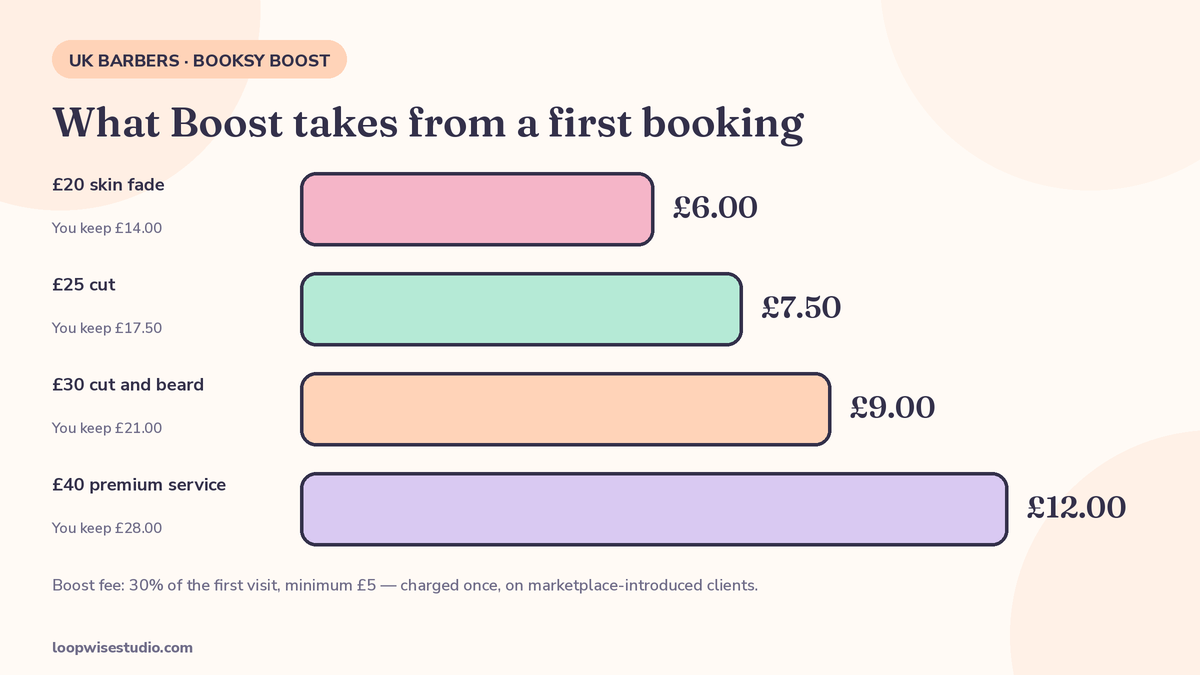
Now the maths nobody does. On real UK price points, a Boost-acquired first visit costs you:
| First booking | Boost fee (30%, min £5) | What you keep |
|---|---|---|
| £20 skin fade | £6.00 | £14.00 |
| £25 cut | £7.50 | £17.50 |
| £30 cut and beard | £9.00 | £21.00 |
| £40 premium service | £12.00 | £28.00 |
Is that a bad deal? For a genuinely new client who becomes a regular, £7.50 to acquire someone worth £25 every three weeks is cheap marketing — cheaper than most ads. The problem is the second part of the equation: that client now lives inside Booksy’s app, gets shown your competitors, and rebooks through the marketplace habit you paid to build. The fee is one-off. The channel is permanent. A regular worth roughly £400 a year in cuts should be rebooking on a page you own, from reminders on your own WhatsApp number — not inside an app that can show them the shop two doors down at the moment they tap “book again.”
That is the real cost of Booksy for a UK barber: not the subscription, and not even the Boost fee. It is the rent you keep paying, in attention and loyalty, on clients you already won.
The app problem: why marketplace booking leaks your regulars
Think about how your clients actually book today. Most UK barbershops run on a personal number: clients message “any chance Saturday morning?”, the barber replies between cuts, done. It is clunky, it eats your evening — and it works, because it meets clients where they already are.
A marketplace replaces that with friction. To book, a client needs the Booksy app or an account, a search, a profile visit, and then the booking. Every step is a place to drop off, and the clients who drop off do not vanish — they walk in somewhere else, or they message you on WhatsApp anyway, and now you are running two booking systems badly instead of one well.
The alternative shape is simple: a booking page of your own that opens straight from a WhatsApp chat — your number, your name on the messages, live slots, a deposit on the appointments that need one, and reminders that come back on the same WhatsApp thread the client already trusts. If that structure sounds familiar, it is exactly the setup laid out in our guide to a booking system for UK salons with WhatsApp reminders — the same mechanics, tuned here for barbershops: shorter slots, walk-ins alongside appointments, and chair renters with their own links.
The alternatives compared for UK barbers
The UK supply of WhatsApp-first booking tools exists, but it is buried in directory listings rather than editorial comparisons — which is partly why you are reading a page like this at all. Here is the honest shape of the field, as described by the sources researched for this article (directory and vendor copy, so treat feature claims as theirs and verify before you pay):
| Option | WhatsApp booking/reminders | Marketplace? | Commission | App required for clients? |
|---|---|---|---|---|
| BookWith | Not its pitch — browser booking page, done-for-you setup | No | None taken from bookings, per its own page | No — browser-based, no download |
| Happoin | Yes — automated reminders from your own business number, AI booking chat | No | Free plan up to 40 appointments/month with no commission (its UK page prices in USD, oddly — check current terms) | No |
| Replan (via Capterra UK listing) | Yes — clients book, reschedule and cancel through WhatsApp | Explicitly not a marketplace | Calendar itself is free per its listing; no POS or billing included | No |
| Fresha | Reminders, but not a WhatsApp-first product | Yes | Commission on marketplace-acquired clients; our Fresha alternative page works through that trade in detail | Fresha app encouraged |
| Square Appointments | Reminders, not WhatsApp-led | No | Free for solo use per Happoin’s comparison; processing fees apply | No |
Two cautions about this table. First, the WhatsApp-native tools are younger and smaller than Booksy; check how long they have been around and how you would get your client list out before you build your Fridays on one. Second, “WhatsApp reminders” can mean anything from a message you send manually to a proper automated sequence with confirm-and-reschedule buttons. Ask to see the actual message flow before you sign — a reminder that cannot be replied to is a notification, not a booking system.
And ignore round-number promises while you comparison-shop. One templated agency page ranking for this search claims UK barbershops see “60% fewer no-shows” and a “35% revenue increase” from WhatsApp automation, with no source for any of it. Numbers without a source are not evidence; judge any setup on your own counted no-shows before and after.
The UK barber specifics no marketplace page mentions
Three realities of UK barbering shape the right setup, and none of them appears on the comparison pages for this search.
Walk-ins and appointments in the same diary. Many UK shops run a hybrid: booked slots for regulars, a walk-in queue for everyone else, and Saturday operating as its own country. A booking page that only handles tidy advance appointments will be abandoned by Friday. Whatever you run must let a walk-in join a visible queue while booked clients keep their slots — and must make Saturday’s deposit rule stricter than Tuesday’s without you editing settings twice a week.
Chair renters are separate businesses. A renter’s clients are the renter’s clients. They need their own booking link, their own reminders and their own list — and the shop owner’s system should not swallow them into a marketplace account the renter cannot take with them when they move chairs. If you rent out chairs, ask any provider, in writing, whose name the client list belongs to.
Your clients already have your number. In most UK shops the real booking system today is a personal WhatsApp, messages answered between cuts and at 11pm. It is unsustainable — and it is also proof of demand for exactly the channel this article is about. The goal is not to move clients off WhatsApp. It is to give the number they already message a proper diary behind it, so the chat stops being your unpaid evening job.
Keep those three in view and most of the comparison table above scores itself.
The hybrid most shops should run first
Here is the move we would recommend to most UK barbershops, and it is not “leave Booksy tomorrow.”
Keep Booksy for discovery. Move your regulars to your own page and your own WhatsApp. Booksy is genuinely good at one job: putting your shop in front of strangers searching for a barber nearby. That is worth the subscription while it lasts. What it should never own is the rebooking of people who already know your name.
The hybrid, step by step:
- Set up your own booking page with your services, real slots, and a deposit on no-show-prone appointments (new clients, Saturdays, long services).
- Connect WhatsApp properly: booking confirmations and reminders from your own business number, with replies landing in a thread you control — including a missed-call text-back for the calls that come while every chair is busy. That exact pattern is covered in our guide to missed call text back for salons and barbershops.
- Move regulars at the chair, not by broadcast. After their next cut: “Book direct next time — here’s the link, it’ll remind you on WhatsApp.” One conversation per regular, over a few weeks. These are your highest-value clients; they deserve a sentence, not a mass message.
- Point everything you control at your own page: Instagram bio, Google profile, the link in your WhatsApp status, the QR code on the mirror.
- Watch Boost for one month. Once your regulars book direct, check what Boost is still bringing you. If the new-client flow justifies 30% of a first visit, keep it with your eyes open. If Boost is mostly charging you for people who would have found you anyway, switch it off.
Most shops find the decision makes itself by step five: the marketplace becomes a small, honest discovery channel, and the diary — the valuable part — is theirs.
If setting this up yourself sounds like another evening of unpaid admin, that is precisely the job Loopwise does for shops: your own booking page, WhatsApp reminders and text-back from your number, done for you. Get a free audit and we will look at your current Booksy setup and tell you whether the hybrid is worth it for your chair count.
Moving off Booksy properly: the migration checklist
If you do decide to leave entirely, do it in the right order — the migration facts are less friendly than the marketing.
- Ask Booksy Support for your client list first. Per Booksy’s UK help centre (as cited by BookWith, help page updated 3 September 2026), your client list is obtained by asking Booksy’s Support team for a copy. Request it before you announce anything, and check what actually arrives.
- Know what does not come with you. Only the people transfer — not their appointment history. Bookings already made inside Booksy stay there until they are done. Export or note down anything you rely on: regulars’ usual services, formula notes, who is mid-way through a course.
- Run both systems for a few weeks. New bookings go to your new page; existing Booksy bookings are honoured where they were made. Publish one clear cut-off date and stick to it.
- Tell clients once, in the channel they use. A WhatsApp message from your own number: new booking link, what stays the same (you, the chair, the price), what changes (no app needed). Repeat it pinned in the shop and on Instagram, then stop apologising for it.
- Close the loop. Once the parallel run ends, cancel the subscription in writing, keep your exported client list somewhere backed up, and check your Google and Instagram links one last time.
Done in that order, leaving Booksy is a fortnight of mild admin. Done backwards — cancel first, ask for your data second — it can cost you the client list the whole business sits on.
Whether you run the hybrid or leave outright, the setup work is the same shape: a booking page that is yours, reminders on your own WhatsApp number, deposits where they earn their place. If you would rather cut hair than configure it, get a free audit — we will map your current Booksy setup and show you the cheapest route off it, or tell you honestly if staying put is the right call.
FAQs
Does Booksy take commission from UK barbers?
Not on ordinary bookings. As stated on Booksy’s own pricing page (read 8 October 2026, via BookWith): no commission on clients from your own marketing, your own profile link, or marketplace bookings while Boost is off. With Boost on, a new marketplace client’s first visit carries a one-off fee of 30% of that visit, minimum £5. There is also a subscription — check the current UK price on Booksy’s pricing page.
Can my clients book without downloading an app?
Yes — that is the main reason to run your own booking page or a browser-based tool like the ones in the table above. The client taps a link, usually inside the WhatsApp chat they already have with you, and books. No account, no download, no marketplace in between.
Can I keep my own WhatsApp number for bookings and reminders?
With a WhatsApp-first setup or your own booking layer, yes — confirmations and reminders go out from your business number and replies come back to you. With a marketplace, the conversation lives inside the app, which is exactly the habit this page suggests moving your regulars out of.
What happens to bookings already made in Booksy if I switch?
They stay in Booksy until they are done. Your appointment history does not migrate, and your client list has to be requested from Booksy Support. That is why the checklist runs both systems in parallel for a few weeks instead of switching overnight.
Is it worth keeping Booksy just for new clients?
Often, yes — at least for a while. Boost’s 30% of one first visit is reasonable money for a stranger who becomes a regular, provided the regular then rebooks direct with you. It stops being worth it when Boost is your only flow of new faces and the regulars never leave the app.
Do WhatsApp reminders really reduce no-shows for barbers?
Reminders on any channel a client actually reads will beat a silent diary, and WhatsApp is where UK clients already talk to their barber. Be wary of anyone quoting you a guaranteed percentage for it — the claims on this search are unsourced. Set up reminders plus a deposit on risky slots, count your no-shows for a month before and after, and believe your own numbers.