Best Booking Software for a One-Person Aesthetic Clinic
The best booking software for a small aesthetic clinic owner operator, scored on solo criteria: true cost at one provider, your admin time and no-shows.
If you run an aesthetic clinic on your own, the best booking software is rarely the one at the top of the roundups. It is the one that costs the least at exactly one provider, takes the deposit and sends the reminders without you touching it, and does not make you learn a clinical records system just to book a facial. For most owner-operators that means a simple booking-first tool — or keeping the tool you already have and adding a proper booking and reminder layer to it — not the enterprise suites the comparison sites keep crowning.
This guide is scored for one person. Not a growing team, not a franchise-in-waiting. One practitioner who is also the receptionist, the marketer and the cleaner.
First, an honest word about every roundup you will read (including this one)
Before the scores, you should know how the existing rankings for this search are built, because it explains why they keep giving you the wrong answer.
- Phorest’s comparison ranks Phorest first. PatientNow’s “best medspa software for solo practitioners” ranks PatientNow first — and its winner is a full clinical practice-management system with an EMR, injection tracking, telehealth and staff goal dashboards. Both are vendor pages wearing a roundup’s clothes.
- The Digital Merchant discloses that it earns a commission when you click through and buy — and its number one pick, Boulevard, is the affiliate-linked one.
- Rankite is the most independent of the set, and it says so plainly: it did not test any of the tools hands-on, its ratings come from G2 and Capterra, and in its quick comparison table the starting price for all eight tools is listed as “See website.”
None of that makes these pages useless — several have genuinely good per-tool pros and cons lists. It does mean their rankings answer their question (“which platform wins this segment?”), not yours (“what should one person with no front desk actually run?”). This page has a bias too, and it is worth stating: Loopwise sells done-for-you booking setups. The criteria below are the ones we would want scored on. Judge them on whether they fit your week, not on who wrote them.
The short answer for a one-person clinic
Buy booking first. Skip the practice-management suite for now. Your software has three jobs that make or protect money every single week:
- Take a booking while you are mid-treatment, with a deposit or card on file for high-value appointments.
- Send a reminder sequence that cuts no-shows without you remembering a thing.
- Bring the client back — a rebooking prompt when the next treatment is due, not when you get a quiet evening.
Everything else — charting depth, injectable lot-tracking, multi-location reporting, payroll, KPI dashboards — is software for a business with staff and rooms. There are three exceptions where a fuller system earns its keep even solo: your regulator or insurer requires clinical records in a specific form; you do a high volume of injectables and genuinely need lot-level tracking; or you are months, not years, from hiring and would rather migrate once. Outside those, the suite is a monthly fee for features you will open twice. Allied-health practitioners usually meet the records exception with Cliniko — our guide to Cliniko alternatives for allied health clinics explains what it includes and where owner-operators tend to leave.
If you already run something that books appointments adequately, read the last section before you buy anything. Plenty of solo clinics do not need new software at all.
Want a straight answer for your exact setup before you spend anything? Get a free audit — we will look at what you run now and tell you whether to keep it, fix it or replace it.
Why every roundup scores you like a chain
Read the scoring columns on the big comparisons and a pattern shows up fast. Chains are scored on multi-location scheduling, cross-location reporting and revenue attribution, staff performance management, room and equipment scheduling, and EMR depth. Zenoti, for example, is praised across roundups precisely for enterprise strength — it is a fine platform for a group with dozens of locations and an operations manager.
Now count what those same pages say about running solo. Across roughly 12,900 words of roundups we read for this article, the solo-specific evaluation comes down to: GlossGenius is simple, Yocale has a free plan, and — in Phorest’s own “how to choose” tail — “a straightforward scheduling tool like Vagaro or Timely may be sufficient” for a solo provider. PatientNow uses the word “solo” in its title while ranking an enterprise EMR first, and even its own cons list admits a full system “may require onboarding time for solo practitioners.”
Nobody models your cost at exactly one provider. Nobody counts your setup hours or your evening admin. Nobody asks who answers a message while your hands are in a treatment. And nobody mentions WhatsApp at all — despite it being the channel clients actually message on in the UK, Ireland and the UAE. That is the gap this guide fills.
The 6 criteria that actually matter when the staff is you
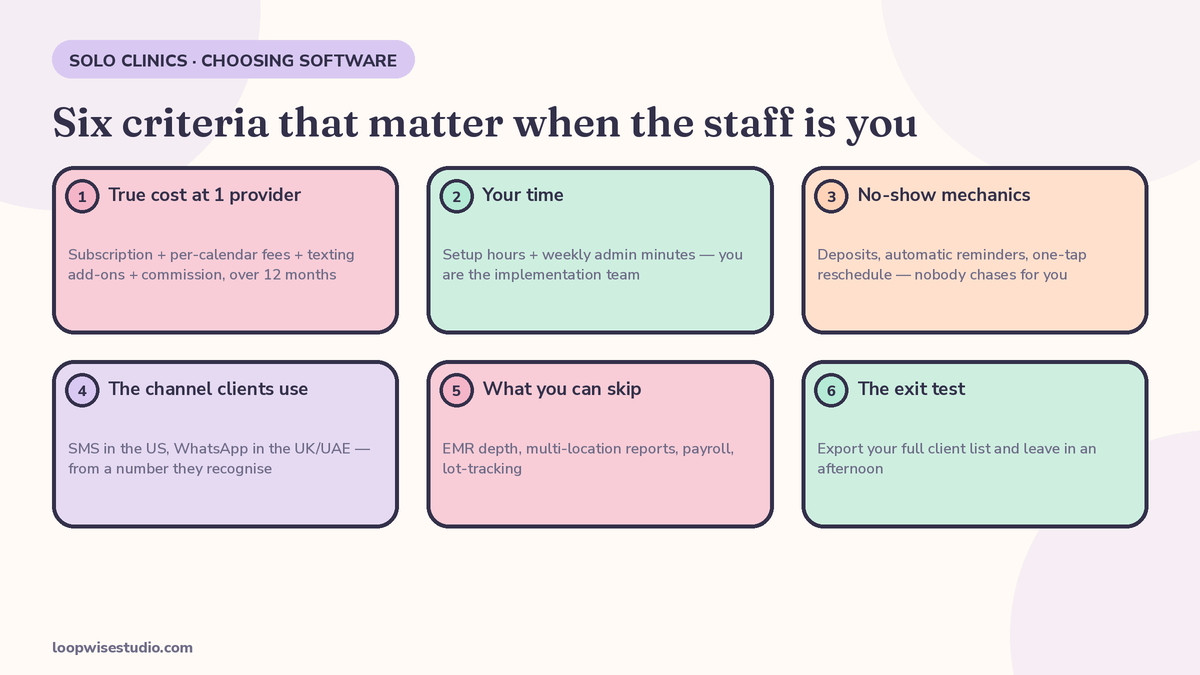
Score any tool on these before you look at a feature list:
| Criterion | What to check | Why it decides it for a solo operator |
|---|---|---|
| 1. True cost at 1 provider, 12 months | Subscription + per-calendar fees + texting add-ons + commission on your booking mix | Headline prices are quoted for the smallest tier; add-ons are where solo bills grow |
| 2. Your time | Setup hours + weekly admin minutes | You are the implementation team. A weekend of setup and an hour a week of admin is a real cost |
| 3. No-show mechanics that work with no staff | Deposit or card-on-file at booking, automatic reminder sequence, one-tap reschedule | Nobody will chase confirmations for you — the system has to |
| 4. The channel your clients use | Reminders and replies by SMS (US) or WhatsApp (UK/UAE), from a number clients recognise | Email reminders get read tomorrow. A message on the app they live in gets read now |
| 5. What you can skip | EMR depth, multi-location reports, payroll, lot-tracking | Every skipped module is money and learning curve you keep |
| 6. The exit test | Can you export your full client list and leave in an afternoon? | Your client list is your business. If it is hostage, the cheap plan is not cheap |
That last one is easy to miss when you are starting out and painful later. Ask the export question before you pay, in writing, and keep the answer.
The honest shortlist, scored on those criteria
Seven tools come up again and again for this search. Here is each one judged as a solo purchase — where it genuinely wins and where it will annoy exactly one person.
GlossGenius — the simplicity pick. Rankite places it last in its eight-tool list, but its reasoning is the most solo-honest on the page: it “suits solo injectors and small teams for its simplicity.” If your dread is learning software, this is the one owners consistently describe as the least work. The trade-off is depth: as your treatment menu and reporting needs grow, you will feel its edges sooner than the bigger platforms’.
Yocale — the free start. Rankite calls it “the cheapest credible start,” with a free plan and a 4.5/5 G2 rating as reported in its comparison (checked October 2026). For a new clinic booking a handful of appointments a week, free and working beats powerful and half-configured. Plan the upgrade conversation for when volume makes the limits pinch.
Timely — the quiet UK/Ireland-friendly option. Phorest’s roundup gives Timely the most grounded solo write-up anywhere on this search: independent and dual-provider clinics, automated deposit collection, and SMS reminders formatted properly for UK and Irish numbers, with pricing in GBP and EUR. If you are UK-based and want deposits handled without drama, it deserves a trial. If you are weighing the same tool in New Zealand, our Timely alternative for New Zealand salons runs the comparison with local pricing and reminder behaviour.
Vagaro — the budget all-rounder with an add-on habit. Every roundup respects Vagaro’s value — Rankite reports a 4.6/5 G2 rating across 397 reviews — and every honest one flags the same catch: features like two-way texting arrive as paid add-ons, so the bill you finish with is not the bill you started with. If Vagaro is on your list, our Vagaro alternative page breaks down exactly where the add-on costs stack up before you commit.
Fresha — free entry, marketplace economics. Fresha’s lean pricing is real and attractive when you are starting out. The cost shows up on the other side: marketplace-sourced new clients carry commission, which is painless for a client you would never have met and expensive for a regular who would have found you anyway. If that trade is your main worry, the Fresha alternative page works through the maths of keeping your regulars commission-free.
Boulevard — the premium client journey, priced like it. The Digital Merchant calls it the best overall for aesthetic clinics, and the booking experience genuinely is polished — this is the tool larger med spas choose for how the booking flow feels. Rankite reports premium pricing “around $158/month” (third-party reported — check Boulevard’s current pricing before budgeting). For one provider, that is a serious monthly commitment to a nicer checkout. The Boulevard alternative page covers when Boulevard earns its price and when the same booking experience can be had for less.
Acuity Scheduling — the lightweight scheduler. The Digital Merchant’s verdict is “best for very small-to-medium-sized clinics,” and that is fair: Acuity books appointments cleanly and does not pretend to run your clinic. It will not chart, it will not manage your stock, and for a solo operator who keeps clinical notes elsewhere, that honesty is a feature.
Scores, compressed:
| Tool | Cost clarity at 1 provider | Setup effort for one person | No-show mechanics | Channel fit | Solo verdict |
|---|---|---|---|---|---|
| GlossGenius | Clear tiers | Lowest | Deposits + reminders | SMS (US) | Best if simplicity is the priority |
| Yocale | Free plan available | Low | Basic reminders | SMS/email | Best free start |
| Timely | GBP/EUR pricing | Low–medium | Automated deposits | UK/IE SMS done properly | Best UK-leaning pick |
| Vagaro | Add-ons blur the total | Medium | Good, some paid extras | Two-way texting is an add-on | Strong value if you watch the add-ons |
| Fresha | Free entry, commission on marketplace clients | Low | Card capture + reminders | App/marketplace-led | Good while marketplace clients are a bonus, not your base |
| Boulevard | Premium (~$158/mo as reported) | Medium | Strong | SMS/email | Lovely journey, hard to justify at one chair |
| Acuity | Clear tiers | Low | Reminders, basic protection | Email/SMS | Best pure scheduler, no clinic features |
What each really costs at one provider for a year
A worked table, with an honesty rule: where a vendor does not publish a price, this table says so instead of filling the gap with a number from memory. Roundups that print a full grid of prices for tools whose own sites say “see website” are guessing at your expense.
| Tool | Published / reported price basis | One provider, 12 months | Watch-outs |
|---|---|---|---|
| Yocale | Free plan (per Rankite) | $0 to start | Free tiers end; know the paid step before you outgrow it |
| GlossGenius | Tiered plans (check current tiers) | Varies by tier | Confirm texting is included in your tier |
| Timely | Published GBP/EUR tiers | Varies by tier | Pick the tier with deposit collection included |
| Vagaro | Tiered + add-ons | Base tier × 12, plus add-ons | Two-way texting and extras are charged on top |
| Fresha | Free entry plan | $0 subscription | Commission on marketplace-acquired new clients |
| Boulevard | “Around $158/month” as reported by Rankite (Oct 2026) — verify with Boulevard | ~$1,896/year at that reported figure | Premium per month, every month, at one provider |
| PatientNow / Zenoti | Quote only (“See website” across roundups) | Not published | If a solo clinic needs a sales call to learn the price, that is information in itself |
Two things this table teaches. First, the spread between a free start and a premium platform is close to two thousand dollars a year at one provider — money that buys a lot of treatments’ worth of marketing. Second, the most expensive line is not always the subscription: a marketplace commission on clients who would have booked you directly, or a texting add-on you assumed was included, can quietly outrun a plan fee. Model your own booking mix — how many new clients, from where, at what ticket — before you sign anything.
If your shortlist narrows to Mangomint, note that this article has deliberately left it a paragraph rather than a row: its follow-up and rebooking setup deserves a full comparison, which is on the Mangomint alternative page. If your question is the simpler one — whether the platform earns its monthly fee at one chair — start with whether Mangomint is worth it for a small salon.
The features you can safely skip until you hire
Vendors will not tell you this, because the skipped features are the upsell. As a solo operator you can park all of the following until a specific event forces your hand:
- Full EMR/charting inside the booking tool — unless your regulator or insurer requires it there. Many solo practitioners chart perfectly well in a dedicated notes tool.
- Injectable lot-level inventory tracking — worth it at volume or where regulation demands it; a notebook habit at low volume.
- Multi-location anything — reporting, hierarchy, cross-site diaries. You have one diary.
- Staff performance dashboards and payroll — there is no staff meeting to take them to.
- Revenue attribution reporting — you know where your clients came from. You spoke to them.
What you cannot skip: online booking that works on a phone, a deposit or card-on-file option for the appointments that hurt when they vanish, an automatic reminder sequence, and the ability to export your client list. That short list is the actual product. Everything else is the brochure.
How to choose in an afternoon: 5 steps
- Write your real numbers down. Appointments per week, average ticket, no-shows per month, and how clients actually contact you (call, DM, WhatsApp, walk-in).
- Score two finalists on the 6 criteria above. Not ten tools — two. The third-best tool configured properly beats the best tool half-set-up.
- Trial with your most expensive treatment first. Set up your longest, highest-value service with its deposit and reminders. If that flow is painful, the easy ones will not save it.
- Send yourself the full client journey. Book, get reminded, reschedule, cancel — on your own phone. Time it. Your clients will not be more patient than you were.
- Ask the exit question before paying. “How do I export my complete client list?” If the answer is a support ticket and a wait, price that in.
When you don’t need new software at all
Here is the option no roundup offers, because roundups are paid when you switch: keep the tool you already have, and fix the layer around it.
Plenty of solo clinics run a diary they like — sometimes plain software, sometimes one from the list above — and lose bookings in the gaps around it: the call that comes in mid-treatment and goes to voicemail, the Instagram enquiry answered four hours later, the reminder that was never switched on, the regular who was never prompted to rebook. None of those are fixed by migrating platforms. They are fixed by a booking page that takes deposits properly, a missed-call text-back that answers in seconds, and a reminder and rebooking sequence that runs itself.
That is exactly what Loopwise builds: the website, booking and WhatsApp/SMS layer on top of the software you already run, done for you. If your current tool books appointments and your problem is the calls and messages around it, a migration is the expensive way to solve the wrong problem. Get a free audit and we will tell you honestly which side of that line you are on — keep and fix, or switch.
FAQs
Is free booking software good enough for a solo aesthetic clinic?
Often, yes, at the start. A free plan that takes bookings, sends reminders and exports your client list covers a new clinic’s real needs. Upgrade when a specific limit costs you money — no deposits on high-value treatments, no reminder sequence, no export — not when a sales page makes you feel behind.
Do I need EMR or charting in my booking software?
Only if your regulator, insurer or treatment volume requires it in that system. Booking software and clinical records are separate jobs. Many solo practitioners book in one tool and chart in another quite safely; what you cannot do is let a vendor bundle the two and charge you suite prices for a diary.
What should I check before paying for any of these tools?
The true 12-month cost at one provider including texting add-ons and any marketplace commission, whether deposits and card-on-file are in your tier, whether reminders go out on the channel your clients use, and how you export your client list if you leave.
When does Boulevard or a premium platform make sense for a solo operator?
When your average ticket is high, your diary is consistently full, and the polish of the booking journey itself protects revenue — or when you are genuinely months from adding providers and want to migrate once. At one chair with gaps in the week, the same money usually works harder on the booking page and follow-up around a simpler tool.
What if I grow to two or three staff next year?
Choose a tool whose per-calendar pricing you have already modelled at three providers, and re-run the cost table before you hire, not after. The solo scores in this article change at three chairs: staff scheduling and shared diaries start to matter, and the suite features you skipped begin to earn their fee.
Can I keep my current software and just fix my no-shows?
Usually, yes. Deposits, a proper reminder sequence and a missed-call text-back are a layer, not a platform. If your diary itself works, adding that layer is faster and cheaper than migrating — and it is the first thing an audit will check.