Booking Website for Pet Grooming Salons + Text Reminders
An online booking website for pet grooming salons with text reminders: the five-message sequence, booking by dog size, card-on-file protection and templates.
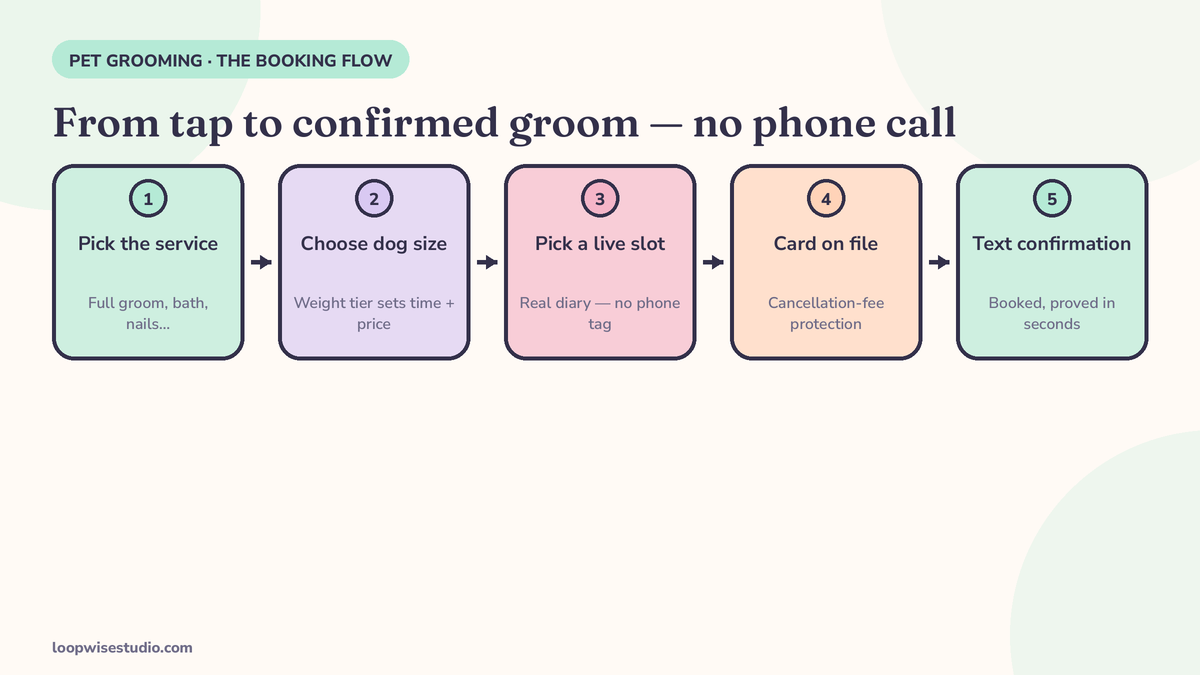
A pet grooming booking website should do five things without you touching the phone: take the booking by service and dog size, confirm it instantly by text, remind the client 24 hours before with a one-tap confirm link, keep a card on file for the cancellation fee, and nudge the client to rebook when the next groom is due. That sequence follows the one Furbello, a grooming software platform, publishes for its salons: immediate confirmation, then email and SMS together 24 hours out.
Notice what every search result for this query actually is: software. Furbello, Resurv, Bookeo, GroomSome — product pages, every one of them DIY. Not a single guide explains the reminder sequence as a system, and nobody offers to build the thing for you. This page is the guide: the sequence step by step, the exact texts to send (copy them), how booking has to work when the client is a dog, and an honest look at software versus done-for-you.
The reminder sequence, step by step
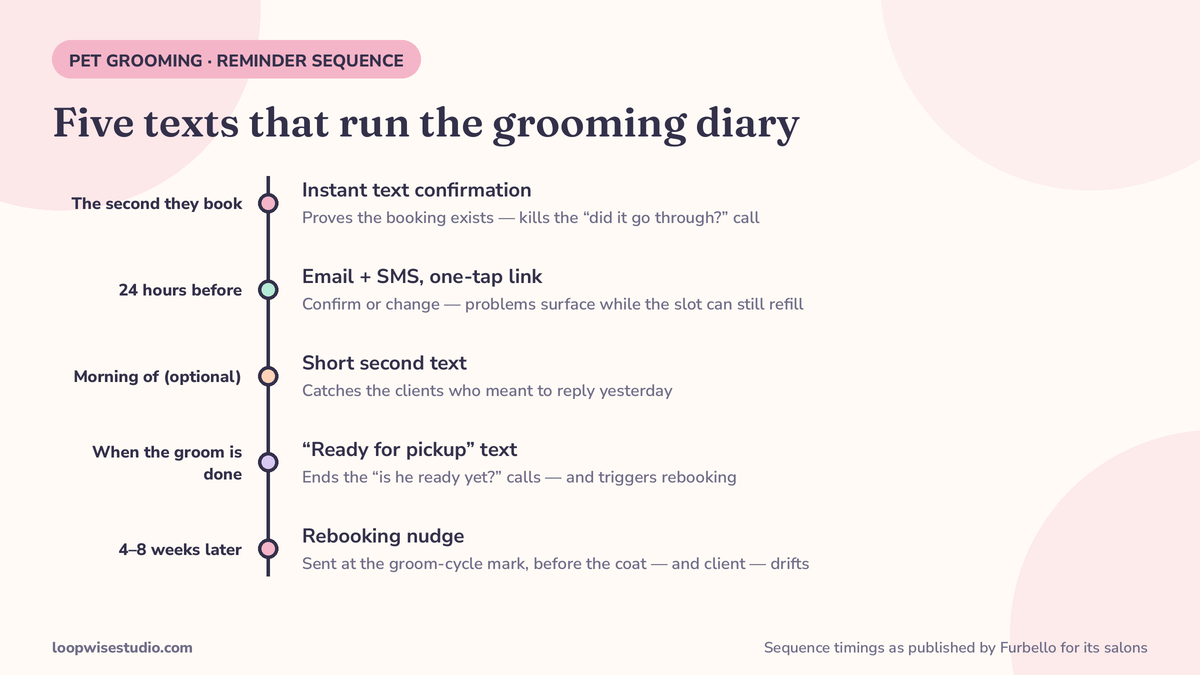
Reminders fail when they’re one message. Here’s the sequence that works, with Furbello’s published timings as the benchmark:
| When | Message | Its job |
|---|---|---|
| The second they book | Instant text confirmation | Prove the booking exists; kill the “did it go through?” phone call |
| 24 hours before | Email + SMS with a one-tap confirm/change link | Surface problems while the slot can still be refilled |
| Morning of (optional) | Short second SMS | Catch the clients who meant to reply yesterday |
| When the groom is done | “Ready for pickup” text | End the “is he ready yet?” calls; trigger payment and rebooking |
| At the groom-cycle mark (4–8 weeks) | Rebooking nudge | Book the next groom before the coat — and the client — drifts |
Furbello’s dashboard updates the moment a client confirms from the reminder link, and opt-outs (STOP/START) are handled automatically — both details worth demanding from any system, because a reminder the client can’t act on is just a notification.
The 24-hour message is the money one. A grooming slot is one to three hours of one groomer’s day; a no-show discovered at 9 a.m. is gone, but a cancellation surfaced at 9 a.m. the day before can still be offered to your waitlist. The same rescue logic applies across appointment businesses — we wrote it up for human salons in filling cancelled appointments automatically.
Copy these texts
Steal these. Adjust the names, keep the structure — short, specific, one action per message.
Confirmation (instant):
Hi Sarah, Milo is booked in for a full groom on Tuesday 14th at 10:00 with Jess. We’ll text you here when he’s ready for pickup. Need to change it? Reply to this text.
24-hour reminder (the one that saves slots):
Reminder: Daisy’s groom is tomorrow (Wed) at 1:30. Tap to confirm you’re coming: [link]. Running late or need to move it? Reply here and we’ll sort it.
Pickup:
Good news — Milo’s groom is done and he’s ready for pickup any time before 5:30. See you soon!
Rebooking nudge (sent at the interval you set per dog):
Hi Sarah, it’s been 6 weeks since Milo’s last groom — his usual slot on Tuesday mornings is open next week. Book here: [link]
No-reply rescue (2 hours after the 24-hour reminder goes unanswered):
Just checking Daisy’s appointment tomorrow at 1:30 still suits — reply YES and we’ll keep the slot held for her.
Where the booking page has to live
A booking page nobody finds books nobody. GroomSome’s own model gives away the distribution list: its booking link is designed to be shared on Instagram, WhatsApp, Facebook and the salon’s website. Take the hint and put yours in all four places — the Instagram bio where your before-and-after photos already sell the groom, your Google profile, your WhatsApp number’s greeting, and the front page of your website. Most grooming bookings start as a DM conversation that dies when nobody replies for three hours. A booking link in the bio ends that conversation in a confirmed slot instead — the client books at 11 p.m., gets the confirmation text instantly, and never talks to a competitor.
The rebooking nudge is where the money compounds
The fifth message in the sequence looks like a courtesy. Run the arithmetic and it’s the largest number on this page. A dog kept on a 6-week groom cycle comes in about 8–9 times a year. Let that same dog drift to a 10-week cycle — because nobody reminded the owner — and it’s about 5 visits a year. Same dog, same price per groom, roughly 40% less revenue from that client, forever, multiplied by every regular on your books. The nudge that closes that gap costs one text, sent automatically at the interval you set for that dog’s coat. No platform in the search results even describes this message. It’s the cheapest system a grooming salon can own.
Booking by the dog, not by the clock alone
Generic booking software thinks in services and times. Grooming doesn’t work like that, and the product pages quietly prove it: Furbello’s own example interface prices by weight tier with breed overrides — a Large dog (46–70 lb) at $95, a Doodle override of +$20 — because a matted doodle and a short-haired lab are not the same appointment wearing different names. Your booking page has to capture, at booking time:
- Size and breed → sets both the price and the duration, so a 3-hour job never lands in a 1-hour slot.
- Coat condition and service add-ons → deshedding, de-matting, nail trim, teeth.
- Pet notes that matter on the day → Furbello’s profiles carry behaviour flags and vaccine status (“nervous with dryers,” “rabies current”). Collected at booking, not discovered at drop-off.
- Multi-pet households → two dogs, one trip, back-to-back slots.
If your booking page can’t do size-based durations, it’s a hair-salon tool with a paw print on it.
No-show protection a groomer can actually enforce
One honest note first: there are no independent no-show statistics for grooming — none. Every “reduces no-shows” claim in this market is unquantified vendor copy, so this page won’t invent a percentage for you.
What does exist is a mechanism, and Furbello’s product shows it plainly: card on file at booking, cancellation fee charged if they don’t show — their interface example uses a $50 no-show fee. The mechanics matter more than the amount:
- The card is taken when they book online, not in an awkward conversation at the desk.
- The policy is stated on the booking page and repeated in the confirmation text — that’s what makes it enforceable without a fight.
- The fee is a backstop. The reminder sequence above is what actually protects the day; the card protects you from the clients the sequence can’t fix.
One empty slot a week, at your own average groom price, is the number to multiply by 52. You don’t need a statistic — you need your own diary. A worked example with the prices already on this page: if a large-dog groom is $95 (Furbello’s interface example) and one booked slot a week goes empty, that’s about $4,940 of diary time a year walking out of a single groomer’s column. Your prices will differ — the multiplication won’t. (Vet clinics run the identical maths; the diary-driven approach is in our guide to reducing no-shows at a veterinary clinic.)
Want the sequence and the card-on-file flow set up on your salon? get a free audit — we map your services, sizes and reminder timings before you commit to anything.
Five checks before you pay for any of it
Whatever you buy — module, platform or done-for-you build — test these against your busiest week, not the demo:
- The reminder has a door, not just a message. The client can confirm or reschedule from the text itself (Furbello’s one-tap confirm/change links are the benchmark).
- Opt-outs handle themselves. STOP/START processed automatically, so you never text a client who opted out.
- Durations come from the dog. Size and breed set the slot length, not a one-size default you override by hand every day.
- A card goes on file at booking. With the cancellation policy stated on the page, before the appointment exists.
- The pickup text exists. Half your inbound calls are “is he ready yet?” — if the system doesn’t send it, the calls continue.
For calibration: Resurv, one of the ranking platforms, admits in its own FAQ that it is “a multi-industry booking platform” wearing a grooming skin, and its reminder feature is a single line — no timings, no sequence, no templates. Bookeo’s grooming page, by contrast, at least charges no commission on bookings (normal payment processing fees apply). The five checks above separate the grooming-real tools from the relabelled ones in about ten minutes.
Mobile groomers: the same system, plus the road
Mobile grooming adds two problems salons don’t have: drive time and arrival uncertainty. Furbello is the only platform in the results that addresses them — route planning with drive time built into the schedule, and arrival-window texts instead of fixed-time promises. If you groom mobile, your booking system must book by area and day (this neighbourhood Tuesdays, that one Thursdays), pad slots with travel, and text a realistic window the morning of. A salon tool that ignores the road will overbook your van within a fortnight.
Software vs done-for-you, honestly
| Route | Published cost | What you get | The catch |
|---|---|---|---|
| Modular DIY app (GroomSome) | SMS Reminders module $4.99/mo; Appointments $14.99/mo; Client Management $9.99/mo | A booking link and modules you assemble | WhatsApp reminders listed as “coming soon”; no website of your own |
| Free-plan platforms (EasyWeek, via Capterra) | Free plan, booking website on their domain | Booking page + SMS/email/WhatsApp/push reminders | Your salon’s booking lives on their domain, under their brand |
| Full grooming platform (Furbello) | Founder pricing, figure not published on its homepage | The sequence and grooming features described above | Still DIY setup: services, prices, durations and reminders are yours to configure |
| Done-for-you on your own website (Loopwise) | Quoted after a free audit | Your domain, your services and sizes set up for you, reminders written and running | Not instant — it’s a build, scoped first |
The pattern: the cheapest tool in this market costs $4.99 a month for the reminder module alone, and it still hands you the setup. The software was never the expensive part — the configuring, the durations, the reminder copy and the policy wording are the work, and every product page leaves them to you.
How Loopwise sets it up
- We map your menu to the dog. Services, size tiers, breed overrides, durations — the pricing logic from your price list, not a template.
- We build the booking page on your website. Your domain, your brand, live slots, card on file at booking.
- We write and wire the five messages. Confirmation, 24-hour reminder with one-tap confirm, morning-of, pickup, rebooking nudge — in your salon’s voice.
- We set your no-show policy into the flow. Fee wording on the page and in the texts, so it’s agreed before it’s ever charged.
- You groom. Bookings confirm themselves, reminders send themselves, and the phone stays in your pocket.
After the first month we review the numbers with you: how many reminders got a tap, which slots still went empty, and whether your rebooking intervals match how your clients actually behave. The sequence is a system, not a set-and-forget — one adjustment to a reminder time or a groom-cycle interval is usually worth more than any new feature a platform tries to sell you in month two.
Loopwise Studio builds websites, online booking and text/WhatsApp automation for appointment businesses — we turn missed calls and website visitors into booked appointments. For grooming salons specifically, we can also connect the follow-up side: clients who came once and never rebooked are a list you already own, and the same timed-text approach powers things like automatic Google review requests for veterinary clinics by text — different trade, same principle: the message goes out at the right moment, every time, without you remembering. Start here: get a free audit.
FAQs
How many reminders should a grooming salon send?
Two before the appointment is the working pattern — an instant confirmation at booking and a reminder 24 hours before (Furbello sends email and SMS together at 24 hours), with an optional second text closer to the visit. Add a pickup text and a rebooking nudge and you have the full sequence.
What should the reminder text say?
The appointment, the pet’s name, the time, and one action — a confirm link or “reply to change it.” Long reminders get ignored; reminders without a way to act on them just announce the no-show earlier.
How do I stop grooming no-shows?
Make it easy to cancel early (one-tap link in the 24-hour text), and back it with a card on file and a stated cancellation fee — Furbello’s example interface uses $50. There are no independent no-show statistics for grooming, so measure your own rate before and after rather than trusting any vendor’s percentage.
Can clients book two dogs at once?
They should be able to — multi-pet households are normal in grooming. Your booking flow needs combined appointments with the right total duration, which is one of the first things generic salon software gets wrong.
Do I need my own website, or is a booking link enough?
A link works, but it lives on the platform’s domain and builds their brand, not yours. A booking page on your own website keeps the client, the search ranking and the rebooking data yours — and it’s the version we build.
What does the software-only route cost, really?
From $4.99/month for a reminders module (GroomSome) up to full platforms whose pricing isn’t published on their homepages (Furbello). The real cost is your setup time: services, durations, prices, reminder copy and policy wording are all on you with DIY tools.