How to Reduce No-Shows at a Veterinary Clinic
Reduce no-shows at your veterinary clinic with a system: the right reminder sequence, rules per appointment type, easy rescheduling, deposits and copy-ready policy wording.

Cut vet no-shows with a system, not more reminders: a booking confirmation, a 48-hour reminder carrying the pet’s name and visit purpose, a 24-hour reply-to-confirm prompt, and a one-tap way to reschedule. Average no-show rates run 10–15% (PetDesk, reported via Shepherd), and each cause — forgetting, cost anxiety, the pet seeming better — needs its own fix.
Most no-show advice treats your diary as one problem. It isn’t. An empty anaesthesia slot on a surgical morning and a missed 15-minute vaccine booster are different losses with different causes, and they respond to different tools.
This guide builds the whole system: what a no-show actually costs you, the reminder sequence with the exact wording, different rules for different appointment types, deposits that don’t scare clients off, and a 15-minute method for measuring your own rate before you change anything.
What a no-show actually costs — worked out in the open
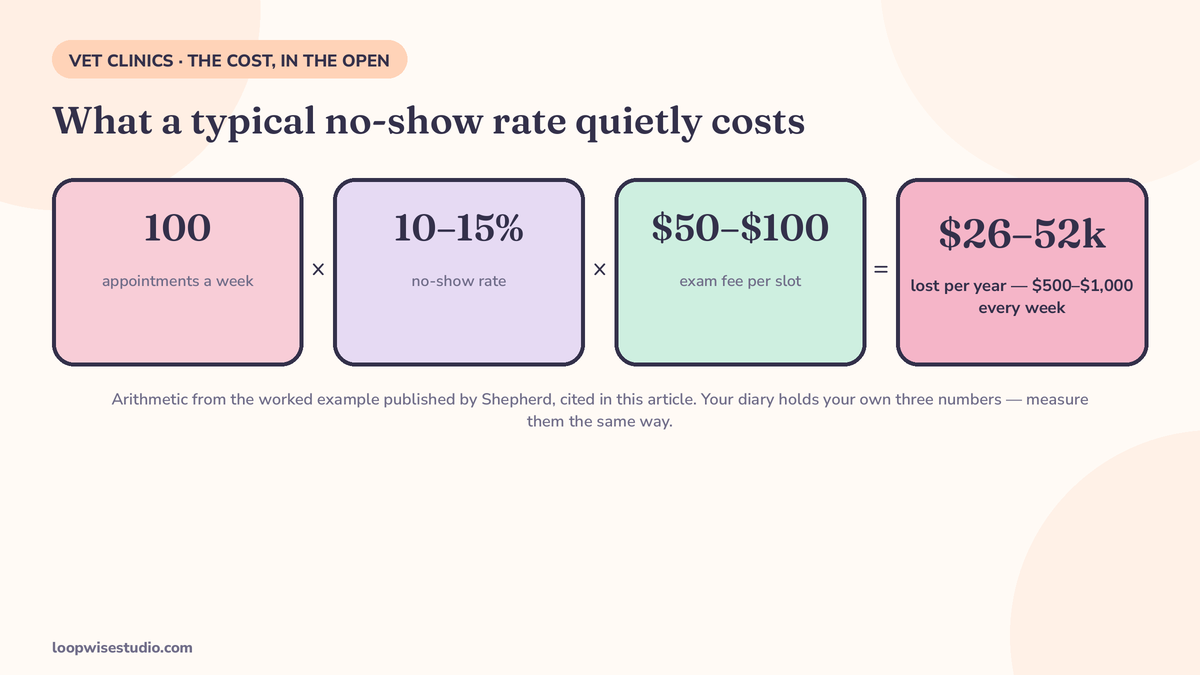
Shepherd’s guide to vet no-shows works through an example worth repeating, with its assumptions stated plainly: a clinic running 100 appointments a week, with 10–15 no-shows (matching the 10–15% average range Shepherd attributes to PetDesk), at an average exam fee of $50–$100.
- 10–15 empty slots × $50–$100 = $500–$1,000 a week
- Across a year: $26,000–$52,000
That is arithmetic from Shepherd’s published example, not a study — run it with your own diary numbers and your own average fee before quoting it to anyone. But even at the gentle end, the leak is a part-time salary walking out of the diary every year.
And the money is only part of it. An empty slot is also a pet who needed care and didn’t get it, a vet standing idle while another client waits three days for an appointment, and a team that learns the diary can’t be trusted — so they start double-booking, which makes the days when everyone shows up chaotic.
Why pet owners no-show — and why each cause has a different fix
| Cause | What it looks like | The fix that matches it |
|---|---|---|
| They forgot | Booked weeks ago; life happened | Timed reminders with the pet’s name and visit purpose, plus a reply-to-confirm prompt |
| The pet seems better | The limp improved, so the recheck feels optional | The confirmation explains what the visit checks even if symptoms fade — book the explanation in at booking time |
| Cost anxiety | They fear the bill more than they fear the symptom | Clear estimate language in the confirmation; deposit and payment expectations stated up front, not at the desk |
| Booking friction | They tried to reschedule, sat on hold, gave up | One-tap reschedule link in every reminder; missed call text back so a failed call becomes a text |
| Life logistics | Transport, work, kids, a pet that won’t get in the carrier | A morning-of reminder early enough to act on, and painless rebooking instead of a guilt trip |
| Long-horizon decay | Vaccines booked 12 months out at checkout | Reconfirm sequence for forward-booked appointments — see the recall section below |
The point of the table: a reminder fixes exactly one row. Clinics that “send reminders” and still run a 15% no-show rate usually have a friction or anxiety problem being treated with a forgetting tool.
The reminder sequence — timing, job and exact wording
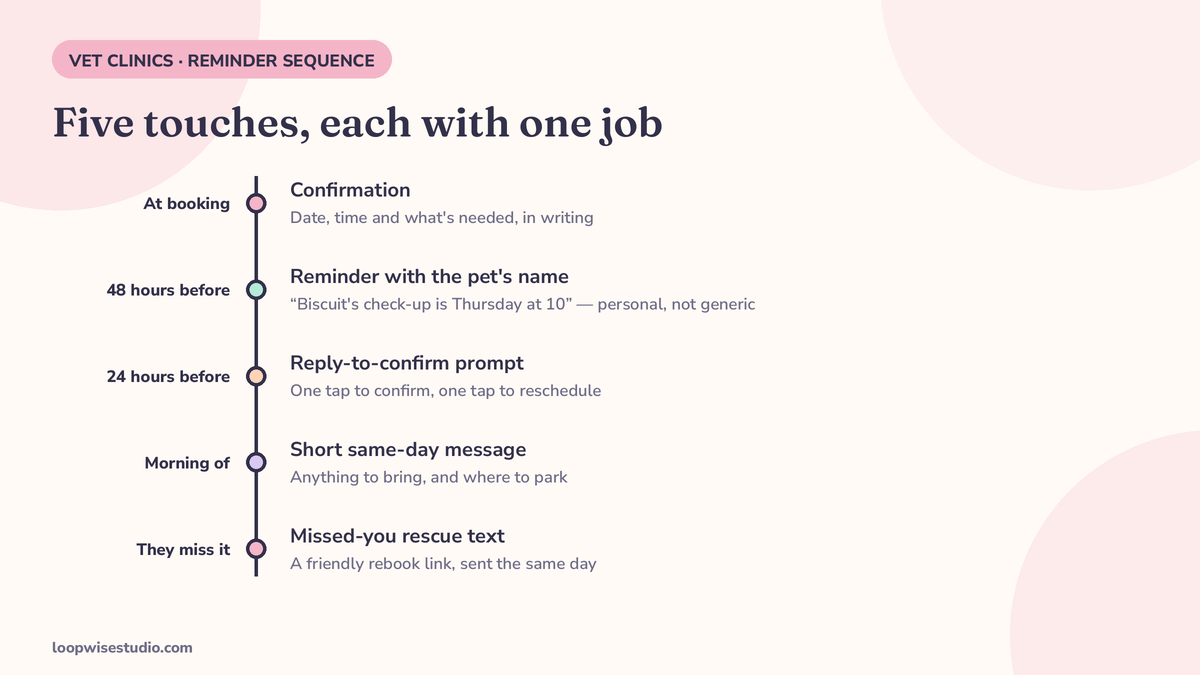
Shepherd publishes the skeleton and it is the right skeleton: confirmation at booking, a 48-hour reminder with the pet’s name and purpose, a 24-hour confirmation prompt, and a same-day reminder for high-value appointments. What the big guides never give you is the copy. Here it is.
| When | Channel | Job | Message |
|---|---|---|---|
| At booking | Text + email | Confirm and set expectations | “Booked ✓ [Pet] is in for [visit purpose] on [day, date] at [time] with [Clinic]. Reply C to confirm, or tap here to reschedule: [link]” |
| 48 hours before | Text | Remind with a reason | “Hi [Name], [Pet]’s [visit purpose] is on [day] at [time]. Even if [he/she] seems back to normal, this visit checks [specific thing]. Reply YES to confirm or tap to move it: [link]” |
| 24 hours before | Text | Force a decision | “Still good for [Pet]’s appointment tomorrow at [time]? Reply YES to keep it — if something’s changed, tap here to rebook so we can offer the slot to another pet: [link]” |
| Morning of | Text | Logistics check | “[Pet]’s appointment is today at [time]. Please arrive 10 minutes early. Running late or stuck? Reply here and we’ll do our best.” |
| 1 hour after a no-show | Text | Rescue, not blame | “We missed [Pet] today — hope everything’s okay. Tap here to grab the next slot: [link]. If something’s wrong with [Pet], call us on [number] or [ER number] for emergencies.” |
Two rules run through the whole sequence. Personalise it — Shepherd’s example makes the point: “‘Hi Sarah, Luna’s vaccination appointment is tomorrow at 10:30 AM’ performs dramatically better than ‘You have an appointment tomorrow.’” And every message carries the reschedule link, because a client who moves an appointment is a saved slot; a client who silently vanishes is not.
Different appointments, different rules
| Appointment type | Real cost of a no-show | Reminder timing | Deposit rule that fits |
|---|---|---|---|
| Wellness / vaccine visit | A 15–20 min slot and a broken vaccine schedule | Standard sequence; reconfirm if booked months ahead | No deposit — friction would cost more bookings than it saves |
| Sick visit | Urgent slot another ill pet needed; the illness doesn’t wait | Same-day confirmation matters most; morning-of message early | No deposit for existing clients; the speed of rebooking is the fix |
| Surgery / dental drop-off | An anaesthesia slot, a fasting pet, a theatre team standing idle | Add a 72-hour message with fasting and drop-off instructions; confirmation reply mandatory | Deposit or card hold is fair here — see wording below |
| Recheck | The treatment plan breaks quietly; nobody notices for weeks | 48-hour message explains what the recheck verifies even if the pet looks well | No deposit; the “pet seems better” message copy does the work |
| New client first visit | Highest no-show risk in the diary, and the slot is longest | Full sequence plus a confirmation reply required to hold the slot | IDEXX’s guide supports deposits for new clients — targeted, not universal |
IDEXX’s own guide lands in the same place: deposits aimed at new clients, surgery and repeat offenders, not a blanket charge on every booking. Blanket deposits punish your best clients for other people’s behaviour.
Easy rescheduling beats strict policies
Every no-show system has two halves: stopping the ones you can prevent, and refilling the slots you can’t. A reply-to-reschedule link in every reminder converts “I can’t make Thursday” from a silent no-show into a slot released 24 hours early — early enough for your waitlist to use it.
Keep a simple waitlist of clients who asked for sooner appointments, and text them the moment a slot opens. When a client does cancel late, the rescue text above goes out the same day: concern first, rebook link second, blame nowhere. The clinics that recover the most diary are the ones that treat a no-show as a booking that failed, not a client who misbehaved.
The same principle runs the front of the funnel: if rescheduling means sitting on hold, clients won’t do it. It is the identical logic behind how med spas reduce no-shows — make the honest path the easy path.
If you’d like a second pair of eyes on where your diary is leaking, get a free audit and we’ll map your appointment types against your reminder setup.
Deposits and no-show fees: who, how much, and the exact wording
Deposits work when they are narrow, explained once in human language, and enforced evenly. Borrow the structure:
- Who: new clients booking a first visit, surgery and dental drop-offs, and clients who have no-showed twice. Nobody else.
- How much: a sensible anchor is the value of the booked service — Shepherd’s example uses a $50–$100 average exam fee; for surgery, a fixed deposit stated at booking. Never a surprise figure invented at the desk.
- The wording (copy-paste):
“For [surgery / first visits], we ask for a $[amount] deposit to hold the slot. It’s taken off your bill on the day. If you need to move your appointment, tell us at least 24 hours ahead and the deposit moves with it — no charge, no hard feelings. Inside 24 hours, or if you don’t come in, the deposit is kept, because that slot was held for your pet and can’t be offered to another.”
That last sentence is doing the real work: it explains the fee as fairness to other pets, not as a penalty for the client. IDEXX makes the same point — have clients acknowledge the impact a no-show has on other pets waiting for care.
The long game: forward-booked pets and silent recall decay
Vet diaries hide a slow no-show problem the other guides never touch. At checkout you book the next vaccine or recheck 6–12 months out. Everyone means well. Twelve months later the appointment exists in your PIMS and nowhere in the client’s life.
Fix it with a horizon rule: any appointment booked more than 90 days ahead gets a reconfirm text 2 weeks before (“[Pet] is due with us on [date] for [purpose] — still good? Reply YES or tap to move it”), before the standard sequence even starts. And run a monthly overdue list — pets whose vaccine or recheck date has passed with no visit booked — and work it with the rescue wording. Overdue recall is a no-show that hasn’t happened yet, and it is the cheapest diary you’ll ever fill. Canadian clinics formalising this can see the same system in online booking for veterinary clinics in Canada.
Cancellations are not no-shows — and one of them is good news
Keep the two separate in your diary and in your thinking. A cancellation with 24 hours’ notice is the system working: the slot came back early enough to offer to the waitlist, and the client did exactly what your reminders asked. A no-show is a slot that died silently.
This is why the reminder sequence is built the way it is. The 24-hour message is not really a reminder — it is a decision deadline dressed as one. “Reply YES to keep it — or tap to move it” gives the client who already knows Thursday is impossible a respectable, ten-second way to say so. Clinics that only confirm, and never invite the cancellation early, push those clients into the no-show column and lose the refill window with them.
Your waitlist mechanic can be just as simple as the one for same-day gaps:
- Keep the list short and honest. Clients who asked for sooner, in the order they asked. Five names is plenty; a stale list of fifty is a chore nobody works.
- Text the first name the moment a slot frees up, with a deadline: “A [day] [time] slot just opened for [Pet]’s [visit type] — want it? Reply YES within 30 minutes and it’s yours.”
- Move down the list on the clock, not on hope. No reply in 30 minutes, next name. Clients understand a fair race; what they resent is hearing the slot went to someone else after they replied quickly.
- Log every refill. A month of refills is the proof — in appointments, not percentages — that early cancellations are revenue, not loss.
Myth vs fact
Myth: “Stricter fees will fix it.” Fees only reach the clients who read policies — your reliable majority. IDEXX’s guide is careful on this point for a reason: deposits are aimed at new clients, surgery and repeat offenders, precisely because blanket strictness punishes the clients who were never the problem and teaches them to book elsewhere.
Myth: “Clients who no-show don’t care about their pets.” The cause list says otherwise. The biggest buckets are forgetting, logistics and quiet anxiety about cost or outcome — all fixable by the clinic’s systems. Shepherd’s whole guide is built on this: no-shows are a system failure wearing a client’s name.
Myth: “More reminders = fewer no-shows.” A fifth reminder sent to a client whose problem is the estimate, the carrier or the hold music changes nothing except how annoyed they are. Match the fix to the cause, then measure by appointment type to prove it worked.
The two-week rollout: changing the system without diary chaos
You do not need a relaunch day. Layer it in:
- Days 1–2: Measure last month’s rate by appointment type (method in the next section). Pick the worst type — that’s the pilot.
- Days 3–4: Switch on the confirmation and 48-hour messages for the pilot type only, using the copy in the sequence table. Add the reschedule link everywhere it appears.
- Days 5–7: Add the 24-hour reply-to-confirm prompt. Start the waitlist sheet and the refill wording.
- Week 2: Add the morning-of message and the missed-you rescue text. Introduce the deposit rule for new clients and surgery bookings, with the fairness wording.
- End of week 2: Compare the pilot type’s rate against your baseline. Then extend to the next appointment type and repeat.
Two weeks, one appointment type at a time, and every change is reversible if a message misfires. The clinics that stall are the ones trying to rebuild the whole diary in a weekend.
One rollout detail that decides whether the team sticks with it: show the front desk the first month’s movement in their own appointment type, not a lecture about policy. Receptionists who can see surgery no-shows falling become the system’s defenders; receptionists who only hear new rules become its quiet saboteurs. The diary is a team instrument — tune it where everyone can hear the note change.
Measure your own rate in 15 minutes
Pull last month from your PIMS and count, per appointment type: booked, arrived, cancelled with notice, no-showed. Your no-show rate is no-shows ÷ booked. Split it by type and by day of week — the pattern is almost never even. Surgery Mondays and six-month vaccine bookings will tell you exactly where to aim first.
Reading the pattern matters more than the headline number. A clinic at 12% overall might be at 4% for wellness visits and 30% for six-month forward bookings — one problem, in one row of the table, with one fix. Conversely a “good” 6% can hide a surgery diary quietly bleeding expensive slots while hundreds of vaccine visits pad the average. Always argue from the split, never the blend.
Re-run it monthly. That one number, by type, is the scoreboard for everything in this guide — and the input for turning satisfied visits into reviews with automatic Google review requests by text once the diary itself is under control.
Frequently asked questions
What is a normal no-show rate for a vet clinic?
Shepherd, citing PetDesk, reports that practices with poor reminder systems or rigid scheduling often exceed a 10–15% average no-show rate. Treat that as a commonly reported range, not a benchmark for your clinic — measure your own rate by appointment type, because a surgery no-show and a vaccine no-show are not the same problem.
How many reminders should we send?
Four touches cover most appointments: confirmation at booking, 48 hours before, a 24-hour reply-to-confirm prompt, and a morning-of message. Add a 72-hour instruction message for surgery and dental drop-offs, and a 2-week reconfirm for anything booked more than 90 days ahead.
Should we charge every client a deposit?
No. IDEXX’s guidance is targeted deposits: new clients, surgery and other high-value slots, and repeat offenders. A blanket deposit adds friction for reliable clients and can cost more bookings than it saves. Pair it with a clear 24-hour move-it-free rule so it reads as fairness, not punishment.
What should a no-show follow-up message say?
Concern first, never blame, and a rebook link in the same message: “We missed [Pet] today — hope everything’s okay. Tap here to grab the next slot.” Send it within the hour while the appointment is still on the client’s mind, and include your number plus emergency directions if the pet might be unwell.
Do reminders alone fix no-shows?
No — they fix forgetting, which is only one cause. Cost anxiety needs estimate language up front, booking friction needs one-tap rescheduling, and “pet seems better” needs a confirmation message that explains what the visit checks. Match the fix to the cause or the rate won’t move.
How do we handle chronic repeat offenders fairly?
Graduated steps, applied evenly: a friendly rescue text after the first, the deposit rule after the second, and — as IDEXX suggests — deposits or limited advance-booking privileges after repeated no-shows. Put the policy in writing at booking so the enforcement is never a surprise.
The short version
No-shows are not a client problem; they are five different problems wearing one name. A named-pet reminder sequence, rules that vary by appointment type, rescheduling that takes one tap, narrow deposits with fair wording, and a monthly recall pass — that is the system that moves the 10–15%.
If you want this mapped onto your clinic’s actual diary, get a free audit and we’ll start with your real numbers.