Booking Website for Personal Trainers: Scheduling & Payments
A booking website for personal trainers with scheduling and payments built in: sell the consult, sell the pack, book sessions against the balance.
A booking website for a personal trainer is their own site with three things built in: a scheduling page that shows real availability, online payment for single sessions and multi-session packs, and automatic reminders for every booked session. Platforms like Trainerize, PT Distinction and Mindbody rent trainers that booking system inside the vendor’s app or page — Worldmetrics’ 2026 roundup of personal trainer scheduling software scores ten of them — while an owned website keeps the client list, the pack payments (through the trainer’s own Stripe), and the follow-up under the trainer’s control. The pack flow is what makes personal training different: consult first, then the client buys a pack and books sessions against its balance.
One thing before anything else, because it decides whether the rest of this page is useful to you: this is written for trainers — the business side of training. If you are a client looking for an app to book your PT, the roundups have you covered. If you are the trainer whose week fills or empties based on a diary you do not own, read on.
How trainers actually book clients now — and where each route leaks
Ask ten solo trainers how their bookings happen and you will hear the same three answers.
Instagram DMs. The enquiry starts where the marketing works. It also dies there: a conversation spread over two days, a price asked and answered, then silence — because booking required a negotiation instead of a tap. There is no deposit, no calendar, no record that survives a lost phone.
Texts and calls between sessions. You are spotting a client and your phone lights up with “are you free Thursday?” You answer at lunch. By then Thursday has gone to whoever replied first. This is the hands-busy pattern every hands-on trade shares — massage therapists lose bookings the identical way, which is why missed call text back for massage therapists is built on the same fix.
A rented platform link. Better — the client books into a real calendar. But the link lives on the platform’s page or inside their app, under their brand, and your client list, your pack balances, and your reviews sit in an account you rent by the month. Leave the platform and you leave the list.
None of these are character flaws. They are what happens when the tools on offer were designed for gyms and salons and handed to a one-person business that sells something neither sells: a relationship, in blocks, paid up front.
Anatomy of the site — five pages, each with one job
The who-you-train page. Not “services.” Who you train, what changes for them, what a first block of training looks like. This page does the persuading that a DM conversation currently does at midnight.
The consultation booking page. A free or paid taster/consult, bookable in two taps, with the intake questions — goals, injuries, training history — asked in the booking, not in a chat thread afterwards. Zoho Bookings’ fitness page makes this same point about intake questions on the form; it is one of the few platform features worth copying onto your own site.
The pack pricing page. The packs, priced plainly: what a block of 10 costs, what monthly coaching costs, what each includes. Trainers hide prices because they fear the reaction; clients leave because they cannot find them. Put the price where the booking is.
The booking page. Real availability, session length, location — gym, park, client’s home, online — set per session type, synced with your actual calendar so a client can never book over your own training, your school run, or your lunch.
The policy page. Cancellation window, pack expiry, what happens to unused sessions. Written once, linked from every confirmation, enforced without a negotiation.
The pack system, step by step — the flow no platform designs for you
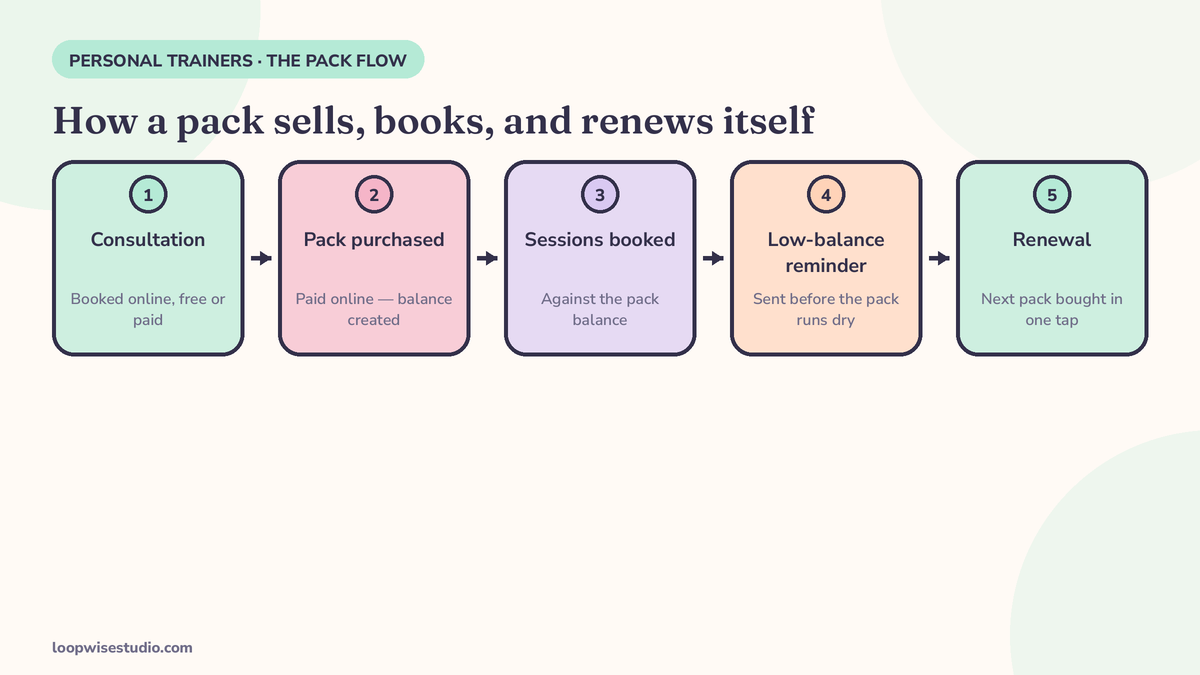
This is the part that makes a trainer’s website different from every other booking page, and it is the part generic schedulers do not model at all:
- Consult first. The prospect books a consultation or taster session. They show up because a reminder sequence — not your memory — confirmed it.
- Buy the pack online. On the spot, or from a link in the follow-up message that evening: card payment through your own Stripe, money in your account, sessions credited to the client’s balance.
- Book sessions against the balance. The client books their Tuesday and Thursday slots from their balance — no payment conversation each week, no “I’ll transfer you Friday.”
- The low-balance reminder fires itself. At two sessions left, the client gets the message: “Two sessions left on your pack — want to roll into the next block before your slots go?” Renewal becomes a reply, not a sales call.
- Renewal lands in the same system. New pack, same balance page, same slots held. The client never re-registers, never downloads anything new, never has a reason to drift.
Compare that with how packs usually run: bought by transfer, tracked in a notes app or your head, sessions booked by weekly text, and the renewal conversation happening — if it happens — in the corridor after the last session, when the client is already halfway out of the habit. The platforms will sell you recurring payments as a feature; Anolla, one fitness platform, describes its Stripe integration as supporting “recurring membership payments and one-time charges for PT sessions, class passes, programs” — the plumbing exists. What no platform gives you is the flow wrapped around your packs, on your site, in your words.
If the flow is clear but the building of it is not your job, get a free audit — we’ll sketch the pack system against your real prices and slots before you commit to anything.
The maths of one leaked consult — run it with your numbers
Trainers rarely lose money in dramatic ways. They lose it one unbooked consult at a time, and the consult is worth more than it looks.
State the assumptions with your own figures; here is the shape with round ones. Say a pack is 10 sessions at $50 — $500. Say one in three proper consults buys a pack (use your own rate; most trainers who track it land somewhere near that). Then a single consult is worth, on average, about $165 of expected revenue — and a prospect who asked for a consult, got a two-day DM thread instead, and drifted has cost you that $165 without ever appearing in any report.
Now count the drift. If your current route leaks two consult requests a month — two people who enquired, never got a clean booking link, and never followed up — the arithmetic says roughly $330 a month, close to $4,000 a year, decided by whether booking was a tap or a negotiation. Your numbers will differ. The point of running them is that “my DMs are fine” stops being a guess.
Scheduling that fits training — recurring slots, buffers, and real life
A trainer’s calendar is not a salon’s. Three mechanics matter:
- Recurring weekly slots are the product. Your 7am client is not booking one session; they are holding every Tuesday and Thursday until further notice. The booking system has to treat the standing slot as the default and the one-off as the exception — the reverse of most schedulers.
- Buffers are travel and turnaround. Thirty minutes between a gym client and a park client is not slack; it is the drive. Build travel buffers per location type, or the diary will cheerfully book you in two postcodes at once.
- Location is part of the booking. Gym floor, outdoors, online — each session type carries its place, its kit notes, and its weather plan for outdoor work. The confirmation should say where, so “where are we meeting?” texts die.
Payments without the platform tax — your Stripe, your packs, your rules
Money is where “rent the system” quietly gets expensive. Not in the subscription — in the stack: the platform’s monthly fee, the payment processing on top, and the add-ons for the features that turn out to be in the next tier.
What the published figures in this space actually look like — all vendor-stated, so check current pricing pages before you budget:
- Platforms range from free entry tiers to scored, ranked products: Worldmetrics’ 2026 roundup scores ten personal trainer scheduling tools from WellnessLiving (9.4/10) and Setmore (9.2) down to Amilia (6.8) — the roundup’s own scores, with no hands-on methodology published alongside them.
- Anolla offers a free plan for solo trainers covering booking, client management and scheduling (vendor-stated), with payments through its Stripe integration.
- BookyWay, listed on Capterra, is free for organisations up to 25 users with paid plans from €14 a month on annual billing (directory listing, vendor-stated).
Against that, an owned website routes pack and session payments through your own Stripe account at card-processing rates, holds no per-booking commission, and — the part trainers feel two years in — the payment history and client list are yours if you ever change anything else. The wider version of this maths sits in our guide to how much a website with online booking costs; the structure is the same even though the trade is different.
Reminders and no-show rules for 1-to-1 sessions — your hour cannot be resold at 1 hour’s notice
A clinic can overbook around a gap. A trainer cannot. Your cancelled 6pm slot at 5pm is worth nothing to anyone, which makes your cancellation rules legitimately stricter than other trades’ — and makes the reminder sequence a financial instrument, not a courtesy:
- Confirmation at booking, restating the cancellation window while motivation is highest.
- A reminder the day before, with a reply-to-move option — a client who moves a session 24 hours out has cost you nothing you cannot refill from a waitlist of consults.
- A morning-of message for early slots, because the 6am no-show decided at 5:40am.
And the rule the sequence enforces: a late cancel or no-show takes the session off the pack balance. Said once, on the policy page, restated in the confirmation — then applied to everyone, kindly and identically. The full version of this thinking, written for trainers specifically, is our guide on how to reduce client no-shows as a personal trainer.
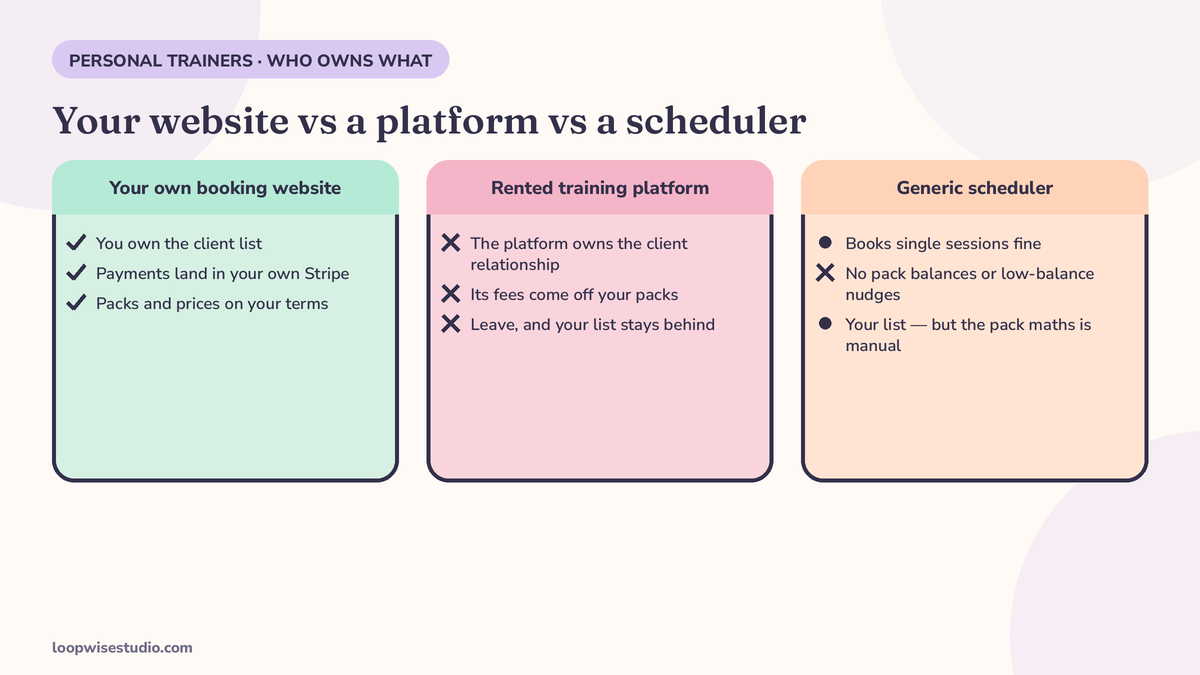
Own website vs training platform vs generic scheduler — who owns what
| Your own website | Training platform (Trainerize, PT Distinction, Mindbody) | Generic scheduler (Calendly, Zoho Bookings) | |
|---|---|---|---|
| Where the client books | Your domain, your brand | Their app or their page | Their booking page, embedded or linked |
| Session packs | Designed around your packs and balances | Supported, inside their model | Not modelled — appointments only |
| Payments land in | Your Stripe | Platform’s payment flow | Your account, per appointment |
| Client list if you leave | Yours, complete | Lives in the vendor’s app | Partial — bookings yes, relationship no |
| Follow-up (reminders, low-balance, renewal) | Yours to design | Their feature set | Reminders only |
The fair word for the platforms: if what you sell is online coaching with programming, check-ins and habit tracking, a platform like Trainerize or PT Distinction is a real product doing a real job — this page is not an argument against them. The hybrid plenty of trainers land on: keep the platform for programme delivery, and put the front door — your site, your consult booking, your pack sales — on your own domain, where your name ranks and your list lives. The same pattern shows up in other one-person appointment businesses; our page for booking websites for mobile IV and wellness clinics makes the own-the-front-door case for a neighbouring trade.
What it costs and how long it takes
The published end of the market is the rentals: free solo tiers, directory-listed plans from €14 a month, platform subscriptions above that — every figure vendor-stated and worth checking on the day. An owned website with scheduling, pack payments, and the reminder system is a project, not a subscription: a one-off build priced against your setup, then ordinary hosting costs — and no monthly rent on your own client list.
The timeline is weeks, and the bottleneck is rarely the build. It is deciding the pack structure and writing the policy page — an afternoon of decisions most trainers have been postponing inside a notes app anyway. Your current route keeps taking bookings until the site is ready to take over.
Expect the first change to be small and immediate rather than dramatic: consults stop depending on your reply speed. A prospect who finds you at 9pm books the consult at 9pm, gets the confirmation and the intake questions while you are asleep, and arrives having already told you their goals and their injury history. The training was always good. The front door finally matches it.
Frequently asked questions
I get clients fine through Instagram. Why do I need a website? Because Instagram is a discovery channel, not a booking system. The DM thread cannot take a pack payment, hold a recurring slot, send a low-balance reminder, or survive your account being restricted. The site does not replace the DMs — it gives every DM a link to land on, where the conversation becomes a booking.
Can clients really book sessions against a pack balance? Yes — that is the core flow this page describes. The client buys the pack once, then books sessions that draw down the balance, and the system shows them (and you) what is left. The low-balance reminder at two sessions is what turns renewal from an awkward pitch into a routine reply.
What if I also coach online through Trainerize or PT Distinction? Keep it for delivery if it serves you. The argument here is about the front door: your website, under your name, taking consults and pack payments into your Stripe. Platforms and an owned site are not enemies — but only one of them is an asset on your balance sheet.
Do I need to show my prices publicly? For packs, yes — plainly priced packs next to the booking button convert better than “DM for prices,” because the client who has to ask is a client who can quietly not ask. Single-session and consult pricing can sit behind the consult if you prefer; the pack page should not hide.
What cancellation window is fair for 1-to-1 sessions? Stricter than most trades, and defensibly so: your hour cannot be resold at short notice. A common structure is a session taken off the pack balance for cancels inside 24 hours, stated on the policy page and restated in the confirmation. Whatever you choose, the rule only works if it is identical for the client you like most.
I’m a solo trainer, not a gym. Is this overkill? The solo trainer is exactly who this is for. A gym has a desk, a team, and a platform budget. You have a phone, a diary, and a finite number of hours — which is why the system that protects those hours has to be automatic, and why it should live on a site with your name on it.
Trainers do not have a marketing problem most weeks. They have a diary problem: enquiries in DMs, packs in a notes app, renewals in a corridor, and balances in their head. A booking website built for how training actually sells — consult, pack, sessions against the balance, renewal — puts all of it in one place that you own, and keeps it there.
get a free audit and we’ll map that flow against your real packs, prices, and slots — and tell you plainly if what you already have is doing the job.