Online Booking Website for Aesthetic Clinics in Dubai
An online booking website for aesthetic clinics in Dubai: live slots, deposits and instant confirmation on your own domain, not a form or a marketplace.
If you own an aesthetic clinic in Dubai, an online booking website is a website where a patient can see your real availability and book a real appointment on your own domain: pick a treatment, pick a practitioner, pick a live time slot, pay a deposit, and get an instant confirmation. It is not a contact form that promises a reply within 24 hours, it is not a listing on someone else’s marketplace, and it is not your receptionist’s WhatsApp inbox. This page is for clinic owners. It explains what a booking website actually contains, how it differs from the ways Dubai clinics take bookings today, what it costs, and how long it takes to build one for a small clinic.
Most Dubai clinics already have a website. Many of them look good. The problem is what happens at the exact moment a patient decides to book. She has read about the treatment, she trusts the clinic, she is ready — and the website gives her a form: name, phone number, message. Then nothing, until someone at the clinic sees it and calls her back. If that takes hours, she has often booked somewhere else in the meantime.
A booking website removes that gap. The patient finishes the job herself, in one visit, at whatever hour she is browsing.
What an online booking website actually is (and what it is not)
The test is simple. Can a patient complete a booking at 11pm, without any member of your staff being involved, and wake up to a confirmed appointment in her messages? If yes, you have an online booking website. If any step needs a person to check, reply, or confirm, you have a brochure with a form on it.
Here is what it is not:
- Not a contact form. A form is a request for a callback. The patient has done her part and still has no appointment. Forms also collect junk: half-filled entries, wrong numbers, price shoppers with no intention of booking.
- Not a marketplace listing. Directories and doctor-booking platforms give patients live slots, but on their domain, next to your competitors, under their brand. The booking relationship belongs to the platform.
- Not a WhatsApp inbox. Chat is a good way to handle questions and post-booking messages, but a chat thread is not a diary. It has no live availability, no deposit step, and no way for a patient to book while your team is in treatment rooms.
- Not a “book now” button that opens a phone call. That is a call button with better marketing.
What it is: your diary, published safely on your website. Treatments, practitioners, durations and available times come straight from the diary your front desk already uses, presented in a way a patient can act on without help.
The booking page, piece by piece
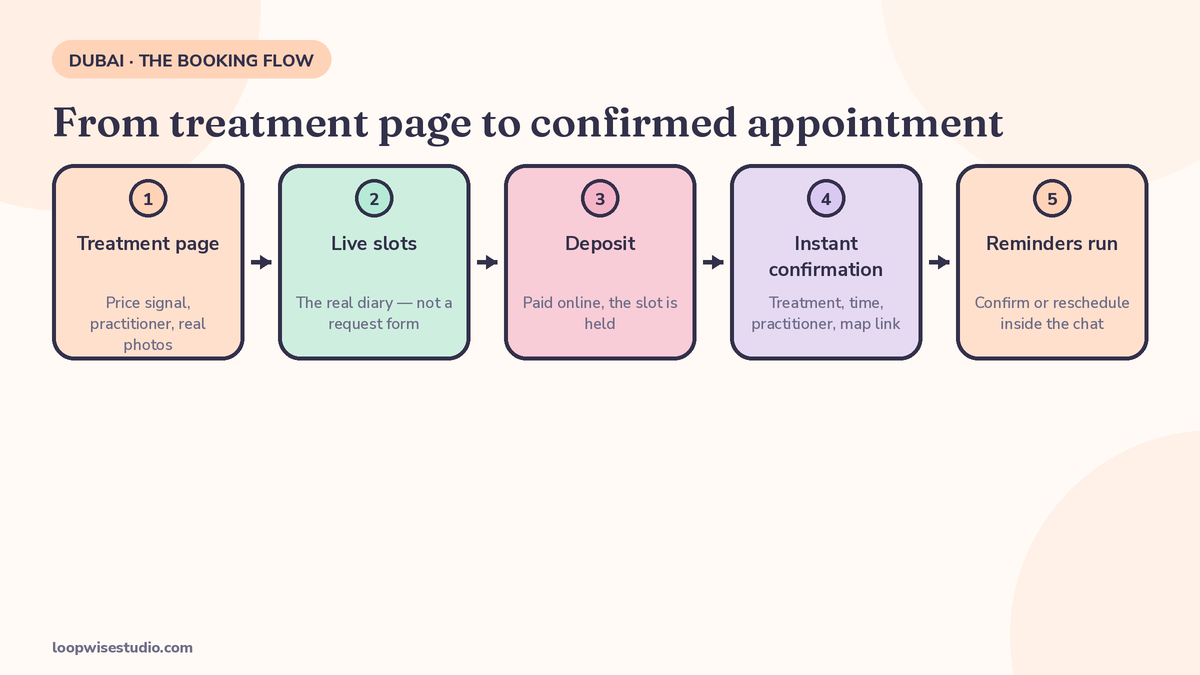
The booking page is where the money is made or lost, and it is the page almost no Dubai clinic website gets right. It should run in this order:
- Treatment first. The patient picks the exact treatment she read about — not a generic “appointment.” If she landed on your laser hair removal page, the booking flow should open with laser hair removal already selected.
- Practitioner choice. Many patients have a preference: the doctor they saw on Instagram, the practitioner a friend recommended. Let them choose, or choose “first available” if they do not care.
- Live slots only. Show real, bookable times. Never show a calendar of greyed-out days with two available slots next week — if availability is genuinely tight, say when new slots open, or offer a waitlist place.
- The right duration, automatically. A full-face treatment and a top-up are not the same length. The diary should block the correct duration for the treatment chosen, including turnaround time, so a self-booked diary does not fall apart by lunchtime.
- A deposit or card hold for long appointments. Short consults can stay deposit-free. Long, high-value slots — the ones that hurt when a patient does not show — should ask for a deposit at the moment of booking, while intent is at its highest.
- Instant confirmation. The moment she books, she gets the appointment confirmed with date, time, location and what to do before the treatment — on screen, by email, and by message. Not tomorrow. Not within 24 hours.
- An easy way to change it. A reschedule link in the confirmation saves your front desk the phone calls and saves the patient from becoming a no-show because moving the appointment felt like too much effort.
Compare that with what most Dubai patients get today:
| Step | Contact form (typical Dubai clinic website) | Online booking website |
|---|---|---|
| Patient decides to book | Fills in name, phone, message | Picks treatment and live slot |
| Time offered | None — she asks, clinic answers later | Real availability, shown instantly |
| Confirmation | “Response within 24 hours” is common | Instant, on screen and by message |
| Deposit | Not collected | Collected or held for long appointments |
| Booking at 11pm | Waits until morning | Completed in a few minutes |
| Who owns the booking | Whoever answers the form | Your clinic, on your domain |
| Diary updated | When staff re-type it | Automatically, at booking |
This is not a theoretical difference. At the time of research, a leading DHA-licensed Dubai aesthetic clinic — established in 2004, with a full treatment website — offered “online booking” that was exactly this: a form promising a personalised response within 24 hours. If that is what a well-funded clinic gives its patients, a smaller clinic with a real booking page is not behind. It is ahead.
Not sure which of these your current site does? get a free audit and we will test your booking path from Google to confirmation and show you the exact step where patients fall away.
Treatment pages that do the selling before booking starts
Patients do not book from your homepage. They book from the treatment page they landed on from Google, so each treatment needs its own page, and each page has one job: answer the questions a patient asks before she will commit, then offer the booking.
A treatment page that converts covers:
- What it is and who it suits, in plain words, without promising results. Dubai’s health advertising rules are strict about claims, and your website has to stay inside them: describe the treatment, do not guarantee the outcome.
- The price, or a clear starting price. Clinics hide prices to force an enquiry. What it forces, mostly, is the patient to the next clinic that does show prices. If the price depends on the area treated or the number of sessions, show the structure, not a mystery.
- Duration and downtime. How long the appointment takes, whether she can go back to work the same day, what she should avoid before and after.
- Who performs it. Name, photo, qualifications. In Dubai this matters more than in most markets: patients check practitioner credentials, and DHA licensing is a trust signal worth showing, not hiding in a footer.
- Consented before-and-after photos, inside the rules. For advertising, Dubai’s health authority requires before-and-after images to show the same patient under the same conditions, unretouched, with a disclaimer that results vary. The competitor agency PremiumPages sets those rules out in its own FAQ for ads. Apply the same discipline to your website gallery and you stay safe and believable at the same time.
- One booking action. A button that starts the booking for that treatment — not “contact us,” not a phone number as the only option.
One page per treatment also happens to be how Google wants it. A single page trying to sell every treatment on your menu ranks for none of them and convinces on none of them. Separate pages give each treatment its own search entry point and its own booking path.
Built for how Dubai patients actually book
A booking website in Dubai has to be built for this market, not translated into it.
Mobile first, properly. Most patients will find you, judge you, and book on a phone, often on mobile data, often in the evening. If the booking flow needs pinching, zooming, or a desktop-sized form, it will be abandoned mid-way.
Arabic and English, not English and a Google Translate widget. A large share of Dubai patients prefer Arabic, and an aesthetic clinic that only speaks English on its website is quietly turning them away. Treatment pages, the booking flow and the confirmation messages should exist in both languages, with the Arabic version laid out properly for right-to-left reading.
Visitors are patients too. Dubai clinics treat a steady flow of visitors and short-stay residents who research from their home country and want an appointment locked in before they land. Those patients cannot “pop in to ask” or easily call an international number in clinic hours. A booking page that works across time zones wins that business by default.
Google is your real homepage. For “near me” and treatment-plus-area searches, most patients meet you on your Google Business Profile before they ever see your website. The profile needs the same care as the site: correct hours, treatment list, photos, and a booking link that goes to your booking page — not to your homepage, and not to a marketplace.
Local payment habits. Deposits need to be payable the way Dubai patients expect to pay: cards through a local gateway such as Telr or a similar provider, and instalment options like Tabby or Tamara where the treatment value justifies it. A deposit step that only accepts an unfamiliar international checkout will leak bookings at the last click.
One diary, every door: where the booking website sits among your other channels
A clinic does not have one front door. It has five or six: the website, the Google profile, Instagram, the phone, WhatsApp, and walk-ins. The booking problem is not the number of doors. It is that each door has historically had its own diary — or no diary at all — and staff stitch them together by hand.
An online booking website becomes the centre of that system:
- Website bookings land in the diary directly, with deposit and confirmation handled by the site.
- Google profile clicks go to the same booking page, so the same live slots are offered.
- Instagram profile links and story links go to the treatment page or straight to booking for that treatment.
- Phone bookings are entered by staff into the same diary, so a slot sold by phone disappears from the website instantly. No double-booking, no apologies.
- WhatsApp enquiries are answered with the booking link when the patient is ready, so even a chat conversation ends in the same diary.
WhatsApp still matters in this setup — for questions before booking and for confirmations, reminders and changes after it. If your clinic’s bookings already run mostly through chat and you want that channel handled as a system in its own right, read our page on a WhatsApp booking system for aesthetic clinics in Dubai, which covers the chat side in full: the automated message sequence, the bilingual templates, and how the diary and the inbox share one number. And if you are still taking bookings by hand in the app today, our step-by-step guide on how to take clinic bookings on WhatsApp in Dubai shows you how to tidy that up this week, before any website work starts.
The point of the website is not to replace those channels. It is to give all of them one diary to point at, so a booking is a booking wherever it started.
What happens after they book is part of the website’s job
A booking is not finished when the patient clicks confirm. The website’s work continues, automatically:
- Confirmation, instantly — date, time, practitioner, address with a map link, and any preparation instructions for that treatment.
- A reminder sequence — a message ahead of the appointment with an easy way to confirm or reschedule, and a shorter message on the day. Automated reminders have real evidence behind them: a 2011 review of 29 studies, cited by the UAE clinic-automation vendor Zavis in its own calculator, found that automated reminders cut missed hospital appointments by 29%. That is a hospital figure, not a promise for your clinic — but the direction is consistent everywhere reminders are measured.
- A reschedule path that frees the slot early. A patient who can move her appointment in two taps on Tuesday gives you a slot you can offer to someone else. A patient who cannot be bothered to phone becomes a no-show on Saturday.
- A review request after the visit, timed for when the patient has actually seen a result, pointing at your Google profile. Reviews feed the same Google entry point that produced the booking in the first place.
None of that needs your receptionist’s memory or her phone. It needs the booking system to treat “after the booking” as part of the booking.
Your patients already book online — on someone else’s website
Here is the uncomfortable part of the current Dubai market. Patients are clearly willing to book aesthetic treatments online with live slots: at the time of research, a single directory, Practo, listed 22 doctors for cosmetic treatments in Dubai with consultation fees shown at AED 500, all bookable through the directory. That demand is not waiting for clinics to catch up. It is booking now — on a marketplace, where the patient sees your competitors one scroll away from your listing, and where the platform, not your clinic, holds the patient’s details and the rebooking relationship.
Every booking that happens on a marketplace is a patient your clinic treated but does not really have. You cannot message her about her next session on your own terms, you cannot build her into your review flow, and the next time she books, the marketplace will happily offer her three other clinics first.
An online booking website moves that exact behaviour — browsing treatments, checking live slots, booking at midnight — onto your domain, under your name, into your diary. The patient’s habit does not need to change. Only the address does.
What it costs and how long it takes
Owners deserve a straight answer on shape, even before exact figures.
- A five-figure acquisition system exists, and it is a different purchase. The one Dubai agency page in this space, PremiumPages, describes its website-plus-Google-Ads system as a five-figure investment with the ads budget on top, launching in around 1.5 to 3 weeks. If you want an ads-led acquisition engine and have that budget, that is a coherent offer. It is not the only way to get a website that takes bookings, and it is not the purchase most 1–3 practitioner clinics need first.
- A DIY builder is the cheapest route and the most expensive in time. You will spend your own evenings writing treatment pages and wiring a booking widget, and the result usually shows it. For a clinic where the owner is also the lead practitioner, those hours are treatment hours.
- A booking website built for you is a fixed-scope project: treatment pages, booking flow, diary connection, deposit setup, bilingual versions, Google profile linking, and the confirmation and reminder setup. At Loopwise we quote work like this as one fixed price agreed before we start, set after a short discovery conversation about your clinic — not an open-ended hourly bill. What we can say in advance: the build for a small clinic is measured in weeks, not months, and the site, domain and content are yours. You are not renting your own front door.
For the wider picture — what websites and booking systems cost across the DIY, freelancer and agency routes, with sourced market ranges — see our guide to how much a website with online booking costs for a clinic. Run your quotes against it before you sign anything, including ours.
Frequently asked questions
We already take bookings on WhatsApp. Do we still need a booking website?
Yes, for a simple reason: WhatsApp handles conversations, not availability. Patients who find you on Google at night want to see live slots and finish the booking without waiting for a reply. Keep WhatsApp for questions and post-booking messages, and let the website carry the booking itself. The two work from the same diary.
Can the booking website work with the diary or software we already use?
In most cases, yes. If your clinic already runs a diary or practice system with real availability, the website’s booking flow connects to it rather than replacing it. If your “diary” is currently a paper book or a staff member’s memory, that gets replaced first — there is no honest way to publish live slots from a diary that does not exist digitally.
Do patients have to pay a deposit to book?
Only where you want them to. A sensible setup is: no deposit for short consultations, a deposit or card hold for long or high-value appointments, and the cancellation policy written next to the booking button, not buried in terms. The deposit is taken at the moment of booking, through a local payment gateway, with instalment options where they fit.
Is an Arabic version really necessary?
For Dubai, yes. A significant share of your potential patients prefer Arabic, and a booking flow is the worst place to make them work in a second language — one misunderstood step and the booking is abandoned. Build the treatment pages, booking flow and confirmation messages in both languages from the start; retrofitting Arabic later costs more than doing it first.
What are the rules on before-and-after photos on our website?
Dubai’s health advertising rules require before-and-after images to be honest: same patient, same conditions, no retouching, and a clear disclaimer that results vary from person to person. Written patient consent is essential. Our builds apply those rules to your gallery and treatment pages — consented, consistent photos with the disclaimer in place — rather than treating your website as exempt from the standards your ads are held to.
How long does it take to launch?
For a 1–3 practitioner clinic with its treatments and photos ready, a booking website is a matter of weeks, not months. The things that stretch timelines are almost never technical: missing practitioner photos, undecided price lists, and photos without consent paperwork. We confirm an exact timeline in the fixed quote before any work starts.
Ready to see where your website loses bookings?
If your website’s booking story ends at a contact form, you do not have an online booking problem — you have a front door that does not open. get a free audit and we will go through your current site the way a patient does at 11pm: from Google, to the treatment page, to the moment of booking. We will show you exactly where the bookings leak, what a live booking website would fix for your clinic, and what it would cost as one fixed price. If your current setup turns out to be fine, the audit will say that too.