Online Booking System for Vet Clinics in Canada
Online booking system for veterinary clinics in Canada: real-time booking vs request forms, the CASL rules for clinic texts, bilingual booking and CAD costs.
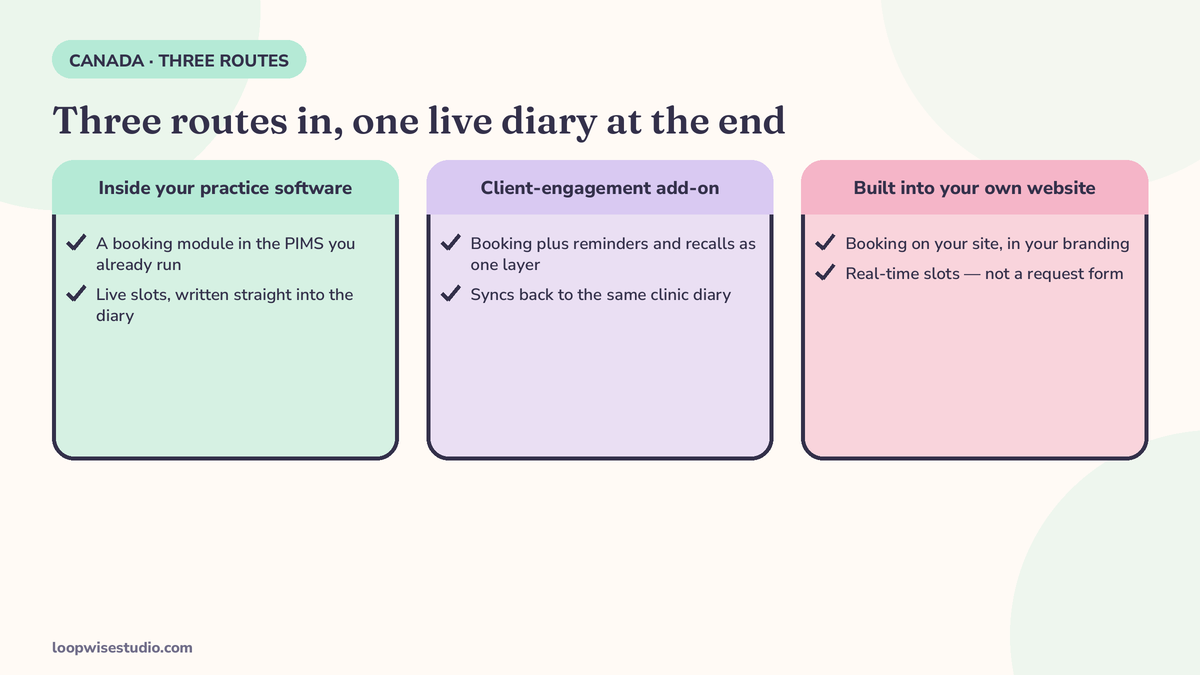
Canadian vet clinics can take bookings online three ways: through their practice software (Digitail is one example), through a client-engagement add-on like PetDesk, or through a booking system built into their own website. Under CASL, a text that only confirms or reminds about an existing appointment is not a commercial electronic message, but any promotional message needs the client’s express consent first — that distinction comes from Apptoto’s published CASL guidance for appointment businesses.
Search for an online booking system for veterinary clinics in Canada and you get directory pages. Capterra Canada lists software. SourceForge lists software. The one detailed story about a clinic fixing its phones is from Arkansas. Nobody has written the Canadian version of this page — so this is it: the three routes, the difference between real booking and a request form, the CASL rules that decide what your reminder texts may say, and what it costs in Canada.
The short answer: three routes, one decision
Every Canadian clinic ends up on one of these:
| Route | What it is | What it depends on |
|---|---|---|
| Booking inside your practice software | A module in your PIMS (Digitail advertises online booking with two-way messaging and automated reminders; Yocale, a Canadian booking platform, starts free per its SourceForge listing) | Your PIMS offering it — and offering it well |
| A client-engagement add-on | PetDesk-style layer on top of your PIMS: real-time booking, reminders, recalls | Paying a second subscription, forever |
| Booking built into your own website | Your site takes the booking against live slots, sends the confirmation and reminders, and the appointment lands in your diary | A one-time build on a website you own |
The directories won’t tell you this, because directories sell listings. A few specifics from those listings are worth knowing before you choose. Yocale — a Canadian booking platform — lists a free starting price on SourceForge, which tells you the Canadian market’s floor is a self-serve tool you configure yourself. Digitail, the cloud PIMS named in both Canadian directories, claims “transparent pricing” in its listing but shows no figure — ask for it in writing. And ThoroVet, at $49/month per its SourceForge listing, is equine-ambulatory software: a reminder that “veterinary” in a directory filter covers very different clinics. The right route depends on one question first: is what you have now actually booking, or just asking?
A request form is not booking — and the phone can tell
Many clinic websites have a “book an appointment” button that opens a form. The owner fills it in, the clinic phones back during opening hours to agree a time, and both sides call it online booking. It isn’t. The phone still rings, the back-and-forth still happens, and after hours the form sits unread while the client books somewhere that answers immediately.
PetDesk’s case study of Osage Veterinary Clinic in Arkansas is the clearest published evidence of the difference. Osage switched from an appointment-request platform to real-time booking synced with its practice software, and PetDesk reports the result as a 40% reduction in phone calls, with the front desk reclaiming about 4 hours a day (18–24 hours a week). Treat those numbers as what they are — the vendor’s own case study, not an independent audit — but the mechanism is sound and matches what any front desk knows: requests create phone calls, confirmed bookings don’t.
Real-time booking means the client sees actual open slots for the right appointment type, picks one, and gets a confirmation — no human in the loop. That is the bar any system on this page has to clear.
What the system has to do before it earns its keep
Whichever route you take, these are the parts that decide whether it works:
- Live, synced slots. The booking page reads the same diary your team works from. A system that double-books once will be switched off within a month.
- Slot exclusions. PetDesk’s Osage write-up highlights exclusions for staff meetings and weather closures — in Canada, read that as snow days and holiday weekends. If owners can book into a closed clinic, the system creates work instead of removing it.
- Guardrails by appointment type. Osage used a disclaimer feature to stop owners booking doctor slots for visits that don’t need a doctor. The Canadian version of the same problem: vaccine boosters booked as full exams, new-client slots taken by nail trims.
- Confirmations and reminders that run themselves. Instant confirmation, a reminder before the visit, and a simple way to reschedule from the message — covered in detail in the CASL section below, because in Canada the wording of these texts is a legal question, not just a marketing one.
- Recalls. The appointments that never get booked are worth as much as the ones that do: vaccine due dates, dental checks, senior pet screens. A booking system that only handles inbound requests leaves the recall list — your most reliable revenue — sitting in the PIMS.
The bookings nobody chases deserve their own paragraph
Inbound booking is only half the system. PetDesk’s retention page frames the other half — declining visit frequency — and its testimonial tiles claim a 10% increase in client retention, a 25% increase in revenue and 30% less time on phones for clinics running PIMS-connected reminders and recalls. Those are a vendor’s testimonial figures, attributed to a named practice manager, with no published methodology — quote them to no one. But the underlying point stands on its own: a clinic’s vaccine-due list, dental rechecks and lapsed-patient list are already sold appointments waiting for a message. Whatever route you choose, ask how recalls run. If the answer is “the front desk works through the list when it’s quiet,” you don’t have a recall system — you have a hope.
If your current setup can’t do the first two, read our breakdown of how much a vet website with online booking costs before you renew anything. And if the phones are the pain right now, the fastest single fix is missed call text back for veterinary clinics — an automatic text the second a call goes unanswered.
Want to know which route fits your clinic’s current setup? get a free audit — we look at your website, your PIMS and your phones, and tell you plainly.
Six questions to ask any vendor before you sign
Copy this list into your next demo call. Every question exists because a source in the Canadian market either dodges it or never raises it:
- Is it real-time booking or a request form? (The distinction that cut one clinic’s calls by 40% in PetDesk’s case study.)
- What happens to my website if I cancel? Managed platforms keep it on their proprietary system; leaving means rebuilding.
- How do you handle CASL consent? Where is express consent captured, where is it recorded, and how are STOP requests processed?
- Show me the full client flow in French. Booking page, confirmation, reminders, reschedule link — not a translated homepage.
- Where is my client data stored, and under which country’s law? The PIPEDA question no vet source answers for you — get the vendor’s answer in writing.
- What does year two cost? Subscription, per-message fees, and the price of the features you saw in the demo that turn out to be a higher tier.
A vendor who answers all six clearly is probably fine. A vendor who goes vague on numbers 2, 3 or 6 is telling you something.
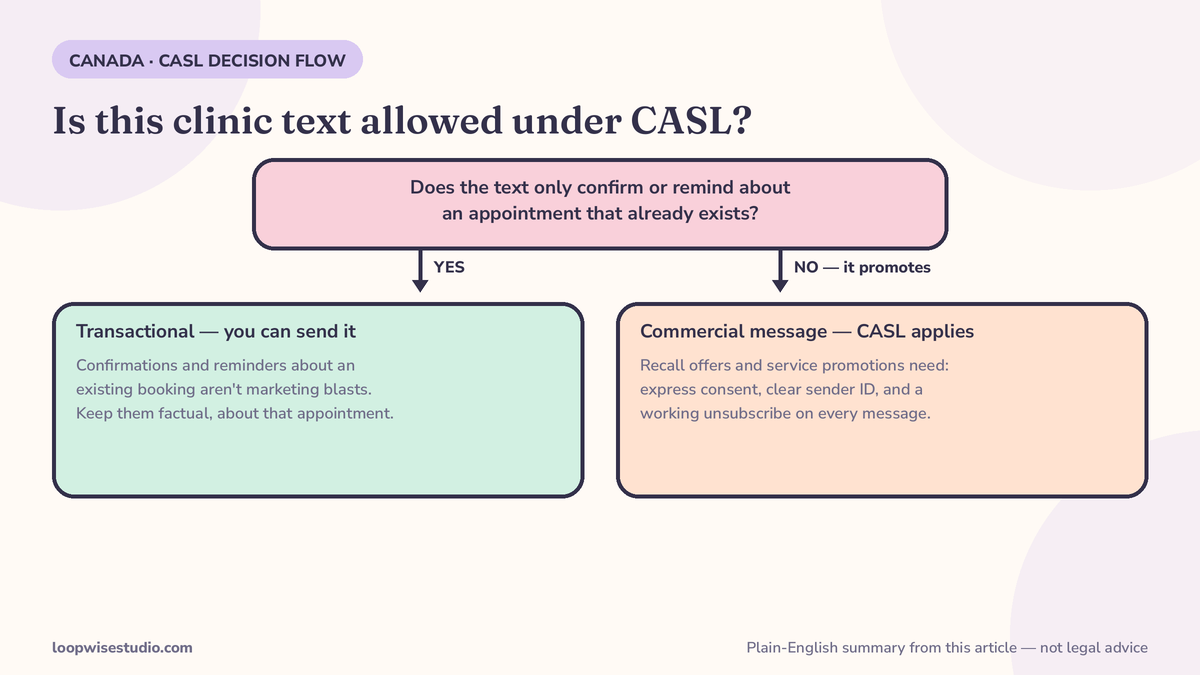
The Canada part nobody else wrote: CASL and your reminder texts
Here is the gap in every directory listing and vendor page aimed at Canadian clinics: none of them mention CASL, Canada’s Anti-Spam Legislation, at all. The rules come from generic guidance published by reminder-software vendors — mainly Apptoto’s CASL guide and SmartSMS Solutions’ 2026 CASL explainer — and they draw a line every clinic needs to understand:
A text that only confirms or reminds about an existing appointment is not a commercial electronic message (CEM). Apptoto states it directly: “an appointment reminder in and of itself would not qualify as a CEM.” SmartSMS agrees — transactional messages that facilitate an already-agreed transaction, explicitly including appointment reminders, are exempt from the CEM rules.
The moment the text promotes anything, it becomes a CEM. Add “…and ask about our dental month special” to a reminder and, per Apptoto, it must contain nothing beyond appointment information to stay a reminder. SmartSMS makes the same point: a promotional element can turn an exempt reminder into a regulated message.
Booking an appointment is not consent to marketing. Apptoto is explicit that booking “does not in and of itself qualify as implied consent” to send CEMs. Vaccine-due recalls that read as marketing, reactivation campaigns to lapsed clients, seasonal offers — those need express consent, captured at intake or at booking, and Apptoto advises recording that consent and keeping it on file. Every CEM also needs sender identification and a working unsubscribe (STOP) mechanism.
Is this text legal under CASL? The 10-second check
| Your text | CASL status | What to do |
|---|---|---|
| “Reminder: Milo’s vaccine appointment is tomorrow at 10:30. Reply C to confirm.” | Transactional — not a CEM | Send it |
| “Milo is due for his booster — book this month and save 15%.” | CEM (it promotes) | Only to clients with express consent on file; include your clinic’s identity + STOP |
| “We miss you! It’s been a year since Bella’s last visit — book now.” | CEM (reactivation marketing) | Same as above |
| “Your appointment is confirmed for Friday 2:00.” | Transactional | Send it |
CASL penalties are not theoretical: CASL guidance summaries (Texty Pro’s explainer) put maximums at up to CA$1 million per violation for individuals and CA$10 million for businesses. You don’t need a lawyer to send reminders — you need the split above, consent captured once at intake, and records kept.
One honest caveat: PIPEDA, Canada’s privacy law, is the other half of the compliance conversation — where client data lives, especially if your software is US-hosted. No veterinary source we found addresses it for clinics, so treat data residency as a question to put to any vendor in writing rather than something this page can settle for you.
Bilingual booking is not a nice-to-have in Canada
No source in the search results mentions French-language booking at all. For a clinic in Quebec it’s not optional in practice, and for clinics in Ottawa, New Brunswick or francophone communities elsewhere, clients who can book, confirm and reschedule in French are clients who don’t phone your English-only front desk to do it. Whichever route you choose, ask the question the directories never ask: does the client-facing flow — booking page, confirmation, reminders, reschedule link — run fully in both languages? If the vendor’s answer is vague, that’s your answer. Partial translation is the usual failure mode: the booking page is French, the confirmation text arrives in English, and the client phones anyway — which defeats the entire purpose. Test the whole journey in French yourself before launch, including the reminder and the reschedule flow, not just the homepage.
What it costs in Canada
Canadian clinics face the same routes as US clinics, priced in the same ranges once you convert: a website with real booking runs from a few hundred dollars a year in DIY tooling to several thousand for a custom build, and add-on platforms charge monthly — Vetstoria, for example, lists a starting price of $249/month on GetApp, before any website exists. We break down every route, including the 3-year totals nobody publishes, in the companion guide: how much a website with online booking costs for a veterinary clinic. One Canada-specific warning: managed vet-website platforms that bundle your site into a monthly fee typically keep the site on their proprietary system — leaving means rebuilding, and that exit cost belongs in your comparison from day one. Our clinic-wide guide to what a website with online booking costs explains the same trap in detail.
How Loopwise sets this up on the clinic you already run
- We audit what you have. Your website, your PIMS, how bookings and recalls actually happen today, and where the phone calls come from.
- We pick the route with you. If your PIMS has a booking module worth using, we build around it. If not, the booking system goes into your own website, synced to your diary.
- We build the client flow. Booking page with appointment-type guardrails and slot exclusions, in English and French if your clients need both.
- We set up the messages — CASL-clean. Confirmations and reminders worded as pure appointment messages; express consent captured at intake and booking for recalls and any promotional message, with STOP handling in place.
- We connect the recall list. Vaccine due dates and lapsed patients become a sequence, not a pile of good intentions — the same follow-up discipline we describe for reducing no-shows at a veterinary clinic, applied to the clients who haven’t booked yet.
- You watch the phone go quiet. Bookings land confirmed, reminders send themselves, and your front desk gets its hours back.
Loopwise Studio builds websites, online booking systems and text/WhatsApp automations for appointment businesses — we turn missed calls and website visitors into booked appointments. If you’d like this running on your clinic’s existing setup, get a free audit and we’ll map your route, your CASL position and your costs before you spend anything.
FAQs
Does my clinic need to replace its practice software to get online booking?
Usually not. If your PIMS offers a real-time booking module, it can be connected properly; if it doesn’t, a booking system built into your own website can work against your diary. What you should avoid is a third “system” nobody syncs — that’s how double-bookings happen.
Are appointment reminder texts legal under CASL?
Yes, when they’re purely about the appointment. Apptoto’s CASL guidance states an appointment reminder by itself is not a commercial electronic message. Add any promotional content and it becomes a CEM, which needs express consent, sender identification and an unsubscribe option.
Can I text clients that their pet’s vaccine is due?
A plain due-date reminder about an existing care plan is transactional in nature; a recall message with an offer or promotion is marketing and needs express consent captured at intake or booking, kept on file. When in doubt, send the plain reminder to everyone and the offer only to clients who consented.
What about clients who prefer French?
Your booking page, confirmations and reminders should run in French as well as English if your client base includes francophones — essential in Quebec, valuable in many other regions. Ask any vendor to show you the full client flow in French, not just a translated homepage.
How long does setup take?
It depends on the route: switching on a PIMS module is days; PetDesk reports its Osage integration took under 30 minutes, though that’s the vendor’s own figure. A booking system built into your website is a small build project — we scope the exact timeline in the free audit, before you commit.
What does Loopwise charge?
Pricing depends on which route your clinic needs, so we quote after the audit rather than publishing a one-size price. The audit itself is free and includes the route recommendation and the CASL checklist for your current texts.