How Much Does a Vet Website With Booking Cost?
How much does a website with online booking cost for a veterinary clinic? Build ranges, the booking software line item guides hide, and honest 3-year totals.

A veterinary clinic website typically costs $500 to $10,000 or more depending on how it’s built: $500–$1,200 for a DIY site, $2,000–$5,000 for a custom site with appointment requests, and $6,000+ with a client portal (figures from Aman Web Solution’s 2026 veterinary website cost guide). Real-time booking software is usually extra on top — Vetstoria, one booking platform, starts at $249/month according to its GetApp profile.
That last sentence is the one every other cost guide leaves out. Guides price “a website” and list booking as a plugin costing $0–$300 a year. Booking platforms price themselves at $249 a month and mention no website at all. Your clinic has to buy both. This page totals them up: the build ranges as published, the booking line item, a 3-year cost table with its assumptions stated, and the exit cost nobody quotes you until you try to leave.
First, the distinction that moves the price more than design does
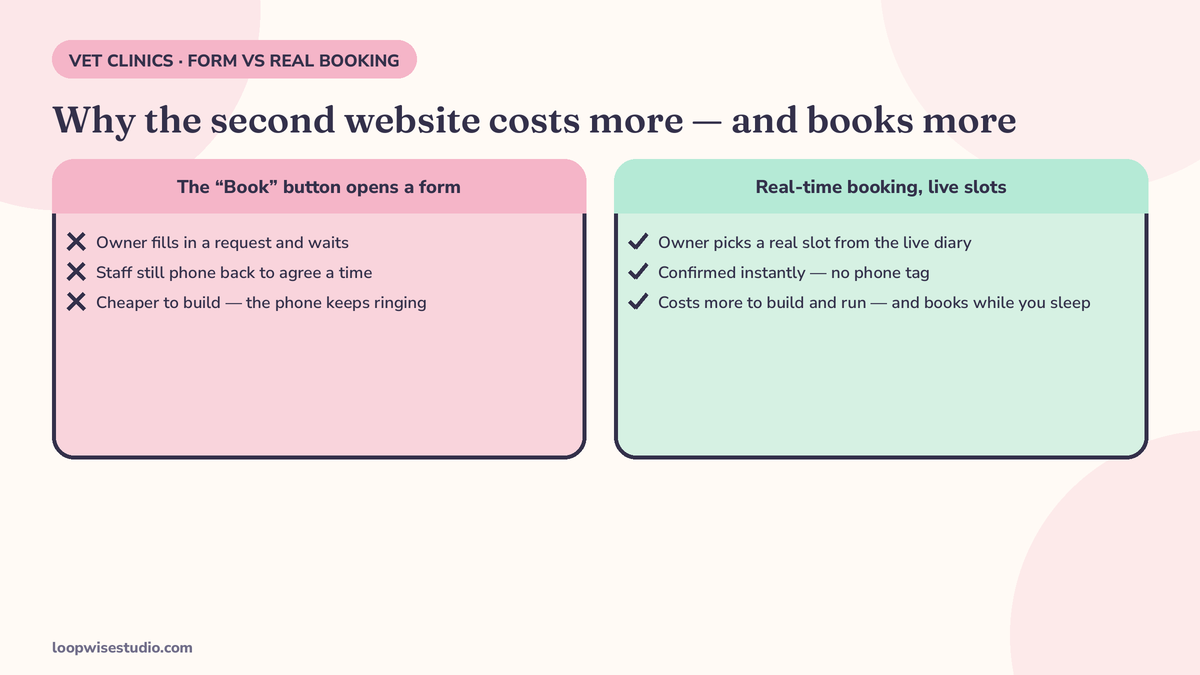
When a quote says “online booking,” it can mean two very different things:
- An appointment request form. The client asks for a time; your team phones back to confirm. This is what most priced guides are actually selling. Aman Web Solution’s cost guide is honest about it — its own FAQ says real-time booking is “only necessary for high-volume multi-vet practices,” which tells you its $2,000–$5,000 custom range buys requests, not booking.
- Real-time booking. The client sees live slots, books one, gets an instant confirmation, and the appointment appears in your diary. Your phone doesn’t ring.
The difference matters in money, not just convenience. PetDesk’s case study of Osage Veterinary Clinic reports that switching from a request platform to real-time booking synced with its practice software cut phone calls by 40% and gave the front desk back roughly 4 hours a day. That’s a vendor case study, so treat the exact figures with care — but the direction is not in doubt, and it’s why real-time booking costs more: it has to connect to your practice software and never double-book.
Every figure below is tagged with which of the two it buys.
The build, route by route — as published
| Route | Published price | Source | What “booking” means at this price |
|---|---|---|---|
| DIY website builder | $500–$1,200 | Aman Web Solution cost guide | You assemble it; booking = whatever plugin you add |
| Premium theme + freelancer | $1,200–$2,000 | Aman Web Solution | Request form |
| Custom WordPress site | $2,000–$5,000 | Aman Web Solution | Appointment requests with urgency triage |
| Agency custom build + client portal | $6,000–$10,000+ | Aman Web Solution | Portal features; booking depth varies |
| Managed vet platform (site bundled) | $500–$2,000 upfront + $150–$400/mo | WebsiteOffers UK buyer guide (the site’s own estimates) | Depends on platform; site is proprietary |
| Custom agency, client-owned | $3,500–$10,000+ upfront + $20–$100/mo hosting/maintenance | WebsiteOffers UK buyer guide | Depends on build |
Aman’s own worked example: a two-vet US clinic rebuild cost $3,400 and took 4 weeks — six service pages plus a request form with urgency triage. Note what that real-world price bought: requests.
Two honesty notes on this table. Aman’s ranges come from a freelancer who sells these builds, and WebsiteOffers labels its figures as its own estimates with no published methodology. Independent, audited pricing data for vet websites doesn’t exist — anyone who gives you a single exact “average cost” is making it up. What you can do is hold every quote against these ranges and ask which row it thinks it’s in.
The line item every guide hides: the booking system itself
If you want real-time booking, the software that provides it is a separate, recurring cost:
- Vetstoria: starting price $249/month flat (GetApp profile, 4.8/5 from 119 reviews) — real-time, PIMS-integrated booking. That’s $2,988 a year, every year, before any website cost.
- App route: GoodBarber’s veterinary app builder charges $55/month (billed yearly) for Premium plus $15/month for its booking add-on, or $105/month for Pro with booking included — booking against Google Calendar, explicitly not a PIMS.
- The bundle route: VetahOS includes a clinic website “free” with any of its PIMS plans, built in 3–5 working days by its account — the website costs nothing because the product being sold is a practice-software switch.
- The plugin line: Aman’s ongoing-cost table prices a booking plugin at $0–$300 a year. That buys request forms and simple calendars. Comparing $300/year to $249/month without noticing they’re different products is how clinics end up surprised.
This is also where Canadian clinics should pause: our companion article on an online booking system for veterinary clinics in Canada covers the CASL rules your reminder texts must follow — a feature requirement (consent capture, STOP handling) that belongs in any quote you compare.
The 3-year totals nobody publishes
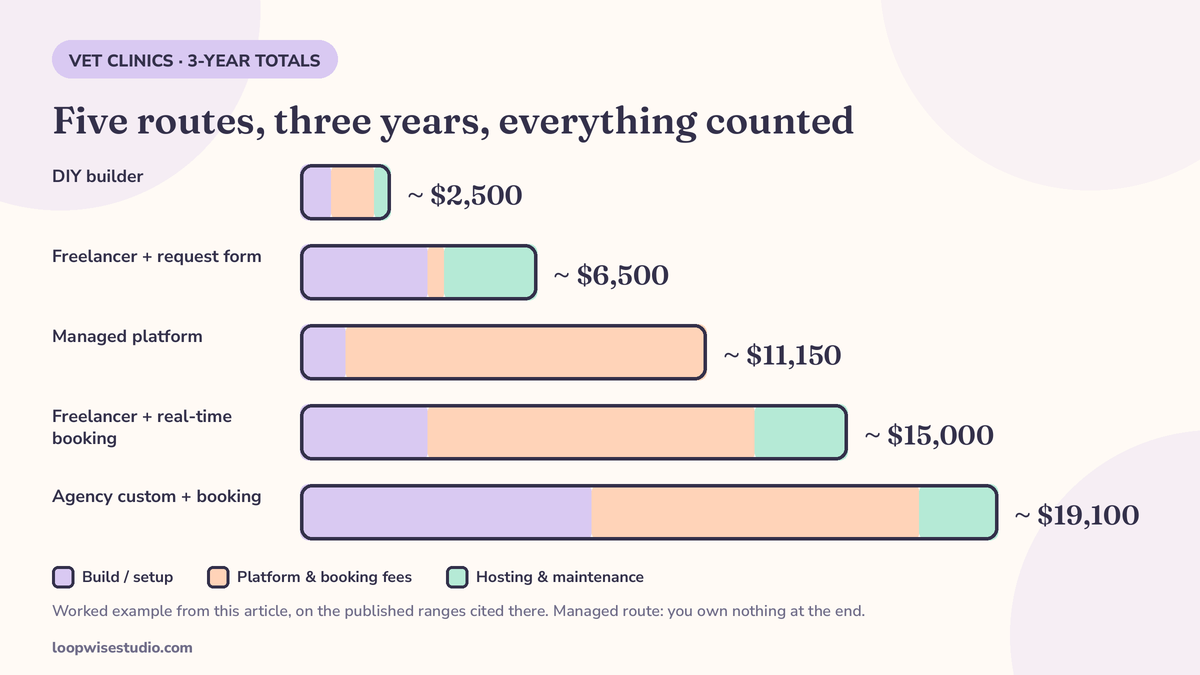
Upfront prices flatter subscription routes and punish owned ones. Here’s the same routes over three years — arithmetic on the published ranges above, using midpoints, with every assumption stated. It is a worked example, not a quote.
| Route (assumptions) | 3-year total |
|---|---|
| DIY: $850 build + $33/mo builder + $150/yr plugin + your own time unpriced | ≈ $2,500 |
| Freelancer site ($3,500) + request-form plugin ($150/yr) + hosting & maintenance ($850/yr, from Aman’s ongoing ranges) | ≈ $6,500 |
| Freelancer site ($3,500) + real-time booking at $249/mo + hosting & maintenance ($850/yr) | ≈ $15,000 |
| Managed platform: $1,250 setup + $275/mo, proprietary | ≈ $11,150 — and you own nothing at the end |
| Agency custom ($8,000) + hosting/maintenance ($60/mo) + real-time booking ($249/mo) | ≈ $19,100 |
Read the middle rows twice. Adding real-time booking to a freelancer site roughly doubles its 3-year cost — not because anyone is ripping you off, but because the booking platform’s $249/month quietly outweighs the entire website build within 14 months. That’s the number to negotiate, compare and interrogate, not the design quote.
And the comparison that matters most: a managed platform at ≈$11,150 over three years leaves you with no website you own. The freelancer-plus-booking route at ≈$15,000 leaves you with a website, your content and your client-facing pages that survive any software switch.
Want your clinic’s actual numbers instead of midpoints? get a free audit — we’ll price your route with your PIMS and your diary in front of us.
Which route fits which clinic
WebsiteOffers’ buyer guide publishes a budget-based decision matrix, and it’s a reasonable starting point: a startup working with under $1,000 goes DIY; an established clinic comfortable at $150–$350/month goes with a managed platform; a multi-location group spending $5,000+ upfront goes custom. We’d add one column the guide lacks — the booking question. A startup that needs real-time booking to survive its phone volume is better served by a modest website plus a real booking platform than by a beautiful website with a request form, because the requests are what generate the calls it’s trying to escape.
Three billing surprises catch clinics out on every route:
- The subscription quietly becomes the biggest cost. At $249/month, a booking platform costs more than the entire mid-range website build within about 14 months. Quotes lead with the build because it’s the smaller number over time.
- The demo shows the top tier. Features like slot exclusions, recall campaigns and two-way messaging may sit in a higher plan than the one priced. Get the feature-to-plan mapping in writing before you compare totals.
- The exit is priced at zero until you use it. Nobody quotes the rebuild you’ll need if you leave a proprietary platform. It belongs in the comparison from day one, not as a shock in year three.
What pushes the price up
- Multi-vet scheduling. Each vet’s diary, appointment types and slot rules have to be modelled separately.
- Client portal and records access. Aman’s range jumps to $6,000–$10,000+ once a portal enters the quote.
- Prescription refills and pharmacy links. Real integrations (the WebsiteOffers guide lists pharmacy and telehealth add-ons) cost more than pages.
- Multiple locations. Each location multiplies diaries, pages and local search work.
- Reminders and recalls done properly. Reminder messaging — texts per appointment, recall sequences for lapsed patients — is an operating cost no build quote includes; it’s also where the return is, since it’s what stops the phone ringing and fills quiet weeks. (For the phone side of the same problem, see missed call text back for veterinary clinics.)
Ongoing costs, from the one guide that itemises them
Aman’s ongoing-cost table, attributed as published: hosting $100–$300/year, domain $12–$20/year, SSL free–$100/year, booking plugin $0–$300/year, maintenance $300–$1,000/year. Add to that the two lines his table omits: your booking platform subscription if you run real-time booking (above), and reminder messaging volume if your platform charges per text.
Put the ongoing picture together and a realistic steady-state year for a clinic with real-time booking looks like this: the platform subscription (from $249/month at Vetstoria’s published starting price — $2,988 a year on its own), hosting at $100–$300, maintenance somewhere in Aman’s $300–$1,000 range, and the domain for the price of a lunch. In other words, the running cost of a booking website that actually books is dominated — roughly ten to one — by the booking platform, not by the website. Any budget conversation that starts with design and never reaches the subscription is having the wrong argument.
One clinic, three quotes — a composite example
To see how the ranges behave, take a composite two-vet clinic (built from the published ranges above, not a real clinic): it needs a website, real-time booking against its PIMS, reminders, and vaccine recalls.
- Quote A — the website quote. Freelancer build at $3,400 (Aman’s case-study price), with a request form described as “online booking.” Year one adds hosting and maintenance of about $850. Total year one: ≈ $4,250. The phone keeps ringing, because requests aren’t bookings.
- Quote B — the platform quote. Managed service at $1,250 setup and $275/month: ≈ $4,550 in year one, ≈ $11,150 by year three, and the website is proprietary — leave, and the site stays behind.
- Quote C — the honest quote. The same $3,400 build plus real-time booking at $249/month: ≈ $7,250 in year one (build + 12 × $249 + $850 running costs). Most expensive on paper — and the only one of the three that actually stops the phone calls Quote A pretends to fix.
The lesson isn’t that C is always right. It’s that A and C differ by one line item, and that line item is the one that does the work.
The cost of “free”: bundles and the price of leaving
A “free” website bundled with software is paid for inside the subscription — and the exit is where it gets expensive. WebsiteOffers’ buyer guide flags that managed vet platforms ($150–$400/month) are proprietary: the site cannot easily be transferred when you leave. Leaving then means a full rebuild ($2,000–$5,000 on Aman’s freelancer ranges), new pages, lost search rankings during the switch, and retraining clients on a new booking flow — all at the exact moment you’re also changing practice software. When you compare quotes, ask one question in writing: if I cancel in year two, what exactly do I keep? A client-owned build keeps everything. Our clinic-wide breakdown of what a website with online booking costs walks the same maths for human clinics — the trap is identical.
The quote checklist: what must be itemised before you sign
Send this to anyone quoting you. A serious quote separates all ten lines; a vague one bundles the expensive ones into “and more.”
- Design and build, as a fixed one-off figure
- Booking type stated in words: request form or real-time, PIMS-synced booking
- The booking platform’s name, plan and monthly price — separate from the website
- PIMS integration: included, extra, or not possible with your system
- Appointment-type rules and slot exclusions: set up for you or left to you
- Reminder and recall setup: sequences written and configured, or a blank tool
- Per-message or per-text charges, if any, and the included allowance
- Hosting, domain, SSL and maintenance per year (hold them against Aman’s $100–$300 hosting and $300–$1,000 maintenance ranges)
- Training and handover: who on your team learns to run it
- Cancellation terms: what you keep — domain, content, pages, client data — if you leave in year two
If a quote can’t fill in line two, it isn’t a quote for online booking. It’s a quote for a website with a form on it, and the 3-year table above shows what that difference is worth.
How to get a number you can trust
- Decide request form vs real-time booking first — it changes every quote.
- Get the booking platform priced separately, in writing, per month.
- Ask for the 3-year total, not the launch price.
- Ask what you keep if you cancel.
- Compare against the published ranges on this page, line by line, before signing anything.
Loopwise Studio builds websites with real online booking and text/WhatsApp follow-up for appointment businesses — one-liner version: we turn missed calls and website visitors into booked appointments. Our quotes are fixed after a discovery call, not picked from a rate card. Start with the free audit: get a free audit and we’ll map your route, your PIMS integration and your 3-year total before you sign anything.
FAQs
What is the cheapest way to get a vet website with booking?
A DIY builder at $500–$1,200 (Aman Web Solution’s range) plus a booking plugin at $0–$300/year. That buys appointment requests, not real-time booking, and the labour is yours — the true cost includes your evenings.
Why does real-time booking cost so much more than a booking form?
Because it has to read and write your actual diary through your practice software, enforce slot rules, and never double-book. A form is a web page; real-time booking is an integration. Platforms like Vetstoria charge from $249/month for it (GetApp).
Is a free website bundled with practice software a good deal?
It can be, if you’re switching PIMS anyway and accept the lock-in. The risk is the exit: managed platforms are typically proprietary (WebsiteOffers’ buyer guide), so leaving means paying for a rebuild at the worst possible time. Get the cancellation terms in writing.
Do these prices apply in Canada?
The ranges above are published in USD by US/UK sources. Canadian clinics face the same routes and similar converted costs, plus one extra requirement: reminder texts must follow CASL, which affects the features you need. Our Canada article covers that in full.
What ongoing costs should I budget for?
From Aman’s itemised table: hosting $100–$300/year, domain $12–$20/year, maintenance $300–$1,000/year — plus your booking platform subscription if you run real-time booking, plus any per-message reminder fees.
Can Loopwise give me a fixed quote?
Yes — after a short discovery call where we look at your PIMS, locations and appointment types. Fixed quotes are the point: you’ll know the build cost and the monthly lines before we start, not after. Bring any competing quotes to that call — we’ll happily walk them line by line against the checklist on this page, including the ones that beat us on build price by hiding the subscription.