Booking System for Tattoo Studios in the UK (With Deposits)
How UK tattoo studios should take bookings: artist calendars, deposits taken online, consent before the day — and the commission maths on platforms.
A booking system for a UK tattoo studio needs artist calendars, a deposit taken online before the slot is confirmed, and consent forms signed before the session. Platforms charge for this per artist or take 20–35% commission on new clients (Fresha 20%, Treatwell 35%, as reported in October 2026); a website you own with booking built in charges a flat monthly fee and no commission. Those platform figures come from a comparison table published by Semicolon Software (checked 5 October 2026) — third-party reported, so verify them on each platform’s own pricing page before you rely on them.
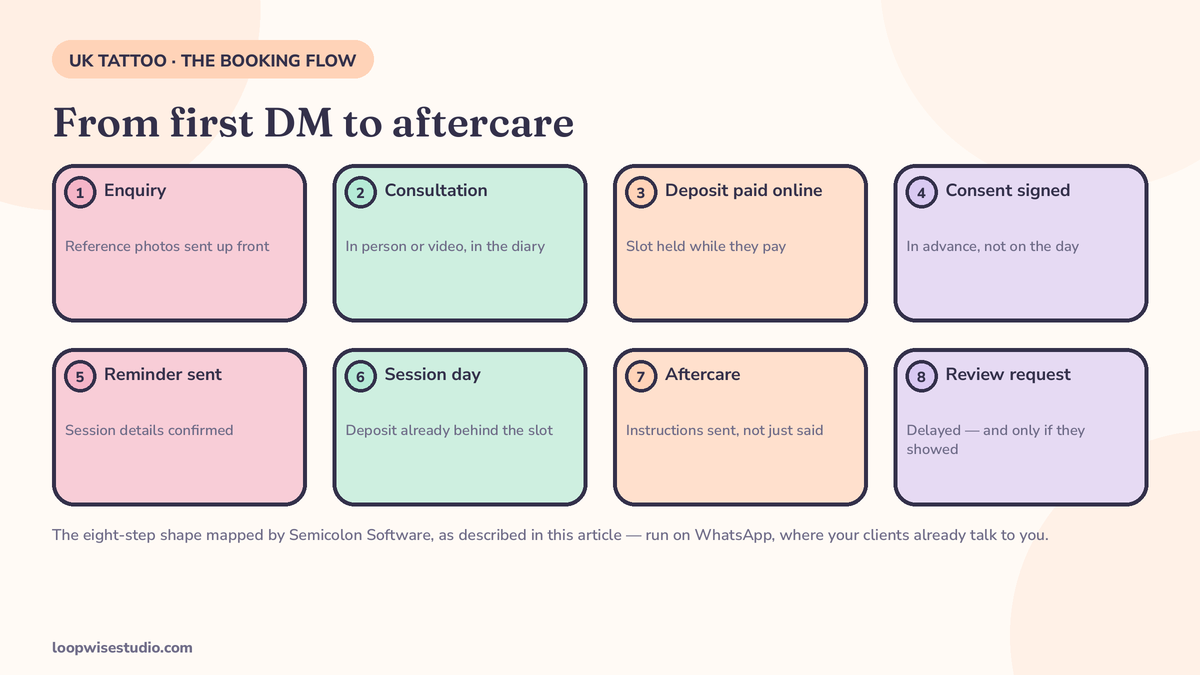
Tattooing is the worst vertical in the beauty industry to run on generic booking software, and the reason is the shape of the work. A haircut is a haircut. A tattoo booking is a design conversation, a consultation, a deposit, a consent form, and then a three-hour slot that is worth nothing to anyone else if the client vanishes. Software built for salons sees a calendar. A tattoo studio needs a funnel.
This page walks through how tattoo booking actually works in UK studios, where it leaks, what the system has to do at each step, and how deposits should really work — sized, worded, and enforced without a fight at the desk.
How tattoo booking actually works in the UK — and where it leaks
Most UK studios run some version of this funnel:
- Enquiry. The client DMs the studio or an artist on Instagram: a screenshot of someone else’s tattoo, a rough idea, “how much for something like this, half sleeve?”
- Conversation. Back and forth over hours or days — size, placement, reference images, style fit. Somewhere in here, half the enquiries die. Nobody replied fast enough, or the thread sank under newer messages.
- Consultation. A short in-person or video chat, booked by hand, in a diary or in someone’s head.
- Deposit. The client pays — often by bank transfer, tracked in a spreadsheet, a notes app, or memory.
- Session. The slot is held on trust and a transfer receipt.
- Aftercare. Verbal instructions, maybe a printed sheet. The follow-up, the healed photo, the review — usually nobody’s job.
Count the leaks. Enquiries die in DMs because replies are slow. Consultations get booked in chats and forgotten. Deposits sit in bank transfers nobody reconciles against the diary, so a “booked” slot sometimes has no deposit behind it at all. And when a client no-shows a four-hour piece, the artist loses a day-part that cannot be refilled at an hour’s notice.
Compare that with the one UK vendor that has mapped this funnel properly. Semicolon Software, a done-for-you tattoo website provider, describes its booking as eight steps — found, book, brief, deposit, remind, consent, self-service reschedule, aftercare — including details nobody else bothers with: the slot is held for 30 minutes while the deposit is paid, consent is signed in advance, and a delayed review request goes only to clients who actually showed up. That is the bar. Notice, though, what channel it runs on: email and your own Twilio SMS. Not WhatsApp — and WhatsApp is where your clients already talk to you. More on that below.
What the booking system must do
Artist calendars, not a studio calendar. Clients book an artist, not a chair. Each artist needs their own diary, their own services (one does fine-line, another does blackwork, their day rates differ), and their own deposit amount.
Durations driven by the piece. Semicolon’s system sets appointment length from the size of the piece — copy that logic whatever you use. A booking form that lets a client book “tattoo, 1 hour” for a back piece is worse than no form at all.
Reference images at enquiry, not on the day. Up to a handful of uploads with the enquiry, plus a body-placement note, so the artist can judge the job before anyone commits diary time.
Age and consent before the session. Tattooing anyone under 18 is illegal in the UK, deposit or not. The system should record an 18+ confirmation at booking and get the consent form signed digitally before the day — encrypted, stored, and deleted on a retention schedule — instead of a clipboard while the machine is already set up.
Self-service reschedule, with the deposit attached. Life happens. If moving an appointment takes a phone call, clients who cannot face the call simply do not show. Let them move it in two taps, inside a window you set, and the deposit follows the booking automatically.
A way to handle guest artists and flash days. Guest spots are booked in a burst and gone in a week. Flash days are dozens of small fixed-price pieces. Your system needs event-style booking for both, or your studio will keep running them off Instagram stories and hope.
For the American version of this problem — deposit payment built into a studio website — see our tattoo studio website with online booking and deposit payment page. The UK difference is mainly the channel: WhatsApp first, and commission rates on UK platforms that make the maths below worth reading twice.
Deposits, properly: how much, how to word it, when it’s lost
The deposit is the part studios get wrong in both directions. Too soft (“just message me on the day”) and the diary is fiction. Too harsh and worded like a threat, and good clients book the studio down the road.
How much. Workable patterns from UK studio practice:
| Booking type | Workable deposit pattern |
|---|---|
| Consultation | Free, but booked in the diary like any appointment — never “just pop in” |
| Small piece (under 2 hours) | Fixed £30–£50 |
| Half-day piece | £80–£100, or roughly 25% of the quoted price |
| Full-day / large work | £100–£150, or 25–30% of the quote |
| Guest artist slot | Higher end of the range — the artist travels once, the slot cannot be re-sold locally |
These are examples to adapt, not rules. What matters is that the amount is large enough that walking away stings, and small enough that a genuine client pays it without a wobble.
How to word it. Copy this and adjust the numbers:
“Your deposit holds your appointment and comes off the price on the day. You can move your appointment once, free, with at least 72 hours’ notice — your deposit moves with it. Inside 72 hours, or if you don’t show, the deposit is kept: that slot was held for you and can’t be re-sold at short notice. Running late? Message us. We’ll always try to help before we keep a deposit.”
Every line of that does a job. “Comes off the price” stops the deposit feeling like an extra charge. “Moves with it” makes booking early feel safe. The 72-hour line is firm but explained. And the last line keeps the door open for the client whose train was cancelled — firm policy, human delivery.
When it’s forfeited. Only in the two cases named: late cancellation inside the window, and no-show. Never as a surprise, never for a first lateness you waved through at the desk. The policy only protects you if clients believe it is real and believe it is fair.
Where the money goes. Deposits should land in your own payment account at the moment of booking — card payment in the booking flow, not a bank transfer someone checks on Friday. Stripe’s standard UK card fee is 1.5% + 20p (as stated on Semicolon’s page). On a £50 deposit that is 95p. That is the entire cost of a deposit system that actually reconciles itself.
If you want help pressure-testing your deposit levels against your no-show pattern, you can get a free audit. We will look at where your diary leaks before we suggest changing anything.
Reminders and the day-before check that saves the slot
For a tattoo studio, the reminder is not a courtesy — it is the last chance to refill a very expensive hole.
A sequence that works:
- At booking: confirmation with date, artist, deposit received, balance due, and the reschedule link.
- One week before (long pieces only): a short check-in. Design finalised? Placement confirmed? This is also where the consent form gets chased if it is still unsigned.
- The day before: the important one. Not “reminder: appointment tomorrow” — a reply-request: “Still good for tomorrow at 11 with [artist]? Reply YES, or tap here to move it.” A client who was going to no-show often will not lie to a direct question; they reschedule, and you get a day to offer the slot to your waiting list.
- Morning of: arrival details, studio address, “eat beforehand, bring ID.”
- After: aftercare instructions on the channel they actually read, a healed-photo request at two weeks, and a review request after that — only to clients who attended.
Run this on WhatsApp and it lands. Run it on email and it competes with 200 unread messages. This is the same reminder-plus-deposit logic we set out for salons generally in reducing tattoo appointment no-shows, tuned here to UK studio diaries and UK clients’ habits.
Your own website vs a booking platform: the commission maths
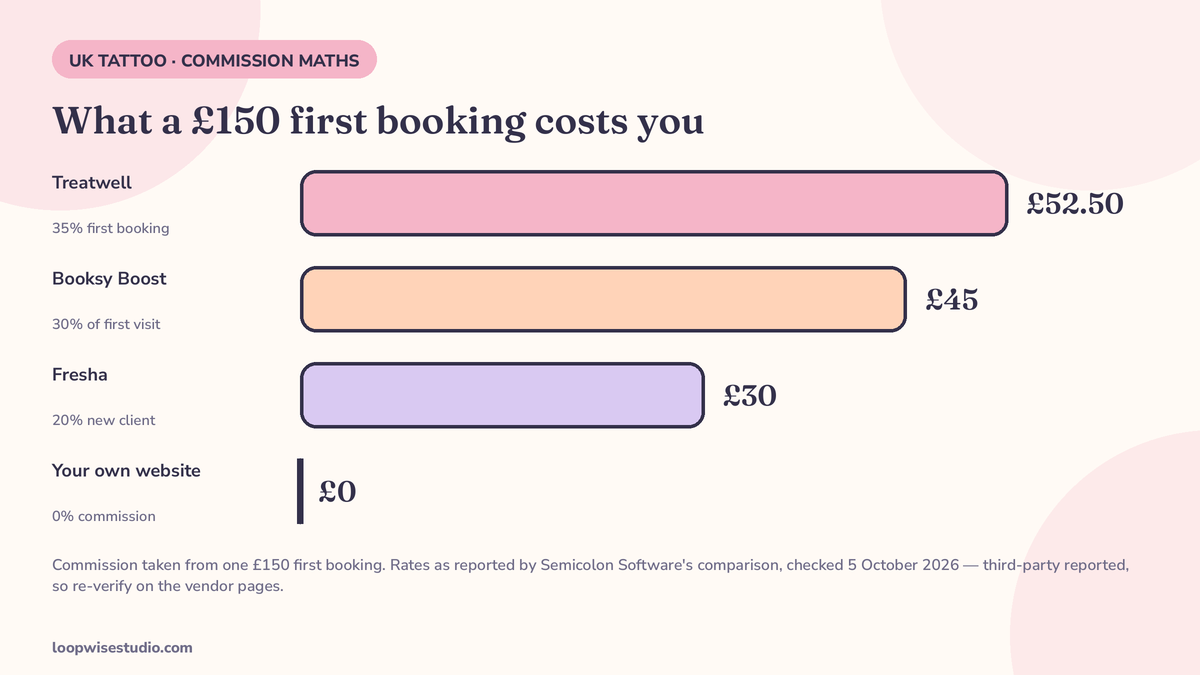
Here is what the routes cost, from Semicolon Software’s comparison table (checked 5 October 2026 against each platform’s own site; third-party reported — re-verify on the vendor pages before publishing or deciding):
| Route | Published/reported cost | Commission |
|---|---|---|
| Your own website (Semicolon, done-for-you) | £449 one-off setup + £39/mo hosting & maintenance, any number of artists | 0% |
| Fresha | £14.95 solo or £9.95 per team member/mo; Smart Website add-on £12.95/mo; card payments 1.40% + 25p; 20 free texts/mo then 6p | 20% on a new marketplace client’s first booking (min £4) |
| Booksy | £40/mo + £5 per extra staff; card payments 1.29% + 20p + VAT | Boost: 30% of first visit (min £5) |
| Treatwell | Subscription price not published; online prepayment processing 2.5% | 35% of a new client’s first marketplace booking |
| Get Ink | £29 solo / £54.40 two artists per month; £1 processing per payment | Per its own terms |
| Tattoo Booking (US SaaS) | $29.99/mo flat per studio, unlimited artists | Deposits tracked rather than necessarily taken online |
Now the worked example — Semicolon’s own calculator, with its assumptions stated: a 3-artist studio taking 4 new marketplace clients a month at a £150 average first tattoo. On that example, the own-website route comes to £39/mo (£917 in year one including setup), against £162.80/mo on Fresha, £230/mo on Booksy and £210+/mo on Treatwell. Those are a vendor’s illustrative numbers, built to flatter the vendor — treat them as arithmetic with stated assumptions, not market data. But run the same sum with your own numbers and the direction rarely changes: commission is charged on exactly the clients who cost you the most to win.
The honest counterpoint: marketplaces bring discovery. If your studio is new and unknown, Treatwell’s 35% is buying you clients you would not otherwise get. The maths flips once most of your chairs are filled by returning clients and word of mouth — then you are paying commission on demand you already own. Most established studios are past that point and have not done the sum.
This is the same decision, in a different shape, that a booking page on your own website forces in every vertical: rent the demand, or own the door it walks through.
What Loopwise builds for tattoo studios
A website on your own domain, the booking funnel built for tattooing, and the client conversation moved onto WhatsApp — your existing studio number, no new hardware, and no app for clients to download:
- Enquiry forms that do the consult prep: reference image uploads, placement, size — the answers your artists actually need, before diary time is offered.
- Per-artist diaries with size-based durations, consult-first or direct-book flows per artist, and guest-artist/flash-day booking when you need it.
- Deposits taken in the flow — card payment at booking, your amount per artist, money straight to your account, deposit follows the booking when a client reschedules themselves.
- Consent before the day: 18+ confirmation recorded, digital consent signed in advance.
- WhatsApp reminders — the day-before reply-check, aftercare messages, healed-photo and review requests, all automatic, all from your studio’s number.
- No commission, ever. Flat pricing, your domain, your client list.
FAQ
How much deposit should a UK tattoo studio take?
Enough that walking away stings: £30–£50 for small pieces, £80–£100 or about 25% for a half-day, £100–£150 or 25–30% for full-day work. Guest-artist slots sit at the top of the range. Always credit it against the price on the day, let it follow the booking on one free reschedule, and keep it only for late cancellations inside your stated window and no-shows.
Can a client reschedule without losing their deposit?
They should be able to — once, free, inside a window you choose (72 hours is common). Self-service rescheduling with the deposit attached is what turns a would-be no-show into a moved booking. Inside the window, or on a second move, the deposit is at risk — and the policy should say so in plain words at the time of booking, not in small print afterwards.
Is WhatsApp booking legal and practical for consent forms?
Booking and reminders on WhatsApp are fine — it is a messaging channel like SMS. Consent forms themselves are better handled as a secure digital form linked from the message, signed before the session, with the 18+ confirmation recorded at booking. Tattooing under-18s is illegal in the UK regardless of consent, so the age check belongs in the booking flow, not on a clipboard at the desk.
Fresha says it’s free. Why would I pay for my own website?
Fresha’s software can be free to run — the reported cost is the 20% commission (minimum £4) on a new marketplace client’s first booking, plus card fees and add-ons (figures third-party reported, October 2026 — check Fresha’s current terms). That is a fair price for discovery when you are new. Once your diary fills with returning clients, you are paying commission on your own demand. Your own website costs a flat fee and takes no cut.
We take deposits by bank transfer now. Why change?
Because transfers do not reconcile themselves. A card deposit in the booking flow is attached to the appointment automatically: paid or not paid, no spreadsheet, no Friday-afternoon checking, and the client cannot “book” a slot without actually paying. The fee is small — Stripe’s standard UK rate of 1.5% + 20p means 95p on a £50 deposit — against artist hours lost to slots that were never really secured.
How fast can a studio switch from DMs and a paper diary?
The website and booking build is the fast part; the slow part is agreeing your services, durations and deposit rules per artist. Studios that have those answers ready go live in weeks. Your old way keeps working until the new one is ready — clients keep DMing, you keep replying, and the system takes over enquiry by enquiry.
To recap: tattoo booking works when the enquiry, the consult, the deposit and the consent all live in one flow — on your own website, with WhatsApp doing the reminding. If that is the studio you want to run, get a free audit and we will map your funnel before quoting anything.