Missed Call Text Back for Salons & Barbershops
Missed call text back for salons and barbershops, explained plainly: how it works, five copy-ready scripts, the real prices from $79/mo, and when you need more.
Missed call text back for salons and barbershops does one simple thing: when a call to your shop goes unanswered — because you are mid-cut, mid-colour, or closed — the caller gets a text from your business number within seconds, with a link to book. Instead of hanging up and calling the next salon on Google, they book with you from that text. It is not voicemail, it is not a robot answering your phone, and it is not a chatbot pretending to be your receptionist.
This page covers what it is and is not, how it runs minute by minute in a salon, the exact texts to send, the barbershop version, and an honest price ladder — from the $79–$99/mo text-back-only tools up to AI receptionists and a human answering service, as priced on the vendors’ own pages in October 2026. So you can decide what your shop actually needs, which for most single-location salons and barbershops is the simple version.
What missed call text back is (and what it is not)
Three different products get sold under similar words, and owners end up paying for the wrong one.
It is: an automatic text triggered by a missed call. The caller gets it while they are still holding their phone, seconds after the call rings out. The text apologises, names your business, and gives them one clear next step — tap the booking link, or reply to the text. Their reply lands with you or your team, and you pick the conversation up when your hands are free.
It is not voicemail. A voicemail asks the caller to do work and wait. One salon text-back vendor (Tally) puts it bluntly on its own page: “Your voicemail has a 0% booking rate.” That is a marketing line, not a measured statistic — but the direction is right. Callers looking for a haircut today rarely leave messages. They dial the next result.
It is not an AI receptionist. An AI receptionist answers the call with a synthetic voice and tries to hold the whole conversation. Some shops want that. It costs several times more, it needs training on your services and prices, and callers can tell. Text back makes a smaller promise and keeps it: nobody who calls you is met with silence.
It is not a general marketing blast tool. These texts go only to people who just called you, about the call they just made. That narrow, expected message is the whole reason it works — and why reply rates on it are nothing like a promotional text campaign.
If your missed calls are mostly new clients trying to book — the usual pattern for salons and barbershops — text back covers most of the leak on its own. It is the same mechanism we set up for treatment-led businesses in our guide to missed call text back for med spas; the scripts and the diary pressure are what change for hair. For a treatment-led version of the same setup, see our guide to text back for massage therapists — the mechanism is identical, but the scripts assume a booked session rather than a walk-in.
How it works in a salon, minute by minute
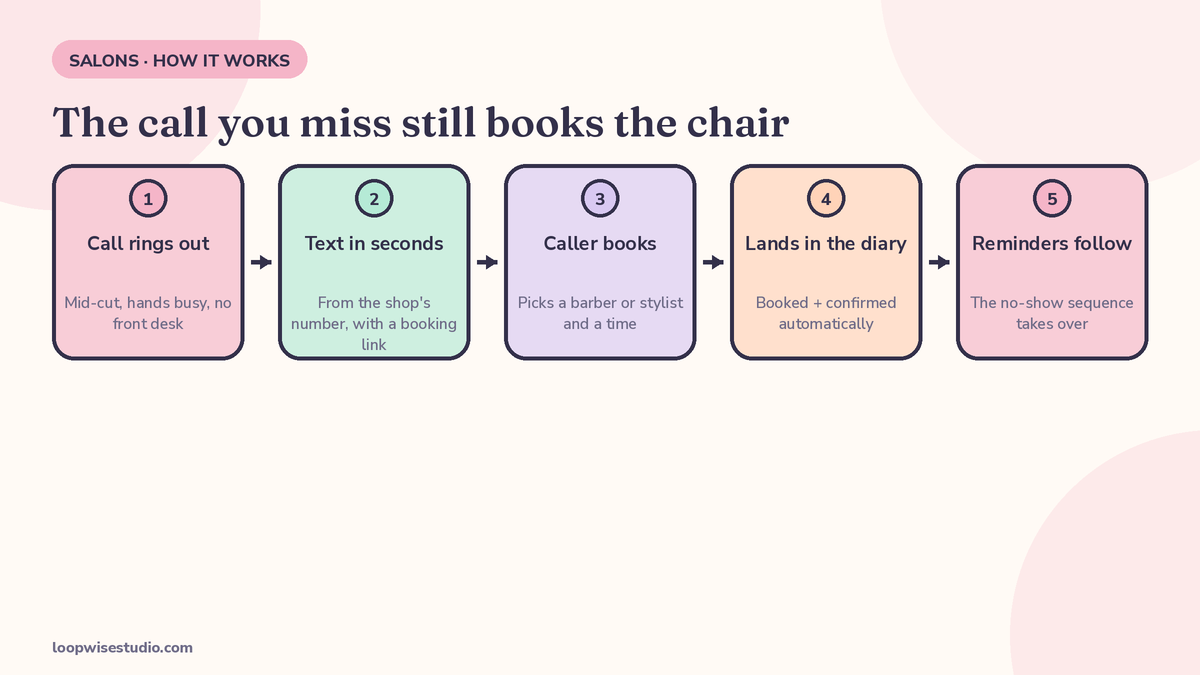
| Time | What happens |
|---|---|
| 0:00 | A caller rings while you are mid-service or with a client at the till. Nobody can get to it. The call rings out. |
| 0:05–0:30 | The caller automatically gets a text from your number: sorry we missed you, here is the booking link, or reply here. |
| 0:30–2:00 | Most callers tap the link and book a real slot, or reply with what they wanted (“balayage next week?”). Either way, they have stopped dialling competitors. |
| When you are free | You or your team see any replies in one inbox, answer the ones that need a human, and the booking is already in the diary with a confirmation and reminder attached. |
| Next morning | You can see how many calls were missed, how many got texts, and how many turned into bookings — including the ones that came in after closing. |
The after-hours part matters more than most owners expect. Booksy, describing patterns in its own customer data, states that 60% of client-booked appointments are made outside working hours. That is Booksy’s figure for its own platform, not a market-wide study — but every salon owner recognises the shape of it. Evening callers are not leaving voicemails either. The text is the only member of staff who answers at 9pm.
What the text should actually say: 5 copy-ready scripts
Most vendors show one example message, usually written for a plumber. Use these instead. Keep your real booking link where the brackets are, and keep each text short — one idea, one action.
1. Daytime, you are busy (the default):
Hi, it’s [Salon] — sorry we missed your call, we’re with clients right now. You can book straight in here: [booking link]. Or reply to this text and we’ll get back to you as soon as we’re free.
2. After hours:
Thanks for calling [Salon] — we’re closed right now and open again at [time] tomorrow. If you’d like to book, our live slots are here: [booking link]. Reply to this text and we’ll pick it up first thing in the morning.
3. The price question (for when your number forwards replies to you — send this as your first reply to “how much is…?”):
Good question — a [service] with [Stylist] starts at [price], and the exact price depends on hair length, which we confirm before we start. Want me to hold a slot? Live times are here: [booking link].
4. The regular whose stylist is away:
Hi [Name], [Stylist] is away until [date] — sorry we missed your call. I can book you in with her first week back: [booking link], or if you need it sooner, [other stylist] has [day/time] open. Just reply and I’ll sort it.
5. Saturday rush (short, because everyone is busy):
[Shop name] here — Saturdays are packed and we missed your call. Walk-in wait and today’s bookings are here: [booking link]. Reply BARBER if you want us to text you back between clients.
Writing rules that apply to all five: say who you are in the first few words (an unknown number gets ignored), one link, one action, and never make the caller repeat what they already asked. If they reply, a human or a sensible follow-up answers their actual question — the first text’s job is to stop them leaving, not to close every sale alone.
The part most tools skip: the booking page the text sends them to
A text back is only as good as the page behind the link. This is where the cheap tools quietly lose you the booking they just saved.
The caller taps your link on their phone, probably standing outside another salon. That page has about 30 seconds to do its job. It needs: your services with prices, real live slots (not a request form), the stylist they asked for, and a confirmation that arrives by text when they book. If it asks them to create an account, download an app, or wait for you to approve the request, a share of them will close it and go back to Google.
Tally and Addison, the two clearest text-back-only products, are honest about this split: Tally sends callers your existing booking link and works with Square, Vagaro, GlossGenius or Booksy; Addison sends your message and callback number and leaves the booking to you. Neither builds or fixes the page the caller lands on. If your current booking page is slow, unclear, or buried inside a marketplace, the text rescues the call and the page loses it again.
That connection — call, text, and a booking page on your own site that actually converts — is the system worth paying for, and it is the one we build. It also feeds the rest of your diary: every caller who could not get the slot they wanted is exactly the person who should be joining the waitlist described in our guide to filling cancelled salon appointments automatically.
Want to know what your missed calls are worth before you buy anything? Get a free audit — we will count them with you, look at where your booking link sends people, and tell you which rung of the price ladder below fits your shop.
The barbershop version
Barbershops show up in the title of almost every product on this list, and then get no content of their own. The setup is genuinely different in a shop, so here it is properly.
There is no front desk. In most barbershops the phone belongs to whoever is nearest it, which during a rush is nobody. There is no receptionist whose job includes the phone — the phone is competing directly with a paying customer in the chair. Text back is arguably more valuable here than in a salon with a front desk, because the alternative is not “the receptionist was busy.” It is “nobody’s job is the phone, ever.”
Walk-ins change the message. A salon text mostly needs to book a future slot. A barbershop text should do two things: offer the booking link for later today or tomorrow, and give a walk-in answer — current wait, or “reply and we’ll text you when a chair frees up.” Same-day demand is the barbershop’s whole trade; a caller at 11am usually wants a cut today, not next Thursday.
Booth renters need their own handling. If your chairs are rented, one shop number with one booking link can send a caller to the wrong barber’s diary. The fix is in the text and the page: the first text asks who they were after (or links to a page where each barber has their own booking button and slots). Set this up once, correctly, and renters stop treating the shop number as a nuisance.
Price and availability questions dominate. “How much for a skin fade?” and “any slots today?” are most of what a barbershop phone carries. Both are answerable in the first exchange if your prices and live diary are connected to the text flow — which is one more reason the booking page behind the link does the heavy lifting.
Text back vs everything else: the honest price ladder
Prices below are as published on each vendor’s own page in October 2026. Check current pricing before you buy anything — vendors change it, and two of these pages were read via their live sales pages during our research rather than a pricing contract.
| Option | What it is | Price as published | What the extra money buys |
|---|---|---|---|
| Tally | Text back only, built for salons; one text per caller, spam filtered, sends your booking link | $79/mo, with a 14-day money-back offer and usage framed around 150 texts/mo | The cheapest clean version of exactly this keyword |
| Addison | Text back only, general small business; custom message, call dashboard, unlimited text-backs | $99/mo flat, no setup fee, 14-day trial | Simplicity; no salon content or booking in the text flow |
| Greeta | AI voice + text-back + booking apps, salon-led | Complete Solo $139/mo | A voice agent that can complete a booking inside the conversation |
| Frontivo | AI receptionist for salons; text-back included from the phone tier up | $199/mo (Phone Only), $299 (Starter), $549 (Growth) | Voice answering, chat, and more channels at the higher tiers |
| Human answering service | A person answers, takes a message or books (Ruby, Smith.ai — prices as cited in Frontivo’s comparison table) | From about $250–$300/mo for a small block of minutes/calls | A real human voice — but finite minutes, and message-taking is not booking |
| Top Crew Systems | Done-for-you service: website, text back, follow-ups, review requests for salons | From $350/mo, no setup fee | Somebody else builds and runs the whole bundle |
| In-house receptionist | A staff member (Frontivo’s table estimates about $4,500/mo, citing US Bureau of Labor Statistics pay data) | ~$4,500/mo fully loaded | A person who can do everything — when they are there, and only then |
Read the ladder the honest way: text back is enough if your problem is “calls ring out while we work and after we close.” You need voice or a human when callers regularly need a real conversation to book — long consultations, complex colour work, medical-style intake. Most salons and barbershops do not have that problem. They have a ringing phone and a pair of scissors in each hand.
And note what no rung of this ladder includes by default: fixing the website and booking page the whole system points at. Several of the products above assume you already have one that converts, or rent you space inside a marketplace instead. Our own comparison of salon platforms in the Vagaro alternative guide shows what that rental can cost over a year.
What setup actually involves
Owners imagine this is a bigger job than it is. The real steps:
- Your number. Usually your existing number is kept and set to forward unanswered calls, or you take a local business number that forwards to your phone. Nobody has to change the number on your window, your Google profile or your cards.
- Carrier approval for texting. In the US, business texting from a local number needs carrier registration (10DLC). One vendor on this list notes that texting switches on after carrier approval — so expect days, not minutes, between “set up” and the first live text. Anyone promising instant should be asked about this directly.
- Your facts. Services, prices, hours, stylists and the booking link go in once. The texts are only ever as good as this sheet, and it is why the scripts above can name prices instead of dodging them.
- Opt-out basics. Texts go only to people who called you. STOP must stop the texts — the serious vendors (Addison’s TCPA guidance is the clearest of the generalists) build that in and say so. Landlines cannot receive texts, so your setup should note landline callers rather than pretend they were texted.
- Your morning view. Decide where replies land — one shared inbox the team can see beats the owner’s personal phone, which is where salon enquiries go to get buried.
What to watch once it is live
Judging this by “the phone feels quieter” will fool you. Watch three numbers monthly: missed calls caught (how many unanswered calls got a text), reply and link-tap rate (whether the text is doing its job — rewrite the script before you blame the tool), and bookings from missed calls (the only number that pays the bill). Note the after-hours share separately; for many shops it is the biggest slice, and it justifies the system on its own.
Loopwise builds this as one system for salons and barbershops: your website and booking page, missed call text back, reminders and follow-ups, set up for you and pointed at your own domain. Get a free audit and we will show you your missed-call picture first — the fix only gets discussed once the numbers are on the table.
Frequently asked questions
Will the text annoy people who call twice?
It should not send twice. Tally’s published approach — one text per caller, the same caller ringing back the same day is not re-texted, and STOP ends it permanently — is the standard to hold any vendor to. Ask yours, in writing, what a repeat caller gets.
Does missed call text back work with my existing booking system?
Generally yes. The text can carry any booking link — Tally lists Square, Vagaro, GlossGenius and Booksy among others — and nothing needs migrating. What matters is whether the page behind your link works well on a phone, which is a separate question worth checking.
Can the text actually book the appointment, or just send a link?
Both models exist. Text-back-only tools (Tally, Addison) send the link or start the conversation and the booking happens on your page. AI receptionist products (Greeta, Frontivo) try to complete the booking inside the call or text thread — at $139–$549/mo rather than $79–$99. For most salons, a good link lands the same booking for less.
What if a caller is on a landline, or does not want texts?
Landlines cannot receive SMS, so a good setup logs those calls for a manual callback instead of counting them as texted. And anyone who replies STOP is out — that is both a legal requirement in the US and basic manners. Your texts only ever go to people who called you first.
How long does it take to go live?
The configuration itself is quick — a number, your services and prices, your scripts, your link. The slow part is US carrier registration for business texting, which can take days. Plan on “live inside a couple of weeks,” and be suspicious of same-day promises.
Is a $79–$99/mo tool enough, or do I need the done-for-you version?
If you have a booking page that converts and someone on your team who will set the tool up properly and watch the replies, the cheap tool is enough. The done-for-you version earns its money when the website and booking page also need building, or when setup is the thing that has been “next week” for six months.