How to Stop Losing Bookings After Hours at Your Clinic
How to stop losing bookings after hours at a clinic: audit every leak channel, fix them in tiers from free to full coverage, and measure what you catch.
To stop losing bookings after hours, a clinic has to fix four separate leaks, not one: the unanswered phone, the website form nobody sees until morning, the social media message that sits unread, and the existing patient who wants to cancel at 9pm, cannot, and simply does not show up tomorrow. Each leak has a different fix, and they stack in tiers — some free and doable tonight, some a service you buy once. This guide walks through all of it in build order, starting with how to count your own after-hours demand before you spend anything.
It is written for clinics generally — dental, physio, aesthetic, GP, therapy. Where an example needs to be specific, it stays small-clinic specific, because that is who loses most here. Big groups have a call center. You have a phone that rings in an empty room.
Where after-hours bookings actually leak
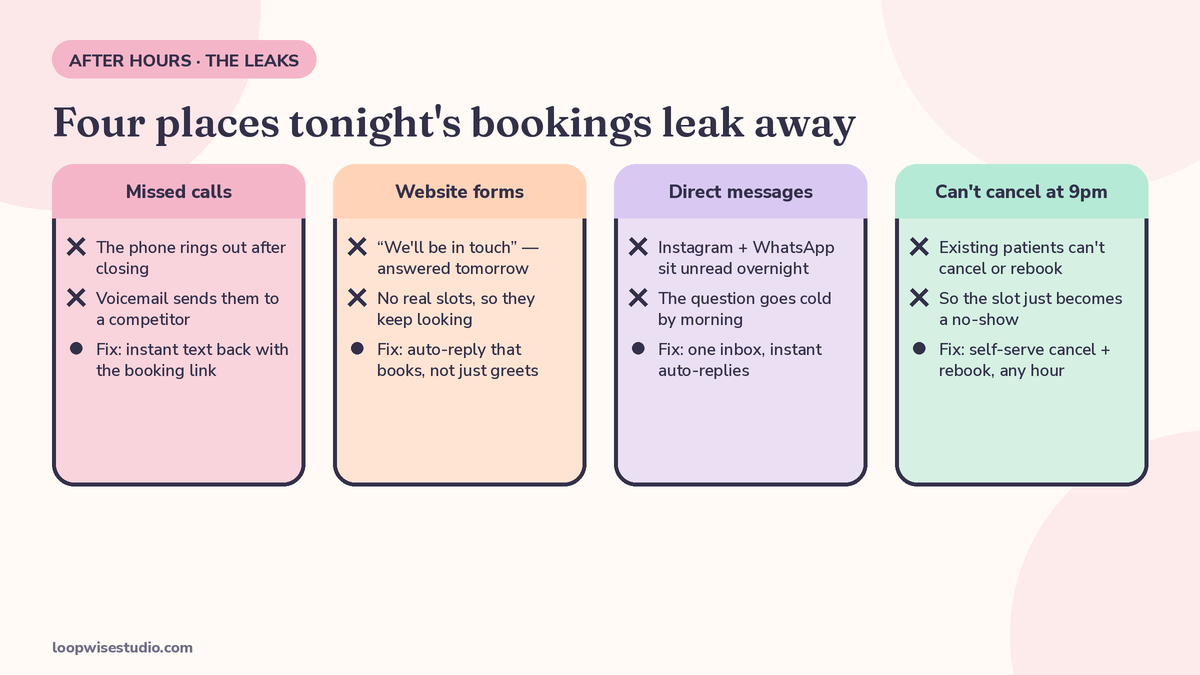
After-hours loss is not one problem with one culprit. It is four channels, each failing in its own way:
| Channel | What the patient experiences after hours | What they do next | What it costs you |
|---|---|---|---|
| Phone call | Rings out, or voicemail with a generic greeting | Calls the next clinic on Google, or gives up | A new booking, gone before you knew it existed |
| Website form | Fills in a form, gets “thanks, we’ll be in touch” | Waits, cools off, books elsewhere in the meantime | A warm enquiry answered cold, 12 hours later |
| Instagram / Facebook / Google message | Sends a message, sees “typically replies within a day” | Messages two other clinics the same evening | The enquiry your marketing paid to create |
| Existing patient, needs to change | Wants to cancel or move tomorrow’s appointment at 9pm; every route is closed | Says nothing. Does not show up. | An empty slot you could have refilled this morning |
That last row is the one almost nobody counts, and it may be the most expensive. A patient who cannot reach you to cancel becomes a silent no-show; a patient who can cancel at 9pm becomes a slot your waitlist can fill at 8am. Research on reminders makes the mechanism plain: in Parikh et al.’s study of 9,835 patients, published in The American Journal of Medicine in 2010 and reported by Clinekt, missed appointments fell from 23.1% with no reminder to 17.3% with an automated reminder and 13.6% with a live staff call. Contact works — the issue after hours is that no contact is possible at all.
A missed appointment has been costed at $196 in research by Kheirkhah et al. (BMC Health Services Research, 2016, measured in 2008 dollars across VA clinics) — your figure will differ, but the point stands: each leak is a chair, a room, and a clinician standing idle.
Count your own after-hours demand first
Before buying anything, spend 30 minutes counting. Vendors will quote you national statistics; your own logs are more useful and they are free.
Your call log (10 minutes). Open last month’s phone records or your phone system’s missed-call list. Count calls that arrived outside your opening hours, plus calls during hours that show as missed. Those two groups together are your phone leak. Even a rough count beats a guess — and mark how many left a voicemail, because the ratio usually makes the point by itself.
Your inboxes (10 minutes). Scroll your website form submissions, Instagram and Facebook messages, and Google Business messages for the last month. Note the timestamps. Every message sent after you closed that was answered the next day — or later — counts. Note honestly how many were never answered at all. Most owners find at least a few: each one was a person asking to give you money.
Your voicemail box (5 minutes). How many messages are in it right now, and how old is the oldest? Voicemail is where after-hours demand goes to be forgotten, and its contents are the most persuasive audit there is.
Your no-show list (5 minutes). Look at last month’s no-shows and mark how many were existing patients who never contacted you. Some share of them tried, at 9pm, through one of the closed channels above.
Add the four counts. That total, per month, is your real after-hours demand. Multiply even a conservative share of it by your average appointment value and you have the number every later decision in this guide should be measured against — your number, not a vendor’s.
“After hours” is three problems, not one
Owners say “after hours” and mean the night. In practice, patients fail to reach you in three different situations, and each wants a different fix:
Closed. Evenings, nights, Sundays, holidays. Nobody is in the building. The fix is capture: something must receive the request, respond instantly, and move it toward a booking without a human present.
Open but busy. Saturday morning, the lunch hour, the Monday 9am rush. Staff are in the building and working hard — and the phone still rings out because every pair of hands is with a patient. This is the leak owners underestimate most, because it happens while they watch. The fix is overflow: the request that cannot be answered by a person gets caught automatically instead of dropped.
Open but nobody picks up that channel. The phone gets answered; the Instagram message does not, because it arrives on the owner’s personal phone, or a form lands in an email inbox checked twice a week. The fix is routing: every enquiry channel lands in one place, where someone — or something — owns it.
Map your audit counts onto these three situations. Most clinics find they have one dominant problem, and it is rarely the one they assumed. Fix that one first.
The fix ladder: free tonight, then in tiers
You do not have to buy your way out of this in one jump. The fixes stack, and each tier captures bookings the tier below misses:
| Tier | What you set up | What it captures | What it still misses | Cost shape |
|---|---|---|---|---|
| 0 — tonight, free | Booking link on your Google Business Profile; voicemail greeting rewritten to send callers to that link and your texting number; form auto-reply that includes the booking link instead of “we’ll be in touch”; message quick-replies on Instagram/Facebook pointing to booking | Patients willing to self-serve when pointed at the door | Anyone who will not tap a link from a voicemail; anyone whose question needs an answer first | An hour of your time |
| 1 — booking link + missed-call text-back | Every missed call, at any hour, gets an instant text with the booking link; online booking shows real slots and confirms on the spot; all message channels route to one inbox with instant auto-replies that book, not just greet | Callers and messagers who will book if it is easy and immediate — the majority | Callers who need a conversation; clinical questions (correctly) | A setup plus a monthly service |
| 2 — full answering coverage | Tier 1 plus after-hours answering for the conversation cases: a staff rota, an answering service, or a voice agent, with rules for what it may book and what it must escalate | Nearly everything, including phone-loyal patients | Very little — but you pay for coverage whether the phone rings or not | Published voice-agent plans in this market run about $199–$249 a month (Adine and Everydesk publish prices in that range), answering services bill per minute, a rota costs staff time |
Two honest notes on the ladder. First, Tier 0 is worth more than it looks. Clinics routinely discover their Google profile — the first thing a searching patient sees — has no booking link at all. Fix the free tier before judging the paid ones. Second, Tier 2 is the right answer for some clinics and overkill for others. If your audit counted six after-hours calls a month, Tier 1 captures most of the value. If it counted sixty, the conversation cases alone justify Tier 2.
What Tier 1 looks like when it is built as one system, for one specific vertical, is shown on our service page for after-hours answering and booking for med spas — if you run a med spa, that is the service version of this guide. The phone mechanism at its heart, and why seconds matter, is broken down in our guide to missed call text back for med spas — the mechanics are the same whatever your clinic type.
Let existing patients cancel and rebook at 9pm
Half the after-hours problem is people you already have. A patient lying in bed at 9pm, realizing tomorrow’s 10am appointment clashes with a work emergency, will do one of three things: reach a system that lets her move it in two taps, reach nothing and intend to call in the morning (then get busy and forget), or reach nothing and quietly decide not to come.
Only the first outcome leaves you a refillable slot. So give every reminder and confirmation a working cancel-and-rebook path that functions at night: a reply or a link that moves the appointment without a phone call. Self-booked patients behave differently again: a 2025 study in Frontiers in Digital Health, reported by EtherealMinds, found no-show rates of 1.8% for online-booked appointments versus 5.9% for staff-booked ones at a private practice (the study’s hospital arm ran the other way, so treat it as direction, not law). People who pick their own slot, and can move it when life changes, mostly show up.
Then close the loop: a slot freed at 9pm should generate a waitlist text that same evening or first thing, not wait for a human to notice a gap. The freed slot is perishable. By mid-morning it is worth nothing.
The 8am handover: what your front desk should see
Capture without a morning routine produces a new kind of mess — requests caught at night and then ignored until lunch, which is worse than never catching them, because the patient was told, in effect, that you received them.
Agree on a single view your front desk opens first, before the phones start:
- Bookings made overnight — already in the diary, deposits taken where your rules require them. No action needed beyond a glance.
- Requests held for confirmation — anything that needs a human yes: unusual requests, first visits for treatments you screen, people who asked a question instead of booking.
- Unresolved threads — messages where the patient asked something and has not yet been answered by a person, sorted oldest first.
- Slots freed overnight — cancellations and moves, with whether the waitlist filled them or they are still open.
Ten minutes, in that order, and the night’s demand is fully inside your normal day. If your setup cannot produce that list, it is capturing enquiries into a pile — the digital version of the voicemail box.
Keep it safe: logistics yes, clinical judgment never
After-hours systems answer logistics: times, prices, directions, prep instructions you have approved, “the doctor will call you in the morning.” They never answer clinical judgment: whether a symptom is normal, whether a treatment is right for someone, whether a worried patient should wait or seek care now.
Build two rules in from the start. First, an escalation path: any message describing symptoms, pain, a reaction, or anything with the words “emergency” in it routes to a named person immediately, with the patient’s own words attached — during the night that may be an on-call phone; at minimum it must be the first item a human sees in the morning, marked urgent. Second, an emergency redirect: your after-hours greeting and auto-replies should say plainly that anyone with an emergency should call emergency services, not wait for a clinic reply.
This is not legal boilerplate. It is the difference between a system patients trust and one that chats cheerfully at someone who is frightened. Any vendor who cannot describe their triage in two sentences does not have one.
What to measure monthly
Four numbers, ten minutes, once a month:
- After-hours requests captured — bookings, texts, and messages received outside hours. The point is that the number exists at all; last year it was invisible.
- Share booked before morning — of those requests, how many became a booking or a confirmed thread before your doors opened. This is the scoreboard for your tier.
- Voicemail volume — it should fall as text-back and booking links catch callers first. If it does not fall, a channel is not routed correctly.
- Night-freed slots refilled — cancellations made after hours, and how many were filled. This one alone often pays for Tier 1.
Compare them to your audit baseline. If the numbers do not move in two months, the problem is not effort — something in the chain is broken, and it will be findable.
If you would like this counted and built for you rather than done from a guide: get a free audit. We run the 30-minute count on your actual logs, tell you which tier your clinic needs — including if the honest answer is Tier 0 and an hour of your own time — and quote one fixed price for the rest. The night version of this problem, and what a booking system that works while the building is empty is worth, is covered from the owner’s side in our piece on how to get bookings while you sleep for a small clinic.
Frequently asked questions
How many after-hours enquiries is “a lot”?
There is no universal threshold — compare against your own diary. If your audit finds after-hours and missed-during-hours requests equal to even 10% of your monthly bookings, capturing them beats almost any marketing spend, because these are patients who already chose you once. If it finds two calls a month, fix Tier 0 and move on.
Do I need an AI receptionist to fix this?
No. An AI voice agent is one Tier 2 option for the conversation cases. The larger share of after-hours loss at most clinics is people who never needed a conversation — they needed a booking link, a real slot, and a confirmation while their intent was warm. Fix capture first; add voice only if your audit shows callers who genuinely need to talk.
Will patients mind getting an automated text at 10pm?
The text arrives because they called or messaged you at 10pm — it answers their action, in seconds, and then stops. What patients mind is the opposite: asking at 10pm and hearing nothing until 10am, by which time they have booked somewhere else. Keep after-hours messages to replies and confirmations, never marketing, and complaints are rare.
What happens with emergencies at night?
Your system should never try to handle one. Greetings and auto-replies direct emergencies to emergency services, and any message describing symptoms is escalated to a named person with the patient’s words attached — first in the morning queue at the very latest, marked urgent. Automation owns logistics; people own anything clinical.
How fast can Tier 1 be live?
The text-back and routing layer is measured in days, not months, because it sits on the number and booking page you already have. If your booking page itself needs work — no real-time slots, no confirmation — that sets the real timeline, and it is worth doing first: a fast reply to a page that cannot take a booking rescues very little.
We get very few night enquiries. Is this still worth it?
Run the audit first — “very few” often turns out to mean “we cannot see them,” because missed calls and unread DMs leave no trace in a diary. If the count really is tiny, do the free tier, check the voicemail box is emptying, and spend your money elsewhere. The audit is what tells you which clinic you are.
Start with the count. Get a free audit and we will do the 30-minute count with you on your real call logs and inboxes, show you which of the four channels leaks most at your clinic, and give you the tier-by-tier fix with one fixed price for anything you want built. If your numbers are small, you will leave with the free fixes and no sales pitch attached.