Missed Call Text Back for Dental Implant Practices
Missed call text back for dental implant practices: scripts for five caller types, a consult-booking flow, and coordinator follow-up that turns replies into accepted cases.
Missed call text back automatically texts an implant enquiry within a minute of an unanswered call, acknowledges what they called about, and links straight to booking a consultation with imaging. For an implant practice, that text is not a courtesy — it protects the highest-value enquiry your marketing produces, and hands it to your treatment coordinator as a live conversation instead of a voicemail that goes cold.
An implant patient is not a cleaning patient. They’ve usually been thinking about this for months. They’ve read, compared, worried about cost, and finally picked up the phone — often in the evening, often while your desk is with a patient or closed. If that call rings out, they don’t leave a voicemail and wait hopefully. They call the next practice on the list, because they finally worked up the nerve and they want the conversation now.
This page is about the system built for that call specifically: the scripts for the five kinds of implant callers, how the text leads to a booked consult rather than a chat that fizzles, what happens after the first text (the part most practices get wrong), and how to value a recovered consult using your own numbers. The general version lives in our guide to missed call text back for dental practices — this is the implant cut of it.
Implant inquiries are not cleaning calls
Four differences change what the text has to do:
- The value of one enquiry dwarfs the cost of the system. A single accepted implant case is worth more than months of the tooling that catches it. The economics we’ll do below use your figures, but the shape is not in doubt.
- The questions are harder. Cost ranges, financing, candidacy, how many visits, whether imaging is included. A caller with hard questions who hits voicemail assumes the consult will be hard work too.
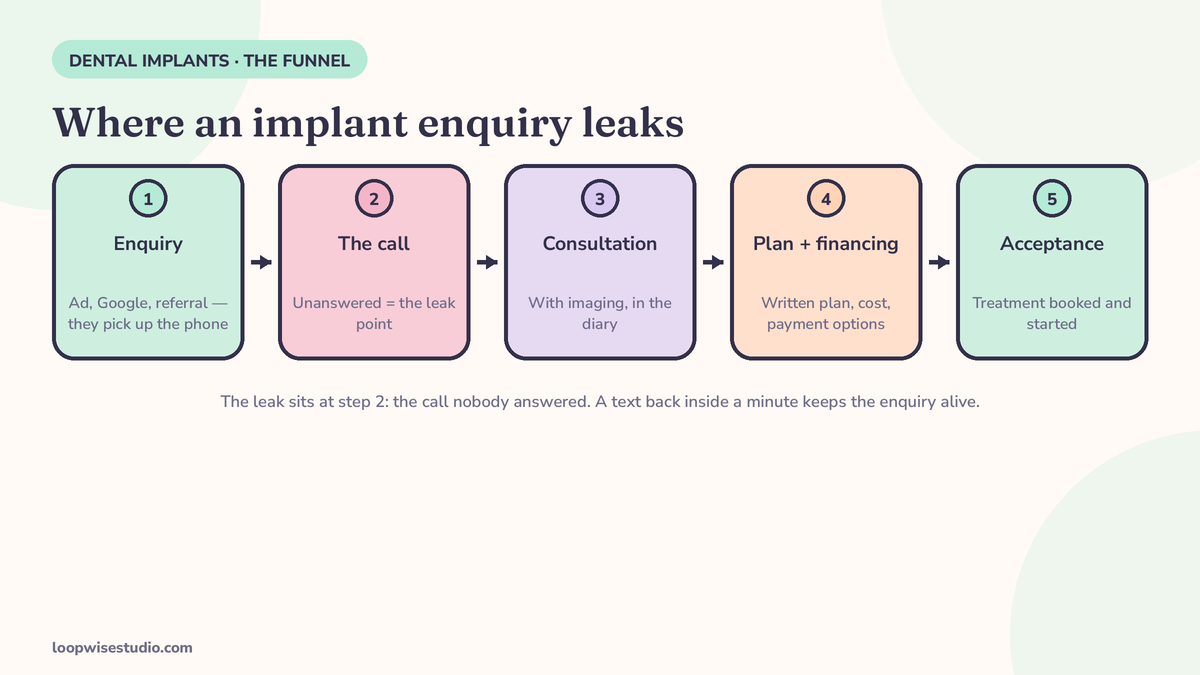
- The funnel has stages a text can move. Aware → called → consult with imaging → plan and financing → accepted. A missed call breaks the funnel at stage two; the text’s only job is to get them to stage three, booked on your real calendar.
- The conversation belongs to a person. In a hygiene practice, any team member can book a cleaning. In an implant practice, the follow-up belongs to your treatment coordinator, because the money conversation happens there. The system has to route to that person by name, not to a shared inbox nobody owns.
How it works: missed call to booked consult
- The call goes unanswered — surgery running long, lunch, after hours.
- Within a minute, the caller gets a text from your practice number, written for their kind of enquiry (next section).
- They tap the link and book a consultation — real slots, with imaging time blocked, confirmed by text instantly.
- The thread and the booking land with your treatment coordinator, who sees the enquiry flagged as an implant consult, with anything the caller said in the thread attached.
- Anyone who doesn’t book gets the follow-up sequence — not silence, and not a generic drip.
The scripts: five implant caller types, five first texts
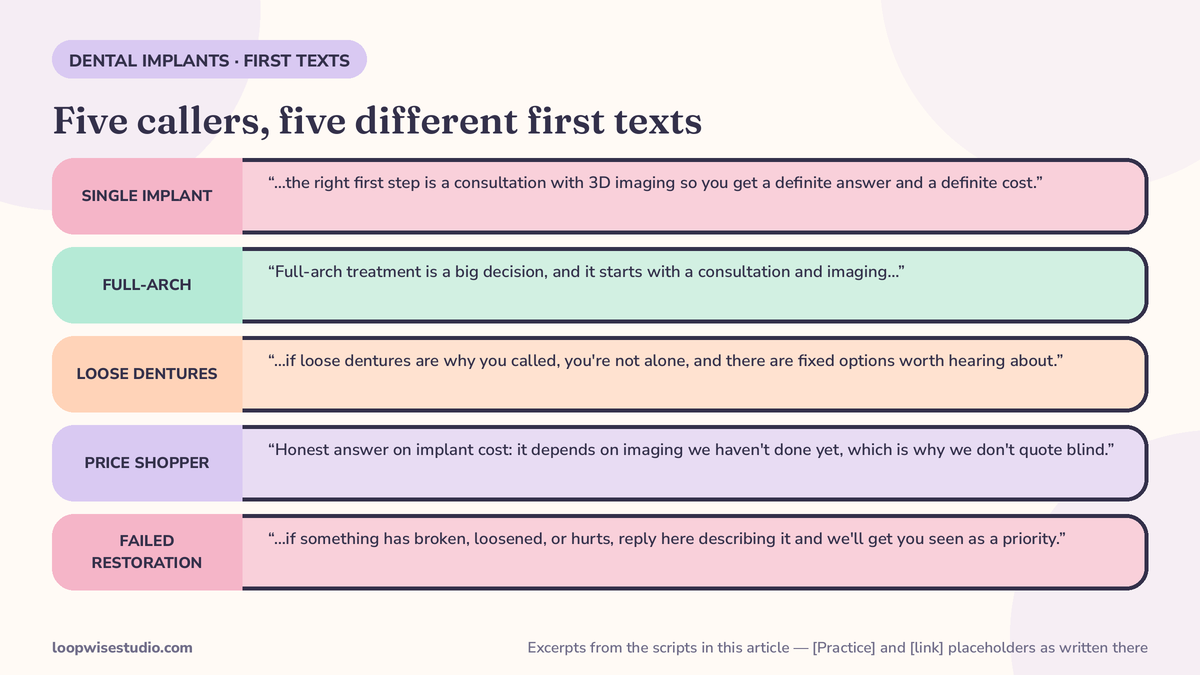
Copy these. Adjust the practice name, the link, and the financing line to match what you actually offer — and only promise what your consult actually includes.
| Caller | First text |
|---|---|
| Single implant enquiry | “Hi, this is [Practice] — sorry we missed your call. If you’re asking about an implant, the right first step is a consultation with 3D imaging so you get a definite answer and a definite cost. Book one here: [link]. Or reply here with any question first.” |
| Full-arch enquiry | “Hi from [Practice] — sorry we couldn’t pick up. Full-arch treatment is a big decision, and it starts with a consultation and imaging so we can show you exactly what’s possible. Times here: [link]. Your questions are welcome by reply too — a coordinator reads every message.” |
| Denture conversion / loose dentures | “Hi, this is [Practice]. Sorry we missed you — if loose dentures are why you called, you’re not alone, and there are fixed options worth hearing about. A consultation is the place to start: [link].” |
| Price shopper | “Hi, this is [Practice] — sorry we missed your call. Honest answer on implant cost: it depends on imaging we haven’t done yet, which is why we don’t quote blind. A consultation gives you the full plan and cost in writing, plus financing options: [link].” |
| Existing patient, failed restoration or pain | “Hi, this is [Practice]. Sorry we missed you — if something has broken, loosened, or hurts, reply here describing it and we’ll get you seen as a priority. If pain is severe, call again now and stay on the line.” |
Notice what none of them say: “Sorry we missed your call! What can we help you with?” A caller who has to explain themselves from zero, twice, feels the effort — and effort is what sends them to the next practice. Every script names the likely reason for the call, lowers the cost/financing anxiety without quoting blind numbers, and puts the consult link before any question.
After the first text: ownership is the whole game
Here is the insight the best operational writing in this space keeps landing on, stated plainly: a text being sent does not mean anyone owns the enquiry, and it does not mean the patient booked. Implant practices don’t lose cases at the first text. They lose them in the two days after, when the reply sits in a shared inbox, the “I need to think about the cost” message gets no answer, and the caller quietly books a consult somewhere that responded like a person.
So the system after the text matters as much as the text:
- One owner. Every implant thread is assigned to the treatment coordinator (or a named backup). Not “the front desk.” A person, whose list it is each morning.
- Urgent flags. Pain, swelling, a failed restoration, anything post-surgical — these jump the queue and get a call, not another text.
- The financing branch. “I need to think about it” is not a no. The coordinator’s job in the thread: acknowledge, restate what the consult will answer (plan, cost in writing, payment options), offer two concrete times. No pressure, no discount theatrics — just a next step that’s easy to take.
- Outcome tracking. Every recovered enquiry ends in one of: consult booked, consult attended, plan accepted, or lost-with-reason. If you can’t see those four columns, you don’t have a system — you have a text message.
If your practice also runs a med spa or wider clinic diary, the same ownership logic is why we push it in our work on missed call text back for med spas — high-value enquiries die in unowned inboxes everywhere.
If you already have Weave, Flex, or Mango: the toggle is not the system
Many implant practices already own the trigger. Practice platforms with integrated phones — Flex with Mango Voice, for example — can auto-text a missed caller with a custom message, with a different message outside operating hours, from a settings toggle. Weave offers similar texting. If you have one of these, switch it on today; something beats nothing.
Then look at what the toggle doesn’t do:
- The message is one generic text for every caller — your full-arch enquiry and your price shopper get the same words.
- There’s no consult-booking flow behind it with imaging time blocked, so the text still ends in phone tag.
- There’s no caller-type routing, no urgent flagging, no coordinator ownership, no follow-up sequence for the people who reply “not yet.”
- There’s no outcome tracking, so a year from now you still can’t say what the toggle recovered.
That is the honest pitch for a purpose-built layer: you may already own the trigger. You don’t yet own the system around it.
What one recovered consult is worth — with your numbers
You’ll find recovery statistics quoted confidently in vendor marketing for this exact topic — specific percentages of missed calls converted, tidy monthly recovery figures for “typical practices.” We don’t use them, and you shouldn’t either: they are not published studies, they are sales copy, and the ones circulating actually use general-dentistry values that would understate an implant practice’s economics anyway. There is no published standard recovery rate. There is your rate, and you can compute the opportunity in four multiplications:
Missed implant enquiry calls per week × share who’d book a consult from a prompt text × your consult show rate × your case acceptance rate × your average case value.
Worked example with assumptions labelled — swap in yours: your call log shows 5 implant enquiry calls missed per week. Say a third of those callers book a consult when texted within the minute (about 1.7 consults a week, ~7 a month). With a 75% show rate, that’s ~5 consults in chairs. If 1 in 3 accepts a plan — 1–2 cases a month — at your average case value, you already know whether that dwarfs the cost of the system. It does, at almost any implant fee schedule, which is exactly why we can afford to be conservative with every assumption. Change each number down by half and the conclusion survives.
The discipline is the same one we use for med spas in how much revenue practices lose from missed calls: count your own missed calls for two honest weeks before believing any number, including ours. Implant practices usually find the count alone settles the argument — most owners have never seen their missed implant calls as a weekly figure, because the phone system doesn’t report them that way. Ask yours to. If it can’t break out missed calls by time of day, that blind spot is itself a finding: the misses cluster exactly where you’d predict (lunch, the last hour, evenings), and those clusters tell you which message variants and which coordinator rota you actually need.
Want that run on your actual call log instead of an example? That’s the audit: get a free audit and we’ll pull your missed-call pattern and do the arithmetic with your figures before quoting anything.
Text back vs AI receptionist vs answering service, for implants
| Missed call text back | AI receptionist | Human answering service | |
|---|---|---|---|
| Answers the caller | A text within a minute of the miss | Answers the call itself, by voice | Answers the call itself |
| Books the consult | Yes — link to your real calendar, imaging blocked | Yes, if properly integrated | Usually takes a message — a booking is not a message |
| Handles the cost/financing question | Acknowledges it, routes to coordinator | Gives approved answers if configured | Takes a message |
| After-hours | Fully covered, same system | Fully covered | Covered, at per-minute cost |
| Feels like | A message from your practice | A voice that isn’t your team | A service that isn’t your practice |
| Fails when | The caller refuses to text at all | The caller dislikes talking to a machine about a five-figure decision | The message sits until morning and the caller books elsewhere |
A fair summary: if your practice misses calls mainly because the desk is busy in hours, text back plus coordinator ownership solves it at the lowest cost and the least weirdness for the patient. An AI receptionist is the stronger tool if you want every call answered by voice around the clock and you’re comfortable with a machine holding an implant conversation. An answering service is the weakest of the three for implants specifically, because it converts a hot enquiry into a callback task. Some practices layer text back under an AI receptionist as the safety net for calls even the AI drops — the two are not enemies.
FAQs
We already have missed-call texting in our phone system. Do we need this? You need the parts around it: caller-specific scripts, a consult booking flow with imaging time protected, coordinator ownership, urgent flags, a follow-up sequence, and outcome tracking. If your current setup covers all of that, keep it. Most toggles cover the first text and nothing after.
Can the text talk about cost and financing? It can acknowledge both honestly without quoting blind: the consult produces the plan and a written cost, and financing options exist if you offer them. It should never invent a price range you haven’t approved, and never diagnose or promise candidacy — that’s the consultation’s job.
What if the caller is an existing patient with a problem? They get the priority script, not a sales one: describe it, get seen fast, call now if it’s severe. Urgent flags route these to a human immediately. Mixing a broken-restoration patient into a marketing flow is the fastest way to lose a patient you already won.
How do we know it’s working? Four numbers, reviewed monthly: enquiry calls missed, consults booked from texts, consults attended, plans accepted. If a vendor report shows you texts sent and calls it success, ask for the other three columns.
How is this different from the missed-call texting in our practice software? Usually in everything after the first text. The built-in feature sends one message; this is the scripts per caller type, the consult booking flow behind the link, the coordinator’s ownership and follow-up, urgent flagging, and the monthly outcome numbers. Think of the toggle as the doorbell and this as the person whose job it is to answer the door.
Does it work after hours? That’s its home turf. Evening is when implant research turns into phone calls. The after-hours variant promises a booked consult and a morning confirmation from the coordinator — and the morning routine has to honour it.
What does it cost to set up? It depends on what you’re building on: an existing toggle that needs scripts and routing is a smaller job than a full build with a booking page and follow-up sequences. We quote one fixed price after the free audit, with the recovered-consult arithmetic done on your own call log first — if the numbers don’t justify it, we’ll tell you.
An implant enquiry that reaches voicemail is a five-figure conversation handed to chance. The text takes a minute to send and one tap to answer. If you want the scripts, the booking flow and the coordinator system built around your practice, get a free audit — we’ll start with your missed calls, not a pitch deck.